Bad Christians and Good Cocktails
On Tuesday evening, we attended a talk at a local church by Dave Tomlinson, author of The Post-Evangelical and How to Be a Bad Christian. It’s hard to believe the latter was published 14 years ago already, while the former is over 30 years old and coincided with a growing social shift away from conservative Christianity-as-usual in the UK and USA. Other authors who have been particularly influential on my thinking such as Brian McLaren and Peter Rollins were allied with this movement, which was sometimes called “the emerging church.”
What is a ‘bad’ Christian? One who’s not fussed about dogma. Tomlinson is an Anglican priest and believes the Church still has value for people at times of joy or sorrow – a bereavement, a wedding, a baptism – moments of epiphany that might encourage them to stop skating on the surface of life and go deeper in a search for spirituality and meaning. However, he stressed how easy it is to find people who are following the way of Jesus outside of churches: anyone working toward peace, justice, or environmental restoration, for instance. He’d rather people focus on ethical lifestyles rather than beliefs. This resonated with me as I don’t believe a line of the creed literally and most of the time don’t think the supernatural exists, yet keep attending church and reading theology. But I know I’ll get more spiritual uplift from the Queer Folk Festival at the end of the month than I often do at a Sunday service, and my secular community volunteering sometimes seems to be of more practical use.
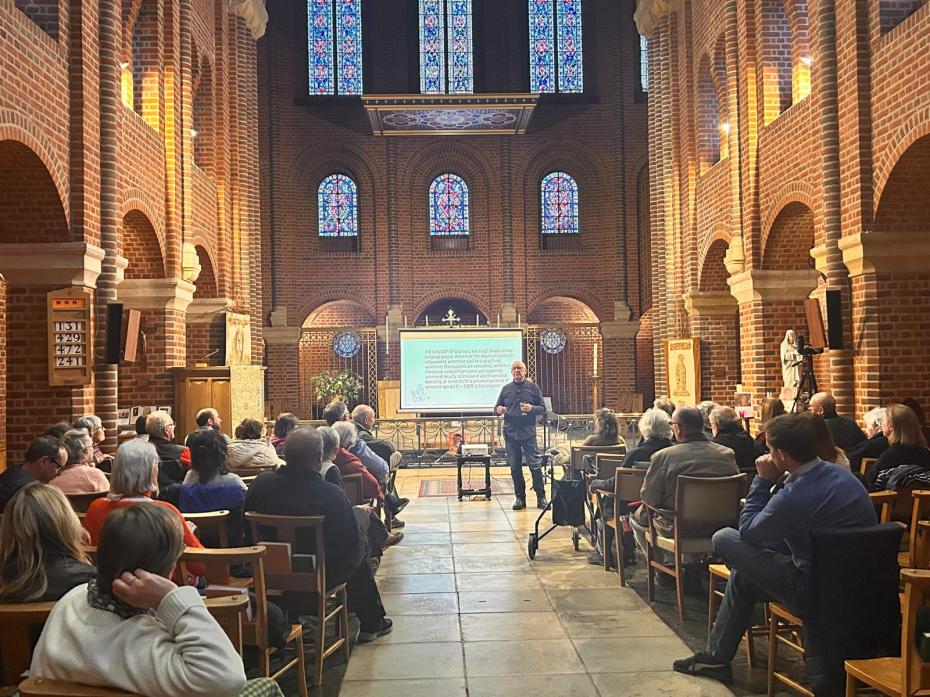
Photo by Rev. Gary Collins
Yesterday (13 May) was World Cocktail Day – the second year I’ve known of its existence and planned to ‘celebrate’ it. Often, I can’t make appealing cocktails because I don’t have the right ingredients, and leaving them out or substituting is frustrating. So, in preparation, I picked up a modest click-and-collect order from Sainsbury’s on Tuesday of dry vermouth, fino sherry, and Angostura orange bitters to take my cocktail-making to the next level.


 It may surprise you given that I’m such a gin lover, but I’d never actually had a martini. I’m not sure how authentic my version, the “England” dry martini from the hilarious 1976 handbook above, was, but it was tasty! (I’ve always thought a Noilly Prat would be a good thing to call a Tory.) Then I tried a “London Calling” (recipe from the book Equal Parts Cocktails by Fred Siggins – I have a habit of downloading any cocktail cookbooks I find on Edelweiss and browsing them on screen to find one or two recipes to save as screenshots) combining navy-strength gin and fino sherry. It was a strong, complex and satisfying drink.


After C got home from band practice, I made him his first whisky old fashioned. The orange bitters went in all three of those so were a good purchase. I wasn’t feeling great yesterday, so had a few sips of each of my two cocktails and then used a funnel to store them in miniature bottles in the fridge for another night. I capped off the evening with a thimbleful of what I’m calling a Chocolate Cherry Truffle: chocolate rum and Portuguese sour cherry liqueur in a 4:1 ratio.
#1952Club: Patricia Highsmith, Paul Tillich & E.B. White
Simon and Karen’s classics reading weeks are always a great excuse to pick up some older books. I assembled an unlikely trio of lesbian romance, niche theology, and an animal-lover’s children’s classic.

Carol by Patricia Highsmith
Originally published as The Price of Salt under the pseudonym Claire Morgan, this is widely considered the first lesbian novel with a happy ending (it’s more open-ended, really, but certainly not tragic; suicide was a common consequence in earlier fiction). Therese, a 19-year-old aspiring stage designer in New York City, takes a job selling dolls in a department store one Christmas season. Her boyfriend, Richard, is a painter and has promised to take her to Europe, but she’s lukewarm about him and the physical side of their relationship has never interested her. One day, a beautiful blonde woman in a fur coat – “Mrs. H. F. Aird” (Carol) – comes to her counter to order a doll and have it sent to her out in New Jersey. Therese sends a Christmas card to the same address, and the women start meeting up for drinks and meals.
 It takes time for them to clarify their feelings to themselves, let alone to each other. “It would be almost like love, what she felt for Carol, except that Carol was a woman,” Therese thinks early on. When she first visits Carol’s home, a mothering dynamic prevails. Carol is going through a divorce and worries about its effect on her daughter, Rindy. The older woman tucks Therese into bed and brings her warm milk. Scenes like this have symbolic power but aren’t overdone; another has Therese and Richard out flying kites. She brings up homosexuality as a theoretical (“Did you ever hear of it? … I mean two people who fall in love suddenly with each other, out of the blue. Say two men or two girls”) and he cuts her kite strings.
The second half of the book has Carol and Therese setting out on a road trip out West. It should be an idyllic consummation, but they realize they’re being trailed by a private detective collecting evidence for Carol’s husband Harge to use against her in a custody battle. I was reminded of the hunt for Humbert Humbert and his charge in Lolita; “the whole world was ready to be their enemy,” Therese realizes, and to consider their relationship “sordid and pathological,” as Richard describes it in a letter.
The novel is a beautiful and subtle romance that unfolds despite the odds against it. I’d read five of Highsmith’s mysteries and thought them serviceable but nothing special (I don’t read crime in general). This does, however, share their psychological intensity and the suspense about how things will play out. Highsmith gives details about Therese’s early life and Carol’s previous intimate friendship that help to explain some things but never reduce either character to a diagnosis or a tendency. Neither of them wanted just anyone, some woman; it was this specific combination of souls that sparked at first sight. (Secondhand from a charity shop that closed long ago, so I know I’d had it on my shelf unread since 2016!) 
The Courage to Be by Paul Tillich
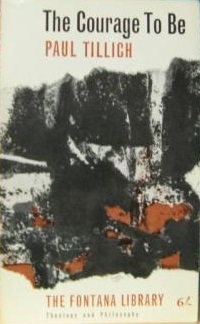 Tillich is a theologian who left Nazi Germany for the USA in 1933. I had to read selections from his work as part of my Religion degree (during the Pauline Theology tutorial I took in Oxford during my year abroad, I think). This book is based on a lecture series he delivered at Yale University. He posits that in an age of anxiety, which “becomes general if the accustomed structures of meaning, power, belief and order disintegrate” – certainly apt for today! – it is more important than ever to develop the courage to be oneself and to be “as a part.” The individual and the collective are of equal importance, then. Tillich discusses various philosophers and traditions, from the Stoics to Existentialism. I have to admit that I barely got anything out of this, I found it so jargon-filled, repetitive and elliptical. It’s been probably 15 years or more since I’ve read any proper theology. I adopted that old student skimming trick of reading the first paragraph of each chapter, followed by the topic sentence of each paragraph, but that left me mostly none the wiser. Anyway, I believe his conclusion is that, when assailed by doubt, we can rely on “the God above the God of theism” – by which I take it he means the ground of all being rather than the deity envisioned by any specific religious system. (University library)
Charlotte’s Web by E.B. White
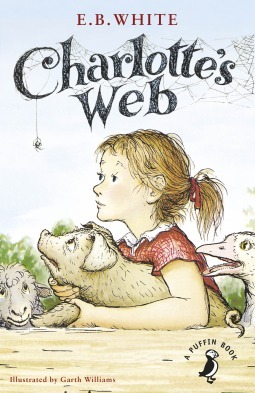 My library has a small section of the children’s department called “Family Matters” that includes the labels “First Time” (starting school, etc.), “Family” (divorce, new baby), “Health” (autism, medical conditions) and “Death.” I have the feeling Charlotte’s Web is not at all well known in the UK, whereas it’s a standard in the USA alongside L.M. Montgomery and Laura Ingalls Wilder. Were it more familiar to British children, it would be a great addition to that “Death” shelf. (Don’t read the Puffin Modern Classics introduction if you don’t want spoilers!) Wilbur is a doubly rescued pig. First, Fern Arable hand-rears him when he’s the doomed runt of the litter. When he’s transferred to Uncle Homer Zuckerman’s farm and an old sheep explains he’ll be fattened up for slaughter, his new friend Charlotte intervenes.
Charlotte is a fine specimen of a barn spider, well spoken and witty. She puts her mind to saving Wilbur’s bacon by weaving messages into her web, starting with “Some Pig.” He’s soon a county-wide spectacle, certain to survive the chop. But a farm is always, inevitably, a place of death. White fashions such memorable characters, including Templeton the gluttonous rat, and captures the hope of new life returning as the seasons turn over. Talking animals aren’t difficult to believe in when Fern can hear every word they say. The black-and-white line drawings are adorable. And making readers care about invertebrates? That’s a lasting achievement. I’m sure I read this several times as a child, but I appreciated it all the more as an adult. (Little Free Library) 
I’ve previously participated in the 1920 Club, 1956 Club, 1936 Club, 1976 Club, 1954 Club, 1929 Club, 1940 Club, 1937 Club, and 1970 Club.
Nonfiction November: Two Memoirs of Biblical Living by Evans and Jacobs
I love a good year-challenge narrative and couldn’t resist considering these together because of the shared theme. Sure, there’s something gimmicky about a rigorously documented attempt to obey the Bible’s literal commandments as closely as possible in the modern day. But these memoirs arise from sincere motives, take cultural and theological matters seriously, and are a lot of fun to read.
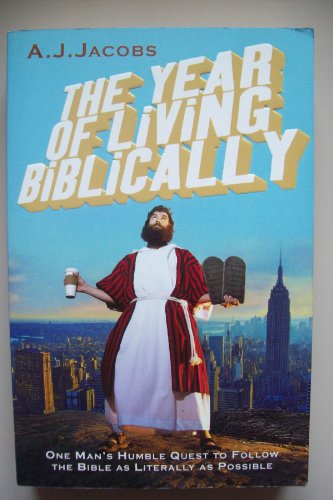
The Year of Living Biblically: One Man’s Humble Quest to Follow the Bible as Literally as Possible by A.J. Jacobs (2007)
Jacobs came up with the idea, so I’ll start with him. His first book, The Know-It-All, was about absorbing as much knowledge as possible by reading the encyclopaedia. This starts in similarly intellectual fashion with a giant stack of Bible translations and commentaries. From one September to the next, Jacobs vows, he’ll do his best to understand and implement commandments from both the Old and New Testaments. It’s not a completely random choice of project in that he’s a secular Jew (“I’m Jewish in the same way the Olive Garden is an Italian restaurant. Which is to say: not very.”). Firstly, and most obviously, he stops shaving and getting haircuts. “As I write this, I have a beard that makes me resemble Moses. Or Abe Lincoln. Or [Unabomber] Ted Kaczynski. I’ve been called all three.” When he also takes to wearing all white, he really stands out on the New York subway system. Loving one’s neighbour isn’t easy in such an antisocial city, but he decides to try his best.
 Jacobs is confused by the Bible’s combination of sensible moral guidelines and bizarre, arcane stuff. His conviction is that you can’t pick and choose – even if you don’t know why a law is important, you have to go with it. One of his “Top Five Most Perplexing Rules in the Bible” is a ban on clothing made of mixed fibers (shatnez). So he hires a shatnez tester, Mr. Berkowitz, who comes to investigate his entire wardrobe. To fulfil another obscure commandment, Berkowitz helps him ceremonially take an egg from a pigeon’s nest. Jacobs takes up prayer, hospitality, tithing, dietary restrictions, and avoiding women at the wrong time of the month. He gamely puts up a mezuzah, which displays a Bible passage above his doorframe. He even, I’m sorry to report, has a chicken sacrificed. Despite the proverb about not ‘sparing the rod’, he can’t truly bring himself to punish his son, so taps him gently with a Nerf bat; alas, Jasper thinks it’s a game. Stoning adulterers? Jacobs tosses pebbles at ankles.
The book is a near-daily journal, with a new rule or three grappled with each day. There are hundreds of strange and culturally specific guidelines, but the heart issues – covetousness, lust – pose more of a challenge. Alongside his work as a journalist for Esquire and this project, Jacobs has family stuff going on: IVF results in his wife’s pregnancy with twin boys. Before they become a family of five, he manages to meet some Amish people, visit the Creation Museum, take a trip to the Holy Land to see a long-lost uncle, and engage in conversation with Evangelicals across the political spectrum, from Jerry Falwell’s megachurch to Tony Campolo (who died just last week). Jacobs ends up a “reverent agnostic.” We needn’t go to such extremes to develop the gratitude he feels by the end, but it sure is a hoot to watch him. This has just the sort of amusing, breezy yet substantial writing that should engage readers of Bill Bryson, Dave Gorman and Jon Ronson. (Free mall bookshop)
A Year of Biblical Womanhood: How a Liberated Woman Found Herself Sitting on Her Roof, Covering Her Head, and Calling Her Husband “Master” by Rachel Held Evans (2012)
 Evans’s book proposal must have referenced Jacobs’s project, but she comes at things from a different perspective as a progressive Christian, and likely had a separate audience in mind. Namely, the sort of people who worry about the concept of biblical womanhood and wrestle with Bible verses about women remaining silent in church and not holding positions of religious leadership over men. There are indeed factions of Christianity that take these passages literally. Given that she was a public speaker and popular theologian, Evans obviously didn’t. But in her native Alabama and her new home of Tennessee, many would. She decides to look more closely at some of the prescriptions for women in the scriptures, focusing on Proverbs 31, which describes the “woman of valor.” She looks at this idealized woman’s characteristics in turn and tries to adhere to them by dressing modestly, taking etiquette lessons, learning to cook and hosting dinners, and practicing for parenthood with a “Baby-Think-It-Over” doll. Like Jacobs, she stops cutting her hair and meets some Amish people. But she also sleeps outside in a tent while menstruating and undertakes silent meditation at an abbey and a mission trip to Bolivia. Each monthly chapter ends with a profile of a female character from the Bible and what might be learned from her story.
It’s a sweet, self-deprecating book. You can definitely tell that she was only 29 at the time she started her project. It’s okay with me that Evans turned all her literal intentions into more metaphorical applications by the end of the year. She concludes that the Church has misused Proverbs 31: “We abandoned the meaning of the poem by focusing on the specifics, and it became just another impossible standard by which to measure our failures. We turned an anthem into an assignment, a poem into a job description.” Her determination is not to obsess over rules but to continue with the habits that benefited her spiritual life, and to champion women whenever she can. I suspect this is a lesser entry from Evans’s oeuvre. She died too soon – suddenly in 2019, of brain swelling after a severe allergic reaction to an antibiotic – but remains a valued voice, and I’ll catch up on the rest of her books. Searching for Sunday, for instance, was great, and I’m keen to read Evolving in Monkey Town (about living in Dayton, Tennessee, where the famous Scopes Monkey Trial took place). (Birthday gift from my wish list, 2023) 
Short, Soul-Soothing Reads for #NovNov24 & #NonfictionNovember: Barnes, Cognetti, Lende, Mann, Nouwen and Winner
After the catastrophic U.S. election results (which we’ve all managed to ignore or normalize so as to keep going with our lives) and a medical crisis with our dear old cat, I’ve been craving literary soul food. These six short nonfiction books have been good companions, promising love, meaning and transcendence in the midst of bereavement and daily routines.
Levels of Life by Julian Barnes (2013)
 Barnes was a favourite author in my twenties and thirties, though I’ve had less success with his recent work. He wrote a few grief-soaked books in the wake of the death of his wife, celebrated literary agent Pat Kavanagh*. I had this mistaken for a different one (Through the Window, I think?) that I had enjoyed more. No matter; it was still interesting to reread this triptych of auto/biographical essays. The final, personal piece, “The Loss of Depth,” is a classic of bereavement literature on par with C.S. Lewis’s A Grief Observed; I would happily take it as a standalone pamphlet. Its every word rings true, especially the sense of duty as the lost one’s “principal rememberer.” But the overarching ballooning metaphor, and links with early French aerial photographer Nadar and Colonel Fred Burnaby, aeronaut and suitor of Sarah Bernhardt, don’t convince. The strategy feels like a rehearsal for Richard Flanagan’s Baillie Gifford Prize-winning Question 7, a similar hybrid work that pulls it off better. (Little Free Library) [118 pages]
*In spring 2008, I attended a talk by John Irving at King’s College, London, where I worked in library services for five years. Barnes and Kavanagh were in the front row and embraced Irving before the start. I was floored to hear of Kavanagh’s death later that year because she’d looked so well. It was a fast-acting brain tumour that felled her just 37 days after diagnosis.
Without Ever Reaching the Summit by Paolo Cognetti (2018; 2020)
[Translated from the Italian by Stash Luczkiw]
 Part pilgrimage and part 40th birthday treat, Cognetti’s October 2017 Himalayan trek through Dolpo (a Nepalese plateau at the Tibetan border) would also somewhat recreate Peter Matthiessen’s The Snow Leopard. Cognetti struggles with altitude sickness and the fare: “I tried salted yak butter tea for the first time—nauseating if you thought you were drinking tea, good and refreshing if you thought you were drinking broth.” He and his companions fancifully decide that Kanjiroba, the lovable stray dog who joins their party, is a reincarnation of Matthiessen. I have limited tolerance for travel books’ episodic combinations of nature descriptions, anthropological observations, and the rigours of the nomadic lifestyle. The same was true here, but the slight spiritual aspect and references to The Snow Leopard lifted it. (Public library) [135 pages]
Find the Good: Unexpected Life Lessons from a Small-Town Obituary Writer by Heather Lende (2015)
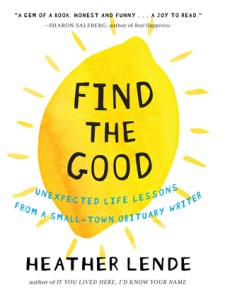 Lende is a journalist in isolated Haines, Alaska (population: 2,000). There’s a plucky motivational bent to these mini-essays about small-town life and death. In writing obituaries for normal, flawed people, she is reminded of what matters most: family (she’s a mother of five, one adopted, and a grandmother; she includes beloved pets in this category) and vocation. The title phrase is the motto she lives by. “I believe gratitude comes from a place in your soul that knows the story could have ended differently, and often does, and I also know that gratitude is at the heart of finding the good in this world—especially in our relationships with the ones we love.” The anecdotes and morals are sweet if not groundbreaking. The pocket-sized hardback might appeal to readers of Anne Lamott and Elizabeth Strout. (Birthday gift from my wish list, secondhand) [162 pages]
Do Not Be Afraid: The joy of waiting in a time of fear by Rachel Mann (2024)
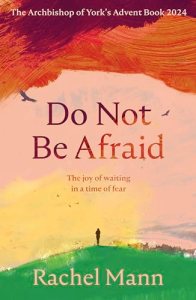 This is the Archbishop of York’s Advent Book 2024; I read it early because, pre-election, I yearned for its message of courage and patience. We need it all the more now. The bite-sized essays are designed to be read one per day from the first Sunday of Advent through to Christmas Day. Often they include a passage of scripture or poetry (including some of Mann’s own) for meditation, and each entry closes with a short prayer and a few questions for discussion or private contemplation. The topics are a real variety but mostly draw on the author’s own experiences of waiting and suffering: medical appointments and Covid isolation as well as the everyday loneliness of being single and the pain of coping with chronic illness. She writes about sitting with parishioners as they face death and bereavement. But there are also pieces inspired by popular culture – everything from Strictly to Quentin Tarantino.
Mann has written several previous Lent course books based on films. I’ve read her work in multiple genres (poetry: A Kingdom of Love and Eleanor Among the Saints; literary criticism: In the Bleak Midwinter; memoir: Dazzling Darkness; fiction: The Gospel of Eve); she is such a versatile writer, and with a fascinating story as a trans priest. Sombre yet hopeful, this is recommended seasonal reading. [114 pages]
With thanks to SPCK for the free copy for review.
The Inner Voice of Love: A Journey through Anguish to Freedom by Henri J. M. Nouwen (1997)
 Anguish is a strong word; I haven’t done any biographical digging to figure out what was going on in Nouwen’s life to prompt it, but apparently this secret journal came out of a lost relationship. (I wonder if it could have been a homosexual attachment. Nouwen was a Dutch Roman Catholic priest who became the pastor of a community for disabled adults in Canada.) He didn’t publish for another eight years but friends encouraged him to let his experience aid others. The one- or two-page reflections are written in the second person, so they feel like a self-help pep talk. The recurring themes are overcoming abandonment and rejection, relinquishing control, and trusting in God’s love and faithfulness. “You must stop being a pleaser and reclaim your identity as a free self.” The point about needing to integrate rather than sideline psychological pain is one I’m sure any therapist would affirm. Nouwen writes that a new spirituality of the body is necessary. This was a comforting bedside book with lots of passages that resonated. (Free – withdrawn from church theological library) [98 pages]
Mudhouse Sabbath: An Invitation to a Life of Spiritual Discipline by Lauren F. Winner (2003)
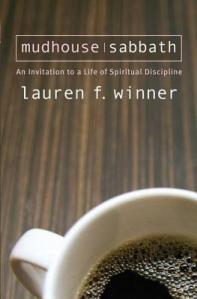 After Winner converted from Orthodox Judaism to Christianity, she found that she missed how Jewish rituals make routine events sacred. There are Christian sacraments, of course, but this book is about how the wisdom of another tradition might be applied in a new context. “Judaism offers opportunities for people to inhabit and sanctify bodies and bodily practices,” Winner writes. There are chapters on the concept of the Sabbath, wedding ceremonies, prayer and hospitality. Fasting is a particular sticking point for Winner, but her priest encourages her to see it as a way of demonstrating dependence on, and hunger for, God. I most appreciated the sections on mourning and ageing. “Perhaps the most essential insight of the Jewish approach to caring for one’s elderly is that this care is, indeed, an obligation. What Judaism understands is that obligations are good things. They are the very bedrock of the Jew’s relationship to God, and they govern some of the most fundamental human relationships”. By the way, Mudhouse is Winner’s local coffeehouse, so she believes these disciplines can be undertaken anywhere. (Secondhand – Awesomebooks.com) [142 pages]

Richard Rohr at Greenbelt Festival (Online) & The Naked Now Review
Back in late August, I attended another online talk that really chimed with the one by Richard Holloway, this time as part of Greenbelt Festival, a progressive Christian event we used to attend annually but haven’t been to in many years now.
Not just as a Covid holdover but also in a conscious sustainability effort, Greenbelt hosted a “fly-free zone” where overseas speakers appeared on a large screen instead of travelling thousands of miles. So Richard Rohr, who appeared old and frail to me – no wonder, as he is now 81 and has survived five unrelated cancers (doctors literally want to do a genetic study on him) – appeared from the communal lounge of his Center for Action and Contemplation in New Mexico to introduce his upcoming book The Tears of Things, due in March 2025. The title is from the same Virgil quote as Holloway’s The Heart of Things. It’s about the Old Testament prophets’ shift from rage to lamentation to doxology (“the great nevertheless,” he called it): a psychological journey we all must make as part of becoming spiritually mature.
From reading his Falling Upward, I was familiar with Rohr’s central teaching of life being in two halves: the first, ego-led, is about identity and argumentation; the second is about transcending the self to tap into a universal consciousness. “It’s a terrible burden to carry your own judgementalism,” he declared. A God encounter provokes the transformation, and generally it comes through suffering, he said; you can’t take a shortcut. Anger is a mark of “incomplete” prophets such as John the Baptist, he explained. Rage might seem to empower, but it’s unrefined and only gives people permission to be nasty to others, he said. We can’t preach about a wrathful God or we will just produce wrathful people, he insisted; instead, we have to teach mercy.
When Rohr used to run rites of passage for young men, he would tell them that they weren’t actually angry, they were sad. There are tears that come from God, he said: for Gaza, for Ukraine. We know that Jesus wept at least twice, as recorded in scripture: once for Jerusalem (the collective) and once for his dead friend Lazarus (the individual). Doing the “grief work” is essential, he said. A parallel to that anger to sadness to praise trajectory is order to disorder to reorder, a paradigm he takes from the Bible’s wisdom literature. Brian McLaren’s recent work is heavily influenced by these ideas, too.
During the question time, Rohr was drawn out on the difference between Buddhism and Christianity (the latter gives reality a personal and benevolent face, he said) and how he understands hope – it is participation in the life of God, he said, and it certainly doesn’t come from looking at the data. He lauded Buddhism for its insistence on non-dualism or unitive consciousness, which he also interprets as the “mind of Christ.” The love of God is the Absolute, he said, and although he has experienced it throughout his life, he has known it especially when (as now) he was weak and poor.
Non-dualism is the theme that led me to go back to a book that had been on my bedside table, partly read, for months.
The Naked Now: Learning to See as the Mystics See (2009)
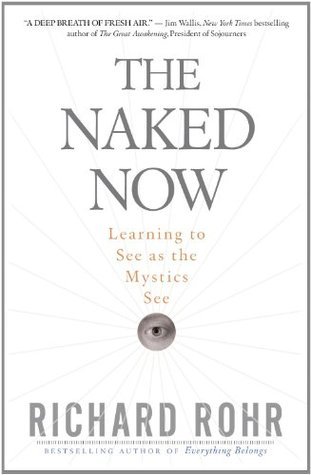 This was my fourth book by Rohr, and as with The Universal Christ, I feel at a loss trying to express how wise and earth-shaking it is. The kernel of the argument is simple. Dualistic thinking is all or nothing, us and them. The mystical view of life involves nonduality; not knowing the right things but “knowing better” through contemplation. It’s an opening of the heart that then allows for a change of mind. And yes, as he said at Greenbelt, it mostly comes about through great suffering – or great love. Jesus embodies nonduality by being not human or divine, but both, as does God through the multiplicity of the Trinity.
The book completely upends the fundamentalist Christianity I grew up with. Its every precept is based on Bible quotes or Christian tradition. It’s only 160 pages long, very logical and readable; I only went through it so slowly because I had to mark out and reread brilliant passages every few pages.
You can tell adult and authentic faith by people’s ability to deal with darkness, failure, and nonvalidation of the ego—and by their quiet but confident joy!
[I’ve met people who are like this.]
If your religious practice is nothing more than to remain sincerely open to the ongoing challenges of life and love, you will find God — and also yourself.
[This reminded me of “God is change,” the doctrine in Parable of the Sower by Octavia E. Butler.]
If you can handle/ignore a bit of religion, I would recommend Rohr to readers of Brené Brown, Susan Cain (thinking of Bittersweet in particular) and Anne Lamott, among other self-help and spirituality authors – e.g., he references Eckhart Tolle. Rohr is also known for being one of the popularizers of the Enneagram, a personality tool similar to the Myers-Briggs test but which in its earliest form dates back to the Desert Father Evagrius Ponticus. 
July Releases, I: Books by Nina Lohman and Ricky Ray for Disability Pride Month
The Wellcome Book Prize (for health- and medicine-related books) and the Barbellion Prize (for representations of disability and/or chronic illness) are much missed, but I continue to be drawn to their highlighted themes in my reading. This is the first year that I’ve been aware of July as Disability Pride Month, though it’s been a thing since 1990 in the USA and 2015 in the UK. My first set of July releases – I have reviews of three novels coming up tomorrow – consists of a nonlinear memoir interrogating life with chronic pain and a chronically ill poet’s collection in which an old dog is an example of grace through suffering.
The Body Alone: A Lyrical Articulation of Chronic Pain by Nina Lohman
For well over a decade, Nina Lohman has endured Chronic Daily Headaches – when a doctor presented her with this phrase, she remarks, it was not so much a diagnosis as a description. Having a clinical term for her extreme pain did nothing to solve it; no treatment she has tried has helped much either, from pharmaceuticals to acupuncture. (Doctors think they’re breaking new ground if they suggest ice packs or elevating her neck.) Like Meghan O’Rourke’s The Invisible Kingdom, this documents a quest with no natural end. Lohman’s health fluctuates, and medical professionals and family and friends minimize her pain because she is able to pass as well, to carry out the daily tasks of raising two children.
The subtitle is apt for a work that is fragmentary and not driven by chronology. Had Cataloguing Pain not already been taken (by Allison Blevins), it might have been a perfect title. Some of Lohman’s short pieces read like poems, including erasure poems based on her medical notes. Repeated headings demonstrate a desire to organise her illness so as to make sense of it: “A Primer,” “Classifications” and “Perhaps” musings. She dwells on the names of things – shades of colours, groups of animals – while she longs for a vocabulary tailored to her own circumstances. Imagined monologues by doctors, friends and her husband (“He”) show pain has not turned her insular; she has empathy even when people act in hurtful ways.

One aspect of the book that I found particularly interesting is that Lohman, though not raised with Christian beliefs, studied theology at university level. Doctrines of the Fall bringing anguish and the Cross offering atonement are logical to her yet feel irrelevant to her situation. She bristles when a religious friend suggests that pain might be “her cross to bear.” Lohman admits she has given up hope on ever being free of pain, so finds resonance with poet Christian Wiman, who has been living with cancer for decades and whose work is equally infused with pain and faith.
It’s a journalistic as well as personal narrative, in the tradition of Anne Boyer, Sinéad Gleeson and Susan Sontag, shifting between modes and registers as Lohman gives a history of opiates, records of her pregnancies, and précis of philosophical understandings of suffering. “Theorizing can only take me so far,” she acknowledges, toward comprehending bodily experiences that defy language. And yet she employs words exquisitely, marshalling metaphors though they’re inadequate. The tone flows from enraged to resigned to cynical and back as she depicts the helplessness of women in a medical system that ignores their pain. Especially if you have enjoyed work by any of the authors I mention above, I highly recommend this debut: it’s sure to be one of my books of the year.
Published by the University of Iowa Press. With thanks to Nectar Literary for the free advanced e-copy for review.
The Soul We Share: Life with Earth and an Old Brown Dog by Ricky Ray
New England poet Ricky Ray describes himself as an “eco-mystic” and is the author of several previous works. Maura Dooley chose this as the Aryamati Collection Prize winner in 2023. As in Birds Knit My Ribs Together by Phil Barnett, nature is a source of comfort in a life complicated by chronic illness. In “Pain: 8 on a Scale out of 10,” Ray explains how “Some days, I never make it out of my head, / that coal-eyed melon … The impinged nerves crack their whips / within my animal pelt”. An accidental overdose and depression are matter-of-fact components of the poet’s history. While uxorious, he regrets that he may never become a father. And yet this couplet expresses deep pleasure in life:
(Dis)ability
Some days, my body is so beautiful
I can’t believe I get to live here.

His elderly rescue dog Addie is his beloved companion, and the delight she takes in physical existence despite advancing cancer is a model to him: “she still has a lot / to teach me about aging, about ignoring it, about how to throw my body— / even when it fails me, even when it hurts like hell—headlong into joy.” Multiple poems remember particular walks with her, such as in a Connecticut forest. He even gets a tutorial from her in how to dig a hole. Later on, he remarks as if to her, “Forgive me, I’m human, / we’re slow to learn, quick to forget— / it could be said we live too long / to appreciate each drop of time in the heart’s well.”
If his primary engagement with the nonhuman world is via a pet, Ray also widens the scope to include environmental plight: “you look up and extinction’s / already guzzling half the bestiary, / You think, / God, what have I done? / And the God in you answers: / harm, now what will you do?” This sense of responsibility meeting resolution echoes throughout the book. Ache is a spur to seek remedies; “I learned that hurt inducts all painfolk as conspirators // in the craft of healing.” The prose poems were a bit long and ranty for me (e.g., “Identity Earth: A Brief Biography of Our Planetary Self” goes on for more than six pages) and overall I found the book a little sentimental and New Age-adjacent. However, the poems about Addie are undeniably touching, and perfect for fans of Mary Oliver’s Dog Songs.
With thanks to Fly on the Wall Press for the free copy for review.
Have you read anything to tie into Disability Pride Month?
February Releases by Hess, Kim, Sides (#ReadIndies); Atwood and Shah
I’m pleased to have, between this post and yesterday’s review catch-up, featured 9 books from 8 independent publishers for Read Indies this month. (I have also done some indie reading from my shelves, which I’ll summarize early in March.) Three of the books in my February review stacks were indie releases. I’ve got a hybrid memoir that blends poetic exploration of scripture with personal psychological reflections; an out-of-the-ordinary mystery about a father’s disappearance that comments on disability, racism and much more; and a terrific set of fabulist short stories. My two bonus (non-indie) February books are an unconvincing collaborative novel and a counselling-focussed bibliotherapy guide.

When Fragments Make a Whole: A Personal Journey through Healing Stories in the Bible by Lory Widmer Hess
 Some of you may know Lory, who is training as a spiritual director, from her blog, Enter Enchanted. It was so kind of her to get in touch offering her first book for review. It’s a unique combination of poetry, scriptural exegesis, and fragments of memoir. Each chapter considers a different healing story from the Gospels. As in the lectio divina I learned from college Christian fellowships, the idea with the verse retellings from the Bible is to imagine oneself into a character’s position and consider the crises that led to seeking Jesus’ help. I especially liked the poem “Talitha, Koum,” which links the stories of the woman with the issue of blood and the resurrection of Jairus’ daughter. In both, faith reverses a seemingly hopeless situation.
The short sections of commentary draw in a lot of context as well as etymology from the Greek. The autobiographical essays chart a history of physical and mental challenges, including dissociation, low self-esteem and shame, and offer openness to healing as its own miracle when there are no easy answers. They are notable for their vulnerability, especially when discussing marital problems. The outlook is intellectual and psychological rather than the spiritualizing I’m used to from my evangelical background – Lory comes from the anthroposophy tradition, which I don’t claim to fully understand but (I think) eschews dogma like original sin and atonement and instead makes the spiritual journey a matter of human reconnection with God through free will and the intellect. This is nicely balanced, though, by her work with developmentally disabled adults in residential homes in New England and Switzerland, which reminds her “there is a truth beyond intellectual knowledge, a language beyond words”. It is a calm, honest, methodical book that will intrigue anyone interested in thinking through how the Bible is applicable to the challenges of daily life.
With thanks to the author and Floris Books (Edinburgh) for the free copy for review.
Happiness Falls by Angie Kim
Buzz from across the pond about Kim’s novels led me to request this even though I don’t typically read mysteries. The bulk is set over 2.5 days in June 2020 as the Korean American Parkson family investigates, on their own and with the help of police and various local tip-offs, what happened to the father, Adam, who’d been at River Falls Park with the severely disabled 14-year-old son, Eugene, who is autistic and has mosaic Angelman syndrome. Mother Hannah and 20-year-old twins Mia and John, home from college for the lockdown, quickly realise something is wrong when Eugene, who has blood on his shirt and under his nails, stumbles home on his own and Adam is unreachable by phone. There’s more to the setup than that, and many complicated side-tracks to the investigation, but the basic questions remain for 300+ pages: What happened to Adam? and What was Eugene’s part in it?
Mia narrates, and it’s a pleasure spending time with her quick, systematic brain as she runs through all the options and deals with each new theory and red herring. She clearly gets it from her father, whose recovered notebook is full of amateur experimentation on the “Happiness Quotient”. Her wit and garrulousness (sample aside: “I’m sorry, but I don’t care how much you love fun fonts—you cannot talk about prison rape in Comic Sans”) spills over into footnotes as if in effusive counterpoint to Eugene, who is nonspeaking.
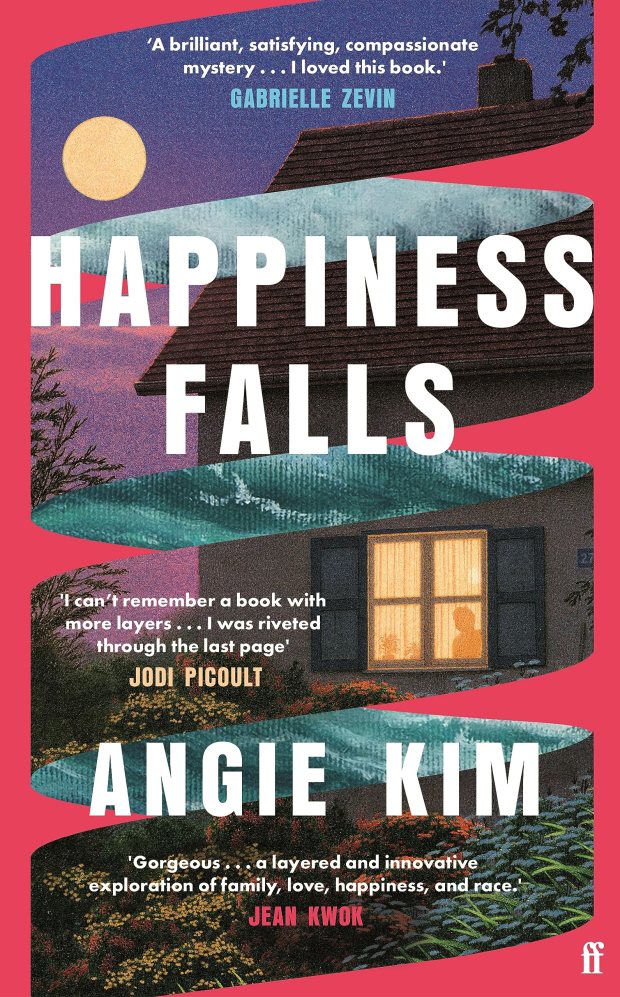
The pandemic setting places interesting constraints on the official proceedings, and the prospect of a new communication method (involving painstaking spelling with a letter stencil) revolutionizes this family as they grasp that Eugene is far from nonverbal and has been ‘locked in’ all along. The account a therapist elicits from him seems to clinch the case, but uncertainty lingers.
This is like a blend of Celeste Ng’s Everything I Never Told You, Rebecca Makkai’s I Have Some Questions for You, and Naoki Higashida’s The Reason I Jump; if you’ve liked one or more of these, I would strongly recommend it. Mystery readers may lack patience for the digressions. The solution is eclipsed by the many issues – prejudice based on race and disability, how one’s circumstances affect contentment, nuances of communication, sibling relationships and twin ESP – explored along the way. Because I am not a crime reader, the pace was no problem for me. My annoyances were with the preponderance of hindsight (“I wish I’d said something,” “It didn’t occur to me until much later”) and the fact that Mia says “begs the question” for raising a question (misuse of a rhetorical term) several times. I found personal meaning in the book because of the Washington, DC-area locales and my severely disabled, nonverbal goddaughter. What if there really is something going on in her mind, and we could find out what it was… I mused. I’ll be keen to read Kim’s debut, Miracle Creek.
With thanks to Faber for the free copy for review.
Crocodile Tears Didn’t Cause the Flood by Bradley Sides
 These 17 flash fiction stories fully embrace the possibilities of magic and weirdness, particularly to help us reconnect with the dead. Brad and I are literary acquaintances from our time working on (the now defunct) Bookkaholic web magazine in 2014–15. I liked this even more than his first book, Those Fantastic Lives (2021), although the contours are very similar. Young people, animals and monsters abound – and sometimes the lines between those identities are unclear. There’s a lot of experimentation with form: a choose-your-own-adventure narrative, a police transcript, a two-truths-and-a-lie challenge, a story all in questions, an English exam, and a letter. A few of my favorite stories were “The Guide to King George,” about an amusement farm’s resident pond monster; “Claire & Hank,” in which a paleontologist’s unearthed Pteranodon becomes a sister to his motherless son; and “Dying at Allium Farm,” whose sassy undead owners think they’re fooling their Tennessee customers. And can you imagine a better title and cover combination?!
With thanks to Montag Press and publicist Lori Hettler for the e-copy for review.
And a couple of bonus February releases that are not from indie publishers:
Fourteen Days, ed. Margaret Atwood and Douglas Preston
This Authors Guild Foundation collaborative project is a Covid-era Decameron update in which the residents of an increasingly derelict New York City apartment complex meet on the rooftop every evening for two early lockdown weeks to clap for healthcare workers, indulge in adult beverages, and swap random stories. The tenants all go by nicknames like “Hello Kitty,” “Florida” and “Vinegar.” The frame narrative has the building superintendent (Yessie, a lesbian of Romanian heritage) worrying over her father’s wellbeing in a care home and surreptitiously recording the oral stories on her phone to later transcribe into the “bible” kept by the previous super. We’re told up front that the manuscript ends up in police custody.
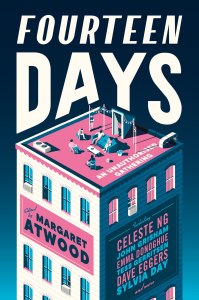 I had a misconception that each chapter would be written by a different author. I think that would actually have been the more interesting approach. Instead, each character is voiced by a different author, and sometimes by multiple authors across the 14 chapters (one per day) – a total of 36 authors took part. I soon wearied of the guess-who game. I most enjoyed the frame story, which was the work of Douglas Preston, a thriller author I don’t otherwise know.
There was a promising idea here, but problems with the execution. One is that, for the most part, the stories are pointless. The characters get hung up on whether they’re ‘true’ or not, but for readers it’s all made up and, while one or two individual tales might be amusing, they do nothing to build a plot and so I found myself mostly skipping over them to get back to the interactions on the roof and the super’s commentary. Another is that, to stand out from an ensemble cast, a voice needs to be really distinctive, and only “Eurovision” (flamboyantly gay) was that for me – based on my love for his rabbit story in particular, I should be reading Joseph Cassara. And finally, the book culminates with an annoying twist that made me cross.
With thanks to Chatto & Windus (Penguin) for the proof copy for review.
Bibliotherapy: The Healing Power of Reading by Bijal Shah
Bibliotherapy is one of my niche bookish interests (see my write-up of my bibliotherapy appointment with Ella Berthoud at the School of Life), so I was delighted to be offered a copy of another relevant book. Bijal Shah grew up in an East African Indian community before moving to the UK with her family as a teenager. When she was in training as a psychodynamic counsellor and attended therapy sessions herself, she realised how helpful literature was in helping her think through traumatic experiences from her past, such as sexism, colourism and a painful break-up. “I have lived half my life in the pages of books,” she observes, “relying on them to put my real life into perspective.” I feel the same way.

The emphasis is very much on therapy here, as Shah elaborates on practices such as literary journaling, recording audio notes, writing poetry, and focusing on gratitude. About half of the book is given over to anonymized sample case studies where she looks at the reasons why a client might come to her for bibliotherapy, the books and exercises she prescribed them, and the sorts of realizations people came to when reflecting on their own lives in relation to what they read. I suspect that the majority of readers, unless they have a vested interest in counselling, will, like me, most enjoy browsing the A–Z list of book prescriptions in the final 20% of the book (with more on Shah’s website). There is good variety to these in terms of author diversity, new vs. backlist reads, and both YA and adult fiction, though most of the recommendations are nonfiction, particularly psychology and self-help: these are much more literal (and, generally, obvious) prescriptions than Berthoud and Elderkin’s playful take.
With thanks to the author and Piatkus (Hachette) for the free copy for review.
Three “Love” or “Heart” Books for Valentine’s Day: Ephron, Lischer and Nin
Every year I say I’m really not a Valentine’s Day person and yet put together a themed post featuring books that have “Love” or a similar word in the title. This is the eighth year in a row, in fact (after 2017, 2018, 2019, 2020, 2021, 2022, and 2023)! Today I’m looking at two classic novellas, one of them a reread and the other my first taste of a writer I’d expected more from; and a wrenching, theologically oriented bereavement memoir.
Heartburn by Nora Ephron (1983)
I’d already pulled this out for my planned reread of books published in my birth year, so it’s pleasing that it can do double duty here. I can’t say it better than my original 2013 review:
The funniest book you’ll ever read about heartbreak and betrayal, this is full of wry observations about the compromises we make to marry – and then stay married to – people who are very different from us. Ephron readily admitted that her novel is more than a little autobiographical: it’s based on the breakdown of her second marriage to investigative journalist Carl Bernstein (All the President’s Men), who had an affair with a ludicrously tall woman – one element she transferred directly into Heartburn.
Ephron’s fictional counterpart is Rachel Samstad, a New Yorker who writes cookbooks or, rather, memoirs with recipes – before that genre really took off. Seven months pregnant with her second child, she has just learned that her second husband is having an affair. What follows is her uproarious memories of life, love and failed marriages. Indeed, as Ephron reflected in a 2004 introduction, “One of the things I’m proudest of is that I managed to convert an event that seemed to me hideously tragic at the time to a comedy – and if that’s not fiction, I don’t know what is.”
As one might expect from a screenwriter, there is a cinematic – that is, vivid but not-quite-believable – quality to some of the moments: the armed robbery of Rachel’s therapy group, her accidentally flinging an onion into the audience during a cooking demonstration, her triumphant throw of a key lime pie into her husband’s face in the final scene. And yet Ephron was again drawing on experience: a friend’s therapy group was robbed at gunpoint, and she’d always filed the experience away in a mental drawer marked “Use This Someday” – “My mother taught me many things when I was growing up, but the main thing I learned from her is that everything is copy.” This is one of celebrity chef Nigella Lawson’s favorite books ever, for its mixture of recipes and rue, comfort food and folly. It’s a quick read, but a substantial feast for the emotions.
 Sometimes I wonder why I bother when I can’t improve on reviews I wrote over a decade ago (see also another upcoming reread). What I would add now, without disputing any of the above, is that there’s more bitterness to the tone than I’d recalled, even though Ephron does, yes, play it for laughs. But also, some of the humour hasn’t aged well, especially where based on race/culture or sexuality. I’d forgotten that Rachel’s husband isn’t the only cheater here; pretty much every couple mentioned is currently working through the aftermath of an affair or has survived one in the past. In one of these, the wife who left for a woman is described not as a lesbian but by another word, each time, which felt unkind rather than funny.
Still, the dialogue, the scenes, the snarky self-portrayal: it all pops. This was autofiction before that was a thing, but anyone working in any genre could learn how to write readable content by studying Ephron. “‘I don’t have to make everything into a joke,’ I said. ‘I have to make everything into a story.’ … I think you often have that sense when you write – that if you can spot something in yourself and set it down on paper, you’re free of it. And you’re not, of course; you’ve just managed to set it down on paper, that’s all.” (Little Free Library)
My original rating (2013): 
My rating now:
Stations of the Heart: Parting with a Son by Richard Lischer (2013)
“What we had taken to be a temporary unpleasantness had now burrowed deep into the family pulp and was gnawing us from the inside out.” Like all life writing, the bereavement memoir has two tasks: to bear witness and to make meaning. From a distance that just happens to be Mary Karr’s prescribed seven years, Lischer opens by looking back on the day when his 33-year-old son Adam called to tell him that his melanoma, successfully treated the year before, was back. Tests revealed that the cancer’s metastases were everywhere, including in his brain, and were “innumerable,” a word that haunted Lischer and his wife, their daughter, and Adam’s wife, who was pregnant with their first child.
 The next few months were a Calvary of sorts, and Lischer, an emeritus professor at Duke Divinity School, draws deliberate parallels with the biblical and liturgical preparations for Good Friday that feel appropriate for this Ash Wednesday. Lischer had no problem with Adam’s late-life conversion from Protestantism to Catholicism, whose rites he followed with great piety in his final summer. He traces Adam and Jenny’s daily routines as well as his own helpless attendance at hospital appointments. Doped up on painkillers, Adam attended one last Father’s Day baseball game with him; one last Fourth of July picnic. Everyone so desperately wanted him to keep going long enough to meet his baby girl. To think that she is now a young woman and has opened all the presents Adam bought to leave behind for her first 18 birthdays.
The facts of the story are heartbreaking enough, but Lischer’s prose is a perfect match: stately, resolute and weighted with spiritual allusion, yet never morose. He approaches the documenting of his son’s too-short life with a sense of sacred duty: “I have acquired a new responsibility: I have become the interpreter of his death. God, I must do a better job. … I kissed his head and thanked him for being my son. I promised him then that his death would not ruin my life.” This memoir brought back so much about my brother-in-law’s death from brain cancer in 2015, from the “TEAM [ADAM/GARNET]” T-shirts to Adam’s sister’s remark, “I never dreamed this would be our family’s story.” We’re not alone. (Remainder book from the Bowie, Maryland Dollar Tree) 
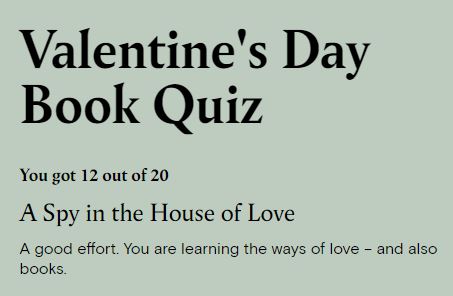
A Spy in the House of Love by Anaïs Nin (1954)
 I’d heard Nin spoken of in the same breath as D.H. Lawrence, so thought I might similarly appreciate her because of, or despite, comically overblown symbolism around sex. I think I was also expecting something more titillating? (I guess I had this confused for Delta of Venus, her only work that would be shelved in an Erotica section.) Many have tried to make a feminist case for this novella about Sabina, an early liberated woman in New York City who has extramarital sex with four other men who appeal to her for various not particularly good reasons (the traumatized soldier whom she comforts like a mother; the exotic African drummer – “Sabina did not feel guilty for drinking of the tropics through Mambo’s body”). She herself states, “I want to trespass boundaries, erase all identifications, anything which fixes one permanently into one mould, one place without hope of change.” The most interesting aspect of the book was Sabina’s questioning of whether she inherited her promiscuity from her father (it’s tempting to read this autobiographically as Nin’s own father left the family for another woman, a foundational wound in her life).
Come on, though, “fecundated,” “fecundation” … who could take such vocabulary seriously? Or this sex writing (snort!): “only one ritual, a joyous, joyous, joyous impaling of woman on a man’s sensual mast.” I charge you to use the term “sensual mast” wherever possible in the future. (Secondhand – Oxfam, Newbury) 
But hey, check out my score for the Faber Valentine’s quiz!
New Poetry Releases by Phil Barnett, Victoria Kennefick and Rachel Mann
I was slow off the mark this month, but finally managed to finish a first batch of review copies. The rest from January will be coming up soon.
Birds link the first and second poetry collections below, and the trans experience the second and third. Other themes include chronic illness, miscarriage, motherhood, history, prayer and praise.
Birds Knit My Ribs Together by Phil Barnett
What an evocative title – reminiscent of last year’s You Bury the Birds in My Pelvis by Kelly Weber – and powerful image of how nature has bolstered the author through chronic illness.

The title phrase comes from the poem “Trepanning,” which imagines different species keeping him company in pain. If they’re sometimes held figuratively responsible, they’re also part of the solution; openness to experience means vulnerability, but also solidarity:
a woodpecker bored my skull
in trepanation
drummed a hole and wasps flew out
goldcrests’ needle-calls put punctures
all along the kidney’s line
swallow’s flightlines skywrote my ill
when thrushes sang it out loud
I appreciated the alliteration, the out-of-the-ordinary verbs, and the everyday metaphors. When spring finds Barnett unable to go further than his garden, the birds come to him, inviting him into “a prosecco world, still all winter / stirred in March, shaken in April”. There is highly visual and aural language throughout the book. In “Unsprung,” a dead heron becomes, in an echo of T.S. Eliot, the “still point at the centre of a wheeling world”. Though a pretty niche collection, it’s a lovely little one that nature-lovers should take a chance on.
With thanks to Arachne Press for the free copy for review.
Carcanet have set the bar high for 2024 poetry with these next two releases:
Egg/Shell by Victoria Kennefick
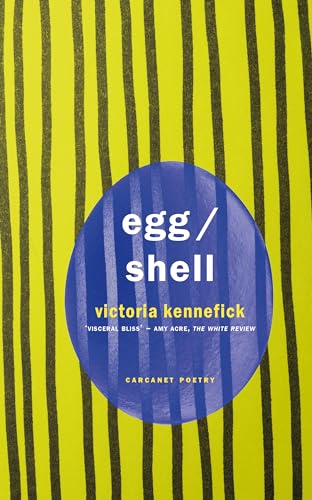 I was blown away by Kennefick’s 2021 debut, Eat or We Both Starve, which I described as “audacious,” “fleshly,” and “pleasingly morbid.” Her sophomore collection is just as strong, with motherhood and the body continuing as overarching themes. The speaker is, by turns, pregnant and mother to a daughter. She experiences multiple miscarriages and names her lost children after plants. Becoming a mother is a metamorphosis all its own (see my recent post on matrescence), while the second long section is about her husband transitioning. This is not actually the first book I’ve read about the changes in a marriage precipitated by a spouse transitioning, and the welter of emotions that it provokes; there’s also Some Body to Love by Alexandra Heminsley in memoir and Cataloguing Pain by Allison Blevins in poetry.
As in Barnett’s collection, bird metaphors are inescapable. “The Wild Swans at the Wetland Centre” must be a nod to W.B. Yeats (his were at Coole). Here, the recurring chickens and swans are the poet’s familiars, and their eggs her totems – ideal vessels, but so easily broken. The same is true of “Cup,” whose lines form the shape of a teacup perched on a saucer. The structure varies throughout: columns, stanzas; a list, a recipe. Amid the sadness, there is a lot of self-deprecation and dark humour in the poem titles (“Victoria Re-Enacts the Stations of the Cross,” falling and spilling coffee all over herself) and one-line poems that act as rejoinders. (“Orientation: A Tragedy” reads “I am so straight I give myself paper cuts.”)
If you’re wondering how life can be captured in achingly beautiful poetry, look no further. I doubt I’ll come across a better collection this year.
More favourite lines:
I get sad as earth becomes sea. I get sad
that in showing you this sinking world
I teach you how to say goodbye.
(from “On Being Two in the Anthropocene”)
I want people
to know me, and to hide.
(from “Le Cygne, My Spirit Animal”)
I want to write down the names of all my dead relatives.
How are they not here anymore? How are yours absent too?
What do we do with them, their names? Is there a box for grief?
(from “Census Night Poem”)
With thanks to Carcanet Press for the free copy for review. Coming out on 29 February.
Eleanor Among the Saints by Rachel Mann
 This is Mann’s second collection, after A Kingdom of Love. In reviewing that book I remarked on the psalm-like cadence, the anatomical and allusive language, and the contrast of past and present. All are elements here as well. The first long section was inspired by Eleanor/John Rykener, a 14th-century seamstress and sex worker whom some have claimed as a trans pioneer. Little is known about her life or self-identification, so Mann does not attempt biography here, but rather is thinking alongside the character. “Construct me weird and kind, leave it to me / To strip off when I’m ready. I shall run wild, / Naked as I dare, out into sober streets.”
Three later poems share the title “A Charm to Change Sex,” each numbered and in two columns – you have a choice of whether to read them across or down the page. Either way, they land somewhere between a spell and a prayer (and there are many other prayers in the table of contents): “Hidden: transfix / Invisible made visible … oh so holy, words lead everywhere / inside become out”. Bodies are as provisional as speech (“All text is stitched, / Body too only subset of making, a stored magic”), and inescapably frail, as evidenced by a father’s illness and death, the subject of several poems.
Repetition and wordplay (“razed/raised”) sometimes tail off into faltering phrases – “#TDOR” is most notable for this. And “Seven Proof Texts on a Transitioned Body” is, by itself, worth buying the book for, with alliteration and slang pushing back at medical and scriptural vocabulary. Mann is an incredibly versatile writer: I’ve read a memoir, a work of literary appreciation, and an academic thriller by her as well as her published poetry. And while I found less that resonated in this collection, I still admired its rigorous engagement with history, theology, and the facts of a life.
With thanks to Carcanet Press for the free copy for review.
My Best Backlist Reads of the Year
Like many bloggers, I’m irresistibly drawn to the new books released each year. However, I consistently find that many of my more memorable reads were published earlier – most of these happen to have been published between one and a few years ago, with the ‘oldest’ being from 2004. These dozen selections – alphabetical within genre but in no particular rank order – together with my Best of 2023 post (coming up tomorrow), make up about the top 10% of my year’s reading.

Fiction
 Loved and Missed by Susie Boyt: The heart-wrenching story of a woman who adopts her granddaughter because of her daughter’s drug addiction. The prose is stunning as Boyt traces the history of this complicated, makeshift family. The title has a wry double meaning, but also connotations of anticipatory grief. There can be love even where there is estrangement, or eternal separation. That is one of the enduring messages of this gem of a short novel.
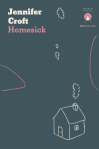 Homesick by Jennifer Croft: Each vignette – some just a paragraph long – is perfectly chosen to reveal a family dynamic and a moment in American history. What Croft does so brilliantly is to chart the accretion of ordinary and landmark events that form a life. In the end it didn’t matter whether this was presented as memoir or autofiction, so true was it to the experience of 1990s girlhood, as well as to sisterhood and coming of age.
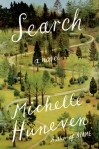 Search by Michelle Huneven: When middle-aged restaurant critic Dana Potowski is invited to be on the search committee to appoint the next minister for her California Unitarian church, she reluctantly agrees but soon wonders whether the experience could be interesting fodder for a new book… The setup might seem niche but will resonate with anyone who’s had a brush with bureaucracy. Pure pleasure; lit fic full of gossip and good food.
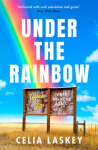 Under the Rainbow by Celia Laskey: Researchers identified Big Burr, Kansas as the most homophobic town in America. An Acceptance Across America task force descends on the rural backwater for a two-year program promoting education and friendship. Each chapter in the linked short story collection is a first-person, present-tense confession from a local or a queer visitor, whose stories interlock. Laskey inhabits all 11 with equal skill and compassion.
 The Chosen by Elizabeth Lowry: This utterly immersive novel examines Thomas Hardy’s relationship with his first wife, Emma Gifford. It opens on the morning of her death. The couple had long been estranged, but Hardy was instantly struck with grief – and remorse, his guilt compounded by what he found in her journals. A universal tale of waning romance, loss, and regret. Beautifully understated; perfectly convincing for the period but also timeless.
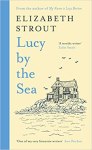 Lucy by the Sea by Elizabeth Strout: As Covid hits, William whisks Lucy from her NYC apartment to a house at the Maine coast. She’s an Everywoman recounting the fear and confusion of the early pandemic. Isolation has benefits: the first ‘room of her own’ she’s ever had, and time to ponder her childhood trauma and what went wrong in her marriage. Astute on American politics and writers’ inspirations; an effortless voice and emotional intelligence.
Nonfiction
 Bibliomaniac by Robin Ince: Ince was meant to undertake a stadium tour in Autumn 2021, but a Covid resurgence put paid to that. Not one for sitting around at home, he formulated Plan B: 100+ events, most of them in independent bookshops, over the course of two months, criss-crossing Britain and hitting many of my favourites. He’s not just a speaker at them but, invariably, a customer. I sensed a kindred spirit in so many lines. Witty and open-minded.
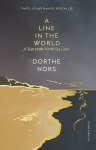 A Line in the World by Dorthe Nors: Nors lives in rural Jutland along the west coast of Denmark – little visited and largely unknown to foreigners. This can be both good and bad. Tourists feel they’re discovering somewhere new, but the residents are insular. Local legends and traditions, bird migration, reliance on the sea, wanderlust, maritime history, a visit to church frescoes, and more. Gorgeous writing and atmosphere, despite the bleakness.
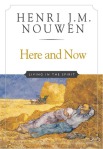 Here and Now by Henri Nouwen: This collection of micro-essays under themed headings like “Living in the Present” and “Suffering” is a perfect introduction to the Dutch Catholic priest’s theology. I marked out many reassuring or thought-provoking passages. I was taken by his ideas that the life of compassion is one of “downward mobility” and that inner freedom comes when you don’t judge anyone. Peaceful and readable; a good bedside devotional.
Poetry
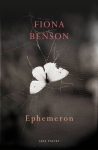 Ephemeron by Fiona Benson: Exquisite poems about the ephemeral, whether that be insect lives, boarding school days, primal emotions or moments from her children’s early years. The book is in four discrete corresponding sections but themes and language bleed from one into another and the whole is shot through with astonishing corporeality and eroticism. The form varies but the alliteration, slant rhymes and unexpected metaphors make each poem glisten.
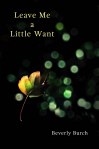 Leave Me a Little Want by Beverly Burch: Burch’s fourth collection juxtaposes the cosmic and the mundane, marvelling at the behind-the-scenes magic that goes into one human being born but also making poetry of an impatient wait in a long post office queue. Beset by environmental anxiety and the scale of bad news during the pandemic, she pauses in appreciation of the small and gradual.
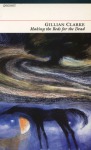 Making the Beds for the Dead by Gillian Clarke: Full of colour and nature imagery, profuse with alliteration and slant rhymes, relishing its specialist terminology, and taking on the serious subject matter of manmade disasters. Several sequences are devoted to gardening and geology; some pieces are ekphrastic, or dedicated to particular poets. The title sequence tackles the 2001foot and mouth disease outbreak. “The Fall” is on 9/11. Very affecting stuff.
My overall favourites were: in novels, Search and The Chosen (one contemporary and one historical) and in poetry, Ephemeron.
What were your best backlist reads this year?
 Bookish Beck = Rebecca Foster. American transplant to England. Freelance proofreader and book reviewer.
