“All to Do with the Moon”: Four Books with Moon in the Title
I happened to read two books with the word moon in their titles within a couple of weeks in September, which prompted me to ransack my shelves and find two more. While these four are in completely different genres – one women’s fiction, one poetry, one memoir and one Booker-winning literary novel – they are all by women (naturally more in touch with the moon?) and all worth reading. In the weeks that I was undertaking this mini reading project, I couldn’t get Krista Detor’s song “All to Do with the Moon” out of my head (on this video, a live recording of the entire “Night Light” suite of three songs, it starts at about 6:15). She’s one of our favorite singer-songwriters, though, so this was no problem.
The Pull of the Moon by Elizabeth Berg (1996)
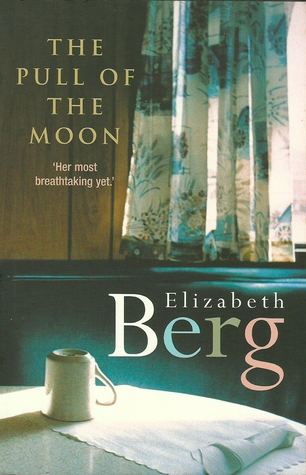 This is my second contemporary novel from Berg. I find her work effortlessly readable. She’s comparable to those other Elizabeths, McCracken and Strout, but also to Alice Hoffman and Anne Tyler. This one reminded me most of Tyler’s Ladder of Years in that both are about a middle-aged woman who takes a break from her marriage to figure out what she wants from life. Nan, “a fifty-year-old runaway,” takes off from her suburban Boston home and drives west, stopping at motels and cabins, eating at diners, and meeting the locals; eventually she gets as far as South Dakota. Her narration is in the form of letters to her husband, Martin, alternated with italicized passages from her journal. She reflects on everything that has made up her life – her upbringing, her marriage and other sexual encounters, raising her daughter, Ruthie – as well as on the small-town folk she meets in Iowa and Minnesota. The moon is a symbol of the femininity Nan fears she’s losing through menopause and hopes to reclaim on this journey.
The Moon Is Almost Full by Chana Bloch (2017)
 This was a lucky find in the clearance section at Blackwell’s on my Oxford day with Annabel. It’s a beautifully produced book from Autumn House, the small Pittsburgh press that released my favorite poetic work of last year: The Small Door of Your Death by Sheryl St. Germain. This was Bloch’s sixth and final book of poetry, published in the year of her death. She writes in the awareness that this cancer will be her end and doesn’t gloss over losses of function and dignity, but still finds delight in life through her family, writing and Jewish rituals: “Never forget / you were put on earth to gather joy // with melancholy hands” (from “Instructions for the Bridegroom”). A favorite poem was “The Will,” in which she imagines how the physical and intangible relics of her life will be distributed (“My plans and projects I hereby bequeath to the air / of which they were conceived. … Let the doctors pack up my heart / and keep it humming for the right customer.”).
Off-topic note: This was typeset in Mrs Eaves, which may well be one of my favorite fonts.
To the Moon and Back: A Childhood under the Influence by Lisa Kohn (2018)
 My special interest in women’s religious memoirs led me to list this among my most anticipated titles of 2018. I had it on my wish list for quite a while and then, when I saw it available for a bargain price online, snapped it up for myself. Lisa Kohn grew up in the New York City environs, the child of hippie parents she called Mimi and Danny rather than Mom and Dad. After their parents divorced, she and her brother lived in New Jersey with their mother and went into the City to visit their father, who was very lax about things like drugs. By the time Kohn was 10, her mother had gotten caught up in Reverend Moon’s Unification Church.
I knew next to nothing about the “Moonies,” so I found it fascinating to learn about this cult led by a South Korean reverend who let it be assumed that he was the new incarnation of Jesus Christ and the flourishing of his family on Earth would usher in God’s Kingdom. The Church became Kohn’s whole life until internal questioning set in during high school, and by the time she went to college she was adrift and into drugs instead. The book recreates scenes and dialogue well, but I found myself losing interest once the cult itself stopped being the main focus. 
Readalikes: Small Fry by Lisa Brennan-Jobs and In the Days of Rain by Rebecca Stott
Moon Tiger by Penelope Lively (1987)
 Seventy-six-year-old Claudia Hampton, on her deathbed in a nursing home, determines to write a history of the world – or at least, the world as she’s seen it. She’s been an author of popular history books (one of which, on Mexico, was made into a film), but she’s also been a daughter, a sister, a lover and a mother. As the book shifts between the first person and the third person, the present and the past, we learn volumes about Claudia and how her memory has preserved the layers of her personal history. There are a couple of big reveals, about her relationship with her brother Gordon and her time as a Second World War correspondent in Egypt, but what’s more impressive than these plot surprises is how Lively packs the whole sweep of a life into just 200 pages, all with such rich, wry commentary on how what we remember constructs our reality.
I made the fine choice to start reading this on holiday at the Jurassic coast in Dorset, which was fitting because Claudia grew up in Dorset and uses ammonites and rock strata as recurring metaphors. This won a well-deserved Booker Prize and is the best of the five Lively books I’ve read. I wasn’t particularly taken with the first couple I read by her, so I’m glad I tried again this year (with Heat Wave and then this). It’s just a shame that the copy I found in the free bookshop where I volunteer has such a dreadfully inappropriate cover, making it look like contemporary chick lit rather than serious literature. 
Some favorite lines:
“Argument, of course, is the whole point of history. Disagreement; my word against yours; this evidence against that. If there were such a thing as absolute truth the debate would lose its lustre. I, for one, would no longer be interested.”
“In life as in history the unexpected lies waiting, grinning from around corners. Only with hindsight are we wise about cause and effect.”
“Once it is all written down we know what really happened.”
A note on the title: From the context, it seems that a moon tiger was a special inflammatory device, maybe like a citronella candle, used to repel mosquitoes and other insects.
 Other ‘Moon’ books I have happened to review:
Crossing the Moon by Paulette Bates Alden
The Moon and Sixpence by W. Somerset Maugham
Booker Prize and Birthday Goings-On
The Booker Prize was announced last night in a live feed I watched over a glass of wine between my yoga class and birthday dessert. As chair of judges Peter Florence recapped each book, he said the most, and most effusively, about Ducks, Newburyport, so I thought Ellmann had it in the bag. Then, when it became clear there would be joint winners, I thought maybe Ellmann and Evaristo would share the Prize. But that’s not how things panned out…
I don’t have much to add to the conversation after yesterday’s Twitter storm; I remain entirely uninterested in reading The Testaments, an unnecessary sequel and, by all accounts, subpar Atwood work that didn’t need more buzz than it’s already attracted. Atwood won the Booker in 2000 for a brilliant novel, The Blind Assassin, one of my absolute favorites, and while she’s enough of a legend to be among the few authors to have won the Prize twice (along with Peter Carey, J.M. Coetzee and Hilary Mantel), maybe not for this book?

I am, however, delighted for Evaristo. If you haven’t yet picked up Girl, Woman, Other, I’d urge you to give it a try. I’m 1/3 into it now. Through a giveaway on Eric’s blog I won a copy plus two tickets to see Evaristo in conversation with Jennifer Nansubuga Makumbi (author of Manchester Happened, which I’ll be covering for the Ake Book Festival blog tour later this month) at the London Literature Festival on the 20th, but I couldn’t wait until I pick up my copy from the Southbank Centre so have been reading a library copy in the meantime.
You probably know that Girl, Woman, Other is a linked short story collection about 12 characters (mostly Black women) navigating twentieth-century and contemporary Britain, balancing external and internal expectations and different interpretations of feminism to build lives of their own. I’ve been surprised by the structure and style, however. It’s in four long chapters, each divided between three characters. These are almost like musical suites, with the three stories interlocking (I’m not in far enough to know if there is overlap between the suites). The prose is mostly uncapitalized and unpunctuated, with only a handful of full stops closing sections. This makes it more like poetry: a wry, radical stream of consciousness. I’d compare it, content-wise, to Homegoing by Yaa Gyasi and The Female Persuasion by Meg Wolitzer.
This is the third tie in Booker history – though after a 1992 tie the rules were changed so that it shouldn’t have happened again. As Gaby Wood, literary director of the Booker Prize Foundation, puts it, “The thinking was it just doesn’t work—it sort of detracts attention from both, rather than drawing attention to either.” So while it’s wonderful that Evaristo is the first Black woman to win the Booker, there is something almost sinister about the fact that, due to the tie, she gets just £25,000 in prize money rather than the full £50,000. However, both she and Atwood were extremely graceful in their acceptance speeches (Atwood sheepish and apologetic at the same time), so I will try to be as well. It’s a turn-up for the books, anyway!
 Yesterday was also my 36th birthday. A dismally wet Monday may not be ideal for a birthday, but I’d had the whole previous weekend for celebrating so can’t really complain. Saturday was a very Newbury day of volunteer gardening in the drizzle; an excellent lunch at Henry & Joe’s, a reasonably new restaurant with small plates of seasonal food, exquisitely presented – on the way to Michelin star quality; an early evening showing of Downton Abbey in the intimate upstairs theatre at the Corn Exchange; and a wander around the Fire Garden art installation, which features giant candles and automata. On Sunday I helped out at a fun and chaotic pet blessing service at church, followed by cake, presents and a homemade feast.


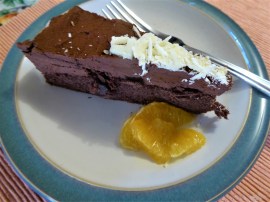 One of the best parts of preparing for my birthday is finding recipes for my husband to make for me. This year I picked a Chocolate Orange Truffle Cake from Perfect Chocolate Desserts (which includes photographs of every step), a veganized Chicken Jackfruit Mole with Red Cabbage Slaw and flatbreads from Pip & Nut: The Nut Butter Cookbook, and A Rum of One’s Own (aka hot buttered rum) from the Tequila Mockingbird literary cocktails book. All amazingly rich and delicious; by nightcap time, I could only manage a sip or two of the rum.

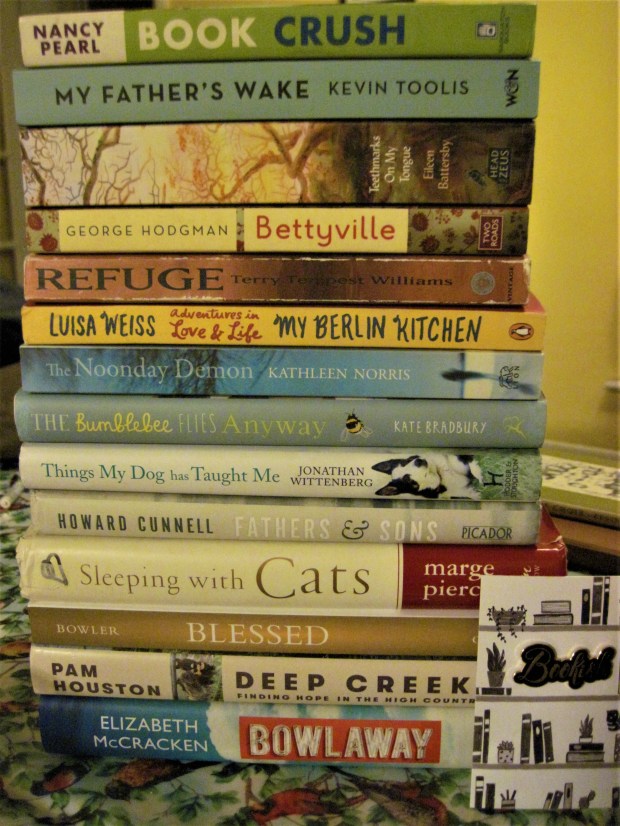
I gave myself the Monday off work (the nice thing about being a freelancer, even if I don’t get paid) and spent much of it reading in comfy spots around the house and looking out at the rain. I also picked out a pile of books I’ve been meaning to reread, but only got around to starting the Thomas. I hadn’t read it since it came out in 2006 yet I remember it so well, even particular phrasing. It was one of the first memoirs to make a really big impression on me.


It won’t surprise you that my wish list contained only books this year, so with the exception of a mug mat, puffin socks and notecards, a couple of CDs, some chocolate and the perfect pin badge (“Bookish”), I received 14 books as presents: two novels and the rest nonfiction, mostly memoirs. I get much of my fiction from the library or from NetGalley/Edelweiss (particularly the American releases I can’t find elsewhere), but there are lots of nonfiction authors whose work I can’t find other than secondhand. I know where I’ll start with this pile: the Houston and McCracken are 2019 releases, so I want to read them before the end of the year in case they make a Best Of list. After that, I’ll let whimsy be my guide. A great haul!
Any additional Booker thoughts?
What caught your eye from my birthday stacks?
And the Winner Is…
In case you haven’t already heard, the winner of the Man Booker Prize 2016 is
The Sellout by Paul Beatty
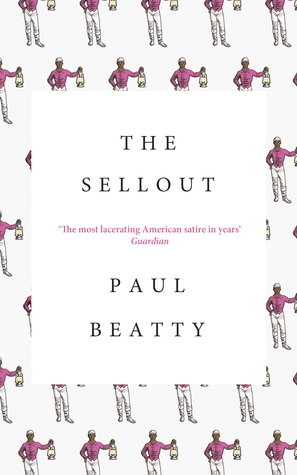 He’s the first American winner of the Booker Prize, for which I must express a modicum of pride. Yet I’m gobsmacked by the judges’ decision. Do you know that lovely bit of British slang? It means, roughly, astounded. You see, I would have placed The Sellout fifth out of six in terms of its likelihood of winning (ahead of only Eileen).
When I reviewed it for Shiny New Books back in early June, I expressed my doubts that this outrageous racial satire would strike a chord in Britain as it had in the States. It’s a zany, irreverent take on racial politics in America today, crammed with old stereotypes of African-Americans. For me, the satire wore thin and I yearned for more of an introspective Bildungsroman. But it’s clear that, with police shootings of black men in America a seemingly daily news phenomenon, the Booker judges chose a timely and incisive winner.
Here’s a taste of the sort of audacious lines the book is chock-full of:
“I understand now that the only time black people don’t feel guilty is when we’ve actually done something wrong, because that relieves us of the cognitive dissonance of being black and innocent, and in a way the prospect of going to jail becomes a relief.”
“When a white bitch got problems, she’s a damsel in distress! When a black bitch got problems, she’s a welfare cheat and a burden on society. How come you never see any black damsels? Rapunzel, Rapunzel, let down your weave!”
Amid the laughs, you still get a sense of how important it is to Beatty that race remain a topic for public discussion. An exchange the narrator has with a police officer could just as easily describe the author’s purpose:
“It’s illegal to yell ‘Fire’ in a crowded theatre, right?”
“It is.”
“Well, I’ve whispered ‘Racism’ in a post-racial world.”
No whisper, this, but a brazen shout.
 Bookish Beck = Rebecca Foster. American transplant to England. Freelance proofreader and book reviewer.
 Bookish Beck