The Wellcome Book Prize 2017 Awards Ceremony
Yesterday evening’s Wellcome Book Prize announcement was my first time attending a literary prize awards ceremony. Despite my nerves going in, there was quite a relaxed atmosphere (I felt almost overdressed in my H&M dress) and it was no different to any party where one struggles to make small talk – except that here all the talk was of books!
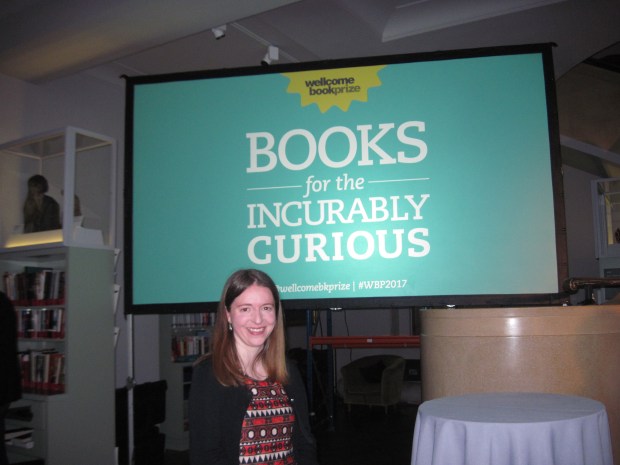
The new high-ceilinged Reading Room at the Wellcome Library (across from London’s Euston station) was a suitably swanky setting, with the unusual collection of health-themed books surrounded by an equally odd set of curios, such as death masks, paintings showing medical conditions, and a columnar red dress designed to resemble a neural tube. There was even a jazz duo playing.


It was especially lovely to meet up with Clare (A Little Blog of Books) and Ruby (My Booking Great Blog) and compare notes on book blogging while nursing a flute of prosecco and some superlative canapés. We also indulged in some subtle celebrity spotting – or, at least, the sort of authors and public figures I consider celebrities: Ned Beauman, Sarah Churchwell, A.C. Grayling, Cathy Rentzenbrink, and Suzanne O’Sullivan, last year’s Wellcome Prize winner. Three of the shortlisted authors were also present.
About 45 minutes into the event, the official proceedings began. Crime writer Val McDermid, the chair of this year’s judging panel, gave introductory remarks about the Prize and the attributes they were looking for when assessing the 140 books in the running this year. She said they were in search of books that went beyond the superficial and revealed more layers upon each rereading – as by now they’ve read the shortlisted books three times.
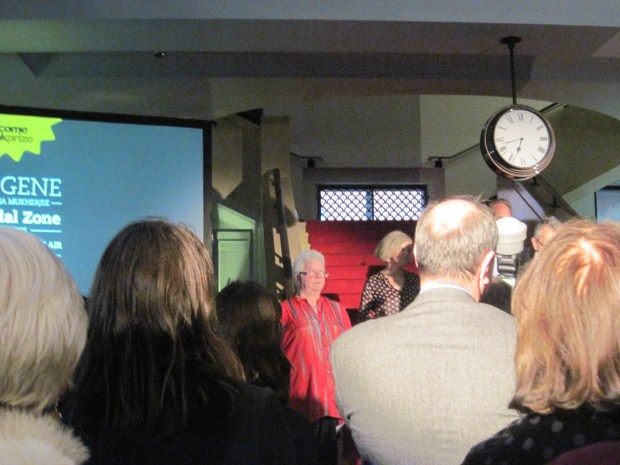
Chair of judges Val McDermid in center; fellow judge and BBC Radio books editor Di Spiers to her left.
Each of the judges then came to the podium to explain what they had all admired about a particular shortlisted book before presenting the author or author’s representative (editor, publisher or, in the case of Paul Kalanithi, his younger brother Jeevan, over from America) with flowers. When McDermid returned to the microphone to announce the winner, she started off by speaking of a book that combined two stories, the medical and the personal. Hmm, this might describe at least four or five of the books from the shortlist, I thought. Could it be When Breath Becomes Air, our shadow panel favorite? Or The Tidal Zone, our runner-up?
Within seconds the wait was over and we learned the actual winner was Mend the Living by Maylis de Kerangal. There was a pleased roar from the room, but also plenty of blinks and head shakes of surprise, I think. De Kerangal gave a few words of thanks, especially to the U.K. translator and publisher who made this edition of her book possible. This was the first work in translation to win the Wellcome Book Prize, and only the second novel (after Turn of Mind by Alice LaPlante in 2011).
Clare and I stuck around for another hour and were unexpectedly asked for book recommendations by a member of the Wellcome legal team who was kind enough to take an interest in us as book bloggers. She confessed that since uni she doesn’t read much anymore, but said that at school she enjoyed Jane Austen and she’s recently read Elena Ferrante’s books. Based on that rather thin history, we suggested she try Zadie Smith, and I also spoke up for Yaa Gyasi’s Homegoing.
On the way out we were given terrific bookish swag bags! Mine contained a paperback reissue copy of The Tidal Zone, a Wellcome Prize bookmark and commemorative booklet, and a blank notebook featuring optician’s glass eyes.

I can’t see such London events ever being frequent for me, especially given the cost of travel in from Newbury, but if a similar opportunity arises again I won’t hesitate to take advantage of it, especially if it means putting faces to names from the U.K. blogging community.
Grief in Literature: Michel Faber and Cathy Rentzenbrink
On Tuesday night I had the chance to see Michel Faber in conversation with Cathy Rentzenbrink at Foyles bookstore in London. The topic was grief in literature, and specifically Faber’s book of poems in honor of his late wife, Undying: A Love Story (which I reviewed here in July). Faber had always written occasional poems, he said, “sort of kind of clever” stuff that he would have taken little note of if he encountered it from another author; the only really good ones, he thought, were about illness, based on his time as a nurse. So when there came this huge uprising of poems about Eva’s last illness, he felt they were a more appropriate way of commemorating her life than a novelistic narrative.

A six-floor bookshop: heaven for book lovers.
Rentzenbrink mentioned two things that particularly struck her: how Eva emerges in the fullness of her personality in the course of these poems, and the fact that the book is not angry. Faber explained that Eva herself was not angry. She did not think of multiple myeloma as her enemy and had no illusions about ‘beating’ cancer; instead, she just tried to achieve the best quality of life and the longest lifespan possible. In fact, she found cancer interesting, Faber recalled: she researched it as much as she could and followed its course with a certain curiosity. He contrasted her experience with that of an acquaintance in the Scottish Highlands who had the same disease and wanted to know nothing about it, leaving it all in the hands of her doctors. Faber believes this ignorance shortened their friend’s life unnecessarily.
Making sure that Eva came through as a real person in the poems was a struggle, Faber confessed. To start with his editors at Canongate, many of whom knew Eva, were frustrated that Undying was mercilessly medical, describing the process and aftermath of cancer treatment. A few poems, then, he wrote as a direct response to that criticism, almost as if ‘on commission’, he said, to infuse the book with more of Eva’s personality.
Only two of the poems were written while Eva was still alive, Faber noted. One was “Nipples,” written at her bedside just 10 days before her death. Eva had dealt with the pain and indignity of her illness admirably, but plasmacytomas – big purple welts all over her skin – truly broke her spirit, he revealed. His poem is a strangely erotic take on these blemishes: “Excited peaks of plasma. … Your flesh is riotous with the pleasure / of predatory cells.”

Cathy Rentzenbrink and Michel Faber
There’s irony there, and a certain dark humor in many of the rest. “There are so many absurdities when a body is breaking down spectacularly,” Faber said. And yet the last two years of Eva’s life were “incredibly intimate and tender,” as a fiercely independent woman ended up very frail and completely dependent on him as her carer. Likewise, Faber had to shift from creativity to practicality to cope with household tasks plus caregiving.
Cathy Rentzenbrink was the perfect person to interview Faber. She is the author of a bereavement memoir, The Last Act of Love, about her brother’s death after eight years in a vegetative state. Moreover, her mother survived a bout with cancer at the same age as Eva; she was heavily involved with that process through accompanying her to chemotherapy appointments. I was a bit disappointed that Rentzenbrink didn’t get to speak more about her own grief and the experience of crafting a narrative out of it. Faber said he too had envisioned more of a dialogue, but that Rentzenbrink thought it would be inappropriate for her to talk about herself and generously kept the focus on his work instead.
I also would have appreciated more context about grief literature in general, and poetry in particular. Faber did mention that there are many kinds of grief poetry. For instance, Thomas Hardy was still writing poems about his first wife decades after her death. Faber consciously avoided writing elegant, well-formed poetry like some that he’s read; instead he wanted his poems to be raw, direct, even shocking. Contrast that with the rainbows and heavenly visions of much of what’s out there. This came home to me a few weeks ago at my husband’s uncle’s funeral. Three poems were recited in the course of the ceremony, all of them heavily clichéd and unfailingly rhymed. This meant that the speakers ended up using singsong voices. In Faber’s poems, though, end rhymes are rare. I noticed them more, along with the sibilance and internal rhymes, through the emphasis he lent when reading aloud.
 Rentzenbrink insisted there is still life to be lived for the grieving. As if to reinforce her point, Faber openly admitted to his relationship with a fellow writer who also lost a longtime partner, Louisa Young, whom he met the year after Eva’s death. He’s aware that this poses a marketing problem: he’s no longer the disconsolate soul in rumpled clothing, barely surviving without his spouse. (Indeed, he looked well put together and hip in his blue leather jacket and bright orange shoes, and his blond mop makes him appear much younger than he is.) Thinking also of a widower friend, Rentzenbrink said that her feeling was “he looked after her for so many years; he can have a little fun now!”
As to Faber’s professional future, he reiterated that he does not plan to write any more novels for adults. All of his fiction is about characters desperate to transcend, he said, and now it’s time for him to do that in his own life. He’s pondered a couple of nonfiction projects about aesthetics and music, but for now his next goal is a YA adventure novel. Whenever plaintive readers beg him for future novels, he cheekily asks whether they’ve read his whole back catalogue – including two collections of short stories, always a hard sell for novel readers. I have six more of Faber’s books to get to myself, so that’s plenty to fuel me in the years ahead. I came away from this event with a greater appreciation for the poems in Undying and a deep respect for a man aware of the seasons of his life, writing and caregiving among them.
Library Checkout: August 2016
I still have dozens of priority books to read from my own shelves , and I’ve been building up a stock of Booker-longlisted titles on my Kindle through NetGalley to try to get through before the shortlist announcement … BUT now that I live in a district where library reservations are free, I haven’t been able to resist placing holds on a bunch of books I’ve been wanting to read.
LIBRARY BOOKS READ
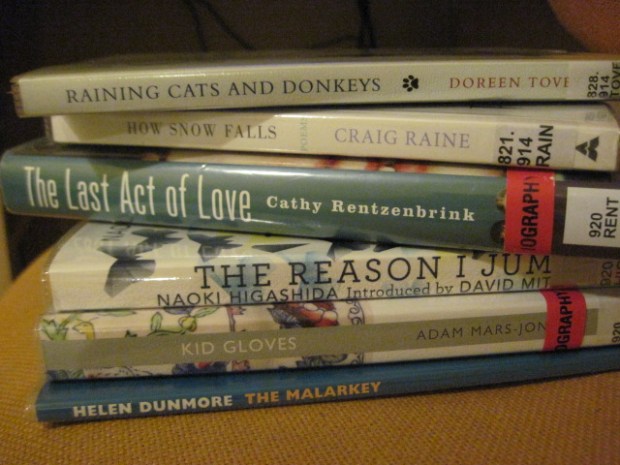
- Raining Cats and Donkeys by Doreen Tovey: Thanks to Liz at Adventures in reading for the recommendation of Tovey’s cat books. I’ll save up a mini-review of this one for a future follow-up post on books about cats.
LIBRARY BOOKS CURRENTLY READING
- How Snow Falls: Poems by Craig Raine
- The Last Act of Love: The Story of My Brother and His Sister by Cathy Rentzenbrink [in advance of a September 20th event at Foyles, London I’ll be attending on grief in literature, featuring her and Michel Faber]
CHECKED OUT, TO BE READ
- The Malarkey (poems) by Helen Dunmore
- The Reason I Jump: One Boy’s Voice from the Silence of Autism by Naoki Higashida
- Kid Gloves: A Voyage round My Father by Adam Mars-Jones
ON HOLD, TO BE PICKED UP
- Late Fragments: Everything I Want to Tell You (about This Magnificent Life) by Kate Gross
IN THE RESERVATION QUEUE
- The Crime Writer by Jill Dawson
- Let Me Tell You about a Man I Knew by Susan Fletcher
- Hot Milk by Deborah Levy [Booker longlist]
- Thirteen Ways of Looking by Colum McCann
- Winter by Christopher Nicholson
- The House at the Edge of the World by Julia Rochester
- Maus: A Survivor’s Tale by Art Spiegelman [graphic novel]
- Golden Hill by Francis Spufford
- Do Not Say We Have Nothing by Madeleine Thien [Booker longlist]
- The Painted Bridge by Wendy Wallace
RETURNED UNFINISHED
Words in Air: The Complete Correspondence between Elizabeth Bishop and Robert Lowell, edited by Thomas Travisano: I paused at page 140. I was enjoying this very much but am setting it aside because it’s an enormous book that I’ve had out from the university library for months and months, and I was making very little visible progress. Like Airmail, the collection of Robert Bly and Tomas Tranströmer’s letters that I read last year, it’s a delightful mixture of the two poets’ reading, writing, travels, and relationships, including their own burgeoning friendship. I need to get hold of a secondhand copy so I can read it at my leisure, a few letters at a time.
 Bookish Beck = Rebecca Foster. American transplant to England. Freelance proofreader and book reviewer.
 Bookish Beck