Love Your Library, August 2024
It’s a Bank Holiday today here in the UK – if you have the day off, I hope you’re spending it a fun way. We’re on a day trip to Windsor Castle with friends who got free tickets through her work. Otherwise, there’s no way we would ever have gone: it’s very expensive, plus down with the monarchy and all that.
Thanks so much to Eleanor (here, here and here), Laura (the two images below) and Marcie for posting about their recent library reading!


Marina Sofia has posted a couple of relevant blogs, one a review of an Alberto Manguel book about his home library and the other a series of tempting photos of world libraries.
In the media: I loved this anti-censorship George Bernard Shaw quote posted by Book Riot on Instagram…

…and my heart was warmed by the story of Minnesota governor and current vice-presidential candidate Tim Walz installing a Little Free Library in the state capitol earlier this year. He gets my vote!
One volunteering day, a staff member told the strange-but-true story of an e-mail just received to the general libraries account. A solicitor presiding over an estate clearance let us know about a West Berkshire Libraries book found among their client’s effects, borrowed in early 1969 and never returned. Did we want it back? The consensus was that, as we’ve been doing fine without this book since BEFORE THE MOON LANDING, we will drop the issue.
Not exactly library related, but in other fun book news, I took a couple of online quizzes and got intriguing results:


My suggestion (for Angie Kim’s Happiness Falls) featured in the recent Faber Members’ summer reading recommendation round-up. And here’s that blog post I wrote for Foreword Reviews about the Bookshop Band’s new album and tour.
I’m hosting book club a week on Wednesday. Although it’s felt for a while like it might be doomed, the group has had a stay of execution at least until January. We took a break for the summer and at our July social everyone made enthusiastic noises about joining in with the four autumn and winter reads we voted on – plus we have two prospective new members who we hope will join us for the September meeting. So we’ll see how it goes.
My library use over the last month:
READ
- Private Rites by Julia Armfield

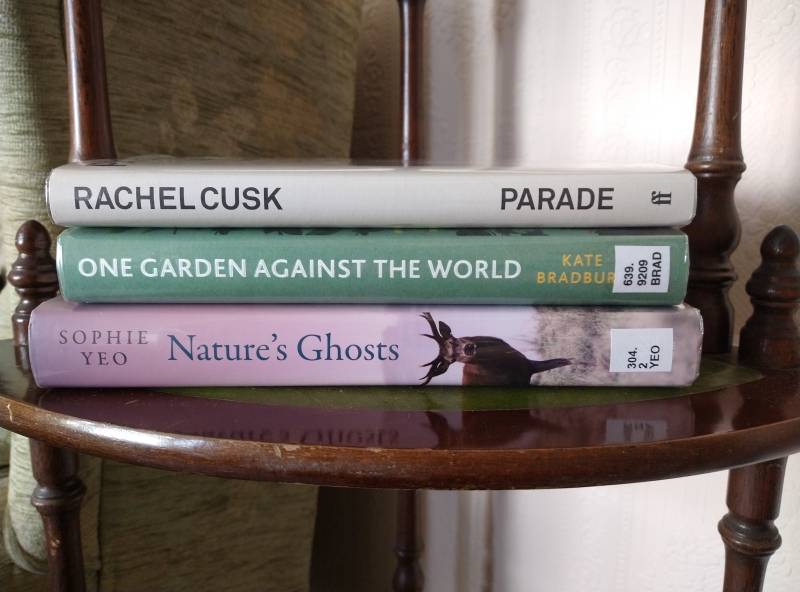
- Parade by Rachel Cusk

SKIMMED
- Nature’s Ghosts: A History – and Future – of the Natural World by Sophie Yeo
CURRENTLY READING
- One Garden against the World: In Search of Hope in a Changing Climate by Kate Bradbury
- Clear by Carys Davies (for September book club)
- Moominpappa at Sea by Tove Jansson
- The Garden against Time: In Search of a Common Paradise by Olivia Laing
- The Burial Plot by Elizabeth Macneal
- Late Light: Finding Home in the West Country by Michael Malay
- The Song of the Whole Wide World: On Motherhood, Grief, and Poetry by Tamarin Norwood
- The Echoes by Evie Wyld
CHECKED OUT, TO BE READ
- Wasteland: The Dirty Truth about What We Throw Away, Where It Goes, and Why It Matters by Oliver Franklin-Wallis
- This Is My Sea by Miriam Mulcahy
IN THE RESERVATION QUEUE
- The Glassmaker by Tracy Chevalier
- James by Percival Everett
- Small Rain by Garth Greenwell
- Bothy: In Search of Simple Shelter by Kat Hill
- The Painter’s Daughters by Emily Howes
- Dispersals: On Plants, Borders and Belonging by Jessica J. Lee
- Held by Anne Michaels
- Playground by Richard Powers
- Intermezzo by Sally Rooney
ON HOLD, TO BE PICKED UP
- The Accidental Garden: The Plot Thickens by Richard Mabey
RETURNED UNFINISHED
- The Cove: A Cornish Haunting by Beth Lynch – I enjoyed her previous memoir, and her writing is evocative, but this memoir about her return to the beloved site of childhood holidays lacks narrative drive. If you’re more familiar with the specific places, or can read it on location, you might be tempted to read the whole thing. I read 30 pages.
What have you been reading or reviewing from the library recently?

Share a link to your own post in the comments. Feel free to use the above image. The hashtag is #LoveYourLibrary.
Love Your Library, April 2023
Cheers to Elle and Laila for participating this month! Thanks also to Laura for her review of The Marriage Portrait and Naomi for a write-up of her recent Atlantic Canada reads, all from the library.
Last month Jana mentioned the non-media items that her library lends out. This reminded me of some interesting kits my library system offers: “wellbeing bags” (a joint venture with the local council) that contain an identical assortment of colouring sheets, card games, short self-help books and language learning tools; and “Reminiscence Collection” boxes specific to a particular decade or experience, geared towards the elderly. I wonder if they have been found to be helpful when working with people with dementia.


Yesterday was the start of National Library Week in the USA. Book banning and censorship are, alas, perennial news items in relation to libraries there. This week the Washington Post’s Ron Charles featured the Llano County, Texas counter-protests in his newsletter (so often my source of bookish news). The list of books banned is ridiculous. A federal judge in Austin paused the bans, prompting county commissioners to float the idea of closing down the library system entirely. Many turned out to support keeping the libraries open. You can read more about the case here.

As for my own library reading since last time (some great stuff this month!):
READ
- Old Babes in the Wood by Margaret Atwood

- Old God’s Time by Sebastian Barry
- Children of Paradise by Camilla Grudova*

- Two Sisters by Blake Morrison
- The Marriage Portrait by Maggie O’Farrell
- Rain by Don Paterson

- Of Mutability by Jo Shapcott (a re-read)
- Portrait of the Artist as a Young Dog by Dylan Thomas
*My first-ever e-book loan! I couldn’t figure out how to get the file to open on my e-reader, so I read it on my PC screen, 10 pages or so at a time, as a break between doing other things.
CURRENTLY READING
- I Can’t Date Jesus: Love, Sex, Family, Race, and Other Reasons I’ve Put My Faith in Beyoncé by Michael Arceneaux
- Shadow Girls by Carol Birch
- Fire Rush by Jacqueline Crooks
- The Cats We Meet Along the Way by Nadia Mikail
- All the Men I Never Married by Kim Moore
- The Boy Who Lost His Spark by Maggie O’Farrell
- The Furrows by Namwali Serpell
- Mrs. Palfrey at the Claremont by Elizabeth Taylor (a re-read for book club)
- Glowing Still: A Woman’s Life on the Road by Sara Wheeler
- In Memoriam by Alice Winn

SKIMMED
- This Is How Your Marriage Ends: A Hopeful Approach to Saving Relationships by Matthew Fray
- Cuddy by Benjamin Myers
- Between the Chalk and the Sea by Gail Simmons
- The Suspicions of Mr. Whicher by Kate Summerscale (a re-read for book club)
RETURNED UNFINISHED
- How Not to Drown in a Glass of Water by Angie Cruz – I read the first 40 pages. A voice-driven novel about a middle-aged immigrant re-entering the work force, it has a certain charm but also (the Spanglish!) a slightly irksome quality.
- Milk by Alice Kinsella – I was enjoying this a lot and had gotten to page 116 before it was requested on an interlibrary loan. I’ll pick it back up as soon as it returns to West Berkshire.
RETURNED UNREAD
- The Book of Eve by Meg Clothier – The first few pages didn’t grab me, but maybe I’d try it another time.
- The Seven Husbands of Evelyn Hugo by Taylor Jenkins Reid – This seems like it would make a good holiday read, so I’ll wait until the demand for it dies down and try it later on.
- A Complicated Matter by Anne Youngson – This was requested; I was also doubtful that I felt like reading yet another WWII novel just now.
What have you been reading or reviewing from the library recently?

Share a link to your own post in the comments. Feel free to use the above image. The hashtag is #LoveYourLibrary.
Love Your Library, February 2023
Thanks to Cathy, Elle and Sarah for contributing with their recent library borrows!
While shelving in the large print area at the library I noticed something I’d never seen before: a “Dyslexic Edition” of a novel. I opened it up and saw that it has large type, but various other features: the font is a sans serif, in medium to dark blue, and there are lots of short sections rather than lengthy paragraphs. Instead of passages being in italics, they appear in bold face. The overall effect is fewer words on a page and maximized readability. We shelve these with large print, but there are plans to pull them out for a future display on disability awareness. There are also some children’s series geared towards dyslexic and reluctant readers, as well as the “Quick Reads” books put out by the Reading Agency for adult readers who may struggle with literacy.
This isn’t library-specific, but most of you will have heard about the new UK expurgated versions of Roald Dahl children’s books commissioned from the consultancy Inclusive Minds by his literary estate. Dahl’s work still flies off the shelves at my library. What’s more, it’s inspired countless other writers with his particular brand of snarky/edgy humour. Apparently the specific changes made are to, in hundreds of places, replace words like “fat,” “stupid” and “ugly.” In general, I’m leery of censorship, preferring that parents speak to their children about the appropriate use of words or, if that can’t be guaranteed, adding an introduction or afterword. (The unaltered “classic” Dahl collection will still be sold, too.)
Yet I am sympathetic in this case because I know how hurtful some stereotypes can be. For instance, we have Jen Campbell to thank for this addition to The Witches (who are portrayed as bald and wearing wigs): “There are plenty of other reasons why women might wear wigs and there is certainly nothing wrong with that.” She has various genetic conditions including alopecia and has long been opposed to casual associations of disfigurement with evil in popular culture.
What’s your take?
And my own library reading since last month:
READ
- The New Life by Tom Crewe

- Once Upon a Tome by Oliver Darkshire
- How to Be Sad by Helen Russell

- Lucy by the Sea by Elizabeth Strout

- City of Friends by Joanna Trollope

- Crying in H Mart by Michelle Zauner
Plus a load of picture books about winter and snow; I reviewed them here.


CURRENTLY READING
- A Fortunate Man by John Berger
- The Things We Do to Our Friends by Heather Darwent
- Martha Quest by Doris Lessing
- Nightwalking: Four Journeys into Britain after Dark by John Lewis-Stempel
- His Only Wife by Peace Adzo Medie
- Manorism by Yomi Sode
I also have the rest of the Folio Prize poetry shortlist out on loan to read soon. A lot of the other books pictured in this post have already gone back unread. I never consider that a problem, though, as it still helps libraries retain funding, and authors get royalties!
What have you been reading or reviewing from the library recently?
Share a link to your own post in the comments. Feel free to use the above image. The hashtag is #LoveYourLibrary.
Young Writer of the Year Award: Shortlist Readings Event
On Saturday I attended an exclusive bloggers’ event at the Groucho Club in London with four of the authors shortlisted for the Sunday Times / Peters Fraser + Dunlop Young Writer of the Year Award (Sally Rooney was unable to make it from Dublin). Also in attendance were fellow shadow panelists Annabel and Clare and some other notable names from the UK blogging community, including Eric Karl Anderson and Naomi Frisby. It was lovely to meet them, and Annabel, for the first time, and to have time to chat with the shortlisted authors.

That’s me with Clare and Annabel. Thanks to Eric Karl Anderson for taking the photo.
The event was chaired by Robert Collins, a former deputy literary editor of the Sunday Times now with Intelligence Squared. Each author gave a short reading from their book and answered questions from the chair and the audience. In every case, what I heard helped me appreciate the work and the author more. All four writers were so funny and warm, and seemed equally humbled and delighted to be in the running for this award.
Minoo Dinshaw reminded me of an Oxford don twice his age. (Indeed, his father is an Oxford don, and his mother is Scottish writer Candia McWilliam, so he has a proud literary pedigree.) He first became aware of Steven Runciman as a child when he and his mother spotted the wizened old man in a hotel lobby in Edinburgh, where they had traveled for the book festival. He then read Runciman’s Crusades books at school, and when in 2011 he met Runciman’s niece and she asked him to write the biography, he said he couldn’t think of anything else he wanted to do. (And still can’t.) Reading from his Kindle as “I didn’t want to break my wrist” (!), he chose a late passage featuring Steven in his nineties. Dinshaw said that while writing about Runciman he felt by turns flirted with and accused. Living in his subject’s house, working in his library, even sleeping in his bed (just the once), he felt he “had a very strange ghost in my life.” Dinshaw said the project captured his attention because he’s romantic and competitive, but that he’d like to try writing fiction in the future.
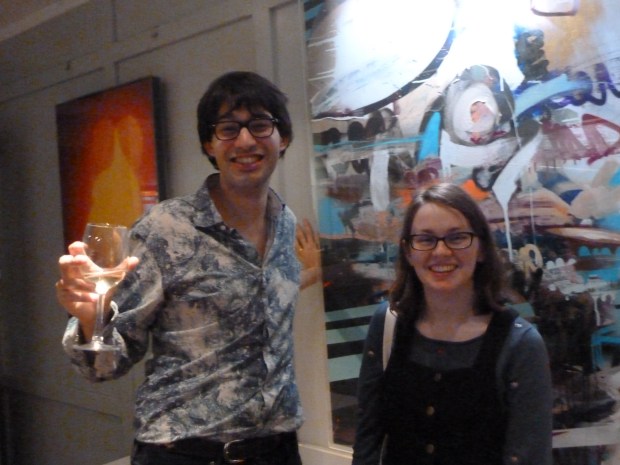
Clare with Minoo Dinshaw. Photo by Annabel Gaskell.
Julianne Pachico read a party scene from “The Tourists,” as it’s approaching the festive season. I was intrigued to learn that the interlinking structure of her book only emerged late on in the editing process; she’d originally meant to write a post-apocalyptic novel set all in one house, but found that setting too limiting. “I sort of work it out as I go along,” she said. So is it short stories or a novel? She’s sick of this question! Really she just wanted to write the kind of book she likes to read, citing Jennifer Egan’s A Visit from the Goon Squad and David Mitchell’s Ghostwritten as examples. Asked about her mentors, Pachico cited her mother, who told her “you’ll never be lonely, you’ll never be bored” as long as you read; and her first tutor, Andrew Cowan, who told her no one out there was writing anything like her story “Junkie Rabbit” – just the affirmation she needed. With all that’s happened in 2017, Pachico said she plans to turn to writing as a way “to outcreate the abyss” (a phrase from her twin sister, who’s also a writer). Pachico also teaches creative writing at Sheffield Hallam.

Julianne Pachico signing my book. Photo by Annabel Gaskell.
(As Sally Rooney was not in attendance, Collins read on her behalf a passage about Frances and Bobbi’s early friendship at school.)
 Claire North, aka “Cat” (real name: Catherine Webb; her fantasy and science fiction books are under various names) was in a way the odd one out at this event. Collins opened by saying that this award is all about getting in on the ground level with these writers, several of whom are debut authors. But North is a teen phenom who published her first book at age 14 and is set to release #20 next year. All along her parents called her a freak and demanded that she get her GCSEs and go to uni because writing “isn’t a proper job” (“but we’re very proud of you!” they’d usually append). She’s experienced the full gamut of responses over the years: some swore she wouldn’t have anything to say until age 40; others sighed that once she turned 18 she could no longer be marketed as “young.” She read the perfect passage from The End of the Day: a frantic, bravura account of the riders of the apocalypse together on a plane. She loves that science fiction “makes the extraordinary domestic” and playing with death appealed to her “flippant nature.” Charlie is, she thinks, the kindest character she’s ever written.
 Sara Taylor read from one of Ma’s earliest stories about how her parents met. She wrote The Lauras while she was supposed to be completing her PhD thesis on censorship in American literature. At the time she was coming to terms with the fact that she was going to be staying in the UK, as well as remembering family road trips and aspects of her relationship with her mother that she wishes were otherwise. Her agent wasn’t comfortable with the focus on an “agender” character, but Taylor held firm. She’s used to ignoring the advice her (older, male) professors and advisors tend to give her. Instead, she gets tips from her ten-years-younger sister back in the States, who knows exactly how to “fix” her work. Taylor feels the USA is 5–10 years behind the UK on gender issues, and revealed that The Lauras is a response to the novel Love Child (1971) by Maureen Duffy. She has recently finished her third novel and hopes to get back into teaching since writing non-stop for nine months makes her “go a little funny.”
This was such a special event. There were no more than 20 people in the room, and at the end I got a chance to speak to each of the authors as they signed my books. I normally get shy in such situations, but everyone was completely approachable. (Sara Taylor and I confirmed that we were indeed on the same study abroad program to England, a few years apart, so spent some time reminiscing about Reading and our formerly women-only colleges. Her mother went to Hood College, my alma mater – thus the brief mention of it in The Lauras.)


Important upcoming dates:
- November 24th: shadow panel meeting in London
- November 27th: deadline for shadow panel winner decision
- November 29th: shadow panel winner announced on STPFD website
- December 3rd: shadow panel winner announced in Sunday Times
- December 7th: prize-giving ceremony at the London Library
I’ll be aiming to post my last couple of reviews on Wednesday.
 Bookish Beck = Rebecca Foster. American transplant to England. Freelance proofreader and book reviewer.
 Bookish Beck