Mr B’s 20th Birthday Party & The Bookshop Band Reunion Gig in Bath
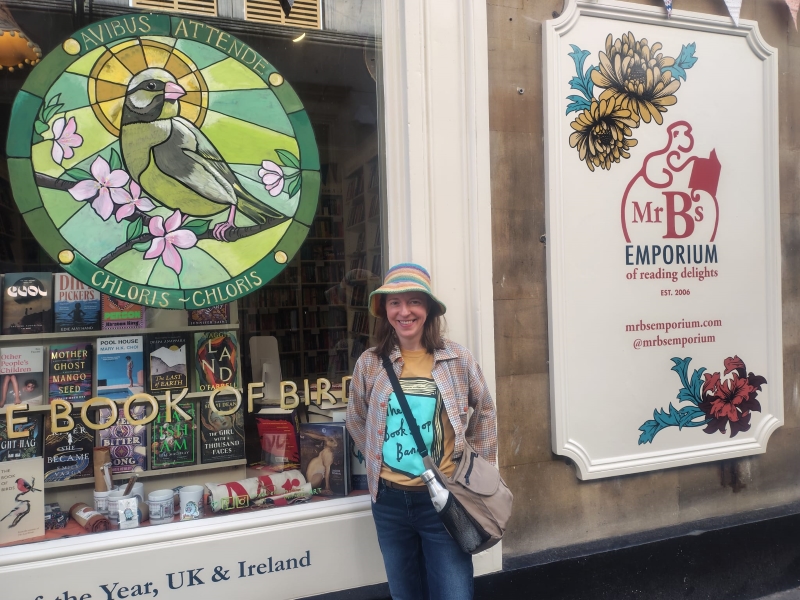
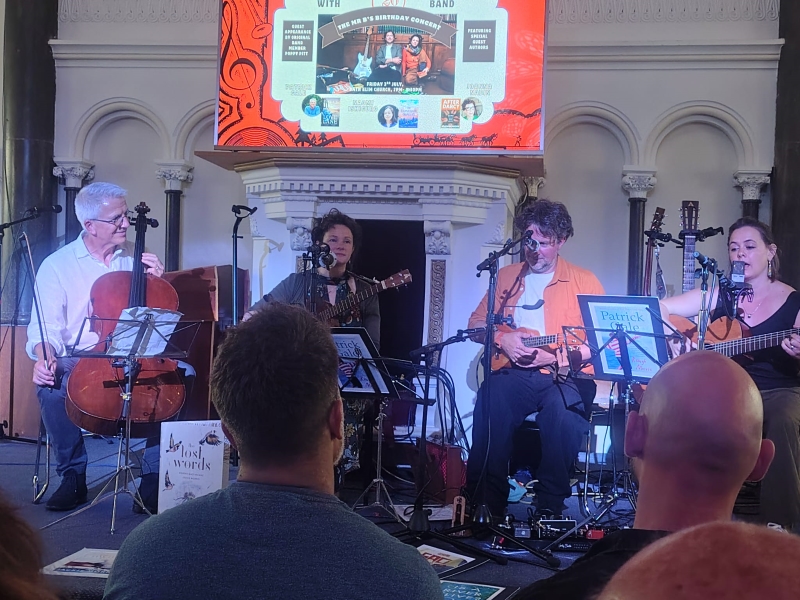
Yes, it’s another of those occasional posts in which I bang on about The Bookshop Band! It’s been two years since I last saw them play live (my post about their Emerge, Return tour gives a lot of general background info), but this concert was special because their third founding member, Poppy Pitt, who left the band in 2015, was back for a one-time reunion concert. She performed 6 of 11 songs with them as part of the 20th birthday event at Bath Elim Church for Mr B’s Emporium of Reading Delights, the UK-famous independent bookshop in Bath where they got their start as the house band in 2010. I’ve visited the bookshop a couple of times, but I was definitely going for the band. The evening also featured appearances from three authors who are longtime friends of the band and/or shop: Patrick Gale, Naomi Ishiguro, and Joanna Nadin.
First two photos by Chris Foster.
The Bookshop Band have written four songs in response to Gale novels and played two of them yesterday evening: “Petroc and the Lights” (Notes from an Exhibition) and “Making Tracks” (Rough Music). Another they didn’t play is “A Place Called Winter” – which shares a title with one of his novels, the companion to which (he insisted it’s not a sequel) has just been published. Love Lane takes up Harry Cane’s story when he returns to England from Canada after 40 years. Gale read a passage in which his daughter Betty awaits his arrival at the port in Liverpool. This is the second time I’ve seen Gale in person, after the keynote talk at the Marlborough Literary Festival four years ago. He’s an excellent speaker. And in a neat fusion of literature and music, he played cello on stage with the band for “Making Tracks”!
Naomi Ishiguro (yep, she’s Kazuo’s daughter) spoke with shop co-owner Nic Bottomley about her third book, The Rainshadow Orphans, the first volume in an urban fantasy trilogy that’s inspired by anime and has a political point to make about how immigration is not a threat. She spoke about the confidence she gained as a Mr B’s bookseller in her early twenties and the challenge of building a whole world whose details (such as the economy) she had to work out so everything would make sense.
The first ever Mr B’s author event was with Joanna Nadin, who was then releasing her fourth book, a children’s pirate adventure. She has just published her 104th book (!!), After Darcy, a Pride and Prejudice sequel set now, with the Bennet sisters all in their thirties and forties. She encountered Austen rather late in life, just seven years ago after being asked to rewrite Sense and Sensibility for middle grade readers. She told Bottomley that writing about Austen’s characters was a pleasure because they’re already there and fully formed, and figuring out what they’d do in the present time was simple. (She’s diagnosed Mary as autistic and Lydia as ADHD.)
We heard a number of Bookshop Band favourites that show up in most sets, such as “Room for Three,” “Faith in Weather” and “Smog over London,” but there were also some deep cuts that Poppy sings and I’d never heard live, so they were a real treat for a mega-fan: “The Paris Wife” (based on the Paula McLain novel about Ernest Hemingway and his first wife, Hadley), “Gold and Black” (about Carol Birch’s Jamrach’s Menagerie) and “Oh Saci” (inspired by the Brazilian legend of Saci Pererê, a mischief maker), as well as “Making Tracks.” Ben and Beth also sang several songs based on their collaborations with Robert Macfarlane and/or Jackie Morris: “The Binding” (Morris’s The Unwinding), “The River” (Macfarlane’s Is a River Alive?) and “Charm on, Goldfinch” (the pair’s The Lost Words & The Lost Spells).
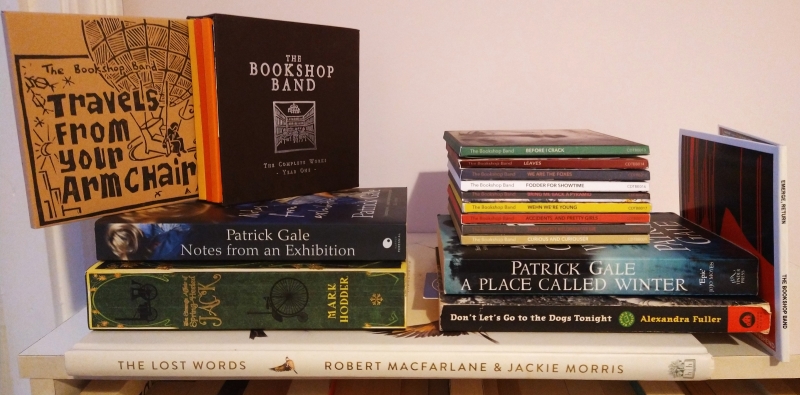
“Smog over London” was written about the Hodder novel. Another favourite from the band’s repertoire is “Bobo and the Cattle,” based on Alexandra Fuller’s memoir, which I’m currently rereading for book club. (We’ve also read both of the Gale novels in book club!)
A fun evening and not too hot, though it was quite stuffy in the church. I wanted to corner Poppy at the end and ask why I’ve never seen her about doing musical things in Newbury, where we both live, but it was too busy and the opportunity didn’t arise. Perhaps one day my dream will come true and I’ll get a reunited Bookshop Band playing a gig in my town!
12 Days in Portugal and Spain & What I Read
 It’s the second time we’ve braved the 20+-hour ferry crossing from the south coast of England to Santander in the north of Spain. Four years ago, we stayed on the edge of the Picos de Europa national park in Spain. This time we prioritized Portugal, spending a night in Spain on the way out and back. (In Léon, we acquired a taste for vermouth – and the free tapas that come with it. So cheap, too. What a fun eating-out culture!)
Portugal was a new country for us and we thoroughly enjoyed getting a taste of it. Spring seemed to be a month ahead of the UK and blossom was abundant. We stayed in three places in the north: Guimarães, the Douro Valley, and the Côa Valley. We took our new-to-us EV and found the distances manageable and charging cheaper and easier than in the UK. Going by car made packing easy and allowed us to bring back some port, Mr. F’s favourite tipple. However, there were hairy drives along confusing city streets and narrow mountain roads.


Our first stay was at Pousada de Santa Marinha, overlooking Portugal’s oldest city. One of a chain of state-restored castles and convents, it was originally a 12th-century monastery. We relished the bountiful breakfast buffet and manicured grounds but wished for more free time to relax in the grand common areas. Mostly we used this as a base for the first of two day trips to Porto, where we got good views from the cathedral tower, had delicious coffee and veggie snacks at 7g Roaster, and did a tour and tasting at Taylor’s port house. Portugal does a good line in doorstep cats. We also had our first sighting of swifts for the year on the 7th, flying above the azulejos (painted tiles) and cobbled streets of Guimarães before a traditional taverna meal of bacalhau (salt cod) fritters and bean stew with vinho verde.


Quinta dos Murças was, if anything, even more luxurious than the pousada. We were the only guests on our first of three nights at the winery, and after a private English-language cellar tour and wine and port tasting, a sit on the wisteria-covered balcony, and a three-course meal in the dining room, we were feeling like royalty. Along with grapes, they grow almonds, olives and several types of citrus. The lemon trees were dripping with the biggest fruits I’ve ever seen, and the smell of the orange blossom was truly intoxicating. The next morning we got up early and took a pack-up picnic on the train back into Porto, which was so hot and busy that we wondered why we’d bothered – though we did have an excellent tasting experience at a smaller producer, Poças, that included white and red wine, several ports, and a cocktail of white port, lime juice, and blood orange tonic served with a salt rim.


Portuguese is significantly more challenging than Spanish, so I was pleased with myself for managing an all-Portuguese transaction with the conductor on the rural branch line. The old-fashioned train carriages were spacious with comfortable seats, though the ride was not what one would call speedy. The journey back was fraught because we found ourselves pressed to catch the final train of the day (at just after 5:30 p.m.!), couldn’t figure out how to buy tickets at the station machines, were short of cash to pay the conductor on board, and arrived 2 hours late after a car collided with a telegraph pole and left the track blocked for an hour. The following day, what did we do? Got back on a train! (In the opposite direction, with tickets we’d carefully purchased ahead online.) This time we traveled toward the eastern end of the scenic Douro Valley so that we managed to see the whole river in pieces. The village of Tua had no particular sights, but we had a pleasant amble along its river boardwalk.


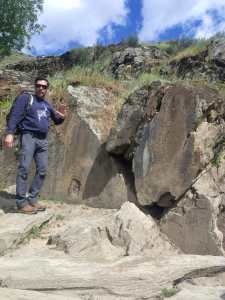 We’d earmarked the Côa Valley because it’s home to a sizable rewilding project. On the way, we stopped at Penascosa, an outdoor rock art site with etchings of ibex, aurochs and deer – and even ancient attempts at animation! The Rewilding Centre, where we stayed, is similar to a hostel and has an industrial kitchen because it also operates as a café for the villagers. In cities, we had tended to find English speakers, but the centre manager here had no English, so we happily switched to French (a true lingua franca!) to communicate with her.
The accommodation may have felt like a step down after our two previous splurges, but we’d booked a different treat to selves: an English-speaking guide from Wildlife Portugal who took us out in a Land Rover and found us loads of eagles, vultures and warblers. Bee-eaters and black storks were particular highlights. We were impressed by the array of landscapes: vines and olive groves, granite boulders, high cliffs, pools created by former mining, and green glens. At the hostel we met an English couple (one half a botanist) who are exploring Europe on Interrail passes during a three-month sabbatical, and they joined us for the second day of wildlife tourism; we discovered that Fernando is just as good with plants as with birds.


It was a varied, comfy, boozy trip. There was the touristy experience in Porto and parts of the Douro Valley, but also the ‘real’ countryside. Things ended on something of a sour note due to a rough return crossing of the Bay of Biscay. We’ll be back in Spain next summer to meet up with my sister and our nephew on his school trip to Barcelona, but that jaunt will be by train!


What I Read
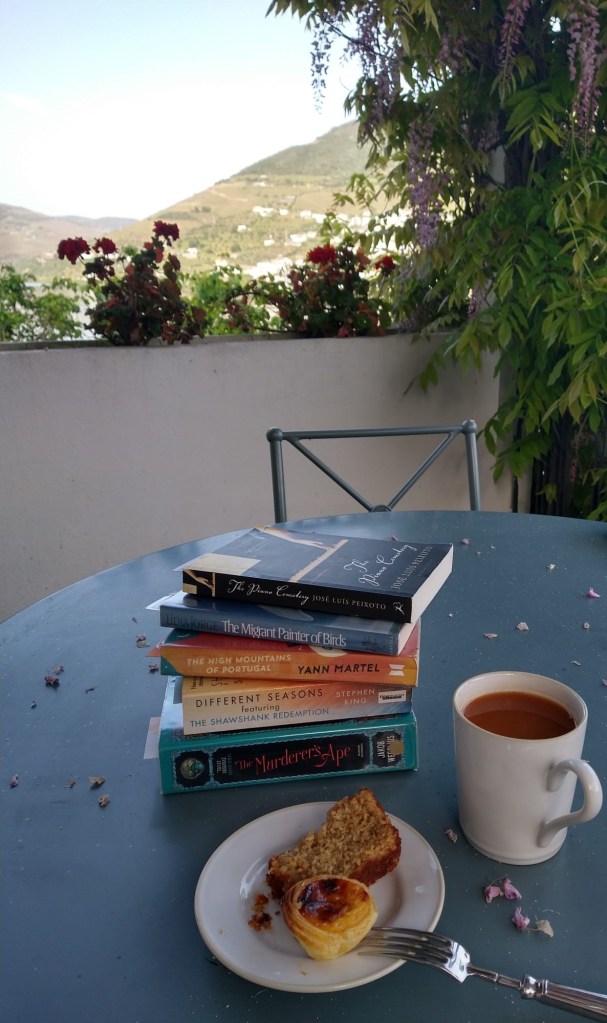
En route: Rita Hayworth and Shawshank Redemption by Stephen King, which I’ll review for a spring-themed post as it’s the first in a quartet of loosely seasonal novellas. You likely know this prison story from the film version.
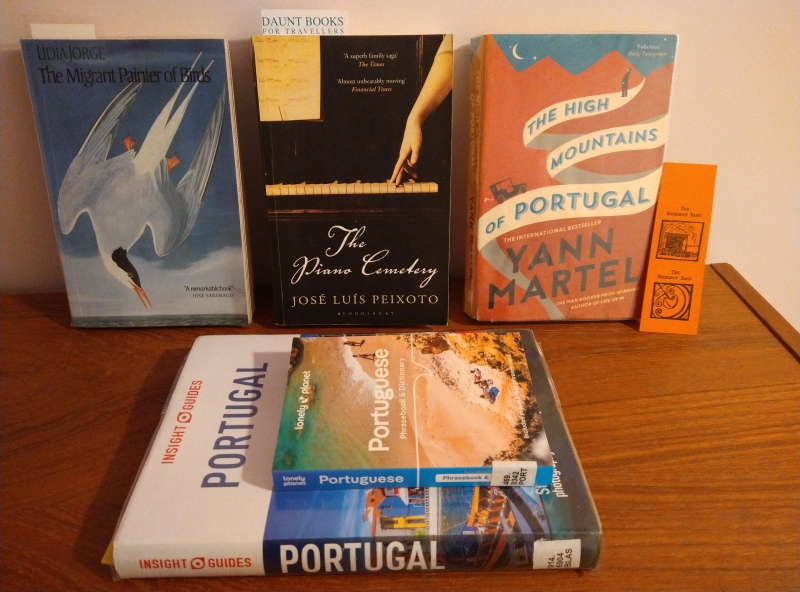
In Portugal: three Portugal-set novels I’d proudly sourced, including two in translation. My only previous knowledge of Portuguese literature had been a DNF of a José Saramago novel.
The Migrant Painter of Birds by Lídia Jorge (1998; 2001)
[Translated by Margaret Jull Costa]
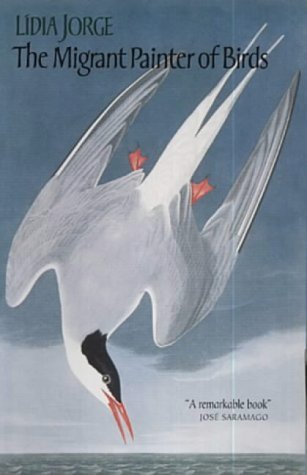 The title figure is Walter, a former soldier who wanders the world and sends his bird paintings back to his daughter at the Dias family home in (fictional) Valmares. His actual visits are few and clandestine: Jorge keeps returning to a scene of him holding his shoes in his hand so he can soundlessly climb the stairs to see his daughter. You see, his daughter is officially his ‘niece’, born of an affair Maria Ema had with her husband Custódio’s brother. That act of adultery is the foundation of the novel but so tacit that it influences everything, including the language and narration. “Walter’s daughter” narrates – in third person or first – and frequently refers to herself as “Walter’s niece” instead.
The slippery narrative moves back and forth in time, pausing at a few landmark years. Very little happens, per se, apart from Walter’s daughter having a liaison with her mother’s therapist and then going to find her father in Argentina, but throughout we are invited to observe the family’s shifting dynamic and understand the narrator’s growing bitterness – “so bruised are we all by the passing of time.” I found the writing intermittently beautiful (“the sun was setting, persimmon red, behind the smooth fields”; “A tangle of living ghosts, the magical cortège of all tyrannies”) but sometimes pretentious or obfuscating to no purpose (“I invoke the decade of irony, the decade of silence pierced by the oblique laughter of cynicism”). (Interlibrary loan) 
The High Mountains of Portugal by Yann Martel (2016)
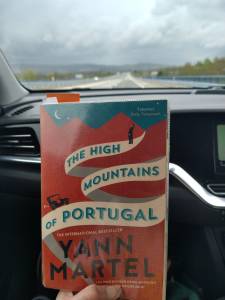 I knew of Martel’s obscure fourth novel through The Bookshop Band’s song “Why I Travel This Way,” about a bereaved man who starts walking backwards. What I didn’t realize is that the book is essentially three linked novellas and that song responds to just the first one, “Homeless.” Within a week, museum curator Tomás’s son, common-law wife, and father all died. Tomás sets off in his uncle’s early motorcar (this being 1904) to find a religious relic he learned about from a 17th-century priest’s journal written in São Tomé. But he has no idea how to drive, and accidents and persecution continue to beset him. A Job-like figure, he has set “his back to the world, his back to God” as a way of “not grieving” but “objecting.” Next, pathologist Eusebio and his wife have a high-minded discussion of the morality of murder mysteries in the 1939-set “Homeward.” Eusebio then undertakes an unexpected late-night job when an old woman arrives with her late husband’s corpse in a suitcase. Every cut reveals the substance of the man’s life rather than the reason for his death.
 After religious parable and magic realism, “Home” initially seems more straightforward with its story of a widowed Canadian senator who buys Odo the chimpanzee from a research centre and relocates to rural Portugal. If you’ve read Life of Pi and/or Beatrice and Virgil, you know that Martel really goes in for his animal allegories. Odo might be considered symbolic of simplicity and joy in life. There are apt connections with the other novellas: not only an overarching theme of grief, but the specifics of one northern Portuguese village and its events that have become legend. And, yes, chimpanzees. A line from the first part serves as Martel’s mantra: “We are risen apes, not fallen angels.” Weird but satisfying. (Public library)
The Piano Cemetery by José Luís Peixoto (2006; 2010)
[Translated by Daniel Hahn]
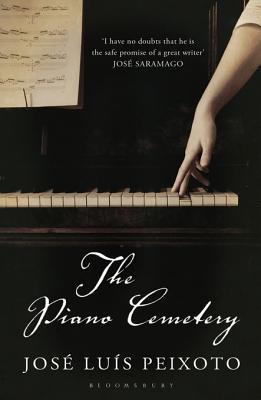 It may be premature, but I feel I can pinpoint some trademarks of Portuguese literature based on the few examples I’ve now read (plus Martel’s pastiche): narrative trickery, family dysfunction, metaphors of blindness, philosophical and religious dialogues, and a fine line between life and death. Unfortunately, in this case I found the appealing elements buried under an off-putting style. The Lázaro family are carpenters in 1910s Lisbon with a back room housing busted pianos that they use for their instrument-repair side business. To start with, the narrator is the dead patriarch of the family, who remembers how he met his wife at the piano cemetery and keeps watch over his children and grandchildren in the present day. There are also two long sections of stream-of-consciousness memories of his son Francisco as he runs the marathon at the 1912 Stockholm Olympics. Francisco Lázaro was a historical figure who died in that athletic pursuit, but the family backstory of estrangement, domestic violence, and adultery that Peixoto builds around him is fictional. Punctuated by distance markers (“Kilometre one” and so on), Francisco’s fragments are decontextualised and often don’t join up or even form complete sentences. Add in the father’s fatphobic attitude toward one of his daughters and the laughably circuitous phrasing (“my thick hand in a single movement, like an impulse, but not even an impulse, like a desire you have for a moment and which becomes concrete in that same moment, another person’s desire within me, a desire which is not thought, but which rises up like a flame” – huh? can I blame the translator?) and you might see why this was a slog for me. (Secondhand purchase – Awesomebooks.com)
Plus a partial reread of a delightful teen novel we both read the last time we were in Spain:
The Murderer’s Ape by Jakob Wegelius
[Translated from the Swedish by Peter Graves]
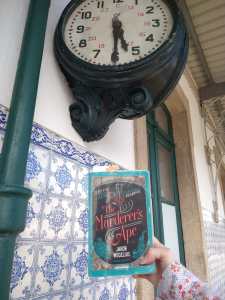 Talk about a risen ape! Sally Jones is an animal narrator extraordinaire: a ship’s engineer who meets every challenge that comes her way with aplomb, traveling from Portugal to India and back just to clear the Chief’s name after he’s falsely accused of murder. She happens to be a gorilla, but her only real limitation is that she can’t voice human language; she understands and writes it perfectly, and can beat most people at chess. This doorstopper never feels like one because it races along on a tide of adventure and intrigue. The technology suggests a 1920s date. All the settings are evocative, but historical Lisbon is especially enticing (and not dissimilar to Peixoto’s): Sally Jones lives with Ana Molina, a famous fado singer, and works in her neighbour Signor Fidardo’s instrument workshop repairing accordions.
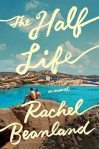
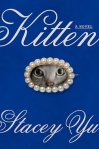 Plus the latter half of another novel or two I had on the go, and most of a couple of pre-release e-books for Shelf Awareness reviews: the odd Kitten by Stacey Yu, about a cat-identifying millennial Disaster woman, and The Half Life by Rachel Beanland. Set in 1970s Sardinia, this was a perfect summer read – intelligent as well as sultry – about a young Navy wife’s sexual coming of age and casual investigation into the ongoing effect of American nuclear submarines on the island’s natural environment.
Some 2024 Reading Superlatives
Longest book read this year: The Bee Sting by Paul Murray

Shortest books read this year: The Wood at Midwinter by Susanna Clarke – a standalone short story (unfortunately, it was kinda crap); After the Rites and Sandwiches by Kathy Pimlott – a poetry pamphlet
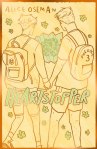 Authors I read the most by this year: Alice Oseman (5 rereads), Carol Shields (3 rereads); Margaret Atwood, Rachel Cusk, Pam Houston, T. Kingfisher, Sarah Manguso, Maggie O’Farrell, and Susan Allen Toth (2 each)
Publishers I read the most from: (Besides the ubiquitous Penguin Random House and its myriad imprints,) Carcanet (15), Bloomsbury & Faber (12 each), Alice James Books & Picador/Pan Macmillan (9 each)
My top author ‘discoveries’ of the year: Sherman Alexie and Bernardine Bishop

Proudest bookish achievements: Reading almost the entire Carol Shields Prize longlist; seeing The Bookshop Band on their huge Emerge, Return tour and not just getting my photo with them but having it published on both the Foreword Reviews and Shelf Awareness websites

Most pinching-myself bookish moment: Getting a chance to judge published debut novels for the McKitterick Prize
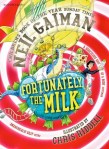
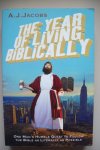
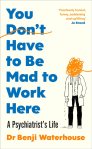
Books that made me laugh: Lots, but particularly Fortunately, the Milk… by Neil Gaiman, The Year of Living Biblically by A.J. Jacobs, and You Don’t Have to Be Mad to Work Here by Benji Waterhouse
Books that made me cry: On Chesil Beach by Ian McEwan, My Good Bright Wolf by Sarah Moss
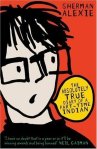
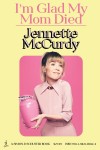 Two books that hit the laughing-and-crying-at-the-same-time sweet spot: The Absolutely True Diary of a Part-Time Indian by Sherman Alexie and I’m Glad My Mom Died by Jennette McCurdy
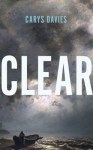
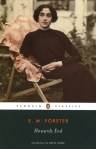
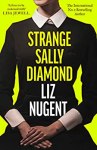
Best book club selections: Clear by Carys Davies, Howards End by E.M. Forster, Strange Sally Diamond by Liz Nugent
Best first lines encountered this year:
- From Cocktail by Lisa Alward: “The problem with parties, my mother says, is people don’t drink enough.”
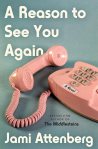
- From A Reason to See You Again by Jami Attenberg: “Oh, the games families play with each other.”
- From The Snow Queen by Michael Cunningham: “A celestial light appeared to Barrett Meeks in the sky over Central Park, four days after Barrett had been mauled, once again, by love.”

Best last lines encountered this year:
 From The Ministry of Time by Kaliane Bradley: “Forgiveness and hope are miracles. They let you change your life. They are time-travel.”
- From Mammoth by Eva Baltasar: “May I know to be alert when, at the stroke of midnight, life sends me its cavalry.”
- From Private Rites by Julia Armfield: “For now, they stay where they are and listen to the unwonted quiet, the hush in place of rainfall unfamiliar, the silence like a final snuffing out.”
- From Come to the Window by Howard Norman: “Wherever you sit, so sit all the insistences of fate. Still, the moment held promise of a full life.”
- From Intermezzo by Sally Rooney: “It doesn’t always work, but I do my best. See what happens. Go on in any case living.”
- From Barrowbeck by Andrew Michael Hurley: “And she thought of those Victorian paintings of deathbed scenes: the soul rising vaporously out of a spent and supine body and into a starry beam of light; all tears wiped away, all the frailty and grossness of a human life transfigured and forgiven at last.”
- From Small Rain by Garth Greenwell: “Pure life.”

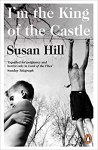
Books that put a song in my head every time I picked them up: I’m the King of the Castle by Susan Hill (“Crash” by Dave Matthews Band); Y2K by Colette Shade (“All Star” by Smashmouth)
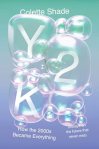
Shortest book titles encountered: Feh (Shalom Auslander) and Y2K (Colette Shade), followed by Keep (Jenny Haysom)
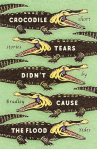 Best 2024 book titles: And I Will Make of You a Vowel Sound, I Can Outdance Jesus, Zombie Vomit Mad Libs, Crocodile Tears Didn’t Cause the Flood, This Is Why We Can’t Have Nice Things
Best book titles from other years: Recipe for a Perfect Wife, Tripping over Clouds, Waltzing the Cat, Dressing Up for the Carnival, The Met Office Advises Caution
Favourite title and cover combo of the year: I’m Mostly Here to Enjoy Myself by Glynnis MacNicol

Best punning title (and nominative determinism): Knead to Know: A History of Baking by Dr Neil Buttery
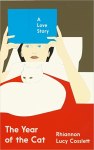 Biggest disappointments: The Glassmaker by Tracy Chevalier (I didn’t get past the first chapter because of all the info dumping from her research); The Year of the Cat by Rhiannon Lucy Cosslett; milk and honey by Rupi Kaur (that … ain’t poetry); 2 from the Observer’s 10 best new novelists feature (here and here)
A couple of 2024 books that everyone was reading but I decided not to: Creation Lake by Rachel Kushner, You Are Here by David Nicholls
 The worst books I read this year: Mammoth by Eva Baltasar, A Spy in the House of Love by Anaïs Nin
The downright strangest books I read this year: Zombie Vomit Mad Libs, followed by The Peculiar Life of a Lonely Postman. All Fours by Miranda July (I am at 44% now) is pretty weird, too.

R.I.P., Part II: Duy Đoàn, T. Kingfisher & Rachael Smith
A second installment for the Readers Imbibing Peril challenge (first was a creepy short story collection). Zombies link my first two selections, an experimental poetry collection and a historical novella that updates a classic, followed by a YA graphic novel about a medieval witch who appears in contemporary life to help a teen deal with her problems. I don’t really do proper horror; I’d characterize all three of these as more mischievous than scary.
Zombie Vomit Mad Libs by Duy Đoàn
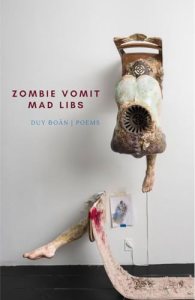 The Vietnamese American poet’s second collection strikes a balance between morbid – a pair of sonnets chants the names and years of poets who died by suicide – and playful. Multiple poems titled “Zombie” or “Zombies” are composed of just 1–3 cryptic lines. Other repeated features are blow-by-blow descriptions of horror movie scenes and the fill-in-the-blank Mad Libs format. There is an obsession with Leslie Cheung, a gay Hong Kong actor who also died by suicide, in 2003. Đoàn experiments linguistically as well as thematically, by adding tones (as used in Vietnamese) to English words. This was a startling collection I admired for its range and pluck, though I found little to personally latch on to. I was probably expecting something more like 36 Ways of Writing a Vietnamese Poem by Nam Le. But if you think poetry can’t get better than zombies + linguistics + suicides, boy have I got the collection for you! (Đoàn’s first book, We Play a Game, won the Yale Series of Younger Poets Prize and a Lambda Literary Award for bisexual poetry.)
To be published in the USA by Alice James Books on November 12. With thanks to the publisher for the advanced e-copy for review.
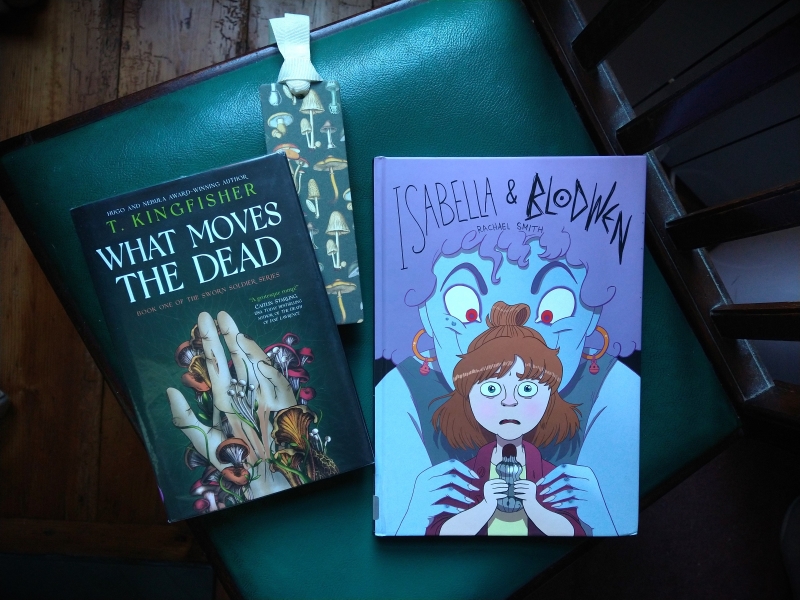
What Moves the Dead by T. Kingfisher (2022)
{MILD SPOILERS AHEAD}
 This first book in the “Sworn Soldier” duology is a retelling of Edgar Allan Poe’s “The Fall of the House of Usher.” Set in the 1890s, it’s narrated by Alex Easton, a former Gallacian soldier who learns that their childhood friend Madeline Usher is dying and goes to visit her at her and her brother Roderick’s home in Ruritania. Easton also meets the Ushers’ friend, the American doctor Denton, and Eugenia Potter, an amateur mycologist (and aunt of a certain Beatrix). Easton and Potter work out that what is making Madeline ill is the same thing that’s turning the local rabbits into zombies…
At first it seemed the author was awkwardly inserting a nonbinary character into history, but it’s more complicated than that. The sworn soldier tradition in countries such as Albania was a way for women, especially orphans or those who didn’t have brothers to advocate for them, to have autonomy in martial, patriarchal cultures. Kingfisher makes up European nations and their languages, as well as special sets of pronouns to refer to soldiers (ka/kan), children (va/van), etc. She doesn’t belabour the world-building, just sketches in the bits needed.
This was a quick and reasonably engaging read, though I wasn’t always amused by Kingfisher’s gleefully anachronistic tone (“Mozart? Beethoven? Why are you asking me? It was music, it went dun-dun-dun-DUN, what more do you want me to say?”). I wondered if the plot might have been inspired by a detail in Merlin Sheldrake’s Entangled Life, but it seems more likely it’s a half-conscious addition to a body of malevolent-mushroom stories (Mexican Gothic by Silvia Moreno-Garcia, various by Jeff VanderMeer, The Beauty by Aliya Whiteley). I was drawn in by Easton’s voice and backstory enough to borrow the sequel, about which more anon. (T. Kingfisher is the pen name of Ursula Vernon.) (Public library)
Isabella & Blodwen by Rachael Smith (2023)
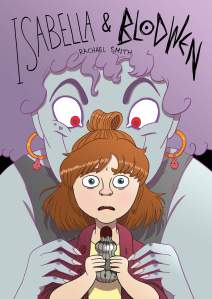 I’d reviewed Smith’s adult graphic memoirs Quarantine Comix (mental health during Covid) and Glass Half Empty (alcoholism and bereavement) for Foreword and Shelf Awareness, respectively. When I spotted this in the Young Adult section and saw it was about a witch, I mentally earmarked it for R.I.P. Isabella Maria Penwick-Wickam is a precocious 16-year-old student at Oxford. With her fixation on medieval history and folklore, she has the academic side of the university experience under control. But her social life is hopeless. She’s alienated flatmates and classmates alike with her rigid habits and judgemental comments. On a field trip to the Pitt Rivers Museum, where students are given a rare opportunity to handle artefacts, she accidentally drops a silver bottle into her handbag. Before she can return it, its occupant, a genie-like blowsy blue-and-purple witch named Blodwen, is released into the world. She wreaks much merry havoc, encouraging Issy to have some fun and make friends.
It’s a sweet enough story, but a few issues detracted from my enjoyment. Issy is often depicted more like a ten-year-old. I don’t love the blocky and exaggerated features Smith gives her characters, or the Technicolor hues. And I found myself rolling my eyes at how the book unnaturally inserts a sexual harassment theme – which Blodwen responds to in modern English, having spoken in archaic fashion up to that point, and with full understanding of the issue of consent. I can imagine younger teens enjoying this, though. (Public library)
The mini playlist I had going through my mind as I wrote this:
- “Running with Zombies” by The Bookshop Band (inspired by The Making of Zombie Wars by Aleksandar Hemon)
- “Flesh and Blood Dance” by Duke Special
- “Dead Alive” by The Shins
And to counterbalance the evil fungi of the Kingfisher novella, here’s Anne-Marie Sanderson employing the line “A mycelium network is listening to you” in a totally non-threatening way. It’s one of the multiple expressions of reassurance in her lovely song “All Your Atoms,” my current earworm from her terrific new album Old Light.
Love Your Library, August 2024
It’s a Bank Holiday today here in the UK – if you have the day off, I hope you’re spending it a fun way. We’re on a day trip to Windsor Castle with friends who got free tickets through her work. Otherwise, there’s no way we would ever have gone: it’s very expensive, plus down with the monarchy and all that.
Thanks so much to Eleanor (here, here and here), Laura (the two images below) and Marcie for posting about their recent library reading!


Marina Sofia has posted a couple of relevant blogs, one a review of an Alberto Manguel book about his home library and the other a series of tempting photos of world libraries.
In the media: I loved this anti-censorship George Bernard Shaw quote posted by Book Riot on Instagram…

…and my heart was warmed by the story of Minnesota governor and current vice-presidential candidate Tim Walz installing a Little Free Library in the state capitol earlier this year. He gets my vote!
One volunteering day, a staff member told the strange-but-true story of an e-mail just received to the general libraries account. A solicitor presiding over an estate clearance let us know about a West Berkshire Libraries book found among their client’s effects, borrowed in early 1969 and never returned. Did we want it back? The consensus was that, as we’ve been doing fine without this book since BEFORE THE MOON LANDING, we will drop the issue.
Not exactly library related, but in other fun book news, I took a couple of online quizzes and got intriguing results:


My suggestion (for Angie Kim’s Happiness Falls) featured in the recent Faber Members’ summer reading recommendation round-up. And here’s that blog post I wrote for Foreword Reviews about the Bookshop Band’s new album and tour.
I’m hosting book club a week on Wednesday. Although it’s felt for a while like it might be doomed, the group has had a stay of execution at least until January. We took a break for the summer and at our July social everyone made enthusiastic noises about joining in with the four autumn and winter reads we voted on – plus we have two prospective new members who we hope will join us for the September meeting. So we’ll see how it goes.
My library use over the last month:
READ
- Private Rites by Julia Armfield

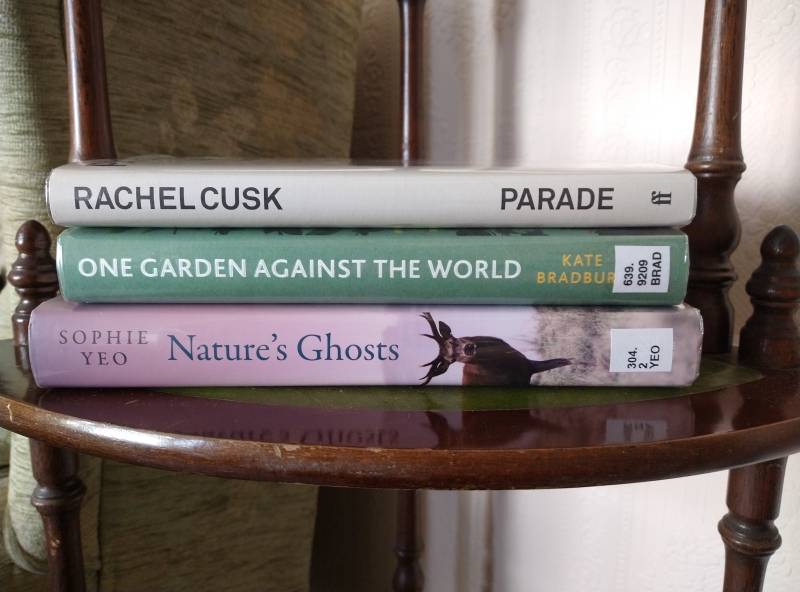
- Parade by Rachel Cusk
SKIMMED
- Nature’s Ghosts: A History – and Future – of the Natural World by Sophie Yeo
CURRENTLY READING
- One Garden against the World: In Search of Hope in a Changing Climate by Kate Bradbury
- Clear by Carys Davies (for September book club)
- Moominpappa at Sea by Tove Jansson
- The Garden against Time: In Search of a Common Paradise by Olivia Laing
- The Burial Plot by Elizabeth Macneal
- Late Light: Finding Home in the West Country by Michael Malay
- The Song of the Whole Wide World: On Motherhood, Grief, and Poetry by Tamarin Norwood
- The Echoes by Evie Wyld
CHECKED OUT, TO BE READ
- Wasteland: The Dirty Truth about What We Throw Away, Where It Goes, and Why It Matters by Oliver Franklin-Wallis
- This Is My Sea by Miriam Mulcahy
IN THE RESERVATION QUEUE
- The Glassmaker by Tracy Chevalier
- James by Percival Everett
- Small Rain by Garth Greenwell
- Bothy: In Search of Simple Shelter by Kat Hill
- The Painter’s Daughters by Emily Howes
- Dispersals: On Plants, Borders and Belonging by Jessica J. Lee
- Held by Anne Michaels
- Playground by Richard Powers
- Intermezzo by Sally Rooney
ON HOLD, TO BE PICKED UP
- The Accidental Garden: The Plot Thickens by Richard Mabey
RETURNED UNFINISHED
- The Cove: A Cornish Haunting by Beth Lynch – I enjoyed her previous memoir, and her writing is evocative, but this memoir about her return to the beloved site of childhood holidays lacks narrative drive. If you’re more familiar with the specific places, or can read it on location, you might be tempted to read the whole thing. I read 30 pages.
What have you been reading or reviewing from the library recently?

Share a link to your own post in the comments. Feel free to use the above image. The hashtag is #LoveYourLibrary.
The Bookshop Band in Abingdon & 20 Books of Summer, 6: Orphans of the Carnival by Carol Birch
The Bookshop Band have been among my favourite musical acts since I first saw play live at the Hungerford Literary Festival in 2014. Initially formed of three local musicians for hire, they got their start in 2010 as the house band at Mr B’s Emporium of Reading Delights in Bath, England. For their first four years, they wrote a pair of original songs about a new book, often the very day of an author’s event in the shop, and performed them on guitar, cello, and ukulele as an interlude to the evening’s reading and discussion.
Notable songs from their first 13 albums are based on Glow by Ned Beauman (“We Are the Foxes”), Don’t Let’s Go to the Dogs Tonight by Alexandra Fuller (“Bobo and the Cattle”), The Unlikely Pilgrimage of Harold Fry by Rachel Joyce (“How Not to Woo a Woman”), and Bring Up the Bodies by Hilary Mantel (“You Make the Best Plans, Thomas”). They have also written responses to classic literature, with songs inspired by Alice in Wonderland, various Shakespeare plays, and a compilation of first lines called “Once Upon a Time.”
I got to see the band live five times pre-pandemic, even after husband-and-wife-duo Ben Please and Beth Porter moved nearly 400 miles away to Wigtown, the Book Town of Scotland. During the first six months of Covid-19 lockdown, the livestream concerts from their attic were weekly treats to look forward to. They also interviewed authors for a breakfast chat show as part of the Wigtown Book Festival, which went online that year.

In the years since, the band has kept busy with other projects (not to mention two children). Porter sings and performs on the two Spell Songs albums based on Robert Macfarlane’s The Lost Words and its sequel. Together they composed the soundtrack to Aardman Animations’ short film, Robin Robin (2021) – winning Best Music at the British Animation Awards, and wrote an album of songs based on Scottish children’s literature. And they have continued writing one-off book songs, such as for the launch of Birnam Wood by Eleanor Catton. (I’m disappointed their songs about All My Wild Mothers by Victoria Bennett and The Spinning Heart by Donal Ryan still haven’t made it onto record.)
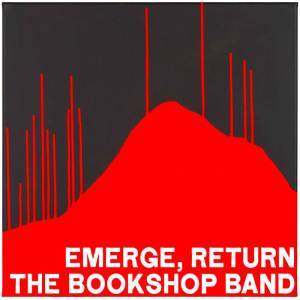 I’ve been enthusing about them for nearly a decade, but they’ve remained mostly under the radar in that time. Not so any longer; their recent album Emerge, Return was produced by Pete Townshend of The Who; the production value has notably advanced while retaining their indie spirit. Foreword Reviews kindly agreed to pay me to fangirl – er, write a blog – about Emerge, Return and the tour supporting it, so I’ll leave it there for the music criticism (their complete discography is now available on Bandcamp and Spotify). I’ll just add that a number of these ‘new’ songs have been kicking around for six to ten years but went unrecorded until now. For that reason, I worried that it might feel like a collection of cast-offs, but in fact they’ve managed to produce something sonically and thematically cohesive. It’s darker than some of their previous work, with moody minor chords and slightly sinister subjects.

Julia Pastrana after death. George Wick, Public domain, via Wikimedia Commons.
I’ve often found that the band will zero in on a detail, scene, or idea that never would have stood out to me while reading a book but, in retrospect, evokes the whole with great success. I decided to test this out by reading Carol Birch’s Orphans of the Carnival in the weeks leading up to seeing them on their months-long UK summer/autumn tour. It’s a historical novel about real-life 1850s Mexican circus “freak” Julia Pastrana, who had congenital conditions that caused her face and body to be covered in thick hair and her jaw and lips to protrude. Cruel contemporaries called her the world’s ugliest woman and warned that pregnant women should not be allowed to see her on tour lest the shock cause them to miscarry. Medical doctors posited, in all seriousness, that she was a link between humans and orangutans.
My copy of Birch’s novel was a remainder, and it is certainly a minor work compared to the Booker Prize-shortlisted Jamrach’s Menagerie. Facts about Julia’s travel itinerary and fellow oddballs quickly grow tedious, and while one of course sympathizes when children throw rocks at her, she never becomes a fully realized character rather than a curiosity.
There is also a bizarre secondary storyline set in 1983, in which Rose fills her London apartment with hoarded objects, including a doll she rescues from a skip and names Tattoo. She becomes obsessed with the idea of visiting a doll museum in Mexico. I thought that Tattoo would turn out to be Julia’s childhood doll Yatzi (similar to in A Council of Dolls by Mona Susan Power, where dolls have sentimental and magical power across the centuries), but the connection, though literal, was not as I expected. It’s more grotesque than that. And stranger than fiction, frankly.
{SPOILERS AHEAD}
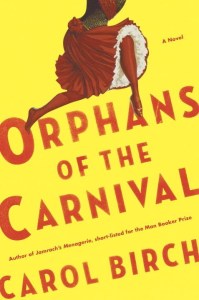 Birch sticks to the known details of Julia’s life. She had various agents, the final one being Theo Lent, who married her. (In the novel, he can’t bring himself to kiss her, but he can, you know, impregnate her.) She died of a fever soon after childbirth. Her son, Theo Junior, who inherited her hypertrichosis, also died within days. Both bodies were embalmed, sold, and exhibited. Theo then married another hairy woman, Marie Bartel of Germany, who took the name “Zenora” and posed as Julia’s sister. Theo died, syphilitic (or so Birch implies) and insane, in a Russian asylum. Julia and Theo Junior’s remains were displayed and mislaid at various points over the years, with Julia’s finally repatriated to Mexico for a proper burial in 2013. In the novel, Tattoo is, in fact, Theo Junior’s mummy.
Two Bookshop Band songs from the new album are about the novel: “Doll” and “Waggons and Wheels.” “Doll” is one of the few more lighthearted numbers on the album. It ended up being a surprise favourite track for me (along with the creepy “Eve in Your Garden,” about Margaret Atwood’s The Testaments, and “Room for Three,” a sombre yet resolute epic written for the launch of Philip Pullman’s La Belle Sauvage) because of its jaunty music-hall tempo; the pattern of repeating most nouns three times; and the hand claps, “deedily” vocal fills, unhinged recorder playing, and springy sound effects. The lyrics are almost a riddle: “When’s a doll (doll doll) not a doll (doll doll)?” They somehow avoid all spoilers while conveying something of the mental instability of a couple of characters.
The gorgeous “Waggons and Wheels” picks up on the melancholy tone and parental worries of earlier tracks from the album. The chorus has a wistful air as Julia ponders the passage of time and her constant isolation: “old friends, new deals / Winter or spring, I am hiding … Winter or spring, I’ll be travelling.” Porter’s mellow soprano tempers Julia’s outrage at mistreatment: “who are you to shout / Indecency and shame? / Shocking, I shock, so lock me out / I’m locked into this face.” She fears, too, what will happen to her child, “a beast or a boy, a monster or joy”. Listening to the song, I feel that the band saw past the specifics to plumb the universal feelings that get readers empathizing with Julia as a protagonist. They’ve gotten to the essence of the story in a way that Birch perhaps never did. Mediocre book; lovely songs. (New (bargain) purchase – Dollar Tree, Bowie, Maryland) 
I caught the Emerge, Return tour at St Nicolas’ Church in Abingdon (an event hosted by Mostly Books) last night. It was my sixth time seeing the Bookshop Band in concert – see also my write-ups of two 2016 events plus one in 2018 and another in 2019 – but the first time in person since the pandemic. I got to show off my limited-edition T-shirt. How nice it was to meet up again with blogger friend Annabel, too! Fun fact for you: Ben was born in Abingdon but hadn’t been back since he was two. Beth’s cousin turned up to the show as well. Although they have their daughters, 2 and 7, on the tour with them, they were being looked after elsewhere for the evening so the parents could relax a bit. Across the two sets, they played seven tracks from the new album, six old favourites, and two curios: one Spell Song, and an untitled song they wrote for the audiobook of Jackie Morris’s The Unwinding. It was a brilliant evening!


Scottish Travels & Book Haul: Wigtown, Arran, Islay and Glasgow
When I was a kid, one-week vacations were rare and precious – Orlando or Raleigh for my dad’s church conferences, summer camp in Amish-country Pennsylvania, spring break with my sister in California – and I mourned them when they were over. As an adult, I find that after a week I’m ready to be home … and yet just days after we got back from Scotland, I’m already wondering why I thought everyday life was so great. Oh well. I like to write up my holidays because otherwise it’s all too easy to forget them. This one had fixed start and end points – several days of beetle recording in Galloway for my husband; meeting up with my sister and nephew in Glasgow one evening the next week – and we filled in the intervening time with excursions to two new-to-us Scottish islands; we’re slowly collecting them all.
First Stop, Wigtown
Hard to believe it had been over five years since our first trip to Wigtown. The sleepy little town had barely changed; a couple of bookshops had closed, but there were a few new ones I didn’t remember from last time. The weather was improbably good, sunny and warm enough that I bought a pair of cutoffs at the Community Shop. Each morning my husband set off for bog or beach or wood for his fieldwork and I divided the time until he got back between bits of paid reviewing, reading and book shopping. Our (rather spartan) Airbnb apartment was literally a minute’s walk into town and so was a perfect base.


I paced myself and parcelled out the eight bookshops and several other stores that happen to sell books across the three and a bit days that I had. It felt almost like living there – except I would have to ration my Reading Lasses visits, as a thrice-weekly coffee-and-cake habit would soon get expensive as well as unhealthy. (I spent more on books than on drinks and cakes over the week, though only ~25% more: £44 vs. £32.)


I also had the novelty of seeing my husband interact with his students when we were invited to a barbecue at one’s family home on the Mull of Galloway – and realizing that we’re almost certainly closer in age to the mum than to the student. Getting there required two rural bus journeys to the middle of nowhere, an experience all in itself.
‘Pro’ tips: New Chapter Books was best for bargains, with sections for 50p and £1 paperbacks and free National Geographics. Well-Read Books was good for harder-to-find fiction: among my haul were two Jane Urquhart novels, and the owner was knowledgeable and pleasant. Byre Books carries niche subjects and has scant opening hours, but I procured two poetry collections and a volume of Dorothy Wordsworth’s journals. The Old Bank Bookshop and The Bookshop are the two biggest shops; wander for an hour or more if you can. The Open Book tends to get castoffs from other shops and withdrawn library stock, but I still made two purchases and ended up being the first customer for the week’s hosts: Debbie and Jenny, children’s book authors and long-distance friends from opposite coasts of the USA. Overall, I was pleased with my novella, short story and childhood memoir acquisitions. A better haul than last time.

‘Celebrity’ sightings: On our walk down to the bird hide on the first evening, we passed Jessica Fox, an American expat who’s been influential in setting up the literary festival and The Open Book. She gave us a cheery “hello.” I also spotted Ben of The Bookshop Band twice, once in Reading Lasses and another time on his way to the afternoon school run. Both times he had the baby in tow and I decided not to bother him, not even to introduce myself as one of their Patreon supporters.
On our last morning in town, we lucked out and found Shaun Bythell behind the counter at The Bookshop. He’d just taken delivery of a book-print kilt his staff surprised him by ordering with his credit card, and Nicky (not as eccentric as she’s portrayed in Diary of a Bookseller; she’s downright genteel, in fact) had him model it. He posted a video to Facebook that includes The Open Book hosts on the 23rd, if you wish to see it, and his new cover photo shows him and his staff members wearing the jackets that match the kilt. I bought a few works of paperback fiction and then got him to sign my own copies of two of his books.


As last time, he was chatty and polite, taking an interest in our travels and exhorting us to come back sooner than five years next time. I congratulated him on his success and asked if we could expect more books. He said that depends on his publisher, who worry the market is saturated at the moment, though he has another SIX YEARS of diaries in draft form and the Remainders of the Day epilogue would be quite different if he wrote it now. Tantalizing!
Note to self: Next time, plan to be in town through a Friday evening – we left at noon, so I was sad to miss out on a Beth Porter (the other half of The Bookshop Band) children’s songs concert at Foggie Toddle Books at 3:00, followed by a low-key cocktail party at The Open Book at 5:30 – but not until a Monday, as pretty much everything shuts that day. How I hope someone buys Reading Lasses (the owner is retiring) and maintains the café’s high standard!
 Appropriate reading: I read the first third of Dorothy L. Sayers’s The Five Red Herrings because it’s set in the area (first line: “If one lives in Galloway, one either fishes or paints”), and found it entertaining, though not enough to care whodunnit. In general, I’m terrible for trying mystery series and DNFing or giving up after the first book. Lord Peter Wimsey seemed like he’d be an amusing detective in the Sherlock Holmes vein, but the rendering of Scottish accents was OTT and the case relied too much on details of train schedules and bicycles.
Arran
Our short jaunt to Arran started off poorly with a cancelled ferry sailing, leaving us stranded in Ardrossan (which Bythell had almost prophetically dubbed a “sh*thole” that morning!) for several hours until the next one, and we struggled with a leaky rear tyre and showery weather for much of the time, but we were still enamoured with this island that calls itself “Scotland in miniature.” That was particularly delightful for me because I come from the state nicknamed “America in miniature,” Maryland. This Airbnb was plush by comparison, we obtained excellent food from the Blackwater Bakehouse and a posh French takeaway, and we enjoyed walks at the Machrie stone circles and Brodick Castle as well as at the various bays (one with a fossilized dinosaur footprint) that we stopped off at on our driving tour.


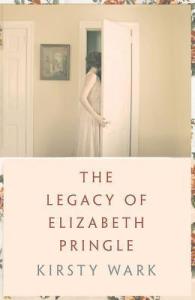 Appropriate reading: The Legacy of Elizabeth Pringle by Kirsty Wark, the only Arran-set novel on my library’s catalogue, is an enjoyable dual-timeline story linked by the Lamlash home of the title character. When she died in her nineties in 2006, she bequeathed her home to a kind woman who used to walk past on summer holidays with her daughter in a pram. Martha Morrison was that baby, and with her mother, Anna, suffering from dementia, it’s up to her to take possession and root out Elizabeth’s secrets. Every other chapter is a first-person fragment from Elizabeth’s memoir, cataloguing her losses of parents and lovers and leading ever closer to the present, when she befriended Saul, an American Buddhist monk based at Holy Island across the water, and Niall, a horticulturist at Brodick Castle. It’s a little too neat how the people in her life pair off (sub-Maggie O’Farrell; more Joanna Trollope, perhaps), but it was fun to be able to visualize the settings and to learn about Arran’s farming traditions and wartime history.
Islay
Islay is a tourist mecca largely because of its nine distilleries – what a pity we don’t care for whiskey! – but we sought it out for its wildlife and scenery, which were reminiscent of what we saw in the Outer Hebrides last year. Our B&B was a bit fusty (there was a rotary phone in the hall!), but we had an unbeatable view from our window and enjoyed visiting two RSPB reserves. The highlight for me was the walk to the Mull of Oa peninsula and the cow-guarded American Monument, which pays tribute to the troops who died in two 1918 naval disasters – a torpedoed boat and a shipwreck – and the heroism of locals who rescued survivors.


We spent a very rainy Tuesday mooching from one distillery shop to another. There are two gin-makers whose products we were eager to taste, but we also relished our mission to buy presents for two landmark birthdays, one of an American friend who’s a whiskey aficionado. Even having to get the tyre replaced didn’t ruin the day. There’s drink aplenty on Islay, but quality food was harder to acquire, so if we went back we’d plump for self-catering.


Incidental additional hauls: I found this 50th anniversary Virago tote bag under a bench at Bowmore harbour after our meal at Peatzeria. I waited a while to see if anyone would come back for it, but it was so sodden and sandy that it must have been there overnight. I cleaned it up and brought home additional purchases in it: two secondhand finds at a thrift store in Tarbert, the first town back on the mainland, and a Knausgaard book I got free with my card points from a Waterstones in Glasgow.


Glasgow
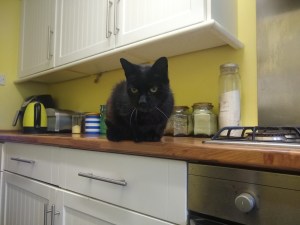 My 15-year-old nephew is currently on a school trip to Scotland and my sister went along as an unofficial chaperone. I couldn’t let them come to the UK without meeting up, so for months we’d pencilled in an evening in Glasgow. When we booked our Airbnb room in a suburb, it was because it was on a super-convenient train line … which happened to be closed for engineering works while we were there. Plan B: rail replacement buses, which were fine. We greatly enjoyed the company of Santos the Airbnb cat, who mugged us for scraps of our breakfasts.
With our one day in Glasgow, we decided to prioritize the Burrell Collection, due to the enthusiastic recommendations from Susan, our Arran hosts, and Bill Bryson in Notes on a Small Island (“Among the city’s many treasures, none shines brighter, in my view”). It’s a museum with a difference, housed in a custom-built edifice that showcases the wooded surroundings as much as the stunning objects. We were especially partial to the stained glass.


Our whistle-stop city tour also included a walk past the cathedral, a ramble through the Necropolis (where, pleasingly, I saw a grave for one Elizabeth Pringle), and the Tenement Museum, a very different sort of National Trust house that showed how one woman, a spinster and hoarder, lived in the first half of the 20th century. Then on to an exceptional seafood-heavy meal at Kelp, also recommended by Susan, and an all-too-brief couple of hours with my family at their hotel and a lively pub.


We keep returning to Scotland. Where next in a few years? Possibly the southern islands of the Outer Hebrides, which we didn’t have time for last year, or the more obscure of the Inner Hebrides, before planning return visits to some favourites. All the short ferry rides were smooth this time around, so I can cope with the thought of more.

We got home to find our mullein plants attempting to take over the world.
Recommended March Releases by Jane Aldous, Danielle Evans, Katherine May & Genanne Walsh
Sonnets, short stories, nature-fuelled wonder, and an autobiographical essay about a father’s death … from postwar Edinburgh to modern-day San Francisco and from fiction about young African American women to pilgrimages along the English coast, I have a real variety to recommend this month. (And coming up in a separate post: Womb by Leah Hazard.)
More Patina than Gleam by Jane Aldous
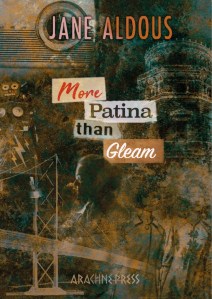 This was my second Arachne Press collection after Routes by Rhiya Pau. Intriguingly, it’s a story composed of 70 sonnets, untraditional in that they do not follow a particular rhyme scheme apart from the odd couplet. There is scant punctuation, with within-line spaces separating the phrases. Aldous, who has recently been featured in a Guardian article on debut authors over 60, imagines a sort of alternative future for her mother had she run away with her when she was a baby. Here, Linda escapes her abusive common-law husband, Vernon, and travels from England to Edinburgh with her 11-year-old daughter, Angie. They settle with an eccentric older woman named Elsie Datlow, who hires Linda as a lady’s companion and keeps her on as a housekeeper when financial struggles force her to accept paying guests. It’s impressive how much Aldous fits into comparatively little text, including Angie’s coming of age, the ups and downs of the Datlows’ picture restoring business, and transgressive romance as both Elsie and Linda fall in love across accepted gender or racial boundaries. This was a pleasant surprise that called to mind works by Muriel Spark and Sarah Waters.
With thanks to Arachne Press for the free copy for review.
Before You Suffocate Your Own Fool Self by Danielle Evans (2010)
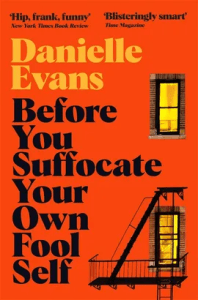 A couple of years ago I reviewed Evans’s second short story collection, The Office of Historical Corrections. This was her first book but has only just been published in the UK. Six of the eight stories are in the first person, the other two in third person. The protagonists tend to be young African American women in moments of transition or clinging to unhealthy relationships. In “Virgins,” 15-year-old Erica and Jasmine want to shed their innocence but can’t necessarily control how it happens. “Snakes” has Tara, a transracial adoptee, spending her ninth summer with her white cousin, Allison, down at their grandmother’s home in Florida. The response to a series of accidents makes it clear to her who is valued in this family. The college girls in “Harvest” consider a variety of reproductive experiences, from selling their eggs to abortion. In “The King of a Vast Empire,” a brother and sister decide to track down a survivor of a car accident their family had when they were children. “Jellyfish” sees a father and daughter meeting for lunch in Harlem and pondering their separate futures.
Many settings were familiar to me from the Delmarva area where I grew up. Here on the cusp of the South, Confederate sympathy still exists, as high schoolers Crystal and Geena discover in “Robert E. Lee Is Dead.” The best friends collaborate on pranks, but Crystal’s grades point to a promising future whereas everyone has given up on Geena, including herself. Along with that one, my two favourites were “Someone Ought to Tell Her There’s Nowhere to Go” and “Wherever You Go, There You Are.” In the former, military veteran Georgie tries to ingratiate himself with his ex-girlfriend by treating her daughter to a princess experience; in the latter, Carla takes her would-be-sexpot 14-year-old niece, Chrissie, on a road trip to North Carolina to meet her ex’s fiancée. Both are exemplary of the assets of the whole collection: strong characters, natural dialogue, and subtle treatment of themes of class and race. I’d proffer this for fans of Sidik Fofana, and as a better option than Dantiel Moniz’s stories.
With thanks to Picador for the proof copy for review.
Enchantment: Reawakening wonder in an exhausted age by Katherine May
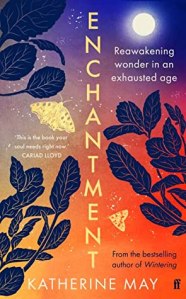 I was a big fan of Katherine May’s Wintering, which published just before the pandemic and, as if presciently, offers strategies for coping with seasons of depression. Coming after a few years of upheaval and disconnection, this follow-up voices May’s longing for rituals of the transcendent that will allow her to live in harmony and close attention to the world around her. Her usual way of communing with nature and other people was group swims in the sea, but that temporarily stopped with lockdown. She sought alternatives, such as visiting a sacred well with a friend, beekeeping, cultivating a wild garden, and chasing a meteor shower. The Earth – Water – Fire – Air structure is sometimes forced, and the content sparse; like Raynor Winn, May, I feel, was pressured to capitalize on the success of her previous work and quickly publish unfinished and rather nebulous material. It’s all surprisingly woo-woo from an English author. Yet May’s writing is unfailingly lovely and this went down easy a chapter at a time. It’s a comparable read to Wanderland by Jini Reddy.
With thanks to Faber for the proof copy for review.
Eggs in Purgatory by Genanne Walsh
I reviewed Genanne Walsh’s novel Twister as part of my summer reading in 2018. This autobiographical essay, recently published by WTAW Press and a finalist in their Alcove Chapbook Series Open, tells the story of the last few months of her father’s life. Aged 89, he lived downstairs from Walsh and her wife in San Francisco. He was quite the character: idealist, stubborn, outspoken; a former Catholic priest influenced by A Course in Miracles and convinced of the oneness of everything. Although he had no terminal conditions, he was sick of old age and its indignities and ready to exit. (“He wanted to be put on an ice floe and pushed offshore. The problem was, I lived above him on the iceberg and would be tasked with shoving him off.”) However, there was confusion about California state laws and whether doctors could help him with this, and at one point the police showed up at the door.
 The title refers to a Middle Eastern dish (see this Nigella Lawson recipe) I’ve known as shakshuka. It was the last proper meal her father ate, Christmas morning 2017 with her and her wife, before he went on his final hunger strike. Later Walsh writes, “Mourning is a kind of purgatory. You exist between worlds. For a long time I walked through, not fully feeling the world of the living or the world of the dead but aware of both.”
The task of a memoir is to fully mine the personal details of a situation but make of it something universal, and that’s just what she does here. Her father’s past with her mother (who died decades before, following a stroke) renders the family dynamic a backdrop to a final pyrrhic battle. Aware that she doesn’t come out of this a saint, Walsh admits to contradictory feelings, including “my life will be so much easier when he dies.” The prediction, no less than its reality, makes her feel guilty. Though she has no faith as such, she senses her father’s influence in her very desire to keep communing with him after his death.
This stunning little book met me at a deep place and I can highly recommend it, especially if you were a fan of In Love by Amy Bloom and All Things Consoled by Elizabeth Hay. (See also The Inevitable – one of its case studies reminded me of this.)
With thanks to the author for the free e-copy for review.
And one dud:
 Birnam Wood by Eleanor Catton – This year’s Klara and the Sun for me: I have trouble remembering why I was so excited about Catton’s third novel that I put it on my Most Anticipated list for 2023, especially given my decidedly mixed feelings about The Luminaries. I’d read a lot about Birnam Wood so its plot held no surprises for me. An American tech billionaire is up to no good on a New Zealand nature reserve; though the members of a guerrilla gardening group summon courage to fight back, his drones see all.
From early on I had little interest in the cast and their doings, especially the buzzword-filled dialogues, and skimmed the rest. Literary fiction usually distinguishes itself from commercial genre fiction by its focus on character depth (and prose quality), but in Catton’s case that was achieved through endless backstory. Her attempt at edginess entails adding at least one F-word to each spoken sentence. (The Bookshop Band, usually so mild-mannered, reflected this by dropping an F-bomb in their song based on the book – see the music video, which cleverly employs a derelict greenhouse and drones.) I’d heard that the ending was a knockout, so I skipped ahead and did find the last 40 pages gripping and the gruesome final tableau worthy of the Shakespearean allusions, but there’s a lot of blah to wade through before that.
With thanks to Granta for the free copy for review.
Would you be interested in reading one or more of these?
Three on a Theme for Valentine’s Day: “Love” Short Story Collections
Even though I’m really not a Valentine’s Day sort of person*, this is the seventh year in a row that I’ve put together a themed post featuring books that have “Love” or a similar word in the title in the run-up to mid-February (2017, 2018, 2019, 2020, 2021 and 2022).
I also don’t generally read short story collections if it’s not September – I seem to need that alliterative crutch to get to a dozen or so of them – but my “Birds” trio and these three were so great that I had to wonder why I don’t read them all year round.
Are these love stories? Some, to an extent. But also loss stories. Loneliness stories. Hatred stories. Abandonment stories. A few even verge on horror. In other words, realistic slivers of life. And as different as Carver’s lean, masculine tales of addiction and failure might seem from Bloom’s wry scenes of family life and Dunmore’s intimate pictures of isolation and mental illness, I found that all three resonated with each other. As for character detail, Dunmore’s “fat men” echo the overweight male protagonist in Bloom’s first story cycle.
Where the God of Love Hangs Out by Amy Bloom (2010)
One of these stories, “Sleepwalking,” was familiar to me because it is reprinted from her 1993 collection, Come to Me, and another two were originally published in 2000’s A Blind Man Can See How Much I Love You – isn’t she great at titles?! She excels at first lines, too: some from this volume are “At two o’clock in the morning, no one is to blame,” “William has gout,” “Clare can’t walk,” “No power” and “I had always planned to kill my father.”
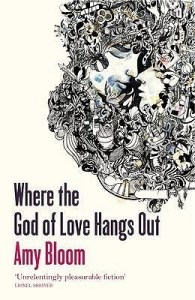 The book contains two quartets of linked stories and four stand-alone stories. The first set is about Clare and William, whose dynamic shifts from acquaintances to couple-friends to lovers to spouses. Bloom, a former psychotherapist, is interested in tracking how they navigate these changes over the years, and does so by switching between first- and third-person narration and adopting a different perspective for each story. She does the same with the four stories about Lionel and Julia, a Black man and his white stepmother. Over the course of maybe three decades, we see the constellations of relationships each one forms, while the family core remains. She also includes sexual encounters between characters who are middle-aged and older – when, according to stereotypes, lust should have been snuffed out.
Of the unlinked stories, the most memorable was “By-and-By,” a distressingly unemotional account of the ripple effects of a serial killer’s actions as seen by a victim’s roommate. I also loved the title story, which appears last. An older man and his daughter-in-law meet twice, by accident, in small-town eateries, the one wanting to come clean about a troubled past and the other wanting to embark on a new and surprising romance. This one reminded me of Richard Russo and early John Irving, while the collection as a whole would suit fans of Julia Glass, Tessa Hadley, Sue Miller, Lorrie Moore and Elizabeth Strout. (Secondhand – Bookbarn International)
What We Talk about When We Talk about Love by Raymond Carver (1981)
Such a famous title that it has spawned countless imitators, two of which I’ve even read (What We Talk about When We Talk about God by Rob Bell and What We Talk about When We Talk about Anne Frank by Nathan Englander). It turns out I had Carver confused with John Cheever, so I was expecting gritty stories of alcoholism in the 1950s Midwest. Yes to the alcohol abuse, but Carver was from the Pacific Northwest and was writing in the 1980s. A number of his protagonists are drunk, deadbeat dads who have been kicked out and make a scene to get back at their wives. Others are more passive, stuck in suburban ennui. Grown men fear turning into their fathers (“Sacks”). Ultimatums are defused (“Everything Stuck to Him”) and custody arrangements fought over (the Solomonic fable “Popular Mechanics”).
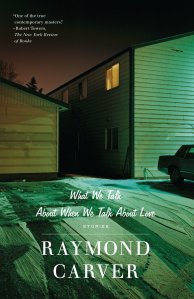 The declarative simplicity of the prose, and the interest in male activities like gambling, hunting and fishing, can’t fail to recall Ernest Hemingway, yet I warmed to Carver much more than Hem. Two of these stories struck me as feminist for how they expose nonchalant male violence towards women; elsewhere I spotted tiny gender-transgressing details (a man who knits, for instance). In “Tell the Women We’re Going,” two men escape their families to play pool and drink, then make a fateful decision on the way home. I don’t think I’ve been as shocked by the matter-of-fact brutality of a short story since “The Lottery.” My favourite was also chilling, “So Much Water So Close to Home.” Both reveal how homosocial peer pressure leads to bad behaviour; this was toxic masculinity before we had that term.
Many of the stories are only 3–8 pages long, such that 17 fit into a slender volume. They’re about half and half first- and third-person, sometimes with speech marks and sometimes not. At 15 pages, the title story is the longest and a great one. Two couples are having pre-dinner drinks and discussing types of love – physical, spiritual and so on. The POV character mostly conveys monologues by his friend Mel, a cardiologist (of course he would be a heart doctor!), comparing the obsessive love of his first wife’s ex, who turned out to be a stalker, and the mature devotion he saw in an elderly couple at his hospital after a horrific car accident. There were a few flippant or less memorable stories in here, but I’m impressed enough to seek out more of Carver’s work, poetry or prose. (Secondhand – Books for Amnesty, York)
Love of Fat Men by Helen Dunmore (1997)
This was an early work by Dunmore, who was so prolific in her two-decade career that I still come across titles of hers that I’ve never heard of before. I don’t think a book by this title would get published nowadays, but I won’t hold it against her. It is literal in that Ulli, a recurring character in 10 of these 19 stories, finds comfort in sleeping with larger men. I wondered what so captured Dunmore’s imagination about Scandinavia: you can work out that Ulli is from Finland and most of the stories are set there or in nearby countries.
 Every other story returns to Ulli, but the fragments of her life miss out the connective tissue: we suspect she’s pregnant as a teen, but don’t learn what she chose to do about it; we witness some dysfunctional scenes and realize she’s estranged from her family later on, but don’t find out if there was some big bust-up that prompted it. She comes across as a loner and a nomad, apt to be effaced by stronger personalities. In “The Ice Bear,” she’s on a ferry from Sweden back to Finland and can’t escape the prattle of a male missionary. In “A Question of Latitude” she’s out for a restaurant meal with friends, one of whom diagnoses her thus: “Nothing really affects you, does it? You just smile and put it out of your mind. And you cut people out of your life the same way, when you’ve finished with them.”
Whereas in the Bloom the interconnected stories are the strongest, here my preference was for the others. “The Bridge Painter” is about a man who leaves a peculiar calling card at each bridge he visits. “Annina” paints a woman with a questionable grasp on reality after the loss of a child. Best of all is probably “North Sea Crossing,” which contrasts two father-and-son pairs. If you only know Dunmore from novels, I can recommend her poetry and short stories, too. (Secondhand – Bas Books, Newbury)
All three: 
Try all of these authors right away if you haven’t already!
*A daytrip into London on Thursday was our Valentine’s gift to selves. We toured the Tower of London and the Science Museum (the Wellcome medical collections for me) and had an exceptional late lunch at Dishoom (starters and drinks pictured below). Tonight we’ll be having chocolate prune pots in front of The Bookshop Band’s love-themed livestream concert.

Dylan Thomas & Folio Prize Lists and a Book Launch
Literary prize season is upon us! I sometimes find it overwhelming, but mostly I love it. Last month I submitted a longlist of my top five manuscripts to be considered for the McKitterick Prize. In the past week the Dylan Thomas Prize longlist and Folio Prize shortlists have been announced. The press release for the former notes “an even split of debut and established names, with African diaspora and female voices dominating.”

- Limberlost by Robbie Arnott (Atlantic Books) – novel (Australia)
- Seven Steeples by Sara Baume (Tramp Press) – novel (Ireland)
- God’s Children Are Little Broken Things by Arinze Ifeakandu (Orion, Weidenfeld & Nicolson) – short story collection (Nigeria)
- Maps of Our Spectacular Bodies by Maddie Mortimer (Picador, Pan Macmillan) – novel (UK)
- Phantom Gang by Ciarán O’Rourke (The Irish Pages Press) – poetry collection (Ireland)
- Things They Lost by Okwiri Oduor (Oneworld) – novel (Kenya)
- Losing the Plot by Derek Owusu (Canongate Books) – novel (UK)
- I’m a Fan by Sheena Patel (Rough Trade Books) – novel (UK)
- Send Nudes by Saba Sams (Bloomsbury Publishing) – short story collection (UK)
- Bless the Daughter Raised by a Voice in Her Head by Warsan Shire (Chatto & Windus) – poetry collection (Somalia-UK)
- Briefly, A Delicious Life by Nell Stevens (Picador, Pan Macmillan) – novel (UK)
- No Land to Light On by Yara Zgheib (Atlantic Books, Allen & Unwin) – novel (Lebanon)
I happen to have already read Warsan Shire’s poetry collection and Nell Stevens’ debut novel (my review), which I loved and am delighted to see get more attention. I had Seven Steeples as an unsolicited review copy on my e-reader so have started reading that, and Maps of Our Spectacular Bodies is one of the books I treated myself to with Christmas money. There’s a possibility of a longlist blog tour, so for that I’ve requested the poetry book Phantom Gang. The shortlist will be announced on 23 March and the winner on 11 May.

This is the first year of the new Rathbones Folio Prize format: as in the defunct Costa Awards, the judges will choose a winner in each of three categories and then the category winners will go on to compete for an overall prize.
Nonfiction:
- The Passengers by Will Ashon
- In Love by Amy Bloom
- The Escape Artist by Jonathan Freedland
- Constructing a Nervous System by Margo Jefferson
- The Social Distance Between Us by Darren McGarvey
Poetry:
- Quiet by Victoria Adukwei Bulley
- Ephemeron by Fiona Benson
- Cane, Corn & Gully by Safiya Kamaria Kinshasa
- England’s Green by Zaffar Kunial
- Manorism by Yomi Ṣode
Fiction:
- Glory by NoViolet Bulawayo
- Scary Monsters by Michelle de Kretser
- Pure Colour by Sheila Heti
- Emergency by Daisy Hildyard
- Lucy by the Sea by Elizabeth Strout
Amy Bloom’s memoir In Love was one of my favourites last year, but I’m unfamiliar with the rest of the nonfiction shortlist and all the poetry collections are new to me (though I’ve read Zaffar Kunial’s Us). From the fiction list, I’m currently reading Elizabeth Strout’s Lucy by the Sea and I’ve read part of Sheila Heti’s bizarre Pure Colour and will try to get back into it on my Kindle at some point. In 2021 I was sent the entire Folio Prize shortlist to feature on my blog, but last year there was no contact from the publicists. I’ve expressed interest in receiving the poetry nominees, if nothing else.
The Women’s Prize longlist is always announced on International Women’s Day (8 March). Very unusually for me, I have already put together a list of novels we might see on that. I actually started compiling the list in 2022, and then last month spent some bookish procrastination time scouring the web for what I might have missed. There are 124 books on my list. Before cutting that down by 90% I have to decide if I want to be really thorough and check the publisher for each one (bar some exceptions, each publisher can only submit two books). I’ll work on that a bit more and post it in the next couple of weeks.
Last night I attended an online book launch (throwback to 2020!) via Sam Read Bookseller in Grasmere, for All My Wild Mothers by Victoria Bennett. Vik saw me express interest in her book on Twitter and had her publisher, Two Roads, send me a copy. I knew I had to attend the launch event because the Bookshop Band wrote a song about the book and premiered it as a music video partway through the evening. I’ve read the first 50 pages so far and it’s a lovely book I’ll review in full later in the month.
 The brief autobiographical essays, each titled after a wildflower and headed by a woodcut of it, sit somewhere between creative nonfiction and nature writing, with Bennett reflecting on her sister’s sudden accidental death, her years caring for elderly parents and an ill son, and the process of creating an “apothecary garden” from scratch on a social housing estate in Cumbria. Interviewed by Catherine Simpson (author of When I Had a Little Sister), she said that the book is about “what grows not in spite of brokenness, but because of it.” The format is such in part because it was written over the course of 10 years and Bennett could only steal moments at a time from full-time caregiving. She has also previously published poetry, but this is her prose debut.
Simpson asked if she found the writing of All My Wild Mothers cathartic and Bennett replied that she went to therapy for that purpose, but that time and words have indeed helped to mellow anger and self-pity. She found that she was close enough in time to the events she writes about to remember them, but not so close as to get lost in grief. The Bookshop Band’s song “Keeping the Magic,” mostly on cello and guitar, has imagery of wildflowers and trees and dwells on the maternal and muddling through. (You can watch a performance of it here.)
Yesterday was a day of bad family news for me, both a diagnosis and another sudden death, so this was a message I needed, of beauty and hope alongside the grief. It’s why I’m so earnestly seeking warmth and spring flowers this season. I found snowdrops in the park the other day, and crocuses in a neighbour’s garden today.
Which literary prize races will you follow this year?
What’s bringing joy into your life these days?
 Bookish Beck = Rebecca Foster. American transplant to England. Freelance proofreader and book reviewer.
