Blog Tour: Extract from Song by Michelle Jana Chan
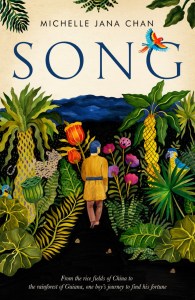 Song escapes the poverty and natural disasters of his hometown in China by sailing to Guiana. The village medicine man describes Guiana as a kind of paradise, and tells him he can earn free passage if he presents himself to the Englishmen in Guangzhou. What he doesn’t realize is that he will effectively be an indentured servant, working in the sugarcane fields for years just to pay for the voyage. From Singapore to India to Guiana, it’s a long and fraught journey, and though his new home does dazzle with its colors and wildlife, it’s not the idyll he expected. Still, Song is determined to make something of himself. “He would yet live a life that was a story worth telling.”
I have an extract from Chapter 1, about the flooding in China, to whet your appetite:
Lishui Village, China, 1878
At first they were glad the rains came early. They had already finished their planting and the seedlings were beginning to push through. The men and women of Lishui straightened their backs, buckled from years of labouring, led the buffalo away and waited for the fields to turn green. With such early rains there might be three rice harvests if the weather continued to be clement. But they quickly lost hope of that. The sun did not emerge to bronze the crop. Instead the clouds hung heavy. More rain beat down upon an already sodden earth and lakes were born where even the old people said they could not remember seeing standing water.
The Li rose higher and higher. Every morning the men of the village walked to the river to watch the water lap at its banks like flames. Sometimes they stood there for hours, their faces as grey as the flat slate light. Still the rain fell, yet no one cared about their clothes becoming wet or the nagging coughs the chill brought on. Occasionally a man lifted his arm to wipe his face. But mostly they stood still like figures in a painting, staring upstream, watching the water barrel down, bulging under its own mass.
Before the end of the week the Li had spilled over its banks. A few days later the water had covered the footpaths and cart tracks, spreading like a tide across the land and sweeping away all the fine shoots of newly planted rice. Further upstream the river broke up carts, bamboo bridges and outbuildings; it knocked over vats of clean water and seeped beneath the doors of homes. Carried on its swirling currents were splintered planks of wood, rotting food, and shreds of sacking and rattan.
Song awoke to feel the straw mat wet beneath him. He reached out his hand. The water was gently rising and ebbing as if it was breathing. His brother Xiao Bo was crying in his sleep. The little boy had rolled off his mat and was lying curled up in the water. He was hugging his knees as if to stop himself from floating away.
Song’s father was not home yet. He and the other men had been working through the night trying to raise walls of mud and rein back the river’s strength. But the earthen barriers washed away even as they built them; they could only watch, hunched over their shovels.
The men did not return that day. As the hours passed the women grew anxious. They stopped by each other’s homes, asking for news, but nobody had anything to say. Song’s mother Zhang Je was short with the children. The little ones whimpered, sensing something was wrong.
Song huddled low with his sisters and brothers around the smoking fire which sizzled and spat but gave off no heat. They had wedged among the firewood an iron bowl but the rice inside was not warming. That was all they had left to eat now. Xiao Wan curled up closer to Song. His little brother followed him everywhere nowadays. His sisters Xiao Mei and San San sat opposite him, adding wet wood to the fire and poking at the ash with a stick. His mother stood in the doorway, the silhouette of Xiao Bo strapped to her back and her large rounded stomach tight with child.
The children dipped their hands into the bowl, squeezing grains of rice together, careful not to take more than their share. Song was trying to feed Xiao Wan but he was too weak even to swallow. The little boy closed his eyes and rested his head in Song’s lap, wheezing with each breath. Their mother continued to look out towards the fields, waiting, with Xiao Bo’s head slumped unnaturally to the side as he slept.
‘I don’t think they’re coming back.’
Song could barely hear what his mother was saying.
‘They’re too late,’ she muttered.
Song wasn’t sure if she was talking to him. ‘Mama?’
Her voice was more brisk. ‘They’re not coming back, I said.’
Blog Tour Review: The Leavers by Lisa Ko
Lisa Ko’s exceptional debut novel, The Leavers, was hand-picked by Barbara Kingsolver for the 2016 PEN/Bellwether Prize for Socially Engaged Fiction, was a finalist for the 2017 National Book Award for Fiction in the States, and is now the launch title for Little, Brown UK’s new imprint, Dialogue Books, which will feature “stories from illuminating voices often excluded from the mainstream,” specifically those “for, about and by readers from the LGBTQI+, disability, working class and BAME communities.” I highly recommend it to fans of Nathan Hill’s The Nix, Atticus Lish’s Preparation for the Next Life and Celeste Ng’s Little Fires Everywhere. It’s an ambitious and satisfying novel set in New York and China, with major themes of illegal immigration, searching for a mother and a sense of belonging, and deciding what to take with you from your past.
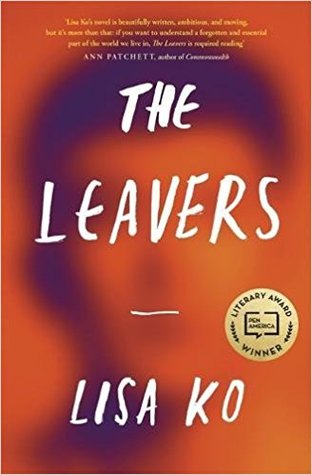 Eleven-year-old Deming Guo and his mother Peilan (nicknamed “Polly”), an undocumented immigrant, live in New York City with another Fuzhounese family: Leon, Polly’s boyfriend, works in a slaughterhouse, and they share an apartment with his sister Vivian and her son Michael. Deming gets back from school one day to find that his mother never came home from her job at a nail salon. She’d been talking about moving to Florida to work in a restaurant, but how could she just leave him behind with no warning?
Ten years later, Deming is Daniel Wilkinson, adopted and raised in upstate New York by a pair of white professors, Peter and Kay. He’s made a mess of his life with drinking and an addiction to online poker, and has been expelled from college. Now the guitar is his life, but even his best friend and bandmate Roland Fuentes isn’t willing to cut him any slack when he doesn’t show up for rehearsals and performances. Peter and Kay are pulling strings to get Daniel accepted into their college, but he keeps screwing up every chance he’s given. He can only hope his efforts to reconnect with his birth mother will be more successful.
The novel shifts fluidly between a third-person account of our protagonist then (Deming) and now (Daniel) and a first-person confession as Polly explains all: her upbringing in poverty in China, her pregnancy out of wedlock, her illegal entry to the United States, and why she had to leave Deming so suddenly. Polly and Deming/Daniel are vibrant characters, and I ached for their struggles. Both have the sense of being split between lives, of “juggling selves.” Their collective story is about figuring out who you are, what can be made right, and what to leave behind as you move forward in life. It’s such a beautiful novel, and an impressive debut from Lisa Ko.
My rating:
The Leavers will be published in paperback by Dialogue Books on April 26th. My thanks to Little, Brown for the free copy for review.
Blog Tour: Two Voices, One Story
“[B]eing an adoptive parent is like parenting in Technicolor: everything is just a little more intense. This means the highs can be really high, but it also means that the lows are going to be really low. You have to prepare yourself.”
~Sharon Roszia, quoted in A Book about Love, by Jonah Lehrer
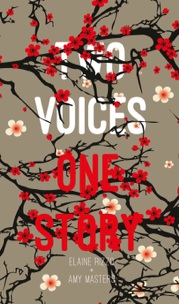
Two Voices, One Story is a mother–daughter memoir that splits narration duties between Elaine Rizzo and Amy Masters, the now-teenage daughter she adopted from China in 1999. Elaine’s sections provide the main thread of their story, while Amy’s passages, generally shorter and printed in italics, chime in to give her perspective on various events and relationships that have been important in her life.
 Elaine is forthright about her infertility and the miscarriage that led to her decision to adopt. In the late 1990s, China’s one-child policy was still in place, but it was the severe flooding of the Yangtze River that led directly to Amy’s adoption. Thousands died and millions more were displaced. Given the context, it’s not so surprising that baby Amy was left outside a welfare center. She was given the Chinese name Tong Fang – “Copper Child.”
For me the highlight of the book was Elaine and Lee’s trip to China to pick up Amy. Although they were nervous and disoriented, they experienced the kindness of strangers and responded with compassion of their own, taking along extra toiletries and clothes of different sizes and leaving the surplus with the care center. Amy had bronchitis, one more worry on top of all the paperwork and red tape they had to go through to finalize the adoption.
Back in England, Amy had some behavioral problems that were likely vestiges of her time at the orphanage. She hated noise, especially thunderstorms; she hit herself and others; and she often woke up screaming. Private schooling ensured she wouldn’t get left behind, and there were many happy times with extended family and holidays to Australia and the west coast of Wales, where Elaine and Amy would later settle with Elaine’s second husband.
But life wasn’t always rosy: Amy was strong-willed and uncooperative – perhaps nothing out of the ordinary for a teenager, but still a challenge for her parents. Elaine recalls a social worker telling them “that very often adoptive parents don’t feel like they have the right to tell their child off, or that they think they shouldn’t say or do anything which might upset the child, because they are trying to compensate for what has happened prior to the adoption.”
Lengthy commuting to her job back in England and years-long house renovations demanded much of Elaine’s attention, yet she remained alert to what was going on with Amy. Unfortunately, in her teen years Amy experienced racism from a few schoolmates, including abusive Facebook messages that drove the family to contact the police. Amy herself, though, always comes across as easygoing about being different: “Every Christmas we used to do a Nativity show and I remember being an angel first and then one of the kings, which I suppose was the right role for me because I really do come from the East.”
Even though this is a very quick read, my interest waxed and waned. The telling can be clichéd and sentimental, and I felt too much space was given to banal details that added little to an understanding of the central mother–daughter relationship. This self-published book has a very appealing cover but needs another look from an experienced editor who could fix the fairly frequent typos and punctuation issues and cut out the bullet points (nine pages’ worth) and speech tics like “I will also say…” and “I have to comment…”
I would certainly recommend this book to those who have a personal experience of or interest in adoption, particularly from overseas (for a fictional take on adoption from China, you might also try The Fortunes by Peter Ho Davies, The Red Thread by Ann Hood, and This Must Be the Place by Maggie O’Farrell), as well as to anyone wondering how to parent or educate a child who is in some way different.
I’ll end with some lovely words from Amy:
when my Chinese mum left me outside the gates of the welfare center almost eighteen years ago now, because there was nothing left for me in Tongling, she must have had the desperate hope that I would find a happy life with people who loved me. I can only say that her wish did come true.
My rating: 
Two Voices, One Story will be published by Clink Street Publishing on March 21st. Thanks to Rachel Gilbey of Authoright Marketing & Publicity for arranging my free copy for review.
I was pleased to participate in the blog tour for Two Voices, One Story.
 Bookish Beck = Rebecca Foster. American transplant to England. Freelance proofreader and book reviewer.
 Bookish Beck