October Recommendations: Ashworth, Donoghue, Kay & McWatt
Intricate essays about writing in the wake of trauma, a feel-good novel about an odd couple on a trip to France, hilarious festive outtakes from a career in medicine, and a race-themed family memoir: I have four very different books to recommend to you this month. All: 
Notes Made while Falling by Jenn Ashworth
(Coming from Goldsmiths Press [UK] on the 15th; already out from MIT Press [USA])
Like Anne Boyer’s The Undying and Sinéad Gleeson’s Constellations, this is an incisive memoir-in-essays about the effects of trauma on a woman’s body. Specifically, Ashworth’s story starts with her son’s birth in 2010, a disaster she keeps returning to over the course of seven sinuous personal essays. A routine C-section was followed by haemorrhaging, blood transfusions and anaphylaxis. The effects lasted for years afterwards: haunted by the sound of her blood dripping and the feeling that her organs could fall out of her abdomen at any time, she suffered from vomiting, insomnia and alcoholism, drinking late into the night as she watched gruesome true crime films.
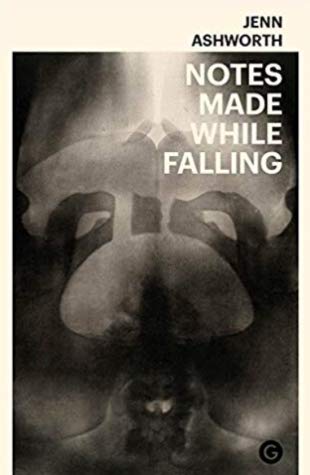 Ashworth toggles between experience, memory, and the transformation of experience into a written record. She admits she has lost faith in fiction, either reading or writing it (she is a lecturer at Lancaster University and the author of four novels). Her Mormon upbringing in Preston is a major part of her backstory, and along with her childhood indoctrination she remembers brief stays in a children’s home and in the hospital with chicken pox.
The essays experiment with structure and content. For instance, “Ground Zero” counts down from #8, with incomplete final lines in each section, then back up to #8, with each piece from the second set picking up where the first left off. Slashes and cross-outs represent rethinking or alternate interpretations. “Off Topic: On Derailment” encompasses so many topics, from excommunication to Agatha Christie to rollercoasters to Charles Dickens, that you have to read it to believe she can make it all fit together (elsewhere she muses on Chernobyl, magic tricks and hating King Lear).
“How to Begin: The Cut” started as a talk given at Greenbelt 2013, when I was in the audience. I especially loved “A Lecture on Influence,” a coy self-examination through creative writing lessons, and “How to Fall without Landing: Celestial City,” a meditation on the precariousness of the human condition. Her frame of literary reference is wide and surprising. This also reminded me of Sight by Jessie Greengrass, The Empathy Exams by Leslie Jamison, I Am, I Am, I Am by Maggie O’Farrell, and In the Days of Rain by Rebecca Stott; I would recommend it to readers of any of the above.
Some favorite lines:
“My God-hurt head has a hole in it or needs one; to let the world in, or out – I can’t ever decide.”
“how to write about everything? How to take in the things that don’t belong to you without being poisoned by them? How to make use of the things that live inside, those seedlings you never asked for? How to breathe in? How to breathe out? How to keep on doing that?”
“Some days it feels like writing truthfully about her own life is the most subversive thing a woman can do.”
My thanks to the publisher for the free copy for review.
Akin by Emma Donoghue
(Coming from Picador [UK] on the 3rd; already out from Little, Brown and Co. [USA])
I’ve read Donoghue’s six most recent works of fiction. Her books are all so different from each other in setting – a one-room prison in contemporary America, bawdy 1870s San Francisco, rural Ireland in the 1850s – that it’s hard to pin her down to one time period or roster of topics. She never writes the same book twice, and that’s got to be a good thing.
 Akin gets off to a slightly slow start but soon had me hooked. Noah Selvaggio, a childless widower and retired chemist in New York City, is looking forward to an imminent trip to Nice, where he was born, to celebrate his 80th birthday. He never guessed that he’d have company on his trip, much less a surly 11-year-old. This is Michael Young, his nephew Victor’s son. Victor died of a drug overdose a year and a half ago; the boy’s mother is in prison; his maternal grandmother has just died. There’s no one else to look after Michael, so with a rush passport he’s added to the itinerary.
In some ways Michael reminded me of my nephews, ages 11 and 14: the monosyllabic replies, the addiction to devices and online gaming, the finicky eating, and the occasional flashes of childlike exuberance. Having never raised a child, Noah has no idea how strict to be with his great-nephew about screen time, unhealthy food and bad language. He has to learn to pick his battles, or every moment of this long-awaited homecoming trip would be a misery. And he soon realizes that Michael’s broken home and troubled area of NYC make him simultaneously tougher and more vulnerable than your average kid.
The odd-couple dynamic works perfectly here and makes for many amusing culture clashes, not so much France vs. the USA as between these Americans of different generations. The dialogue, especially, made me laugh. Donoghue nails it:
[Noah:] “The genre, the style. Is rap the right word for it? Or hip-hop?”
[Michael:] “Don’t even try.” Michael turned his music back on.
(At the cathedral)
[Michael:] “This is some seriously frilly shit.”
[Noah:] “It’s called Baroque style.”
[Michael:] “I call it fugly.”
But there’s another dimension to the novel that keeps it from being pleasant but forgettable. Noah’s grandfather was a famous (fictional) photographer, Père Sonne, and he has recently found a peculiar set of photographs left behind by his late mother, Margot. One is of the hotel where they’re staying in Nice, known to be a holding tank for Jews before they were sent off to concentration camps. The more Noah looks into it, the more he is convinced that his mother was involved in some way – but which side was she on?
This is feel-good fiction in the best possible sense: sharp, true-to-life and never sappy. With its spot-on dialogue and vivid scenes, I can easily see it being made into a movie, too. It’s one of my favorite novels of the year so far.
My thanks to the publisher for the proof copy for review.
Twas the Nightshift before Christmas by Adam Kay
(Coming from Picador on the 17th)
 If you’ve read This Is Going to Hurt, the UK’s bestselling nonfiction title of 2018, you’ll know just what to expect from the comedian’s holiday-themed follow-up. It’s raunchy, morbid and laugh-out-loud funny. In the seven years that Kay was a medical doctor, he had to work on Christmas Day six times. He takes us through the holiday seasons of 2004 to 2009, from the sickeningly festive run-up to the letdown of Christmas day and its aftermath. With his Rudolph tie on and his Scrooge spirit intact, he attends to genital oddities, childbirth crises and infertility clients, and feebly tries to keep up his relationships with his family and his partner despite them having about given up on him after so many holiday absences.
This will be a stocking-stuffer for many this year, and I can see myself returning to it year after year and flicking through for a laugh. However, there’s one story here that Kay regrets omitting from This Is Going to Hurt as being too upsetting, and he also ends on a serious note, urging readers to spare a thought for those who give up their holidays to keep our hospitals staffed.
A favorite passage:
“A lot of the reward for this job comes in the form of a warm glow. It doesn’t make you look any less tired, you can’t pay the rent with it, and it’s worth a lot less than the social life you’ve traded it for, but this comforting aura of goodness and purpose definitely throws light into some dark corners and helps you withstand a lot of the shit.”
My thanks to the publisher for the proof copy for review.
Shame on Me: An Anatomy of Race and Belonging by Tessa McWatt
(Coming from Scribe UK on the 10th)
 “What are you?” This question has followed McWatt since she was eight years old. When her third-grade teacher asked the class if they knew what “Negro” meant, one boy pointed to her. “Oh, no, not Tessa,” the teacher replied, following up with a question: “What are you, Tessa?” But it has always been hard to put her mixed-race background into one word. Her family moved from Guyana to Canada and she has since settled in England, where she is a professor of creative writing; her ancestry is somewhat uncertain but may include Chinese, Indian, indigenous South American, Portuguese, French/Jewish, African, and Scottish.
The book opens with the startling scene of her grandmother, a young Chinese woman brought over to work the sugarcane fields of British Guiana, being raped by her own uncle. “To strangers, even friends—on some days also to myself—I am images of violence and oppression. I am the language of shame and destitution, of slavery and indenture, of rape and murder. I am images of power and privilege, of denial and shades of skin, shapes of faces,” McWatt writes.
Her investigation of the meaning of race takes the form of an academic paper, Hypothesis–Experiment–Analysis–Findings, and within the long third section she goes part by part through the bodily features that have most often been used as markers of racial identity, including the nose, eyes, hair and buttocks. She dives into family history but also into wider historical movements, literature and science to understand her hybrid self. It’s an inventive and sensitive work reminiscent of The Color of Water by James McBride. I would recommend it to anyone who enjoys reading (or feels they should try) interrogations of race.
A favorite line:
“as I try to square my politics with my privilege, it seems that my only true inheritance is that I am always running somewhere else.”
I won a signed proof copy in a Twitter giveaway.
Have you read any October releases that you would recommend? Do any of these tempt you?
Short Story Collections Read Recently
This is the fourth year in a row that I’ve made a concerted effort to read more short stories in the alliterative month of September. (See also my 2016, 2017 and 2018 performances.) Short story collections are often hit and miss for me, and based on a few recent experiences I seem to be prone to DNFing them after two stories – when I’ve had my fill of the style and content. I generally have better luck with linked stories like Olive Kitteridge and its sequel, because they rely on a more limited set of characters and settings, and you often get intriguingly different perspectives on the same situations.
So far this year, I’ve read just five story collections – though that rises to 13 if I count books of linked short stories that are often classed as novels (Barnacle Love, Bottled Goods, Jesus’ Son, The Lager Queen of Minnesota, Olive Kitteridge, Olive, Again, That Time I Loved You and The Unchangeable Spots of Leopards). Twelve is my minimum goal for short story collections in a year – the equivalent of one per month – so I’m pleased to have surpassed that, and will continue to pick up the occasional short story collection as the year goes on.
The first two books I review here were hits with me, while the third disappointed me a bit.
The Assassination of Margaret Thatcher by Hilary Mantel (2014)
 Four of these 10 stories first appeared in the London Review of Books, and another four in the Guardian. Most interestingly, the opening story, “Sorry to Disturb,” about a bored housewife trying to write a novel while in Saudi Arabia with her husband in 1983–4, was published in the LRB with the subtitle “A Memoir.” That it’s one of the best few ‘stories’ here doesn’t negate Mantel’s fictional abilities so much as prove her talent for working in the short form.
My other few favorites were the very short ones, about a fatal discovery of adultery, an appalling accident on a holiday in Greece, and a sighting of a dead father on a train. I also enjoyed “How Shall I Know You?” in which an author is invited to give a talk to a literary society. I especially liked the jokey pep talks to self involving references to other authors: “come now, what would Anita Brookner do?” and “for sure A.S. Byatt would have managed it better.” Other topics include children’s horror at disability, colleague secrets at a Harley Street clinic, and a sister’s struggle with anorexia. The title story offers an alternative history in which Thatcher is assassinated by the IRA upon leaving an eye hospital after surgery.
In her stories Mantel reminds me most of Tessa Hadley. It’s high time I read another Mantel novel; most likely that will be the third Thomas Cromwell book, due out next year.
My rating:
In the Driver’s Seat by Helen Simpson (2005)
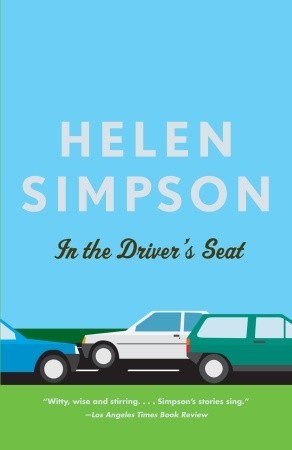 I liked this even more than Simpson’s first book, Four Bare Legs in a Bed, which I reviewed last year. The themes include motherhood (starting, in a couple of cases, in one’s early 40s), death versus new beginnings, and how to be optimistic in a world in turmoil. There’s gentle humor and magic to these stories that tempers some of the sadness. I especially liked “The Door,” about a grieving woman looking to restore her sense of security after a home break-in, “The Green Room,” a Christmas Carol riff (one of two Christmas-themed stories here) in which a woman is shown how her negative thoughts and obsession with the past are damaging her, and “Constitutional,” set on a woman’s one-hour circular walk during her lunch break and documenting her thoughts about everything from pregnancy to a nonagenarian friend’s funeral. [The UK title of the collection is Constitutional.]
In two stories, “Every Third Thought” and “If I’m Spared,” a brush with death causes a complete change of outlook – but will it last? “The Year’s Midnight” creates a brief connection between frazzled mums at the swimming pool in the run-up to the holidays. “Up at a Villa” and the title story capture risky moments that blend fear and elation. In “The Tree,” which is funny and cringeworthy all at the same time, a man decides to take revenge on the company that ripped off his forgetful old mother. Prize for the best title goes to “The Phlebotomist’s Love Life,” though it’s the least interesting story of the 11.
(Found in a Little Free Library at the supermarket near my parents’ old house.)
Some favorite lines:
“the inevitable difficulty involved in discovering ourselves to others; the clichés and blindness and inadvertent misrepresentations”
“Always a recipe for depression, Christmas, when complex adults demanded simple joy without effort, a miraculous feast of stingless memory.”
“You shouldn’t be too interested in the past. You yourself now are the embodiment of what you have lived. What’s done is done.”
My rating: 
The Lager Queen of Minnesota by J. Ryan Stradal (2019)
I had sky-high hopes for Stradal’s follow-up after Kitchens of the Great Midwest (it was on my Most Anticipated list for the second half of the year). Theoretically, a novel about three pie-baking, beer-making female members of a Minnesota family should have been terrific. Like Kitchens, this is female-centered, on a foodie theme, set in the Midwest and structured as linked short stories. Here the chapters are all titled after amounts of money; they skip around in time between the 1950s and the present day and between the perspectives of Edith Magnusson, her estranged younger sister Helen Blotz, and Edith’s granddaughter, Diana Winter.
 Edith and Helen have a rivalry as old as the Bible, based around an inheritance that Helen stole to reopen her husband’s family brewery, instead of sharing it with Edith. Ever since, Edith has had to work minimum-wage jobs at nursing homes and fast food restaurants to make ends meet. When Diana comes to live with her as a teenager, she, too, works hard to contribute to the family, but then gets caught up in a dodgy money-making scheme. It’s in penance for this error that she starts working at a local brewery, but beer soon becomes as much of an obsession for Diana as it once was for her great-aunt Helen.
I had a few problems with the book’s setup: Helen is portrayed as a villain, and never fully sheds that stereotypical designation; meanwhile, Edith is passive and boring, just a bit “wet” (in British slang). Edith and Diana suffer more losses than seems likely or fair, and there are too many coincidences involved in Diana’s transformation into a master brewer. I also found it far-fetched that a brewery would hire her as a 19-year-old and let her practice making many, many batches of lager, all while she’s still underage. None of the characters fully came alive for me, though Diana was the closest. The ending wasn’t as saccharine as I expected, but still left me indifferent. I did like reading about the process of beer-making and flavor development, though, even though I’m not a beer drinker.
My rating: 
Short story DNFs this year (in chronological order):
Mr Wrong by Elizabeth Jane Howard – I read the two shortest stories, “Summer Picnic” and “The Proposition.” The former was pleasantly like Elizabeth Taylor or Tessa Hadley lite; I got zero out of the latter.
 I Want to Show You More by Jamie Quatro – I read the first two stories. “Decomposition,” about a woman’s lover magically becoming a physical as well as emotional weight on her and her marriage, has an interesting structure as well as second-person narration, but I fear the collection as a whole will just be a one-note treatment of a woman’s obsession with her affair.
Multitudes: Eleven Stories by Lucy Caldwell – I read the first two stories. I enjoyed the short opener, “The Ally Ally O,” which describes a desultory ride in the car with mother and sisters with second-person narration and no speech marks. I should have given up on “Thirteen,” though, a tired story of a young teen missing her best friend.
The Country Ahead of Us, the Country Behind by David Guterson – I read “Angels in the Snow” (last Christmas) and “Wood Grouse on a High Promontory Overlooking Canada” (the other week). Both were fine but not particularly memorable; a glance at the rest suggests that they’ll all be about baseball and hunting. If I wanted to read about dudes hunting I’d turn to Ernest Hemingway or David Vann. Nevertheless, I’ll keep this around in case I want to try it again after reading Snow Falling on Cedars this winter.
Currently reading:
 Ship Fever by Andrea Barrett – Elegant stories about history, science and human error. Barrett is similar to A.S. Byatt in her style and themes, which are familiar to me from my reading of Archangel. This won a National Book Award in 1996.
- Descent of Man by T. Coraghessan Boyle – Even in this slim volume, there are SO MANY stories, and all so different from each other. Some I love; some are meh. I’m tempted to leave a few unread, though then I can’t count this towards my year total…
- Sum: Tales from the Afterlives by David Eagleman – A bibliotherapy prescription for reading aloud. My husband and I read a few stories to each other, but I’m going it alone for the rest. This is fairly inventive in the vein of Alan Lightman’s Einstein’s Dreams, yet I find it repetitive.
Future prospects:
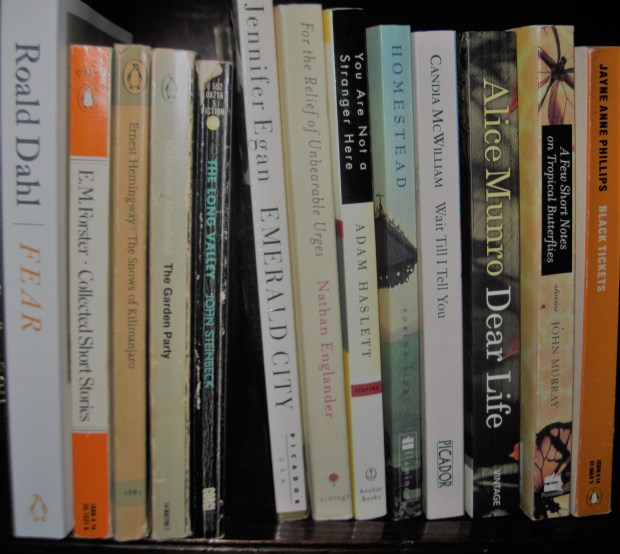
See also Laura’s excellent post about her favorite individual short stories.
Are you a short story fan? Read any good ones recently?
Season’s Readings: What I’ll Be Reading This Christmas
With part of my birthday book token I treated myself to the new paperback edition of Jeanette Winterson’s Christmas Days, which I’ll read off and on over the holidays this year and next, probably. I recently finished Rachel Joyce’s wintry short story collection and started Madeleine L’Engle’s third Crosswicks Journal, An Irrational Season. The first two chapters are set at Advent and Christmas and the rest later in the liturgical year; I’ve set the book aside to come back to in January. L’Engle is a great author to read if you’d like some liberal, non-threatening theology at this time of year. I particularly recommend her Christmas-themed book that I read last year. (Mini-reviews of the Joyce and L’Engle are below.)
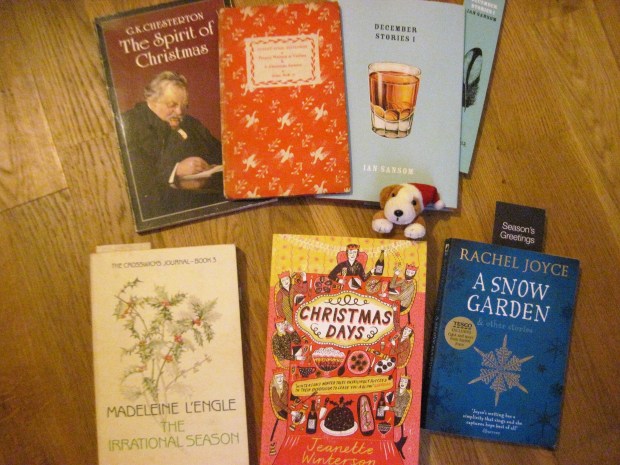
I also have a signed copy of Ian Sansom’s December Stories I that I won in a giveaway on Cathy’s blog, so I’ll be dipping into plenty of seasonally appropriate short stories this year. Earlier this year I picked up copies of the G.K. Chesterton collection (signed by the anthology editor) and the Robert Louis Stevenson volume (which contains prayers plus a sermon written during his time in Samoa) free at church from the theological library of a woman who’d died and donated her books to the church family.


A Snow Garden and Other Stories by Rachel Joyce
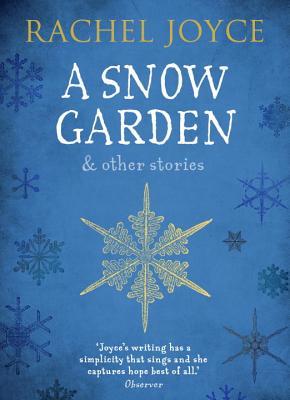 Two stand-outs were “The Boxing Day Ball,” a prequel to The Unlikely Pilgrimage of Harold Fry, describing how Harold and Maureen met, and “A Faraway Smell of Lemon,” in which a woman mourning the end of her relationship wanders into a cleaning supplies store and learns the simple lesson that everybody hurts. (“Life is hard sometimes” – fair enough, but can we say it without a cliché?) “I’ll Be Home for Christmas” is about the boy formerly known as Tim, now the mega pop star X. All he wants is a quiet few days back home, but he can’t seem to escape his reputation. Characters and little elements from previous stories reappear in later ones. My favorite was probably the title story, about a father trying to make the holidays perfect for his sons after his breakdown and divorce.
Joyce chooses to write about ordinary and forgotten people, but sometimes her vision of chavvy types doesn’t quite ring true, and when she isn’t being melancholy she’s twee. “Christmas Day at the Airport” was so contrived it made me groan. While I don’t think any of her books are truly great, they’re pleasant, relatable and easy to read.
My rating: 
Favorite lines:
“There is much to do, much to prepare, much to mend, but it cannot be done in a day and sometimes it is better to do one small thing.” (from “A Faraway Smell of Lemon”)
“The truth was, there were no instructions when you got married. There was no manual in the birthing suite that explained how to bring up a happy child. No one said, you do this, and then you do this, and after that this will happen. You made it up as you went along.” (from “The Marriage Manual”)
Bright Evening Star: Mystery of the Incarnation by Madeleine L’Engle
 “The story of Jesus’ birth has been oversentimentalized until it no longer has the ring of truth, and once we’d sentimentalized it we could commercialize it and so forget what Christmas is really about.” L’Engle believes in the power of storytelling, and in this short volume of memoir she retells the life story of Jesus and recalls her own experiences with suffering and joy: losing her father young (his lungs damaged by poison gas in WWI) and the death of her husband of 40 years versus the sustaining nature of family love and late-life friendships. Chapters 4 and 5 are particular highlights.
L’Engle was not at all your average American Christian: raised in the Episcopal tradition, she didn’t even encounter Evangelicalism until her mid-forties, and she doesn’t understand the focus on creationism and sexual morality. She also writes about free will and the adoration of Mary and how A Wrinkle in Time (rejected by many a publisher) was her fable of light in the midst of darkness. The title comes from The New Zealand Prayer Book, which also gives helpful alternate names for the persons of the Trinity: Earth Maker, Pain Bearer, Life Giver. This isn’t a particularly Christmas-y book, but it still lends itself to being read a chapter at a time during Advent.
My rating:
Some other favorite lines:
“Christ, in being born as Jesus, broke into time for us, so that time will never be the same again.”
“Family can be a movable feast. It can be a group of friends sitting around the dining table for an evening. It can be one or two people coming to stay with me for a few nights or a few weeks. It should be the church, and I am grateful that my church is a small church.”
Are you reading any particularly wintry or Christmasy books this year?
Tidings by Ruth Padel & Other Christmassy Reading
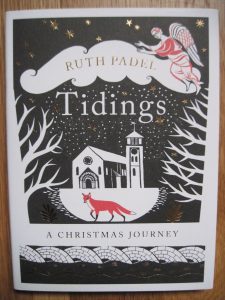 Ruth Padel is one of my favorite poets, so I jumped at the chance to read her new book-length holiday poem, Tidings: A Christmas Journey. Set across one Christmas Eve and Christmas day and narrated by Charoum, the Angel of Silence, the poem switches between Holly, a seven-year-old girl excited for Christmas, and Robin, a forty-four-year-old homeless man who follows a fox to a Crisis Centre. Here he gets a hot meal and some human kindness to make up for the usual bleakness of the holidays:
Christmas is the salt mine.
Salt in the wound, a nothing-time.
I was loved once. Who by? Can’t remember.
I especially liked the fragments that juxtapose this contemporary London story with centuries of history:
Up here the evening glides over golden moss
on the flat-top tomb of Mary Wollstonecraft
&
Pagan Christmas fizzes and teems with ghosts,
midwinter fires, mummers and waites, Yule
logs and mistletoe.
The poem also journeys to Jerusalem and Rome to survey a whole world of Christmas traditions, then and now.
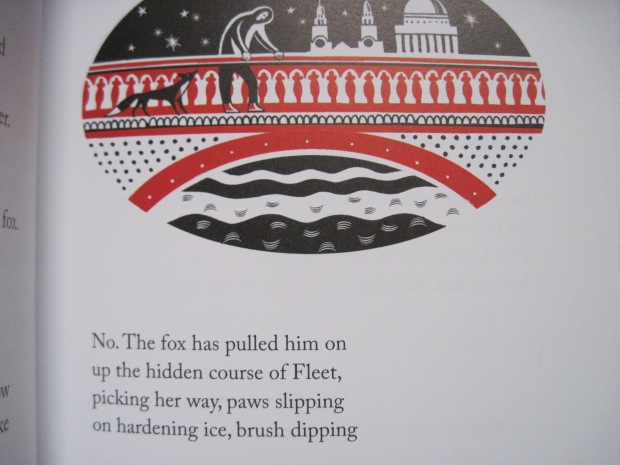
It’s a lovely little volume, with the red, black and white theme offset by touches of gold. The illustrations are gorgeous, but the story line disappointed me: starting with the character names, it all felt rather clichéd. Padel has treated urban foxes much more successfully in her collection The Soho Leopard, and apart from a very few instances – like the above quotes – the verse struck me as largely undistinguished, even awkward (like the out-of-place clinical vocabulary in “Love, / and the lack of it, can change the limbic brain”). This means that, for me, this book fails to earn a place as a Christmas classic I’ll reread year after year.
Tidings was published in the UK by Chatto & Windus on November 3rd. My thanks to Cat Mitchell of Random House for the free review copy.
My rating:
Other Christmassy Reading
 This year I’m resuming my place in Waiting on the Word, Malcolm Guite’s selection of religious-slanted poems to read from the start of Advent through Epiphany. For those who want to explore the history and interpretation of Christmas, I can recommend The First Christmas by the late Marcus Borg, one of my favorite progressive theologians.
As I have for the past several years, I’ll dip into The Ecco Book of Christmas Stories, edited by Alberto Manguel. My favorites are by Truman Capote, John Cheever, Jane Gardam and Jeanette Winterson (who has a brand-new, full-length Christmas story collection out this year). I’ll also sample some Russian classics via A Very Russian Christmas, which has short stories from Tolstoy, Chekhov and more.
 In addition, I have Cleveland Amory’s The Cat Who Came for Christmas and The Cat Who Stayed for Christmas out from the library, which should make for some very cozy reading under the cat. I’ll browse the numerous Christmas-themed poems in U.A. Fanthorpe’s Collected Poems, another library book. And I may even deign to try Hogfather, one from my husband’s beloved Discworld series by the late Terry Pratchett.
[See also this wonderful list of Christmas reading suggestions from Heaven Ali.]
Are you reading anything special this Christmas season?
When Is a Bookshop Not a Bookshop?
The answer to the riddle: when all the books are free! Christmas came early on Sunday when I visited a place I long knew of but had never visited: The Book Thing of Baltimore. It’s an entirely not-for-profit venture run with the help of volunteers and donations. “Our mission is to put unwanted books into the hands of those who want them,” says their website. My hubby and I were going into the city to meet friends for the day, so I suggested a quick run to Book Thing, a hidden treasure on an unassuming concrete lot that’s only open on the weekends.
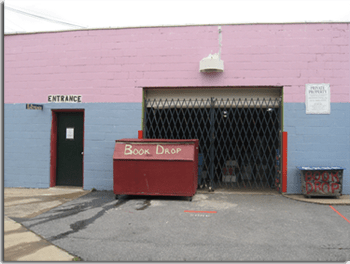
The unassuming shop front for Book Thing. (From their website)
I brought along a backpack crammed full of unwanted books from my old bedroom to donate, thinking that I would pick up just two or three in return. I was expecting one disorganized room full of pretty crummy books. To my delight, it was an enormous four-room warehouse with an amazing selection. A wonderful place to wander around and pick up things at random, but not great for seeking out particular titles given that the books – notably, fiction and biographies – are in no discernible alphabetical order.
Are you at all surprised to learn that I came away with a backpack just as overstuffed as I came with? At one point, as I was stacking up some terrific animal-themed books, my husband said, “You do realize you can only take what you can fit in your backpack? We’re going back by train!” My refrain was “but they’re all free!” I ended up with 31 books in total.
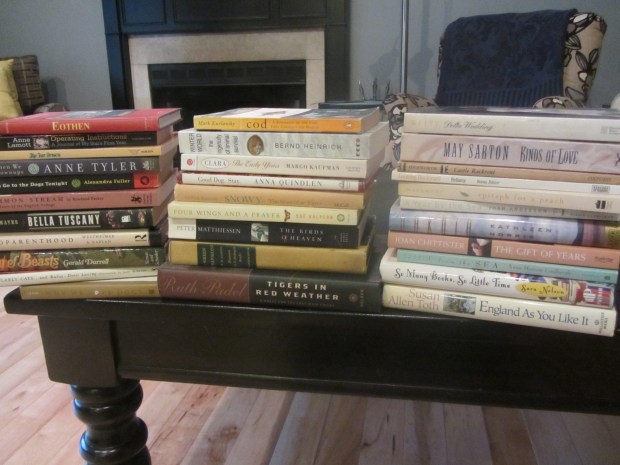
The haul.
I was especially thrilled with: The Fur Person, May Sarton’s book about cats, which I’d been hoping to find secondhand on this trip; Tigers in Red Weather, Ruth Padel’s travel book about searching for the world’s few remaining tigers in all their known habitats – I’d already read it but my husband hasn’t; Dakota by Kathleen Norris, a new favorite theology writer; Sara Nelson’s So Many Books, So Little Time (how apt!); and A Year by the Sea by Joan Anderson, which I’d never heard of but should fit right into my interest in women’s diaries.
Lest you think I’m some selfish book fiend, note that the pile on the left in the photograph below is for giving away to family and friends this Christmas. (Yes, I am aware that the pile of books we are keeping dwarfs the gift stack. Sigh.)
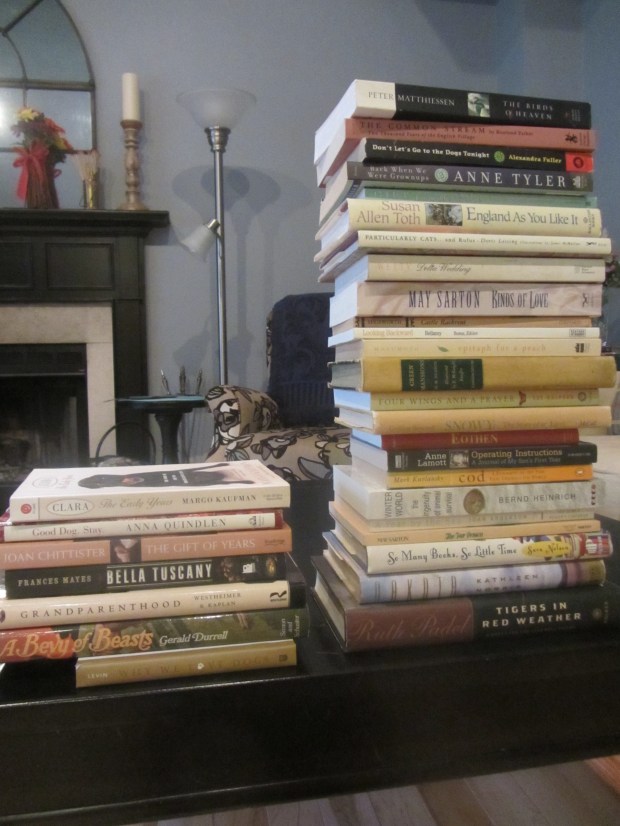
Dueling stacks.
All in all, it was a great day in Baltimore. We had a terrific lunch at City Café; browsed part of the amazing (and also free!) Walters Art Museum; toured the central campus of Johns Hopkins University, where my friend is a PhD student; walked through a small park; observed the shops and eateries of hipster Hampden; and saw the famous Christmas lights on 34th Street. They call it “Charm City,” and on Sunday it more than lived up to its name.
Book Thing is as sprawling as my favorite bookshop, Wonder Book (Frederick, Maryland), but you needn’t hand over any money. It’s as varied and tempting as any public library, but you don’t have to bring the books back. Nothing says “Merry Christmas” like free books!
Reviews Roundup, November–December
One of my goals with this blog is to have one convenient place where I can gather together all my writing that has appeared in disparate online locations. To that end, once a month I provide links to all book reviews I’ve published elsewhere, with a rating (below each description) and a taster so you can decide whether to read more. A few exceptions: I won’t point out my Kirkus Indie, BlueInk or Publishers Weekly reviews since I don’t get a byline.
The Bookbag
 In Search of Mary: The Mother of All Journeys by Bee Rowlatt: A BBC journalist and mother of four sets out, baby in tow, to trace the steps of Mary Wollstonecraft in Norway and France. A follow-up trip to California is a little off-topic, but allows Rowlatt to survey the development of feminism over the last few centuries. This isn’t as successful a bibliomemoir as many I’ve read in recent years, such as Rebecca Mead’s My Life in Middlemarch or Samantha Ellis’s How to Be a Heroine, but for readers interested in engaging in the ongoing debate about how women can balance work life with motherhood, and especially for any women who have attempted traveling with children, it’s a fun, sassy travelogue.

Foreword Reviews
 Italy Invades: How Italians Conquered the World by Christopher Kelly and Stuart Laycock: Proceeding alphabetically from Afghanistan to Zimbabwe, the authors give a comprehensive picture of Italians’ global reach through one- to five-page snapshots. There are many familiar names here, such as Caesar, Garibaldi and Marco Polo. Along with exploration, some major reasons for historical crossover were trade, war, colonialism and immigration. At times it feels as if the authors are grasping at straws; better to skip one-paragraph write-ups altogether and focus instead on the countries that have extensive links with Italy. Nonetheless, this is a lively, conversational book full of surprising facts.

Why You Won’t Go to Hell by Benjamin Vande Weerdhof Andrews: In a well-structured argument, Andrews prizes empirical thinking, rejects the supernatural, and affirms the possibility of godless morality. His central thesis is that religion doesn’t evolve to keep pace with society and so holds humanity back. The book’s tone is too often defensive, often in response to included website comments, and there are some failures of accuracy and fairness. Ultimately, though, this could be an inspirational book for atheists or believers, prompting both groups to question their assumptions and be willing to say “I don’t know.” Readers of Sam Harris and Christopher Hitchens will be particularly drawn to the book, but others should take a chance on it too.

 Cultured Food for Health by Donna Schwenk: When Schwenk started eating cultured foods in 2002, she had diabetes, high blood pressure, and a premature newborn. Keen to see if good bacteria could help with her medical problems, she started introducing the “healing powerhouse” of kefir (a fermented milk product resembling thin yogurt), kombucha (bubbly tea), and cultured vegetables into her diet, and soon reaped the rewards. About a quarter of the book is background information about probiotic foods. Bullet-pointed lists of health benefits, along with an alphabetical inventory of the diseases that cultured foods can treat, should prove helpful. The rest of the book is devoted to recipes, most vegetarian.
Three Simple Questions: Being in the World, But Not of It by Charlie Horton: Horton, trained as a social worker, was diagnosed with cerebellar degeneration in 1988. It has gradually affected his speech and movement. Despite having lived with disability for nearly three decades, he declares, “the world I live in is rich, and my spirit is young.” Here he documents how he deals with depression and physical limitations through guided meditations that bring him closer to God. Although he comes from a Christian perspective, he writes about spirituality in such inclusive terms that his work should speak to people of any faith.
Middle Passage: The Artistic Life of Lawrence Baker by Louis B. Burroughs, Jr.: This ghostwritten autobiography of an African-American artist is not only an evocative, eventful life story that moves from the Jim Crow South to the North, but also a forceful artist’s manifesto. Burroughs writes in Baker’s voice, a decision that works surprisingly well. The title is a powerful reference to the slave trade. Indeed, Burroughs consciously crafts Baker’s autobiography as an “up from slavery” narrative reminiscent of Richard Wright and Maya Angelou – with ‘slavery’ in this case being poverty and racism.
Nudge
 40 Sonnets by Don Patterson: All but one of the poems in this new book have the sonnet’s traditional 14 lines; “The Version” is a short prose story about writing an untranslatable poem. However, even in the more conventional verses, there is a wide variety of both subject matter and rhyme scheme. Topics range from love and death to a phishing phone call and a footpath blocked off by Dundee City Council. A few favorites were “A Powercut,” set in a stuck elevator; “Seven Questions about the Journey,” an eerie call-and-response; and “Mercies,” a sweet elegy to an old dog put to sleep. There weren’t quite enough stand-outs here for my liking, but I appreciated the book as a showcase for just how divergent in form sonnets can be.
 Without You There Is No Us by Suki Kim: This is a quietly gripping book even though not much of moment happens over Kim’s five months teaching young men at a missionary-run college in Pyongyang. She was in a unique position in that students saw her as ethnically one of their own but she brought an outsider’s perspective to bear on what she observed. Just before she flew back to the States in 2011, Kim Jong-Il died, an event she uses as a framing device. It could have represented a turning point for the country, but instead history has repeated itself with Kim Jong-un. Kim thus ends on a note of frustration: she wants better for these young men she became so fond of. A rare glimpse into a country that carefully safeguards its secrets and masks its truth.
 Alive, Alive Oh!: And Other Things that Matter by Diana Athill: Diana Athill turns 98 on December 21st. Apart from “Dead Right,” however, this collection is not primarily concerned with imminent death. Instead Athill is still grateful to be alive: marveling at a lifetime of good luck and health and taking joy in gardening, clothing, books, memories and friendships. Six of the 10 essays originally appeared elsewhere. The collection highlight is the title piece, about a miscarriage she suffered in her forties. Another stand-out is “The Decision,” about moving into a retirement home in her nineties. This doesn’t live up to her best memoirs, but is an essential read for a devoted fan, and a consolation given she will likely not publish anything else (though you never know). [For first-time Athill readers, I’d recommend starting with Somewhere Towards the End, followed by Stet, about her work as a literary editor.]
I also post reviews of most of my casual reading and skimming on Goodreads:
The Weightless World by Anthony Trevelyan: This debut novel blends postcolonial bureaucracy with steampunk zaniness. The setup is familiar enough: businessmen head overseas to take financial advantage of a former colony, puzzle over unfamiliar customs, and by the end are chastened but gain a clearer sense of values. Narrator Steven Strauss is the personal assistant to Raymond Ess, an entrepreneur with a history of mental illness. Their aviation company has gone bust; Strauss is to accompany Ess to India and keep him occupied by looking for an anti-gravity machine. Not anchored by either current events or convincing fantasy, the plot suffers in comparison to works by Geoff Dyer or Nick Harkaway. Despite entirely serviceable writing and a gravity-defying theme, it never really takes off.

 My Confection: Odyssey of a Sugar Addict by Lisa Kotin: 1978. Twenty-one-year-old mime goes to macrobiotic rehab to recover from sugar addiction. Fails. Shows signs of being a sex addict as well. Pared down to headlines, that’s how this fairly rambling memoir about Kotin’s relationships with food, family, lovers, and career opens. I kept waiting for a turn, some moment of revelation, when Kotin’s binge eating would be solved. Still, her recreation of her obsessive younger self can be pretty funny and charming, and her family sounds a bit like the Sedaris clan. I found this a bit dated, but others may find the time period and Jewish family background more evocative.
 Good on Paper by Rachel Cantor: I’m going to chalk this one up to blurb inflation. The writing is lively and the plot well crafted, with quirky postmodern touches, but the novel as a whole did not live up to my absurdly high expectations: it’s really nothing like A.S. Byatt’s Possession. It’s 1999 and Shira Greene is a failed translator from the Italian, now working as a temp in New York City and raising her daughter Andi with the help of her gay, Pakistani co-parent, Ahmad. One day she gets a call from Romei, a Nobel Prize-winning Italian poet who wants her to translate his new work, a version of Dante’s Vita Nuova that focuses on his relationship with his ill wife – and eventually starts to comment on Shira’s own life in surprising ways.
Water Sessions by James Lasdun: Wonderful poems from a severely underrated writer. The British Lasdun has relocated to small-town upstate New York, where he’s learned the spiritual worth of manual labor. There are such interesting rhyme schemes and half-rhymes throughout. One of the most striking poems, “Thing One and Thing Two,” compares human and animal sexuality in a rather disturbing way. The title sequence is a dialogue between a patient and a therapist, discussing what went wrong in a relationship and how arguments are never ‘about’ the thing that started it.
 The Secret Chord by Geraldine Brooks: A retelling of the life of King David from the perspective of the prophet Nathan. The naming takes some getting used to, but the stories – from gory massacres to moments of triumph – are recognizable from the Old Testament. What makes Brooks’s take unique is the different points of view it shows and the ways it subtly introduces doubt about David’s carefully cultivated image. It’s sensual historical fiction, full of rich descriptive language. Strangely unmemorable for me, perhaps because the storyline is just too familiar. Brooks doesn’t offer a radical reinterpretation but sows small seeds of doubt about the hero we think we know. (Full review in Jan/Feb 2016 issue of Third Way magazine.)
 When I Die: Lessons from the Death Zone by Philip Gould: Gould may be familiar to British readers as a key strategist of the New Labour movement and one of Tony Blair’s advisors. In 2008 he was diagnosed with esophageal cancer and chose to pay for private treatment at New York’s Sloan-Kettering hospital instead of going for a radical operation through the NHS – a fateful decision. Gould’s own account is fairly short, about 140 pages, but it’s supplemented by short reminiscences from his wife and two daughters. Daughter Georgia’s, especially, is a very good blow-by-blow of his final week. All royalties from the book went to the National Oesophago-Gastric Cancer Fund.
 Twain’s End by Lynn Cullen: “Twain’s End” was a possible name for the Clemens house in Connecticut, but it’s also a tip of the hat to Howards End and an indication of the main character’s impending death. In January 1909, when the novel opens, Samuel Clemens, 74, is busy dictating his autobiography and waiting for Halley’s Comet, the heavenly body that accompanied his birth, to see him back out. His secretary, Isabel Lyon, is 45 and it’s no secret that the two of them are involved. I love how the novel shifts between the perspectives of several strong female characters yet still gives a distinct portrait of Clemens/Twain. Interestingly, I found that it helped to have visited the Twain house in Connecticut – I could truly picture all the scenes, especially those set in the billiard room and conservatory.
 Meadowland: The Private Life of an English Field by John Lewis-Stempel: Lewis-Stempel is a proper, third-generation Herefordshire farmer, but also a naturalist with a poet’s eye. His day job might involve shooting rabbits, cutting hay and delivering lambs, but he still finds the time to notice and appreciate wildlife. He knows his field’s flowers, insects and birds as well as he knows his cows; he gets quiet and close enough to the ground to watch a shrew devouring beetles. June and July are the stand-out chapters, with some truly magical moments. When his mower breaks on a stone, he has to cut the hay by hand, returning him to a centuries-gone model of hard labor. All delivered in the loveliest prose.

Did You Ever Have a Family by Bill Clegg: A strong debut novel about personal and community responses to tragedy. Clegg’s multivocal approach works quite well, though there are perhaps a few too many voices diluting the mixture. I like how the revelations of what really happened that night before the wedding to cause the fatal house fire come gradually, making you constantly rethink who was responsible and what it all means. The small-town Connecticut setting is a good one, but I’d question the decision to set so much of the book in Washington, where the bereaved June drives on a whim. For a tragic story, it’s admirably lacking in melodrama.
 A Homemade Life: Stories and Recipes from My Kitchen Table by Molly Wizenberg: Foodoir extraordinaire! I liked this even better than Delancey, which is a terrific book about opening a pizza restaurant in Seattle with her husband. Here we get the prequel: the death of her father Burg from cancer, time spent living in Paris, building a new life in Seattle, starting her now-famous food blog (Orangette), and meeting her husband Brandon through it. Each brief autobiographical essay is perfectly formed and followed by a relevant recipe, capturing precisely how food is tied up with her memories. Wizenberg’s very fond of salad, but also of cake, and every recipe is full-on in terms of flavors and ingredients.
Ellen Foster by Kaye Gibbons: This was a random library book sale purchase, chosen almost entirely for the title. I set aside my usual dislike of child narrators and found an enjoyable voice-driven novella about a feisty ten-year-old who loses both her parents (good riddance to her father, at least) and finds her own unconventional family after cycling through the homes of some truly horrid relatives. Just as an example, her maternal grandmother sends her out to work picking cotton. The book is set in the South, presumably in the 1970s or 80s, so it’s alarming to see how strong racial prejudice still was.
 The Ecco Book of Christmas Stories, edited by Alberto Manguel: I read this over several years, a handful each holiday season. There are some very unusual choices, including some that really have hardly anything to do with Christmas (e.g. one by Bessie Head). Still, it’s a nice book to have to hand, even if just to skip through. Manguel strikes a good balance between well-known short story writers, authors you might never think to associate with Christmas, and fairly obscure works in translation. Four favorites: “A Christmas Memory,” Truman Capote (overall favorite); “Christmas Is a Sad Season for the Poor,” John Cheever; “The Zoo at Christmas,” Jane Gardam; and “O’Brien’s First Christmas,” Jeanette Winterson.
Dickens: Not Just for Christmas
Charles Dickens is almost singlehandedly responsible for creating our view of the traditional Christmas. It’s no surprise, then, that many people associate him with the holiday season. An armchair next to a fire somehow seems like the ideal place for curling up with one of his chunky tomes. I know some readers who try to pick up one of his books every winter, like Lucy over at Literary Relish. This year my husband is reading a facsimile edition of the original serialized version of Hard Times (re-issued by Stanford University’s Discovering Dickens project in 2005) in the run-up to Christmas, and also plans to get through The Cricket on the Hearth. One of my goals for 2016 is to return to Dombey and Son, which I got about 200 pages into a few years ago but never managed to finish.
We’ve also been lucky enough to catch a number of Dickens-themed theatre productions over the years: in London, Patrick Stewart’s one-man production of A Christmas Carol and Simon Callow’s one-man The Mystery of Charles Dickens, an open-air version of A Christmas Carol that took place around the streets of York, and, this year, Dickens Abridged at Norden Farm Centre for the Arts near Maidenhead. This was from Adam Long, the same brilliant mind that, as a founding member of The Reduced Shakespeare Company, helped create The Complete Works of William Shakespeare (abridged) as well as The Complete History of America (abridged) and The Bible: The Complete Word of God (abridged). I’ve seen four of their shows now, and all were utterly hilarious.
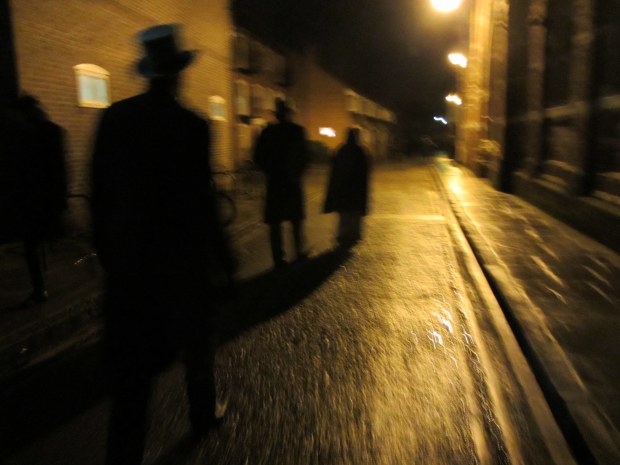
A spooky scene: walking the streets of York for a wandering production of A Christmas Carol.
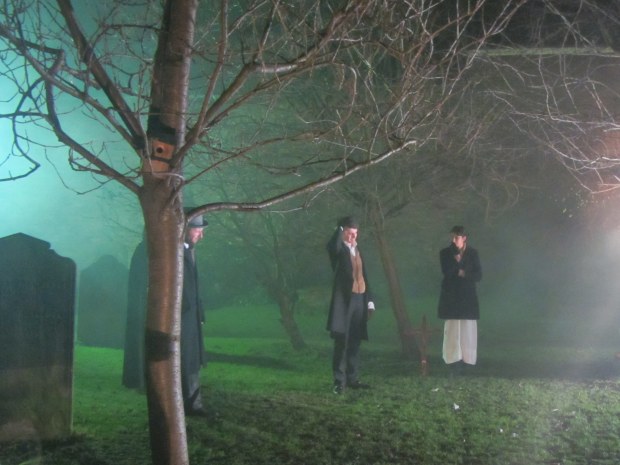
York Christmas Carol: stopping for a scene in a graveyard.
To our surprise, Dickens Abridged was basically a musical in a comedy folk style. We were reminded of Flight of the Conchords or Folk On. There were just four male actors on stage playing all the historical and fictional roles, including, of course, all the female ones. Some of Dickens’s novels didn’t even get a mention (though did I really expect Barnaby Rudge to turn up?!), others got the briefest of nods, and some came in for extensive treatment.
![A Christmas Carol: Mr. Fezziwig's Ball. John Leech [Public domain], via Wikimedia Commons](https://commons.wikimedia.org/wiki/File:A_Christmas_Carol_-_Mr._Fezziwig%27s_Ball.jpg?uselang=en-gb)
A Christmas Carol: Mr. Fezziwig’s Ball. John Leech [Public domain], via Wikimedia Commons
Among the show’s highlights were the guillotine scene in A Tale of Two Cities, Tiny Tim’s amazing transforming crutch, and the refrain sung by Dickens: “I am a man of anxiety and sorrow” – sung in a 1980s power ballad style, if you can imagine that.
What I found most remarkable about this production was how it was not just the abridged works of Dickens but also the abridged life of Dickens. His time at the blacking factory and his marriage to Catherine Hogarth are two turning points that the play emphasized to good effect. Some readers only vaguely familiar with Dickens might not know about his troubled marriage and the divorce case that left Catherine in disgrace as Dickens took up with a mistress, young actress Nelly Ternan. So while Dickens Abridged was heavy on the laughs, it was also informative and thoughtful.
Dickens: not just for Christmas, but it’s a good time to dive into his works if you haven’t already.
Is Dickens part of your regular holiday reading? Who are some of your other favorite authors to read at this time of year?
 Bookish Beck = Rebecca Foster. American transplant to England. Freelance proofreader and book reviewer.
 Bookish Beck