Three on a Theme of Sylvia Plath (The Slicks by Maggie Nelson for #NonfictionNovember & #NovNov25; The Bell Jar and Ariel)
A review copy of Maggie Nelson’s brand-new biographical essay on Sylvia Plath (and Taylor Swift) was the excuse I needed to finally finish a long-neglected paperback of The Bell Jar and also get a taste of Plath’s poetry through the posthumous collection Ariel, which is celebrating its 60th anniversary. These are the sorts of works it’s hard to believe ever didn’t exist; they feel so fully formed and part of the zeitgeist. It also boggles the mind how much Plath accomplished before her death by suicide at age 30. What I previously knew of her life mostly came from hearsay and was reinforced by Euphoria by Elin Cullhed. For the mixture of nonfiction, fiction and poetry represented below, I’m counting this towards Nonfiction November’s Book Pairings week.
The Slicks: On Sylvia Plath and Taylor Swift by Maggie Nelson (2025)
 Can young women embrace fame amidst the other cultural expectations of them? Nelson attempts to answer this question by comparing two figures who turn(ed) life into art. The link between them was strengthened by Swift titling her 2024 album The Tortured Poets Department. “Plath … serves as a metonym – as does Swift – for a woman who makes art about a broken heart,” Nelson writes. “When women make the personal public, the charge of whorishness always lurks nearby.” What women are allowed to say and do has always, it seems, attracted public commentary, and “anyone who puts their work into the world, at any level, must learn to navigate between self-protectiveness and risk, becoming harder and staying soft.”
Nelson acknowledges a major tonal difference between Plath and Swift, however. Plath longed for fame but didn’t get the chance to enjoy it; she’s the patron saint of sad-girl poetry and makes frequent reference to death, whereas Swift spotlights joy and female empowerment. It’s a shame this was out of date before it went to print; my advanced copy, at least, isn’t able to comment on Swift’s engagement and the baby rumour mill sure to follow. It would be illuminating to have an afterword in which Nelson discusses the effect of spouses’ competing fame and speculates on how motherhood might change Swift’s art.
Full confession: I’ve only ever knowingly heard one Taylor Swift song, “Anti-Hero,” on the radio in the States. (My assessment was: wordy, angsty, reasonably catchy.) Undoubtedly, I would have gotten more out of this essay were I equally familiar with the two subjects. Nonetheless, it’s fluid and well argued, and I was engaged throughout. If you’re a Swiftie as well as a literary type, you need to read this.


[66 pages]
With thanks to Vintage (Penguin) for the advanced e-copy for review.
The Bell Jar by Sylvia Plath (1963)
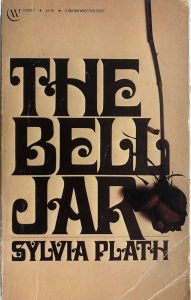 Given my love of mental hospital accounts and women’s autofiction, it’s a wonder I’d not read this before my forties. It was first published under the pseudonym “Victoria Lucas” because Plath thought it immature, “an autobiographical apprentice work which I had to write in order to free myself from the past.” Esther Greenwood is the stand-in for Plath: a talented college student who, after working in New York City during the remarkable summer of 1953, plunges into mental ill health. Chapter 13 is amazing and awful at the same time as Esther attempts suicide thrice in one day, toying with a silk bathrobe cord and ocean waves before taking 50 pills and walling herself into a corner of the cellar. She bounces between various institutional settings, undergoing electroshock therapy – the first time it’s horrible, but later, under a kind female doctor, it’s more like it’s ‘supposed’ to be: a calming reset.
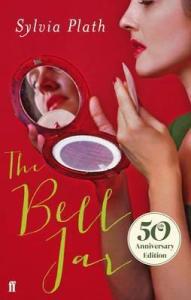 The 19-year-old is obsessed with the notion of purity. She has a couple of boyfriends but decides to look for someone else to take her virginity. Beforehand, the asylum doctor prescribes her a fitting for a diaphragm. A defiant claim to the right to contraception despite being unmarried is a way of resisting the bell jar – the rarefied prison – of motherhood. Still, Esther feels guilty about prioritizing her work over what seems like feminine duty: “Why was I so maternal and apart? Why couldn’t I dream of devoting myself to baby after fat puling baby? … I was my own woman.” Plath never reconciled parenthood with poetry. Whether that’s the fault of Ted Hughes, or the times they lived in, who can say. For her and for Esther, the hospital is a prison as well – but not so hermetic as the turmoil of her own mind. How ironic to read “I took a deep breath and listened to the old brag of my heart. I am, I am, I am” knowing that this was published just a few weeks before this literary genius ceased to be.
Apart from an unfortunate portrayal of a “negro” worker at the hospital, this was an enduringly relevant and absorbing read, a classic to sit alongside Emily Holmes Coleman’s The Shutter of Snow and Janet Frame’s Faces in the Water.
(Secondhand – it’s been in my collection so long I can’t remember where it’s from, but I’d guess a Bowie Library book sale or Wonder Book & Video / Public library – I was struggling with the small type so switched to a recent paperback and found it more readable)
Ariel by Sylvia Plath (1965)
Impossible not to read this looking for clues of her death to come:
Dying
Is an art, like everything else.
I do it exceptionally well.
(from “Lady Lazarus”)
Eternity bores me,
I never wanted it.
(from “Years”)
The woman is perfected.
Her dead
Body wears the smile of accomplishment
(from “Edge”)
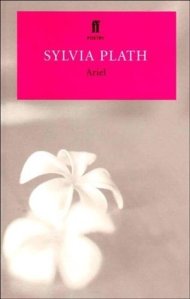 I feel incapable of saying anything fresh about this collection, which takes no prisoners. The images and vocabulary are razor-sharp. First and last lines or stanzas are particularly memorable. (“Morning Song” starts “Love set you going like a fat gold watch”; “Lady Lazarus” ends “Out of the ash / I rise with my red hair / And I eat men like air.”) Words and phrases repeat and gather power as they go. “The Applicant” mocks the obligations of a wife: “A living doll … / It can sew, it can cook. It can talk, talk, talk. … // … My boy, it’s your last resort. / Will you marry it, marry it, marry it.” I don’t know a lot about Plath’s family life, only that her father was a Polish immigrant and died after a long illness when she was eight, but there must have been some daddy issues there – after all, “Daddy” includes the barbs “Daddy, I have had to kill you” and “If I’ve killed one man, I’ve killed two— / The vampire who said he was you / And drank my blood for a year, / Seven years, if you want to know.” It ends, “Daddy, daddy, you bastard, I’m through.” Several later poems in a row, including “Stings,” incorporate bee-related imagery, and Plath’s father was an international bee expert. I can see myself reading this again and again in future, and finding her other collections, too – all but one of them posthumous. (Secondhand – RSPCA charity shop, Newbury)
The Group by Lara Feigel (and Mary McCarthy)
Lara Feigel’s memoir Free Woman was one of my favourite books of 2018. In it she interrogates conventions of marriage and motherhood while rereading the works of Doris Lessing – The Golden Notebook (1962), in particular, dramatizes women’s struggles to combine their disparate roles into a harmonious identity. Drawing inspiration from Lessing as well as from another early feminist novel, The Group by Mary McCarthy (more on this below), Feigel’s debut novel crafts a kaleidoscopic portrait of five women’s lives in 2018.
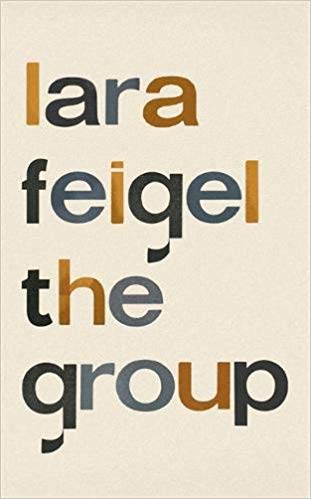 Stella, Kay, Helena, Polly and Priss met at a picnic while studying at Oxbridge and decided to rent a house together. Now 40-ish, they live in London and remain close, though their lives have branched in slightly different directions. Kay is an English teacher but has always wanted to be a novelist like her American husband, Harald. Priss is a stay-at-home mother excited to be opening a café. Polly, a gynaecological consultant at St Thomas’s Hospital, is having an affair with a married colleague. Helena, a single documentary presenter, decides she wants to have a baby and pursues insemination via a gay friend.
Narrating her friends’ lives as well as her own is Stella, an editor at a Faber-like publishing house whose director (also Helena’s uncle) is under investigation for sexual misconduct. Stella, a stand-in for the author, has split from her husband and has a new baby via IVF as well as an older child; this hint of autofiction lends the book an intimacy it might have lacked with an omniscient perspective. Although you have to suspend disbelief in a few places – could Stella really know so many details of her friends’ lives? – it feels apt that she can only understand these other women in relation to herself. Her voice can be catty, but is always candid, and Feigel is astute on the performative aspects of femininity.
Fast-forward a Sally Rooney novel by about 20 years and you’ll have an idea of what to expect here. It is a sexually frank and socially engaged narrative that arose from the context of the #MeToo movement and fully acknowledges the privilege and limitations of its setting. The characters express guilt over lamenting middle-class problems while there is such suffering in the wider world – we glimpse this in Polly’s work with African girls who have undergone genital mutilation. The diversity is limited to Black boyfriends, Helena’s bisexuality, and the fact that one group member decides not to have children (that 1 in 5 is statistically accurate).
The advantage of the apparent heterogeneity in the friend group, though, is that it highlights depths of personality and subtleties of experience. Stella even sees herself as an amateur anthropologist:
So here we are then. Five exact contemporaries who once shared a cluttered, thin-walled student house off the Cowley Road, all privileged, white, middle-class, all vestigial hangers-on, left over from an era when we received free educations at our elite university and then emerged into a world where we could still just about find jobs and buy flats, provided with opportunities for selfishness and leisure by our cleaners and our childminders. Nothing very eventful happens to us, but that gives more room for the ethnographer in me to get to work.
Feigel previously wrote two group biographies of cultural figures of the Second World War era, and she applies that precise skill set – capturing the atmosphere of a time period; noting similarities but also clear distinctions between people – to great effect here. You’ll recognize aspects of yourself in all of the characters, and be reminded of how grateful you are for (or how much you wish you had) friends whom you know will always be there for you. It’s an absorbing and relevant novel that ranks among my few favourites of the year so far.
My rating: 
The Group was published by JM Originals (John Murray) on July 2nd. My thanks to the publisher for the free copy for review.
Readalikes: The Radiant Way by Margaret Drabble, Girl, Woman, Other by Bernardine Evaristo, and Expectation by Anna Hope.
See Susan’s review also.
The Group by Mary McCarthy (1963)
As soon as I heard about Lara Feigel’s forthcoming novel, I unearthed the Mary McCarthy paperback I’d plucked from Bookbarn’s shelves in 2017. I decided to read Feigel’s first, lest it feel less than fresh; perhaps inevitably, McCarthy’s felt dated in comparison. I had trouble engaging with it as a whole, but still enjoyed contrasting the two books.
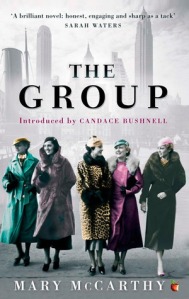 McCarthy focuses on eight girls from the Vassar class of ’33. Kay, the first to marry, has an upper-crust New York City wedding one week after graduation. But after Harald loses his theatre job, his cocktail habit and their luxury apartment soon deplete Kay’s Macy’s salary. Meanwhile, Dottie loses her virginity to Harald’s former neighbour in a surprisingly explicit scene. Contraception is complicated, but not without comic potential – as when Dottie confuses a pessary and a peccary. Career, romance, and motherhood are all fraught matters.
Feigel borrows the names of four of her five group members, plus those of some secondary characters, from McCarthy, with Stella a new character perhaps inspired in part by McCarthy’s Libby, who wants to work with books but, after delivering an earnest report on a 500-page pot-boiler, hears that “we really have no work that you’re uniquely qualified to do. You’re one of thousands of English majors who come pouring out of the colleges every June, stage-struck to go into publishing.” (That sure sounds familiar!)
Narrowing the circle and introducing a first-person narrator were wise choices that made Feigel’s version more accessible. Both, though, are characterized by forthright commentary and a shrewd understanding of human motivations. I’ll try again with McCarthy’s The Group someday, but for now I’m planning to pick up her Memories of a Catholic Girlhood.
Note: Mary McCarthy is one of the authors profiled in Michelle Dean’s Sharp.
 Bookish Beck = Rebecca Foster. American transplant to England. Freelance proofreader and book reviewer.
 Bookish Beck