Book Serendipity, January to February 2024
I call it “Book Serendipity” when two or more books that I read at the same time or in quick succession have something in common – the more bizarre, the better. This is a regular feature of mine every couple of months. Because I usually have 20–30 books on the go at once, I suppose I’m more prone to such incidents. The following are in roughly chronological order.
- I finished two poetry collections by a man with the surname Barnett within four days in January: Murmur by Cameron Barnett and Birds Knit My Ribs Together by Phil Barnett.

- I came across the person or place name Courtland in The Optimist’s Daughter by Eudora Welty, then Cortland in a story from The Orange Fish by Carol Shields, then Cotland (but where? I couldn’t locate it again! Was it in Elizabeth Is Missing by Emma Healey?).
- The Manet painting Olympia is mentioned in Christmas Holiday by W. Somerset Maugham and The Paris Novel by Ruth Reichl (both of which are set in Paris).


- There’s an “Interlude” section in Babel by R.F. Kuang and The Vulnerables by Sigrid Nunez.
- The Morris (Minor) car is mentioned in Elizabeth Is Missing by Emma Healey and Various Miracles by Carol Shields.
- The “flour/flower” homophone is mentioned in Babel by R.F. Kuang and Various Miracles by Carol Shields.
- A chimney swift flies into the house in Cat and Bird by Kyoko Mori and The Optimist’s Daughter by Eudora Welty.
- A character named Cornelius in The Fruit Cure by Jacqueline Alnes and Wellness by Nathan Hill.
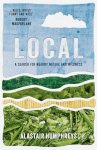
- Reading two year challenge books at the same time, A Year of Biblical Womanhood by Rachel Held Evans and Local by Alastair Humphreys, both of which are illustrated with frequent black-and-white photos by and of the author.
- A woman uses a bell to summon children in one story of Universally Adored and Other One Dollar Stories by Elizabeth Bruce and The Optimist’s Daughter by Eudora Welty.
- Apple turnovers get a mention in A Year of Biblical Womanhood by Rachel Held Evans and Wellness by Nathan Hill.
- A description of rolling out pie crust in A Year of Biblical Womanhood by Rachel Held Evans and Cat and Bird by Kyoko Mori.

- The idea of a house giving off good or bad vibrations in Wellness by Nathan Hill and a story from Various Miracles by Carol Shields.

- Emergency C-sections described or at least mentioned in Brother Do You Love Me by Manni Coe, The Unfamiliar by Kirsty Logan, Wellness by Nathan Hill, and lots more.
- Frustration with a toddler’s fussy eating habits, talk of “gentle parenting” methods, and mention of sea squirts in Wellness by Nathan Hill and Matrescence by Lucy Jones.
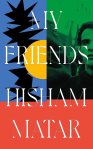
- The nickname “Poet” in The Tidal Year by Freya Bromley and My Friends by Hisham Matar.
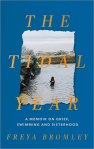
- A comment about seeing chicken bones on the streets of London in The Tidal Year by Freya Bromley and Went to London, Took the Dog by Nina Stibbe.
- Swans in poetry in The Tidal Year by Freya Bromley and Egg/Shell by Victoria Kennefick.
- A mention or image of Captcha technology in Egg/Shell by Victoria Kennefick and Went to London, Took the Dog by Nina Stibbe.
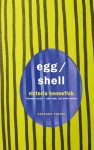

- An animal automaton in Loot by Tania James and Egg/Shell by Victoria Kennefick.
- A mention of Donna Tartt in The Tidal Year by Freya Bromley, Looking in the Distance by Richard Holloway, and Matrescence by Lucy Jones.
- Cathy Rentzenbrink appears in The Tidal Year by Freya Bromley and Went to London, Took the Dog by Nina Stibbe.
 Dialogue is given in italics in the memoirs The Tidal Year by Freya Bromley and The Unfamiliar by Kirsty Logan.
- An account of a man being forced to marry the sister of his beloved in A Year of Biblical Womanhood by Rachel Held Evans, Wellness by Nathan Hill, and The Tiger’s Wife by Téa Obreht.
- Saying that one doesn’t want to remember the loved one as ill (but really, not wanting to face death) so not saying goodbye (in Cat and Bird by Kyoko Mori) or having a closed coffin (Wellness by Nathan Hill).
- An unhappy, religious mother who becomes a hoarder in Wellness by Nathan Hill and I’m Glad My Mom Died by Jennette McCurdy.
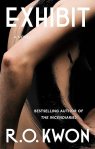
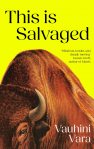
- Characters called Lidija and Jin in Exhibit by R. O. Kwon and Lydia and Jing in the first story of This Is Salvaged by Vauhini Vara.
- Distress at developing breasts in Cactus Country by Zoë Bossiere and I’m Glad My Mom Died by Jennette McCurdy.
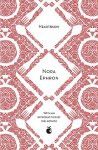
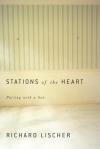
- I came across mentions of American sportscaster Howard Cosell in Heartburn by Nora Ephron and Stations of the Heart by Richard Lischer (two heart books I was planning on reviewing together) on the same evening. So random!
- Girls kissing and flirting with each other (but it’s clear one partner is serious about it whereas the other is only playing or considers it practice for being with boys) in Cactus Country by Zoë Bossiere and Winter’s Bone by Daniel Woodrell.
- A conversion to Catholicism in Places I’ve Taken My Body by Molly McCully Brown and Stations of the Heart by Richard Lischer.
- A zookeeper is attacked by a tiger when s/he goes into the enclosure (maybe not the greatest idea!!) in Tiger by Polly Clark and The Tiger’s Wife by Téa Obreht.

- The nickname Frodo appears in Tiger by Polly Clark and Brother Do You Love Me by Manni Coe.
- Opening scene of a parent in a coma, California setting, and striking pink and yellow cover to Death Valley by Melissa Broder and I’m Glad My Mom Died by Jennette McCurdy.

- An Englishman goes to Nigeria in Howards End by E.M. Forster and Immanuel by Matthew McNaught.
 The Russian practice of whipping people with branches at a spa in Tiger by Polly Clark and Fight Night by Miriam Toews.
- A mother continues washing her daughter’s hair until she is a teenager old enough to leave home in Mrs. March by Virginia Feito and I’m Glad My Mom Died by Jennette McCurdy.
- Section 28 (a British law prohibiting the “promotion of homosexuality” in schools) is mentioned in A Bookshop of One’s Own by Jane Cholmeley, Some Kids I Taught and What They Taught Me by Kate Clanchy, and Brother Do You Love Me by Manni Coe.
- Characters named Gord (in one story from Various Miracles by Carol Shields, and in Fight Night by Miriam Toews), Gordy (in The Absolutely True Diary of a Part-Time Indian by Sherman Alexie), and Gordo (in Blood Red by Gabriela Ponce).

- Montessori and Waldorf schools are mentioned in Cactus Country by Zoë Bossiere and When Fragments Make a Whole by Lory Widmer Hess.
- A trailer burns down in The Absolutely True Diary of a Part-Time Indian by Sherman Alexie and Cactus Country by Zoë Bossiere.
What’s the weirdest reading coincidence you’ve had lately?
Winter Reads: Claire Tomalin, Daniel Woodrell & Picture Books
Mid-February approaches and we’re wondering if the snowdrops and primroses emerging here in the South of England mean that it will be farewell to winter soon, or if the cold weather will return as rumoured. (Punxsutawney Phil didn’t see his shadow, but that early-spring prediction is only valid for the USA, right?) I didn’t manage to read many seasonal books this year, but I did pick up several short works with “Winter” in the title: a little-known biographical play from a respected author, a gritty Southern Gothic novella made famous through a Jennifer Lawrence film, and two picture books I picked up at the library last week.
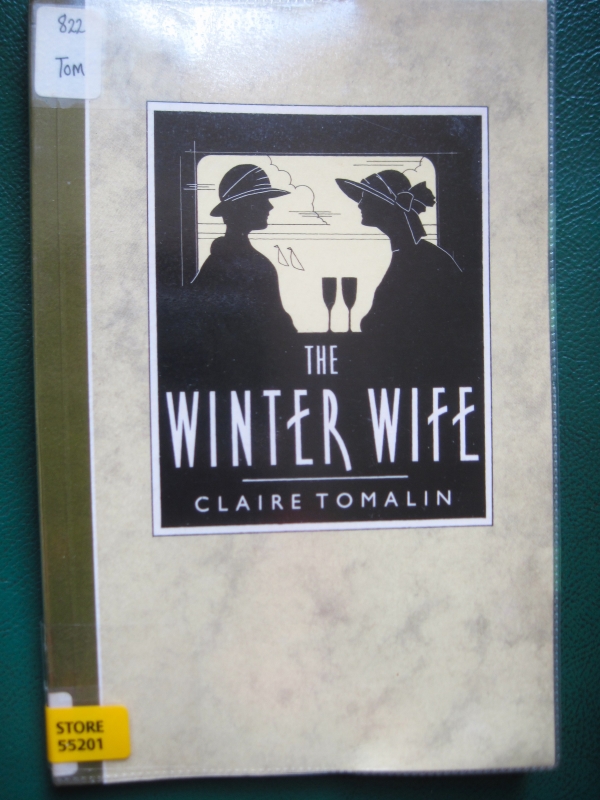
The Winter Wife by Claire Tomalin (1991)
A search of the university library catalogue turned up this Tomalin title I’d never heard of. It turns out to be a very short play (two acts of seven scenes each, but only running to 44 pages in total) about a trip abroad Katherine Mansfield took with her housekeeper?/companion, Ida Baker, in 1920. Ida clucks over Katherine like a nurse or mother hen, but there also seems to be latent, unrequited love there (Mansfield was bisexual, as I knew from fellow New Zealander Sarah Laing’s fab graphic memoir Mansfield and Me). Katherine, for her part, alternately speaks to Ida, whom she nicknames “Jones,” with exasperation and fondness. The title comes from a moment late on when Katherine tells Ida “you’re the perfect friend – more than a friend. You know what you are, you’re what every woman needs: you’re my true wife.” Maybe what we’d call a “work wife” today, but Ida blushes with pride.
Tomalin had already written a full-length biography of Mansfield, but insists she barely referred to it when composing this. The backdrops are minimal: a French sleeper train; Isola Bella, a villa on the French Riviera; and Dr. Bouchage’s office. Mansfield was ill with tuberculosis, and the continental climate was a balm: “The sun gets right into my bones and makes me feel better. All that English damp was killing me. I can’t think why I ever tried to live in England.” There are also financial worries. The Murrys keep just one servant, Marie, a middle-aged French woman who accompanies her on this trip, but Katherine fears they’ll have to let her go if she doesn’t keep earning by her pen.
Through Katherine’s conversations with the doctor, we catch up on her romantic history – a brief first marriage, a miscarriage, and other lovers. Dr. Bouchage believes her infertility is a result of untreated gonorrhea. He echoes Ida in warning Katherine that she’s working too hard – mostly reviewing books for her husband John Middleton Murry’s magazine, but also writing her own short stories – when she should be resting. Katherine retorts, “It is simply none of your business, Jones. Dr Bouchage: if I do not work, I might as well be dead, it’s as simple as that.”
She would die not three years later, a fact that audiences learn through a final flash-forward where Ida, in a monologue, contrasts her own long life (she lived to 90 and Tomalin interviewed her when she was 88) with Katherine’s short one. “I never married. For me, no one ever equalled Katie. There was something golden about her.” Whereas Katherine had mused, “I thought there was going to be so much life then … that it would all be experience I could use. I thought I could live all sorts of different lives, and be unscathed…”
The play is, by its nature, slight, but gives a lovely sense of the subject and her key relationships – I do mean to read more by and about Mansfield. I wonder if it has been performed much since. And how about this for unexpected literary serendipity?
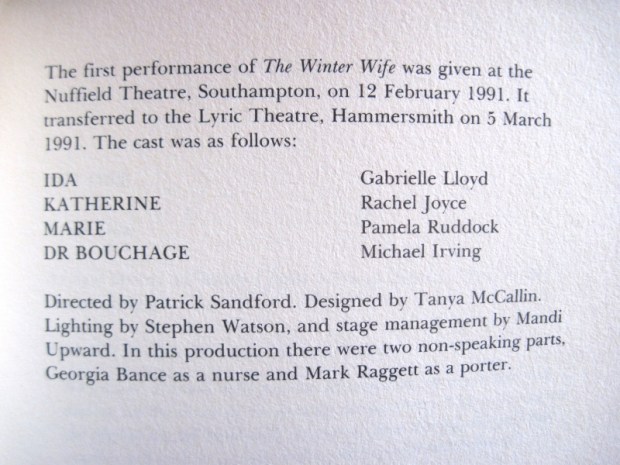
Yes, it’s that Rachel Joyce. (University library) 
Winter’s Bone by Daniel Woodrell (2006)
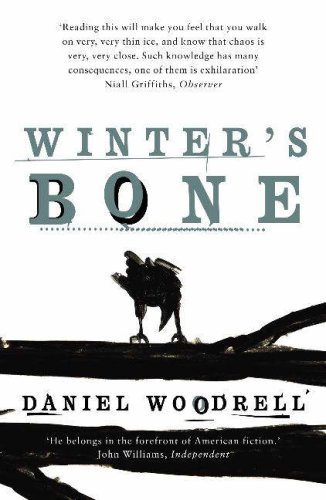 I’d seen the movie but hadn’t remembered just how bleak and violent the story is, especially considering that the main character is a teenage girl. Ree Dolly lives in Ozarks poverty with a mentally ill, almost catatonic mother and two younger brothers whom she is effectively raising on her own. Their father, Jessup, is missing; rumour has it that he lies dead somewhere for snitching on his fellow drug producers. But unless Ree can prove he’s not coming back, the bail bondsman will repossess the house, leaving the family destitute.
Forced to undertake a frozen odyssey to find traces of Jessup, she’s unwelcome everywhere she goes, even among extended family. No one is above hitting a girl, it seems, and just for asking questions Ree gets beaten half to death. Her only comfort is in her best friend, Gail, who’s recently given birth and married the baby daddy. Gail and Ree have long “practiced” on each other romantically. Without labelling anything, Woodrell sensitively portrays the different value the two girls place on their attachment. His prose is sometimes gorgeous –
Pine trees with low limbs spread over fresh snow made a stronger vault for the spirit than pews and pulpits ever could.
– but can be overblown or off-puttingly folksy:
Ree felt bogged and forlorn, doomed to a spreading swamp of hateful obligations.
Merab followed the beam and led them on a slow wamble across a rankled field
This was my second from Woodrell, after the short stories of The Outlaw Album. I don’t think I’ll need to try any more by him, but this was a solid read. (Secondhand – New Chapter Books, Wigtown)
Children’s picture books:
 Winter Sleep: A Hibernation Story by Sean Taylor and Alex Morss [illus. Cinyee Chiu] (2019): My second book by this group; I read Busy Spring: Nature Wakes Up a couple of years ago. Granny Sylvie reassures her grandson that everything hasn’t died in winter, but is sleeping or in hiding beneath the ice or behind the scenes. As before, the only niggle is that European and North American species are both mentioned and it’s not made clear that they live in different places. (Public library)
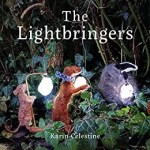 The Lightbringers: Winter by Karin Celestine (2020): An unusual artistic style here: every spread is a photograph of felted woodland creatures. The focus is on midwinter and the hope of the light coming back – depicted as poppy seed heads, lit from within and carried by mouse, hare, badger and more. “The light will always return because it is guarded by small beings and they are steadfast in their task.” The first of four seasonal stories. (Public library)
Any wintry reading (or weather) for you lately?
Sidle Creek by Jolene McIlwain (Blog Tour)
I’m a sucker for “dirty realism,” a term coined in the 1980s to encompass gritty stories of blue-collar Americana: Ron Rash, David Vann, Daniel Woodrell et al. (I wrote a whole article about it in 2013). It’s less common, certainly, to find women writing in this subgenre, and that feminine touch is part of what makes Sidle Creek unique. In this debut collection of 22 short stories, loosely linked by their location in the Appalachian hills in western Pennsylvania and a couple of recurring minor characters, Jolene McIlwain softens the harsh realities of addiction, poverty and violence with the tender bruises of infertility and lost love.
The title story, which opens the book, has a shifting first-person point-of-view, first telling us about and then putting us into the mind of Esme Andersen, who’s 20 in 1975. Various diagnoses have plagued her family, medical words that repeat as chants: hemorrhage, endometriosis. Superstitions around the creek cast it alternately as a potential site of harm or healing as her single father tries to help her deal with her severe periods. The cover image comes from “Shell,” in which Tiller Shanty reads signs in the markings on red-winged blackbird eggs. He learned his skill of divination from his Vietnamese wife, but conceals from her a portent about her future. It turns out there’s more than one way to lose a beloved.
Grief is a resonant theme in so many of the stories. “The Fractal Geometry of Grief” is a shining example. Hubert Ashe, a widowed mathematician, becomes obsessed with a doe and sets up trail cams and a feeding station to watch her. It’s not clear whether he believes the animal is a reincarnation of his wife or not, but it’s unwise to get so attached in a hunting area. In “Seeds,” a man finds a photograph of his dying wife as a girl and revisits the sadness of her life. “Steer,” one of the most affecting stories, has a middle-aged man hit by anxiety, unable to forget the death of one of their cattle back when he was 16. As horrific as the experience was, it made him receptive to both beauty and pain.
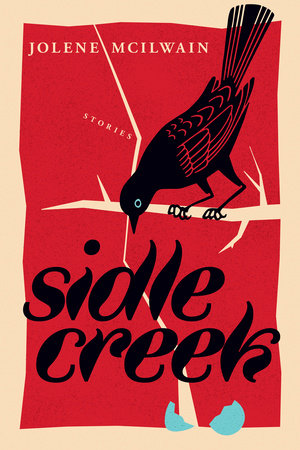
Animal suffering is indeed frequent – something that seems important to mention, as I know a lot of readers who avoid scenes of it whenever possible. In “Eminent Domain,” the electricity shed where teenagers used to go drinking is found to be full of slaughtered cats. It’s the prompt the protagonist needs to escape this dead-end town. “Loosed” is a masterpiece in the vein of Demon Copperhead (though much more violent) about a man who makes money on increasingly cruel sport: cock fighting, then dog fighting, then dirty fights between his own four sons. The flash forward that ends this one is devastating. I, too, am sensitive to reading about animal deaths, but the animal suffering only matches the human here. The nastiness of “The Less Said” makes that plain.
Pregnancy or infant loss is a recurring element. In just three pages, “Seed to Full” expresses a world of sorrow as a woodworker crafts a coffin for his infant son. Even where it is not a central subject, infertility is mentioned in a number of stories. In “You Four Are the One,” four adolescent neighbor girls help Cinta Johns out around the house, hoping with her that this fifth pregnancy will be the one that lasts. “The Steep Side,” a memorable closer that shifts between past and future, has a teen coming across a crashed van, a heavily pregnant woman, and an older woman claiming to be a nurse. What he sees haunts him into adulthood.
There’s an air of mystery to that one, and particularly in “Those Red Boots,” about the disappearance of a waitress who worked at a Hooters-style joint where all the comely staff wear the same uniforms and perform titillating dances. My preference was for longer stories like this where you get greater depth of characterization and more scenes and dialogue. I might have considered cutting a handful of the flash-length stories. However, even in these micro-fictions, there are still interesting setups. My favorite among them was “The Fourth,” in which Independence Day fireworks are triggering for shell-shocked Uncle Ron.
At times harrowing, always clear-eyed, these stories are true to life and compassionate about human foibles and animal pain. I would highly recommend them to readers of Kent Haruf and Jayne Anne Phillips. McIlwain has such an established voice that this hardly seems like a first book. I can’t wait to read whatever she writes next.
With thanks to Melville House for the proof copy for review.
Buy Sidle Creek from Bookshop.org [affiliate link]
I was delighted to be invited to participate in the blog tour for Sidle Creek. See below for details of where other reviews have appeared or will be appearing soon.
Short Story Collections Read Recently
This is the third year in a row that I’ve made a concerted effort to read more short stories in the alliterative month of September; see also my 2016 and 2017 performances. (I actually finished Sarah Hall’s collection in late August, but I’m going to cheat and include it anyway.) That makes for four volumes in total read recently. Surprisingly, I had my best luck with two that were published back in the early 1990s.
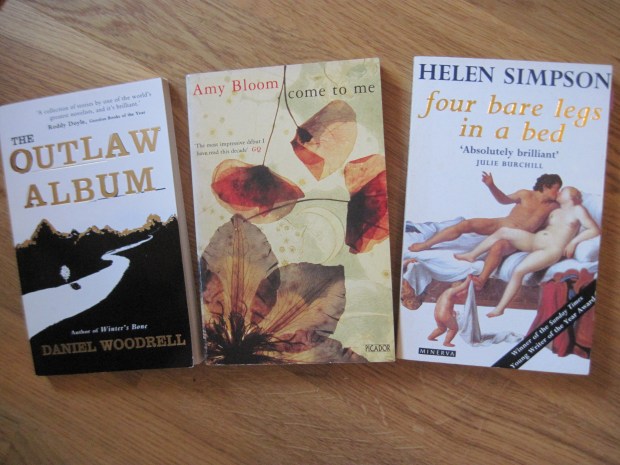
I read Sarah Hall’s book from the library; these three were bargains from my local charity warehouse, the Community Furniture Project.
Like many devoted novel readers, I struggle with short stories because they can feel fragmentary or open-ended, and it takes that much more effort to keep up with multiple settings and groups of characters. Yet I also get frustrated when the narrative voice and themes are too similar across a whole set of tales.
However, when done well short stories can be marvelous, of course. I enjoyed K.J. Orr’s article on short stories in the September 7th issue of the Times Literary Supplement. Among the virtues of the short story, she lists the following:
- “the capacity to stoke questions of definition and instability, resolution and irresolution … ; to deliver its conundrums to the reader in a state of compression”
- “The unpredictability involved means that picking up a new short story always feels to me a moment full of possibilities.”
- “The short story can combine complexity and uncertainty with ebullience and humour. It can take on subjects and situations that risk seeming clichéd and open them to wonder. It can put the familiar and the strange in conversation.”
And yet sometimes the quality of the writing, or at least the intensity of my engagement, can vary wildly within a story collection, which often makes the books difficult to rate and respond to as a whole. That’s what I found with these first two.
Madame Zero by Sarah Hall (2017)
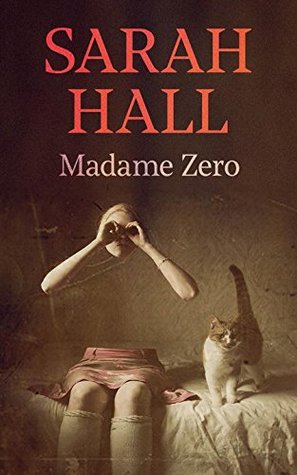 Three corkers; two pretty good; four been-there-read-that. My favorites were the first and last stories, “Mrs Fox” and “Evie” (winner of the BBC National Short Story Prize 2013 and shortlisted for the Sunday Times EFG Private Bank Short Story Award 2013, respectively). Both concern a fairly average marriage derailed when the wife undergoes a transformation. In the former Sophia literally turns into a fox and her husband scrambles for a way to make the relationship last. In “Evie,” Richard’s wife develops a voracious appetite for sweets and sex, and starts talking gibberish. This one is very explicit, but if you can get past that I found it both painful and powerful. I also especially liked “Case Study 2,” about a psychologist’s encounter with a boy who’s been brought up in a commune. It has faint echoes of T.C. Boyle’s “The Wild Child.”
“Wilderness” focuses on an intense episode of fear of heights during a trip to South Africa. In “Luxury Hour,” a new mother meets up with an old lover near the swimming pool they used to frequent and wonders where and why their lives diverged. This one reminded me of the first chapter of Rachel Cusk’s Transit.
As for the rest? “Goodnight Nobody” was completely forgettable, and the other three are in the vague speculative/post-apocalyptic vein that’s been done to death: “Theatre 6” = Red Clocks; “Later, His Ghost” = The Road et al.; “One in Four” = Station Eleven et al. I admire Hall’s writing in general, but The Wolf Border remains the best thing I’ve read by her.
My rating: 
The Outlaw Album: Stories by Daniel Woodrell (2011)
 Based on the first six stories, I was planning a 5-star rating. (How can you resist this opening line? “Once Boshell finally killed his neighbor he couldn’t seem to quit killing him.”) But the second half of the book ended up being much less memorable; I wouldn’t say it wasn’t worth reading, but I got very little out of four of the stories, and the other two were okay but somewhat insubstantial. By contrast, the first two stories, “The Echo of Neighborly Bones” and “Uncle,” are gritty little masterpieces of violence and revenge.
I also particularly liked “Black Step” and “Night Stand,” about traumatized soldiers back from war (Woodrell himself was a Marine). Each has a creepy segment where the veteran gives sarcastic answers to the unspecified typical questions they always get; we have to infer that these are: How many people did you kill? What’s it like to kill someone? and What do you do with the bodies? There’s a nice balance between first- and third-person voices; lyrical and unlearned prose; and speech marks and none. I will definitely read more by Woodrell.
My rating:
I thoroughly loved these next two debut collections. In each case I’d read one or two previous books by the author and not been wild about the writing (White Houses; In-Flight Entertainment and Cockfosters), but these two have convinced me to try more of their work.
Come to Me by Amy Bloom (1993)
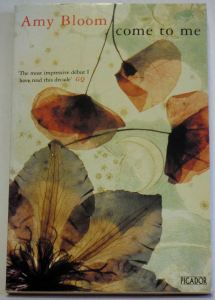 Bloom was a practicing psychotherapist, so it’s no surprise she has deep insight into her characters’ motivations. This is a wonderful set of stories about people who love who they shouldn’t love. In “Song of Solomon,” a new mother falls for the obstetrician who delivered her baby; in “Sleepwalking,” a woman gives in to the advances of her late husband’s son from a previous marriage; in “Light Breaks Where No Sun Shines,” adolescent Susan develops crushes on any man who takes an interest in her. My favorite was probably “Love Is Not a Pie,” in which a young woman rethinks her impending marriage during her mother’s funeral, all the while remembering the unusual sleeping arrangement her parents had with another couple during their joint summer vacations. The title suggests that love is not a thing to be apportioned out equally until it’s used up, but a more mysterious and fluid entity.
Linked short stories can be a useful halfway-house for readers who prefer novels and are still unsure about reading stories. Happily, then, the heart of this collection is five pieces that orbit around the same characters. In “Hyacinths” we meet David as a boy in Manitoba and get a glimpse of him as an adult. In the next story we encounter his second wife, Galen, and her lover, Henry. “Silver Water” is about a mental health crisis with David and Galen’s daughter, and the next two stories are about Henry, his wife Marie, and the other bonds they form.
Although I read the book quickly while on holiday and so haven’t marked out any particular quotes, convincing dialogue and insightful observations are on almost every page. I was reminded most of short stories I’ve read by Elizabeth McCracken and Carol Shields.
My rating: 
Four Bare Legs in a Bed and Other Stories by Helen Simpson (1990)
 Simpson won the inaugural Sunday Times Young Writer of the Year Award for this in 1991. Her protagonists are women disillusioned with the norms of marriage and motherhood. They ditch their safe relationships, or carry on brazen affairs; they fear pregnancy, or seek it out on their own terms. The feminist messages are never strident because they are couched in such brisk, tongue-in-cheek narratives. For instance, in “Christmas Jezebels” three sisters in 4th-century Lycia cleverly resist their father’s attempts to press them into prostitution and are saved by the bishop’s financial intervention; in “Escape Clauses” a middle-aged woman faces the death penalty for her supposed crimes of gardening naked and picnicking on private property, while her rapist gets just three months in prison because she was “asking for it.” (Nearly three decades on, it’s still so timely it hurts.)
I loved “The Bed,” a kind of fairy tale about a luxurious bed solving all a woman’s problems; “What Are Neighbours For,” in which each woman cattily plans what she can get out of the others; “Labour,” a brief five-act play set in a hospital delivery room; and “Zoë and the Pedagogues,” about a woman learning to drive who has two very different teachers (perhaps inevitably, this recalled Mirror, Shoulder, Signal by Dorthe Nors). “An Interesting Condition,” which takes place in an antenatal class, is like Curtis Sittenfeld’s “Bad Latch,” while multiple stories reminded me of Shena Mackay, especially “Send One Up for Me,” about a woman tiptoeing around her boarding house and trying not to anger the landlady.
My rating:
Are you a short story fan? Read any good ones recently?
Bloggers’ Opinions Must Not Be Bought: A Cautionary Tale
I’m leery of accepting self-published work for review. If this is prejudice on my part, it’s not unjustified: I’ve reviewed hundreds of self-published books during my four years of freelance work for Kirkus, Foreword, BlueInk, Publishers Weekly, and The Bookbag, and although I do find the very occasional gem that could hold its own in a traditional market, the overall quality is poor. When self-published authors get in touch via my blog, I usually delete their enquiries immediately. But for some reason I decided to give a second look to a request I received through Goodreads earlier this year. (All identifying details have been removed.)
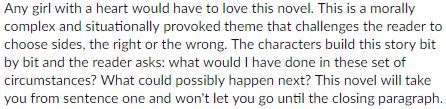
I’ll admit it: the flattery probably helped:
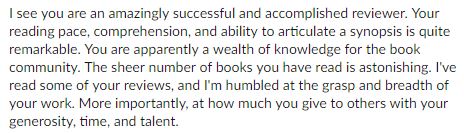
This was for a historical novel that had 4-star reviews from two Goodreads friends whose judgment I trust, so I agreed to have the author send a copy to my parents’ house in the States so that it would be waiting for me there when I arrived for my recent trip. When I opened the box, two alarm bells rang at once. First there was this. Uh oh.

Second of all: the author had taken the trouble of looking up restaurants in my parents’ area and ordered a $60 gift card from one of them to send along with the book parcel. Double uh oh.
I spent weeks wondering what in the world I was going to do about this ethical quandary. I even contacted a Goodreads friend who’d reviewed the book and asked what their experience with the author had been like. The reply was very telling:
I still feel unsettled over my interaction with [name redacted]. I’ve always made it a point not to review unsolicited books. But over a period of several weeks, [they] sent me a number of emails that ranged from flattering to fawning – and always polite and charming. Eventually, I, too, received a $60 gift card to a favorite restaurant that was within blocks of my home. I ended up, I believe, 4 starring [the] book, although the truth is that it was more of a 3-star read. Since reviewing, I have valued my independence – and honesty – and since then, have had the uncomfortable feeling of being “bought”, and for a low price at that.
I cannot tell you what to do. Obviously, I feel as if my own values were compromised. For me, it wasn’t worth what I still believe is a blot on my integrity. If you do decide to review, I’d simply encourage you to be honest because (I learned the hard way) the aftermath isn’t a good feeling.
Well, I’d promised to review the book, so I forced myself to open it, pencil in hand. After I’d corrected 10 problems of punctuation and grammar within the first six pages, I commenced skimming. There were some decent folksy metaphors and a not-half-bad dual narrative of a young woman’s odyssey and a small town’s feuds. But there were also dreadful sex scenes, melodramatic plot turns, and dialogue and slang that didn’t ring true for the time period. If I squinted pretty darn hard, I could see my way to likening the novel to the works of Ron Rash and Daniel Woodrell. But it wasn’t by any means a book I could genuinely recommend.
So when the author checked up a couple of months later to see whether I had gotten the book and what I thought of it, here’s what I replied:

I received the following abject apology, but no helpful information.

To my brief follow-up –

– I received this:
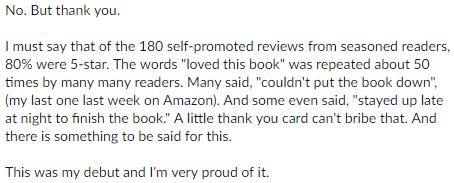
Note the phrase “self-promoted” and the meaningless repetition of “couldn’t put it down!”
And then they went on to disparage me for my age?!

I don’t believe for a minute that this person was ignorant of what they were doing in sending the gift cards. What’s saddest to me is that they have zero interest in getting an honest opinion of the work or hearing constructive criticism that could help them improve. They clearly don’t respect professionals’ estimation, either, or they’d be brave enough to pay for a review from Kirkus or another independent body. Instead, they’ve presumably been ‘paying’ $60 a pop to get fawning but utterly false 5-star reviews. Just imagine how much money they’ve spent on shipping and ‘thank-you gifts’ – easily many thousands of dollars.
And could I really have been the first in 180+ people to express misgivings about what was going on here? How worrying.
I was tempted to be generous and give the novel the briefest of 3-star reviews, perhaps as an addendum to another review on my blog, just so that I could feel justified in keeping the gift card and not have to face a confrontation with the author. But it didn’t feel right. If I want my reviews to have integrity, they have to reflect my honest opinions. As it stands, I have the gift card in an envelope, ready to be returned to the author when I’m in the States for my sister’s wedding next month; the book will most likely get dropped off at a Little Free Library.
If I was a vindictive person, I’d be going on Goodreads and Amazon and giving the book a 1-star review: as a necessary corrective to the bogus 5-star ones, and as a way of exposing this dodgy self-promotional activity. But that would in turn expose all of this person’s readers, including a valued Goodreads friend. And who knows how the author would try to retaliate.
So there you have it. My cautionary tale of a self-published author trying to buy my good opinion. What have I learned? Mostly to be even more wary of self-published work; possibly not to make any promises to review a book until I’ve seen a sample of it. But also to listen to my conscience and, when something is wrong, have the courage to speak out right away.
 Bookish Beck = Rebecca Foster. American transplant to England. Freelance proofreader and book reviewer.
 Bookish Beck