Spring Reads, Part II: Blossomise, Spring Chicken & Cold Spring Harbor
Our garden is an unruly assortment of wildflowers, rosebushes, fruit trees and hedge plants, along with an in-progress pond, and we’ve made a few half-hearted attempts at planting vegetable seeds and flower bulbs. It felt more like summer earlier in May, before we left for France; as the rest of the spring plays out, we’ll see if the beetroot, courgettes, radishes and tomatoes amount to anything. The gladioli have certainly been shooting for the sky!
I recently encountered spring (if only in name) through these three books, a truly mixed bag: a novelty poetry book memorable more for the illustrations than for the words, a fascinating popular account of the science of ageing, and a typically depressing (if you know the author, anyway) novel about failing marriages and families. Part I of my Spring Reading was here.
Blossomise by Simon Armitage; illus. Angela Harding (2024)
 Armitage has been the Poet Laureate for yonks now, but I can’t say his poetry has ever made much of an impression on me. That’s especially true of this slim volume commissioned by the National Trust: it’s 3 stars for Angela Harding’s lovely if biologically inaccurate (but I’ll be kind and call them whimsical) engravings, and 2 stars for the actual poems, which are light on content. Plum, cherry, apple, pear, blackthorn and hawthorn blossom loom large. It’s hard to describe spring without resorting to enraptured clichés, though: “Planet Earth in party mode, / petals fizzing and frothing / like pink champagne.” The haiku (11 of 21 poems) feel particularly tossed-off: “The streets are learning / the language of plum blossom. / The trees have spoken.” But others are sure to think more of this than I did.
A favourite passage: “Scented and powdered / she’s staging / a one-tree show / with hi-viz blossoms / and lip-gloss petals; / she’ll season the pavements / and polished stones / with something like snow.” (Public library) 
Spring Chicken: Stay Young Forever (or Die Trying) by Bill Gifford (2015)
 Gifford was in his mid-forties when he undertook this quirky journey into the science and superstitions of ageing. As a starting point, he ponders the differences between his grandfather, who swam and worked his orchard until his death from infection at 86, and his great-uncle, not so different in age, who developed Alzheimer’s and died in a nursing home at 74. Why is the course of ageing so different for different people? Gifford suspects that, in this case, it had something to do with Uncle Emerson’s adherence to the family tradition of Christian Science and refusal to go to the doctor for any medical concern. (An alarming fact: “The Baby Boom generation is the first in centuries that has actually turned out to be less healthy than their parents, thanks largely to diabetes, poor diet, and general physical laziness.”) But variation in healthspan is still something of a mystery.
Over the course of the book, Gifford meets all number of researchers and cranks as he attends conferences, travels to spend time with centenarians and scientists, and participates in the Baltimore Longitudinal Study of Aging. There have been some truly zany ideas about how to pause or reverse aging, such as self-dosing with hormones (Suzanne Somers is one proponent), but long-term use is discouraged. Some things that do help, to an extent, are calorie restriction and periodic fasting plus, possibly, red wine, coffee and aspirin. But the basic advice is nothing we don’t already know about health: don’t eat too much and exercise, i.e., avoid obesity. The layman-interpreting-science approach reminded me of Mary Roach’s. There was some crossover in content with Mark O’Connell’s To Be a Machine and various books I’ve read about dementia. Fun and enlightening. (New purchase – bargain book from Dollar Tree, Bowie, MD) 
Cold Spring Harbor by Richard Yates (1986)
 Cold Spring Harbor is a Long Island hamlet whose name casts an appropriately chilly shadow over this slim novel about families blighted by alcoholism and poor decisions. Evan Shepard, only in his early twenties, already has a broken marriage behind him after a teenage romance led to an unplanned pregnancy. Mary and their daughter Kathleen seem to be in the rearview mirror as he plans to return to college for an engineering degree. One day he accompanies his father into New York City for an eye doctor appointment and the car breaks down. The men knock on a random door and thereby become entwined with the Drakes: Gloria, the unstable, daytime-drinking mother; Rachel, her beautiful daughter; and Phil, her earnest but unconfident adolescent son.
Evan and Rachel soon marry and agree to Gloria’s plan of sharing a house in Cold Spring Harbor, where the Shepards live (Evan’s mother is also an alcoholic, but less functional; she hides behind the “invalid” label). Take it from me: living with your in-laws is never a good idea! As the Second World War looms, and with Evan and Rachel expecting a baby, it’s clear something will have to give with this uneasy family arrangement, but the dramatic break I was expecting – along the lines of a death or accident – never arrived. Instead, there’s just additional slow crumbling, and the promise of greater suffering to come. Although Yates’s character portraits are as penetrating as in Easter Parade, I found the plot a little lacklustre here. (Secondhand – Clutterbooks, Sedbergh) 
Any ‘spring’ reads for you recently?
Love Your Library, January 2023
Elle has been reading loads from the library (and discovering the freedom of DNFing or not reading the library books you borrow; this is not a problem in the least, and it still helps the library’s statistics!). Naomi always finds interesting books to read and review from her library system. Margaret’s “My Life in Book Titles 2022” almost exclusively featured books she’d borrowed from libraries. Through Twitter I saw this hilarious TikTok video from Cincinnati Library about collecting book holds. If only I could be so glamorous on my Tuesday volunteering mornings. Washington Post critic Ron Charles’s weekly e-newsletter is one of my greatest bookish joys and I was delighted to see him recently highlight an initiative from my hometown’s local library system. Whenever I go on the cross trainer, I read library books or my e-reader so exercise time isn’t ‘lost’ time when I could be reading.

Since last month:
READ
- A Night at the Frost Fair by Emma Carroll

- Bournville by Jonathan Coe

- A Heart that Works by Rob Delaney
- The Weather Woman by Sally Gardner
- Leila and the Blue Fox by Kiran Millwood Hargrave
- Standard Deviation by Katherine Heiny
- Our Missing Hearts by Celeste Ng
- Born a Crime: Stories from a South African Childhood by Trevor Noah
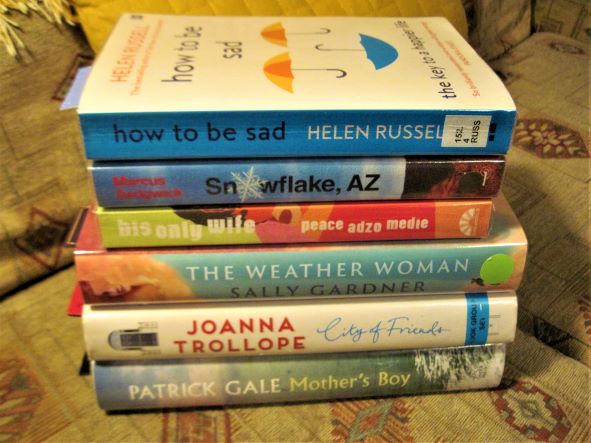
CURRENTLY READING
- Once Upon a Tome by Oliver Darkshire
- Martha Quest by Doris Lessing (for our women’s classics book club subgroup)
- How to Be Sad by Helen Russell
- Lucy by the Sea by Elizabeth Strout
- City of Friends by Joanna Trollope (for February’s book club)
- Crying in H Mart by Michelle Zauner
My library system has a ton of new books on order – I set up an alert so I would be e-mailed a weekly digest of all 2023 adult fiction and nonfiction releases added to the catalogue – so my reservation queue is nearly full now with all kinds of tempting stuff, including a new biography of Katherine Mansfield and a bereavement memoir by Blake Morrison, whose And When Did You Last See Your Father? was my favourite nonfiction read of 2018. In fiction, I’m particularly excited about The New Life by Tom Crewe, How Not to Drown in a Glass of Water by Angie Cruz, and Maame by Jessica George.
What have you been reading or reviewing from the library recently?

Share a link to your own post in the comments. Feel free to use the above image. The hashtag is #LoveYourLibrary.
The Perils of Sedentary Work
I’ve worked from home as a freelance writer and editor for a smidge over 2.5 years now, and I think the sedentary lifestyle is just starting to catch up with me in terms of my health. Now, it’s not like my previous library assistant job was particularly high-impact, but it at least meant a walk to the local train station, a walk on the other end from the London terminus to my building, daily activity in the form of shelving, errands on foot during my lunch break, and then the commute in reverse.
These days, with the exception of a weekly walk to the grocery store (0.6 mile away), a few strolls up the road to the playing field for some fresh air, and maybe biweekly vacuuming, I’m almost entirely inactive. I’ve never had any lively hobbies apart from walking/gentle hiking, which we only tend to do in earnest on holiday. I don’t have a bike, and I’ve never learned to drive in the UK; my husband takes the car to work most days anyway. Without the rhythms many people have of going out to work, chasing after kids, running errands, and so on, I’m pretty much confined to our flat and spend most of my time sitting down. Of course I could go on YouTube at any time to find aerobics and yoga videos, but do I? No way, José.

Desk setup #1
Just in the past couple weeks I’ve started noticing twinges in my fingers and thumbs and weakness in my forearm – worst with my right arm/hand, which I write with. It’s not really surprising given that I spend eight hours a day typing, mouse clicking, and hand-writing notes on review books, and that’s not even counting the writing I do on my own time. I belong to a Facebook forum for women writers, and hand trouble is certainly not unique to me. In one thread a few dozen ladies replied to chip in about hand pain and what to do about it. Their suggestions ran the gamut from ice packs and supplements to massages and acupuncture.
More generally, I’ve felt achy and lethargic. I never feel refreshed from sleep, and I end my low-energy days feeling mentally but also physically exhausted. Pangs in my lower back are almost certainly due to my posture at my two desk setups, but it was several years ago that I realized I no longer felt resilient to physical knocks. If I wrenched my neck too far to one side or tweaked my shoulder while reaching under the bed, I’d be feeling it for the whole rest of the day, if not longer. Last week it was my hips that ached. This week it’s the side of my left foot. Surely I shouldn’t feel quite so crumbly at the age of 32! Our mostly vegetarian diet is very good, so that’s not the issue – apart from a few vitamins I might be low on. What to do?
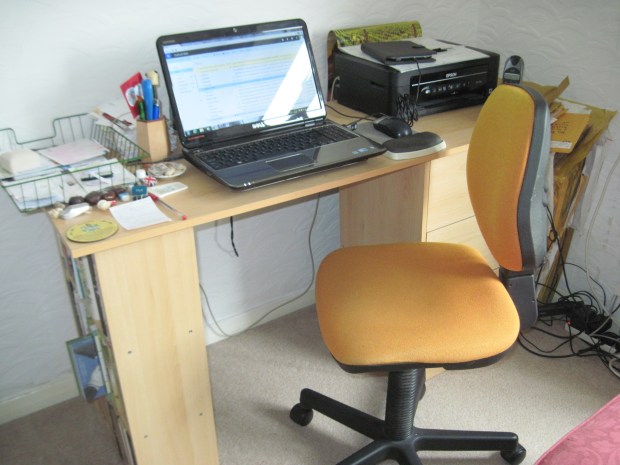
Desk setup #2
 A few books (it always comes back to books here) finally convinced me to do something about my health. You might be surprised to learn which ones. One is Winter World by Bernd Heinrich, a work of wildlife biology I featured in last week’s Books in Brief. In one chapter Heinrich marvels at how bears can hibernate for months without adverse physical effects, given that humans in extended bedrest studies suffer lost muscle mass and bone density, poor absorption of nutrients, and pre-diabetes levels of insulin resistance. “Our bodies are not adapted to inactivity,” he writes. “In our evolutionary history, in contrast to bears, exercise was a constant, and we’re not made to tolerate being idle for long.” A 25-year study of 17,000 Harvard graduates found “the stresses of inactivity mimic the aging response. Every hour of vigorous exercise as an adult was repaid with two hours of additional life span.” It’s no surprise that I’m feeling older than my age!
 I’ve also recently stumbled across Jenifer Joy Madden’s books, The Durable Human Manifesto (2013) and How to Be a Durable Human (coming out later this month). Here are a few of the things she taught me or reinforced:
- Computer work burns a quarter the calories of manual labor.
- “Excessive sitting is a lethal activity,” according to James Levine of the Mayo Clinic.
- A sedentary lifestyle increases the risks of DVT, cancer, and metabolic disease.
- The USA has seen a resurgence in rickets from lack of Vitamin D from diet/sunshine.
- Reading on a screen, one blinks 66% less often than when reading in print, leading to dry eyes.
So with these books to convict me, what have I chosen to do about my health?
- Since Saturday I’ve been taking a daily multivitamin with iron.
- I’m making more of an effort to drink a glass of milk a day.
- I bought a supportive wrist/finger glove to wear while typing and writing by hand.
- If that fails, I’ve bought a moldable ice pack.
- I’m looking into yoga classes in the area.
- Biggest change of all: we ordered a cross trainer and it arrived a couple hours ago. It’s on the low end of both price and functionality, but will meet my needs. As soon as my hubby can put it together – facing the window in the spare room – and we rig up an e-reader ledge, I plan on using it for half an hour every weekday. That’s time spent standing and exercising, but hopefully not lost ‘work’ time if I can read a review book on my Kindle at the same time.

Seems to be helping a bit so far…
As someone who works with words, I live so much in my head that just to acknowledge that I have a body that occasionally needs care is big for me. I know the above are not huge steps, but they’re a start. With vigilance, I should be able to ward off osteoporosis, arthritis and carpal tunnel syndrome, three conditions I’m probably more likely than average to develop later on in life.
 Bookish Beck = Rebecca Foster. American transplant to England. Freelance proofreader and book reviewer.
 Bookish Beck