Jane Eyre at the Newbury Corn Exchange
This is the second theatre adaptation of Jane Eyre that I’ve reviewed since I started my blog (and my second trip to Newbury’s Corn Exchange within two weeks). The previous one was just over four years ago, of the celebrated touring production that I saw at London’s National Theatre (review here). In comparing my notes from last night with my write-up from four years ago, I’ve discovered that the two productions were fairly similar in approach, with a bare-bones collection of wooden structures and furniture creating the set, and a handful of actors covering all the parts. Last night’s was even more stripped-back, with just a few blackened planks and a partial staircase representing the ruin of Thornfield Hall and serving as the backdrop for all the other settings. And here there were only five cast members, as compared to the NT’s 10: three actresses and two actors, with all bar one (Jane) revolving through the roles via simple costume changes like donning a bonnet or a waistcoat.
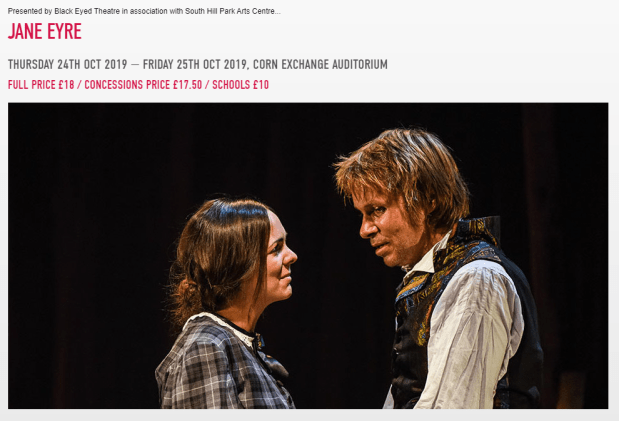
Probably my favorite aspect of this production was the live music. An antique piano stood at stage left and all the actors took turns playing it for background music or as part of a specific scene. Other instruments were also taken up occasionally: fiddle, cello, guitar, harmonium and recorder. Whereas the NT production made anachronistic use of pop songs, this production stuck to folk music that seemed appropriate to the time period. St. John Rivers’s pompous piety was exaggerated for comic effect, with Mrs. Fairfax another particularly amusing character. As in the NT show, one actor even briefly played Pilot the dog.
There were a few decisions that were less than successful for me, though. An eight-year jump between Helen’s death at Lowood School and Jane’s arrival at Thornfield Hall feels like a jolt. Jane wears the same dress throughout and nothing indicates her aging. She narrates her story as if she is revisiting her life in her mind. At a few points these explanations from the front of the stage slow down the action. Meanwhile, the strong Yorkshire accent the actress used was so much like Daisy’s in Downton Abbey that I struggled to take her seriously – it’s too much of a contrast with the Queen’s English most of the other characters speak. Is what we think of as a Yorkshire accent now actually how people spoke at that time?
But the chief transgression was omitting the pivotal scene in which Jane hears Rochester calling out to her and knows she has to return to Thornfield. Instead, Jane just makes a rational decision to “go home” after St. John leaves for India. Did the director think that modern audiences would find the mild supernatural content too unbelievable? Or was it just a practical matter in that the actor portraying Rochester happened to be playing the piano at that point? Surely a way could have been found around that.
In any case, it was a pleasant way to pass a few hours on a squally October night.
My rating: 
There is more information on the play, including photographs and a video trailer, on the Corn Exchange website.
What’s the last thing you saw at the theatre?
Thomas Hardy Tourism in Dorset
We fancied a short break before term starts (my husband is a teaching associate in university-level biology), so booked a cheap Airbnb room in Bridport for a couple of nights and headed to Dorset on Wednesday, stopping at the Thomas Hardy birthplace cottage on the way down and returning on Friday via Max Gate, the home he designed on the outskirts of Dorchester.
I’d been to both before, but over 15 years ago. In the summer of 2004, at the end of my study abroad year, I used a travel grant from my college to spend a week in Dorset and Nottinghamshire, researching the sense of place in the works of Hardy and D.H. Lawrence. I marvel at my bravery now: barely out of my teens, there I was traveling alone by train and bus to places I’d never been before, finding my own B&B accommodation, and taking long countryside walks to arrive at many sites on foot.

Max Gate
I found that much had changed in 15 years. The main difference is that both properties have now been given the full National Trust treatment, with an offsite visitor centre and café down the lane from Hardy’s Cottage, and the upper floors of Max Gate now open to the public after the end of private tenancies in 2011.* This could be perceived as a good thing or a bad thing: Everything is more commercial and geared towards tourists, yes, but also better looked after and more inviting thanks to visitor income and knowledgeable volunteers. Fifteen years ago I remember the two sites being virtually deserted, with the cottage’s garden under black plastic and awaiting a complete replanting. Now it’s flourishing with flowers and vegetables.
*In 2004 only a few ground-floor rooms were open to the public. I happened to spot in the visitor’s book that novelist Vikram Seth had signed in just before me. When I made the caretakers aware of this, they expressed admiration for his work and offered him an exclusive look at the study where Hardy wrote Tess of the d’Urbervilles. I got to tag along! The story is less impressive since it’s been a standard part of the house tour for eight years now, but I still consider it a minor claim to fame.
The thatched cottage doesn’t possess anything that belonged to the Hardy family, but is decorated in a period style that’s true to its mid-1800s origin. Hardy was born here and remained until his early thirties, completing an architecture apprenticeship and writing his first few books, including Under the Greenwood Tree. Even if you’re not particularly familiar with or fond of Hardy’s work, I’d recommend an afternoon at the cottage for a glimpse of how simple folk lived in that time. With wood smoke spooling out of the chimney and live music emanating from the door – there are two old fiddles in the sitting room that guests are invited to play – it was a perfectly atmospheric visit.

 Afterwards, we headed to Portland, an isthmus extending from the south coast near Weymouth and known for its stone. It’s the setting of The Well-Beloved, which Hardy issued in serial form in 1892 and revised in 1897 for its book publication. Jocelyn Pierston, a sculptor whose fame is growing in London, returns to “the Isle of Slingers” (Hardy gave all his English locales made-up names) for a visit and runs into Avice Caro, a childhood friend. On a whim, he asks her to marry him. Before long, though, following a steamy (for Victorian literature, anyway) scene under an upturned boat during a storm, he transfers his affections to Miss Bencomb, the daughter of his father’s rival stone merchant. The fickle young man soon issues a second marriage proposal. I read the first 30 pages, but that was enough for me.

St. George’s Church, Portland, in a Christopher Wren style.
 [I failed on classics or doorstoppers this month, alas, so look out for these monthly features to return in October. I did start The Warden by Anthony Trollope, my first of his works since Phineas Finn in 2005, with the best of intentions, and initially enjoyed the style – partway between Dickens and Hardy, and much less verbose than Trollope usually is. However, I got bogged down in the financial details of Septimus Harding’s supposed ripping-off of the 12 old peasants who live in the local hospital (as in a rest center for the aged and infirm, like the Hospital of St Cross at Winchester). He never should have had his comfortable £800 a year, it seems. His son-in-law, the archdeacon Dr. Grantly, and his would-be son-in-law, gadfly John Bold, take opposing sides as Harding looks to the legal and religious authorities for advice. I read the first 125 pages but only briefly skimmed the rest. Given how much longer the other five volumes are, I doubt I’ll ever read the rest of the Barchester Chronicles.]
My other appropriate reading of the trip was Moon Tiger by Penelope Lively, in which Claudia Hampton, a popular historian now on her deathbed, excavates the layers of her personal past and dwells on the subjectivity of history and memory. She grew up in Dorset and mentions ammonites and rock strata, which we encountered on our beach walks.

Bridport isn’t so well known, but we thought it a lovely place, full of pleasant cafés, pubs and charity shops. It also has an independent bookshop and two secondhand ones, and we had an excellent meal of dumplings and noodle bowls at the English/Asian fusion restaurant Dorshi. It’s tucked away down an alley, but well worth a special trip. Our other special experience of the trip was a tour of Dorset Nectar, a small, family-run organic cider farm just outside of Bridport, which included a tasting of their 10+ delicious ciders. We had splendid late-summer weather for our three days away, too – we really couldn’t have asked for better.


Three secondhand books purchased, for a total of £4.10.
Second Person Narrative at New Era Theatre
It was a busy weekend for me: we saw Teesside folk duo Megson play at our local arts centre on Friday evening; on Saturday I baked a Dorset apple cake to take down to Hampshire for my father-in-law in advance of his 70th birthday, and in the evening, while my hubby got on with PhD stuff, I went to New Era Theatre, housed in a former chapel in our church carpark, for the first time. It’s a cozy space with only about 50 seats, and I sat on the front row.


The production was called Second Person Narrative, written by Jemma Kennedy and directed by Andy Kempe. Four actresses of different ages play the main character, known only as “You,” at various stages of her life. She’s an Everywoman, completely ordinary but also unique. Short scenes jump ahead three to six years at a time to highlight the big and small events that shape her life. At age 11, she tells the photographer on school picture day that she wants to be an explorer and save animals. At 23, she’s trying to spin her minimal experience into an enticing CV. At 36, she’s disillusioned by her first trip to the rainforest.
The set was a blue rectangular space with an Astroturf floor, hanging clouds covered in timepieces, and a gallery wall at the back where artifacts from You’s life accumulated scene by scene: her stuffed rabbit, a bouquet of flowers, a backpack, a cocktail shaker, and so on. The items are clever reminders of touchpoints from her story, but the wall is depressing: you look at it and wonder, Is that really all that a life adds up to? Occasional music emphasized the theme of time passing, with snippets of “As Time Goes By” and “Time after Time,” and the ending of each scene was signaled by the sound of a camera click.
 Supporting characters seemed to serve as commentators on the protagonist’s choices. Her friends, mostly female, were dressed in white, while older males were in gray and played officious roles: her first work supervisor, a persnickety boyfriend who barely noticed when she left him during a trip to Italy, and a trio of men trying to turn her into a TV role model in her twenties or sell her a retirement flat in her seventies. By contrast, You wore red and black. Actresses played multiple roles: You’s mother and Granny from the early years were You in the third and fourth stages of life. This wasn’t just for convenience’s sake; it provides continuity and shows the character coming to resemble the generations of women before her.
The two most poignant scenes for me were when You is shopping with her mother and the salesgirl assumes the older woman will be in the market for things like a full-length caftan, and when sixtysomething You, having published a poetry collection, has to field inane questions from readers who don’t differentiate between a writer’s biography and art. Other scenes, though, such as You awkwardly flirting in a bar, didn’t add much to the whole.
I did expect the play to make more of the second person perspective. It’s something I find fascinating in books – though it’s often difficult to sustain for any longer than a short story or one chapter. The main character is never addressed by name; others refer to “she” or “her.” On a few occasions other actors come to the edge of the stage and carry on a one-sided dialogue, turning the audience into “You” and letting us fill in for ourselves what she’s saying in reply. What was confusing to me about that was that, as the years passed, the audience wasn’t only taking on the role of You, but her daughter and granddaughter too.
Only once is actual second person narration employed. This is during a nice meta moment when You, now 56, is hosting a book club meeting for friends; the text they’re discussing is Second Person Narration. After an argument with her daughter, she says aloud, “You look at your friends. You feel embarrassed. You pick your black top off the floor and wonder if you can actually still get into it.” One of the friends on stage asks, “Why is she talking like that?”
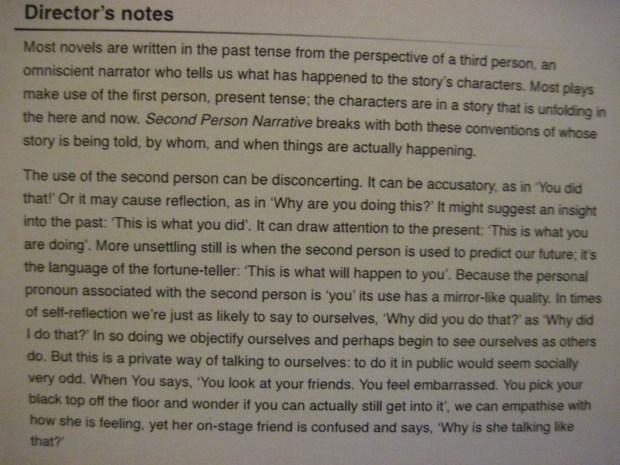
Overall, I found the production a bit odd and not entirely coherent, but it did succeed in making me think about the expectations placed on a woman’s life – by her family and friends, by society at large, and also by herself. The ending then, I think, specifically invites us to question how things would have gone differently had You been born male.
My rating:
What do you make of second person narration? Do you think you would have enjoyed this play?
Music to Read and Write By
I usually can’t read while music is playing; the exception is if we’re on a long car journey – my husband needs to have peppy music playing to keep alert while he’s driving, so I have to find a Kindle book or two that I can zone out with. In day-to-day life, though, I tend to read in silence. If I find myself a little dozy and want to stay awake to get more pages read or edited, my music choices tend to be wordless: a classical compilation, or some instrumental folk. However, here’s another exception: I can read and work very well to Sigur Rós, an Icelandic indie/post-rock group who sing in Icelandic and/or Hopelandic, their invented language. For some reason Jónsi’s ethereal falsetto just washes over me and I can turn off the part of my brain that tries desperately to make English sense out of the words.

Writing is another matter. Unless I urgently need to concentrate – for instance, if I’m writing my first article for a new venue and feeling daunted and inadequate (cough, LARB, cough) – I almost always have music playing. I often turn to albums I know very well: they provide good cheer but aren’t distracting, so make for good background music. My most played tracks of all are from three playlists I made for my sister around the time of her husband’s death. I chose songs that would be meaningful and even uplifting without being in any way sappy. Examples: “The Drugs Don’t Work” (The Verve), “The Heart of Life” (John Mayer), “P.S. You Rock My World” (Eels) and “All Possibilities” (Badly Drawn Boy).
I recently discovered the play count feature on Windows Media Player and had great fun going through and seeing which individual songs and whole albums I’d played the most in the couple of years I’ve used my secondhand laptop. In some cases I was surprised, but most of these artists I could have predicted:
My 17 Most Played Albums:
Fading West, Switchfoot (32 plays)
Flat Earth Diary, Krista Detor (30 plays)
Memory Man, Aqualung (30 plays)
The Take-off and Landing of Everything, Elbow (25 plays)
You Knows It, Folk On (25 plays)
One Wild Life: Soul, Gungor (25 plays)
Barely, Krista Detor (24 plays)
Collapsible Lung, Relient K (24 plays)
Carrie & Lowell, Sufjan Stevens (23 plays)
Sparks, Imogen Heap (20 plays)
Havoc and Bright Lights, Alanis Morissette (17 plays)
Chocolate Paper Suites, Krista Detor (16 plays)
With Love, Rosie Thomas (16 plays)
Ghost Stories, Coldplay (15 plays)
Born and Raised, John Mayer (15 plays)
The Impersonator, Marc Martel (15 plays)
This Earthly Spell, Karine Polwart (15 plays)
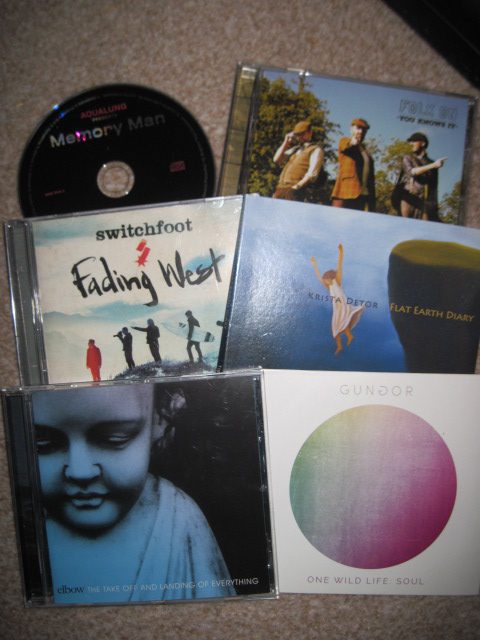
Of course, this mostly just tells you my listening tastes. But I’d like to think these artists hit a good balance of upbeat and mellow, catchy and contemplative. Or just plain daft, in the case of comedy folk trio Folk On. If I’m feeling particularly nostalgic, my inclination might be to play albums that defined the late 1990s or early 2000s for me, from artists like Matchbox 20, Snow Patrol, Coldplay, Sting and The Verve. (Not represented on this list, but I feel like I play them all the time: Bell X1, The Bookshop Band, Duke Special, and The Shins.)
Can you read or write to music? What are some of your favorite albums to work by?
We’re moving on Monday and may be without home Internet access for a week, so I’ll be scheduling a few posts ahead in case I can’t devote much time to blogging.
 Bookish Beck = Rebecca Foster. American transplant to England. Freelance proofreader and book reviewer.
 Bookish Beck