20 Books of Summer, 14–16: Polly Atkin, Nan Shepherd and Susan Allen Toth
I’m still plugging away at the challenge. It’ll be down to the wire, but I should finish and review all 20 books by the 31st! Today I have a chronic illness memoir, a collection of poetry and prose pieces, and a reread of a cosy travel guide.
Some of Us Just Fall: On Nature and Not Getting Better by Polly Atkin (2023)
I was heartened to see this longlisted for the Wainwright Prize. It was a perfect opportunity to recognize the disabled/chronically ill experience of nature and the book achieves just what the award has recognised in recent years: the braiding together of life writing and place-based observation. (Wainwright has also done a great job on diversity this year: there are three books by BIPOC and five by women on the nature writing shortlist alone.)
 Polly Atkin knew something was different about her body from a young age. She broke bones all the time, her first at 18 months when her older brother ran into her on his bicycle. But it wasn’t until her thirties that she knew what was wrong – Ehlers-Danlos syndrome and haemochromatosis – and developed strategies to mitigate the daily pain and the drains on her energy and mobility. “Correct diagnosis makes lives bearable,” she writes. “It gives you access to the right treatment. It gives you agency.”
The book assembles long-ish fragments, snippets from different points of her past alternating with what she sees on rambles near her home in Grasmere. She writes in some depth about Lake District literature: Thomas De Quincey as well as the Wordsworths – Atkin’s previous book is a biography of Dorothy Wordsworth that spotlights her experience with illness. In describing the desperately polluted state of Windermere, Atkin draws parallels with her condition (“Now I recognise my body as a precarious ecosystem”). Although she spurns the notion of the “Nature Cure,” swimming is a valuable therapy for her.
Theme justifies form here: “This is the chronic life, lived as repetition and variance, as sedimentation of broken moments, not as a linear progression.” For me, there was a bit too much particularity; if you don’t connect to the points of reference, there’s no way in and the danger arises of it all feeling indulgent. Besides, by the time I opened this I’d already read two Ehlers-Danlos memoirs (All My Wild Mothers by Victoria Bennett and Floppy by Alyssa Graybeal) and another reference soon came my way in The Invisible Kingdom by Meghan O’Rourke. So overfamiliarity was a problem. And by the time I forced myself to pick this off of my set-aside shelf and finish it, I’d read Nina Lohman’s stellar The Body Alone. For those newer to reading about chronic illness, though, especially if you also have an interest in the Lakes, it could be an eye-opener.
With thanks to Sceptre (Hodder) for the free copy for review.
Selected Prose & Poetry by Nan Shepherd (2023)
 I’d read and enjoyed Shepherd’s The Living Mountain, which has surged in popularity as an early modern nature writing classic thanks to Robert Macfarlane et al. I’m not sure I’d go as far as the executor of the Nan Shepherd Estate, though, who describes her in the Preface as “Taylor Swift in hiking boots.” The pieces reprinted here are from her one published book of poems, In the Cairngorms, and the mixed-genre collection Wild Geese. There is also a 28-page “novella,” Descent from the Cross. After World War I, Elizabeth, a workers’ rights organiser for a paper mill, marries a shell-shocked veteran who wants to write a book but isn’t sure he has either the genius or the dedication. It’s interesting that Shepherd would write about a situation where the wife has the economic upper hand, but the tragedy of the sickly failed author put me in mind of George Gissing or D.H. Lawrence, so didn’t feel fresh. Going by length alone, I would have called this a short story, but I understand why it would be designated a novella, for the scope.
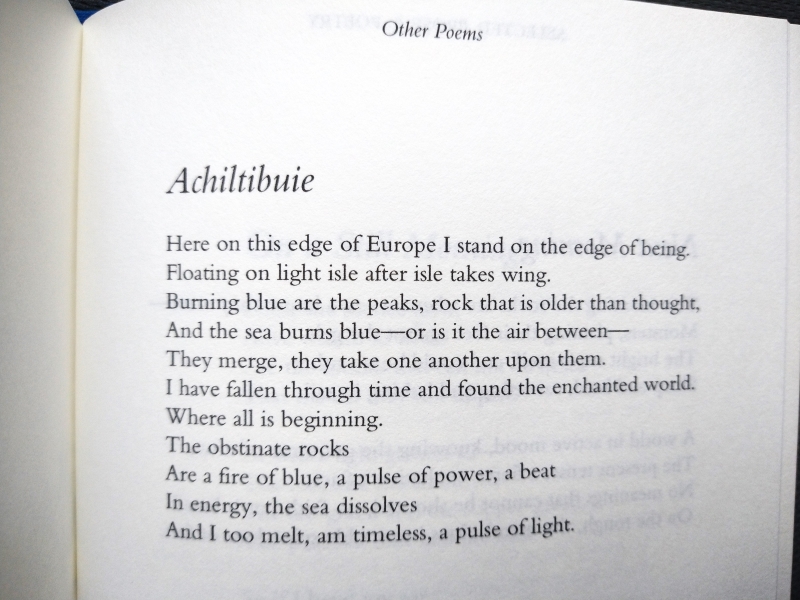
None of the miniature essays – field observations and character studies – stood out to me. About half of the book is given over to poetry. As with the nature writing, there is a feeling of mountain desolation. There are a lot of religious references and hints of the mystical, as in “The Bush,” which opens “In that pure ecstasy of light / The bush is burning bright. / Its substance is consumed away / And only form doth stay”. It’s a mixed bag: some feels very old-fashioned and sentimental, with every other line or, worse, every line rhyming, and some archaic wording and rather impenetrable Scots dialect. It could have been written 100 years before, by Robert Burns if not William Blake. But every so often there is a flash of brilliance. “Blackbird in Snow” is quite a nice one, and reminiscent of Thomas Hardy’s “The Darkling Thrush.” I even found the cryptic lines from “Real Presence” that inspired a song on David Gray’s Skellig. My favourite poem by far was:
Overall, this didn’t engage me; it’s only for Shepherd fanatics and completists. (Won from Galileo Publishers in a Twitter giveaway)
England As You Like It: An Independent Traveler’s Companion by Susan Allen Toth (1995)
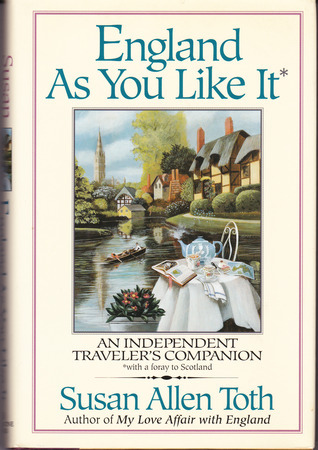 A reread. As I was getting ready to go overseas for the first time in the summer of 2003, Toth’s trilogy of memoirs whetted my appetite for travel in Britain. (They’re on my Landmark Books in My Life, Part II list.) This is the middle book and probably the least interesting in that it mostly recounts stays in particular favourite locations, such as Dorset, the Highlands, and various sites in Cornwall. However, I’ve never forgotten her “thumbprint theory,” which means staying a week or more in an area no larger than her thumb covers on a large-scale map, driving an hour or less for day trips. Not for her those cram-it-all-in trips where you race through multiple countries in a week (I have American friends who did Paris, London and Rome within six days, or five countries in eight days; blame it on stingy vacation policies, I guess). Instead, she wants to really bed into one place and have the time to make serendipitous discoveries such as an obscure museum or a rare opening of a private garden.
I most liked the early general chapters about how to make air travel bearable, her obsession with maps, her preference for self-catering, and her tendency to take home edible souvenirs. Of course, all the “Floating Facts” are hopelessly out-of-date. This being the early to mid-1990s, she had to order paper catalogues to browse cottage options (I still did this for honeymoon prep in 2006–7) and make international phone calls to book accommodation. She recommends renting somewhere from the National Trust or Landmark Trust. Ordnance Survey maps could be special ordered from the British Travel Bookshop in New York City. Entry fees averaged a few pounds. It’s all so quaint! An Anglo-American time capsule of sorts. I’ve always sensed a kindred spirit in Toth, and those whose taste runs toward the old-fashioned will probably also find her a charming tour guide. I’ve also reviewed the third book, England for All Seasons. (Free from The Book Thing of Baltimore)
Review Book Catch-Up: Bamforth, McGrath, Mertz
Today I have a book of medico-philosophical musings, a triptych of novels about the resonant moments of a Canadian childhood, and a varied collection of ekphrastic poems.
Scattered Limbs: A Medical Dreambook by Iain Bamforth (2020)
 A doctor based in Strasbourg, Iain Bamforth offers a commonplace book full of philosophical musings on medicine and wellness from the ancient world to today. All through December I would read just a few pages at a time as a palate cleanser between larger chunks of other books. Most of the entries are under three pages in length, with some one-sentence dictums interspersed. The point of reference is broadly European, with frequent allusions to English, French, and German literature (Charles Dickens, Marcel Proust, and Thomas Mann) and to Greek thinkers like Aristotle and Plato. The themes include memory, overtreatment, technology, and our modern wellness culture. If you’re equally interested in medicine and philosophy, this is a perfect bedside book for you; if you only gravitate towards one or the other, it’s possible that you could run low on patience for the high-brow rumination. My favourite piece was on “panicology,” and two stand-out lines are below.
“Prognostication is where writers and doctors resemble each other most.”
“A proper attitude to death can be a source of life. That is medicine’s only profundity.”
With thanks to Galileo Publishers for the free copy for review.
The Santa Rosa Trilogy by Wendy McGrath (2011–19)
I’m indulging in one last listen to our holiday music compilations as I write, before putting everything away until a hoped-for ‘Christmas in July’ with family and friends. Yesterday I devoured Broke City, the third novella in Wendy McGrath’s Santa Rosa Trilogy, in one sitting and treasured all the Christmas and pine tree references: they bind the book together but also connect it satisfyingly back to Book 1, Santa Rosa, which opened with Christine’s neighbour preparing a Christmas cake one summer. That annual ritual and its built-in waiting period take on new significance when the adult Christine’s life changes suddenly.
In this trio of linked narratives about Christine’s 1960s Edmonton childhood, totem objects and smells evoke memories that persist for decades: Pine-Sol, her parents’ cigarettes, the local meat-packing plant. Even at age seven, Christine is making synaesthetic links between colours and scents as she ponders language and imagines other lives. That her recollections – of a carnival, the neighbourhood grocery store, queasy road trips to her grandmother’s in Saskatchewan, a drive-in movie, and Christmas Eve with her father’s side of the family – so overlap with my late-1980s mental flipbook proves not that suburban Maryland and upstate New York (where I grew up and my mother’s home turf, respectively) are so similar to Alberta, but that this is the universal stuff of a later 20th-century North American childhood.


The other night, discussing The Light Years by Elizabeth Jane Howard, my book club noted how difficult it is to capture childhood in all its joy and distress. McGrath does so superbly, exploiting the dramatic irony between what Christine overhears and what she understands. Readers know her parents’ marriage is in trouble because she never sees them laughing or happy, and she hears her mother complain to her father about his drinking. We know the family is struggling because a man from the City delivers a box of Spam, standard issue to all those who are out of work over the winter. A simple mishearing (“clatteral,” “brain tuber”; thinking that an abattoir sounds “like a fancy ballroom”) can be a perfect example of the child perspective, too. Meanwhile, the pop culture references situate the story in the time period.
Towards the end of Broke City, young Christine declares, “I shall be unusual.” As we root for the girl to outrun her sadder memories and forge a good life, we hope that – like all of us – she’ll find a balance between the ordinary and the exceptional through self-knowledge. While Broke City was my favourite and could probably stand alone, it’s special to chart how moments turn into memories across the three books. I’d recommend the trilogy to readers of Tove Ditlevsen, Tessa Hadley, and Elizabeth Hay. I particularly loved the hybrid-poetry style of the Prologue to Santa Rosa (similar to what Bernardine Evaristo employs), so I would also be interested to try one of McGrath’s two poetry collections.
Some favourite passages:
“he walks at the same time everyday summer and winter
early morning when the day still makes promises” (Santa Rosa)
“Christine thought of herself as a child, with no idea of the world but all the ideas in the world. … Christine is the girl that used to live here, but the girl has disappeared. Her ghost is here, existing parallel to the person she is now. How did this happen? There must have been something she wasn’t paying attention to, something she didn’t see coming.” (Broke City)
With thanks to Wendy McGrath and Edmonton’s NeWest Press for the e-copies for review. I learned about the books from Marcie; see her appreciation of McGrath’s work at Buried in Print.
Color and Line by Carole Mertz (2021)
 “Ekphrastic” was a new vocabulary word for me – or, if I’d heard it before, I needed a reminder. It refers to poetry written to describe or respond to artworks. Many of Carole Mertz’s poems, especially in the first section, attest to her love of the visual arts. This is the Ohio church organist’s first full-length collection after the 2019 chapbook Toward a Peeping Sunrise and extensive publication in literary magazines. She was inspired by art ranging in date from 1555 to 2019. “Come Share a Glass with Me,” for instance, is a prose poem that imagines the story behind a Van Gogh. I loved the line “The ewer sits expectant” in a short poem capturing The Staircase by Xavier Mellery.
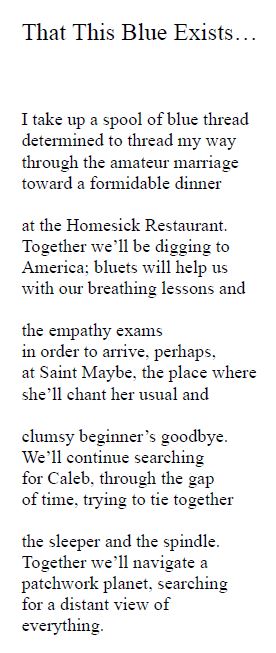
One could look up all of the artworks discussed, but the descriptions here are so richly detailed that I often didn’t feel I needed to. Two paintings in a row depict sisters. A poem about Salome and the beheading of John the Baptist draws on the Bible story, but also on its many portrayals through art history. Other topics include concern for the Earth and beloved works of literature. I particularly enjoyed “The Word in Joseph’s Hand,” a Christmas hymn that can be sung to the tune of “Lo, How a Rose E’er Blooming,” and a haiku about a cardinal, “a flash of bright red / … in the garden”. Below is my favourite of the poems; it incorporates the titles of 14 books, nine of them by Anne Tyler. See if you can spot them all!
Color and Line was released by Kelsay Books on the 2nd. My thanks to Carole Mertz for the e-copy for review.
Would you be interested in reading one or more of these?
And, just for fun, put a description of or link to your favourite Bernie-in-mittens meme in the comments.
 Bookish Beck = Rebecca Foster. American transplant to England. Freelance proofreader and book reviewer.
 Bookish Beck