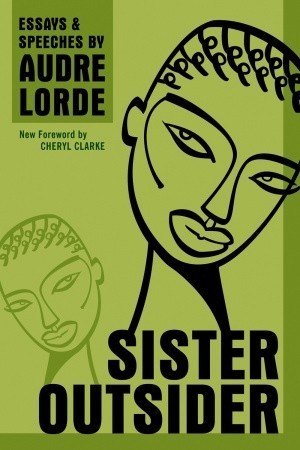
Sister Outsider by Audre Lorde (#NovNov25 Buddy Read, #NonfictionNovember)
This year we set two buddy reads for Novellas in November: one contemporary work of fiction (Seascraper) and one classic work of short nonfiction. Do let us know if you’ve been reading them and what you think!

Sister Outsider is a 1984 collection of Audre Lorde’s essays and speeches. Many of these short pieces appeared in Black or radical feminist magazines or scholarly journals, while a few give the text of her conference presentations. Lorde must have been one of the first writers to spotlight intersectionality: she ponders the combined effect of her Black lesbian identity on how she is perceived and what power she has in society.
The title’s paradox draws attention to the push and pull of solidarity and ostracism. She calls white feminists out for not considering what women of colour endure (or for making her a token Black speaker); she decries misogyny in the Black community; and she and her white lover, Frances, seem to attract homophobia from all quarters. Especially while trying to raise her Black teenage son to avoid toxic masculinity, the author comes to realise the importance of “learning to address each other’s difference with respect.”
This is a point she returns to again and again, and it’s as important now as it was when she was writing in the 1970s. So many forms of hatred and discrimination come down to difference being seen as a threat – “I disagree with you, so I must destroy you” is how she caricatures that perspective.
 Even if you’ve never read a word that Lorde wrote, you probably know the phrase “The Master’s Tools Will Never Dismantle the Master’s House” – this talk title refers to having to circumvent the racist patriarchy to truly fight oppression. “Revolution is not a one-time event,” she writes in another essay. “It is becoming always vigilant for the smallest opportunity to make a genuine change in established, outgrown responses”.
My two favourite pieces here also feel like they have entered into the zeitgeist. “Poetry Is Not a Luxury” deems poetry a “necessity for our existence … the way we help give name to the nameless so it can be thought.” And “Uses of the Erotic: The Erotic as Power” is a thrilling redefinition of a holistic sensuality that means living at full tilt and tapping into creativity. “The sharing of joy, whether physical, emotional, psychic, or intellectual, forms a bridge between the sharers which can be the basis for understanding much of what is not shared”.
In some ways this is not an ideal way to be introduced to Lorde’s work, because many of the essays repeat the same themes and reasoning. I made my way through the book very slowly, one piece every day or few days. The speeches would almost certainly be more effective if heard aloud, as intended – and more provocative, too, as they must have undermined other speakers’ assumptions. I was also a bit taken aback by the opening and closing pieces being travelogues: “Notes from a Trip to Russia” is based on journal entries from 1976, while “Grenada Revisited: An Interim Report” about a 1983 trip to her mother’s birthplace. I saw more point to the latter, while the former felt somewhat out of place.
Nonetheless, Lorde’s thinking is essential and ahead of its time. I’d only previously read her short work The Cancer Journals. For years my book club has been toying with reading Zami, her memoir starting with growing up in 1930s Harlem, so I’ll hope to move that up the agenda for next year. Have you read any of her other books that you can recommend?(University library) [190 pages]
Other reviews of Sister Outsider:
Cathy (746 Books)
Marcie (Buried in Print) is making her way through the book one essay at a time. Here’s her latest post.

 Bookish Beck = Rebecca Foster. American transplant to England. Freelance proofreader and book reviewer.
 Bookish Beck