My (Not the) Booker Prize Reading
A week from today, on the 14th (my birthday, as well as Susan’s – be sure to wish her a happy one!), this year’s Booker Prize will be announced. The Prize’s longlist didn’t contain much that piqued my interest this time around; I read one book from it and didn’t get on with it well at all, and I also DNFed another three.
Read
Frankissstein by Jeanette Winterson
 Winterson does her darndest to write like Ali Smith here (no speech marks, short chapters and sections, random pop culture references). Cross Smith’s Seasons quartet with the vague aims of the Hogarth Shakespeare project and Margaret Atwood’s The Heart Goes Last and you get this odd jumble of a novel that tries to combine the themes and composition of Frankenstein with the modern possibilities of transcending bodily limitations. Her contemporary narrator is Ry Shelley, a transgender doctor sponsored by the Wellcome Trust who supplies researcher Victor Stein with body parts for his experiments in Manchester. In Memphis for a tech expo, Ry meets Ron Lord, a tactless purveyor of sexbots.
Their interactions alternate with chapters narrated by Mary Shelley in the 1810s; I found this strand much more engaging and original, perhaps because I haven’t read that much about Shelley and her milieu, whereas it feels like I’ve read a lot about machine intelligence and transhumanism recently (To Be a Machine, Murmur, Machines Like Me). I think Winterson’s aim was to link the two time periods through notions of hybridness and resistance to death. It never really came together for me. 
DNFed
 Night Boat to Tangier by Kevin Barry – I read the first 76 pages. The other week two grizzled Welsh guys came to deliver my new fridge. Their barely comprehensible banter reminded me of that between Maurice and Charlie, two ageing Irish gangsters. The long first chapter is terrific. At first these fellas seem like harmless drunks, but gradually you come to realize just how dangerous they are. Maurice’s daughter Dilly is missing, and they’ll do whatever is necessary to find her. Threatening to decapitate someone’s dog is just the beginning – and you know they could do it. “I don’t know if you’re getting the sense of this yet, Ben. But you’re dealing with truly dreadful fucken men here,” Charlie warns at one point. I loved the voices; if this was just a short story it would have gotten a top rating, but I found I had no interest in the backstory of how these men got involved in heroin smuggling.
The Wall by John Lanchester – I lost interest in it and wasn’t drawn in by the first pages.
 The Man Who Saw Everything by Deborah Levy – I read the first 35 pages. There’s a lot of repetition; random details seem deliberately placed as clues. I’m sure there’s a clever story in here somewhere, but apart from a few intriguing anachronisms (in 1988 a smartphone is just “A small, flat, rectangular object … lying in the road. … The object was speaking. There was definitely a voice inside it”) there is not much plot or character to latch onto. I suspect there will be many readers who, like me, can’t be bothered to follow Saul Adler from London’s Abbey Road, where he’s hit by a car in the first paragraph, to East Berlin.
 There’s only one title from the Booker shortlist that I’m interested in reading: Girl, Woman, Other by Bernardine Evaristo. I’ll be reviewing it later this month as part of a blog tour celebrating the Aké Book Festival, but as a copy hasn’t yet arrived from either the publisher or the library I won’t have gotten far into it before the Prize announcement.
As for the other five on the shortlist…
- I’m a conscientious objector to Margaret Atwood’s The Testaments. I haven’t appreciated her previous dystopian sequels, and I’ve never really understood all the hype around The Handmaid’s Tale.
- I don’t plan on reading Lucy Ellmann’s Ducks, Newburyport – unless some enterprising soul produces an abridged version of no more than 250 pages.*

Ducks, Newbury
- I didn’t rate The Fishermen highly enough to give Chigozie Obioma’s An Orchestra of Minorities a try.
- I forced myself through Midnight’s Children some years back. What a pointless slog! Lukewarm reviews of his recent work mean I’m now doubly determined to avoid Salman Rushdie’s Quichotte.
- Although the setup appeals to me (a prostitute’s whole life spooling out in front of her in the moments before her death) and I enjoyed her previous novel well enough, I’ve not heard enough good things to pick up Elif Shafak’s 10 Minutes 38 Seconds in this Strange World.
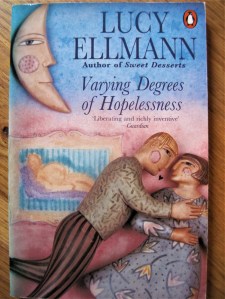 *However, I was delighted to find a copy of her 1991 novel, Varying Degrees of Hopelessness (just 182 pages, with short chapters often no longer than a paragraph and pithy sentences) in a 3-for-£1 sale at our local charity warehouse. Isabel, a 31-year-old virgin whose ideas of love come straight from the romance novels of ‘Babs Cartwheel’, hopes to find Mr. Right while studying art history at the Catafalque Institute in London (a thinly veiled Courtauld, where Ellmann studied). She’s immediately taken with one of her professors, Lionel Syms, whom she dubs “The Splendid Young Man.” Isabel’s desperately unsexy description of him had me snorting into my tea:
He had a masculinity.
His broad shoulders and narrow hips gave him a distinctive physique.
He held seminars and wore red socks.
To hold seminars seemed to indicate a wish to develop a rapport with his students.
The red socks seemed to indicate testosterone.
I swooned in admiration of him.
Unfortunately, the Splendid Young Man is more interested in Isabel’s portly flatmate, Pol. There’s a screwball charm to this campus novel full of love triangles and preposterous minor characters. I laughed at many of Ellmann’s deadpan lines, and would recommend this to fans of David Lodge’s academic comedies. But if you wish to, you could read this as a cautionary tale about the dangers of romantic fantasies. Ellmann even offers two alternate endings, one melodramatic and one more prosaic but believable. I’ll seek out the rest of her back catalogue – so thanks to the Booker for putting her on my radar. 
In the meantime, I did a bit better with the “Not the Booker Prize” (administered by the Guardian) shortlist, reading three out of their six:
Flames by Robbie Arnott
 This strange and somewhat entrancing debut novel is set in Arnott’s native Tasmania. The women of the McAllister family are known to return to life – even after a cremation, as happened briefly with Charlotte and Levi’s mother. Levi is determined to stop this from happening again, and decides to have a coffin built to ensure his 23-year-old sister can’t ever come back from the flames once she’s dead. The letters that pass between him and the ill-tempered woodworker he hires to do the job were my favorite part of the book. In other strands, we see Charlotte traveling down to work at a wombat farm in Melaleuca, a female investigator lighting out after her, and Karl forming a close relationship with a seal. This reminded me somewhat of The Bus on Thursday by Shirley Barrett and Orkney by Amy Sackville. At times I had trouble following the POV and setting shifts involved in this work of magic realism, though Arnott’s writing is certainly striking.
A favorite passage:
“The Midlands droned on, denuded hill after denuded hill, until I rolled into sprawling suburbs around noon. Here’s a list of the places I’d choose to visit before the capital: hell, anywhere tropical, the Mariana Trench, a deeper pit of hell, my mother’s house.”
My thanks to Atlantic Books for the free paperback copy for review.
See Susan’s review for a more enthusiastic response.
 The Unauthorised Biography of Ezra Maas by Daniel James: A twisty, clever meta novel about “Daniel James” trying to write a biography of Ezra Maas, an enigmatic artist who grew up a child prodigy in Oxford and attracted a cult following in 1960s New York City, where he was a friend of Warhol et al. (See my full review.)
Supper Club by Lara Williams: A great debut novel with strong themes of female friendship and food. The Supper Club Roberta and Stevie create is performance art, but it’s also about creating personal meaning when family and romance have failed you. (See my full review.)
The other three books on the shortlist are:
- Skin by Liam Brown: A dystopian novel in which people become allergic to human contact. I think I’ll pass on this one.
 Please Read This Leaflet Carefully by Karen Havelin: A debut novel by a Norwegian author that proceeds backwards to examine the life of a woman struggling with endometriosis and raising a young daughter. I’m very keen to read this one.
- Spring by Ali Smith: I’ve basically given up on Ali Smith – and certainly on the Seasons quartet, after DNFing Winter.
(The Not the Booker Prize will be announced on the Guardian website this Friday the 11th.)
Have you read something from the (Not the) Booker shortlist(s)? Any predictions for next week?
Ways of Finding out about New Books
People sometimes ask how I hear about all the books I add to my to-read list, especially brand new and forthcoming titles. Some are through pure serendipity when browsing in a bookshop or public library, or looking through the read-alikes on various websites including Goodreads and Kirkus, but for the most part I’m more strategic than that. Below are my go-to sources of information about books, with links provided where possible.
E-ARC REQUEST SITES
NetGalley and Edelweiss are the primary websites where I get the lowdown on upcoming books, and request e-copies to review.
E-NEWSLETTERS
Amazon Books
Biographile
Emerald Street (books content on Mondays and Wednesdays)
Omnivoracious (the Amazon Book Review)
MAGAZINES
North American magazine Bookmarks is terrific – and not just because I regularly write for it! As well as surveying new and upcoming titles, it directs attention to older books through thematic articles and author profiles. BookPage can be picked up for free in U.S. public libraries and has a great mix of reviews and interviews.
If you’re in the UK and manage to get hold of The Bookseller (perhaps at a public library), it has the full scoop on forthcoming titles, usually months in advance. Booktime (free in independent bookstores) and New Books (associated with Nudge) are also worth a look.
NEWSPAPER REVIEWS
More and more newspapers are starting to put up a paywall around their online content, but the Guardian is still free and excellent. Others like the New York Times offer you 5–10 free articles per month before you have to pay.
OTHER BOOK-THEMED WEBSITES
PRIZE LISTS
Every year I pick up recent titles I wouldn’t otherwise have heard of thanks to the longlists for the Baileys Women’s Prize for Fiction, the Folio Prize, the Guardian’s First Book Award or Not the Booker Prize, the Man Booker Prize, the Pulitzer Prize, the Samuel Johnson Prize, the Wainwright Prize, the Wellcome Prize, and so on.
TRUSTED RECOMMENDERS
This might be Goodreads friends, fellow bloggers whose opinions I value, or writers who know their books, like Ella Berthoud and Susan Elderkin (authors of The Novel Cure), Nick Hornby (articles from his “Stuff I’ve Been Reading” column in the Believer were collected into several entertaining volumes) and Nancy Pearl (the “Book Lust” series).
Follow as many authors, publicists, publishers and fellow reviewers as you can and you will never be short of book news! (The same goes for Facebook, should you wish.)
WEBSITES WITH SOME BOOKS CONTENT
Gretchen Rubin chooses 3 book club books per month
Where do you tend to find out about new books? Let me know about any resources I’ve missed.
Bookish Time-Wasting Strategies
Being self-employed has certainly helped me develop better self-motivation and self-discipline, but that doesn’t mean I can’t still procrastinate with the best of them. When I do, though, I try to keep it book-related. Here are ten of my chief time-wasters:
- Requesting advance books via NetGalley and Edelweiss. I really don’t need any more books, but I can’t resist trawling the online listings to see what’s coming out in the next few months. It feels like a special treat to get to read favorite authors’ new books before they’re technically released – I have the new Jonathan Safran Foer, Maria Semple and Alexandra Kleeman books lined up to read soon.
- Checking out The Bookbag’s and Nudge’s offerings for reviewers. The same goes for these: more print ARCs on the pile is the last thing I need, but I simply have to know what they have for reviewers to choose from. Sometimes I come across books I’d never heard of, or ones I thought were only available in America. Still, I am trying to be very choosy about what I volunteer for.
- Browsing Goodreads giveaways. I’m going to sound like a broken record – I seem incapable of resisting free books, wherever they come from. Every few weeks I spend an hour or two occasionally switching over to the Goodreads giveaways page while I’m doing other things online. It takes some persistence to wade through all the rubbish to get to the entries for proper books you’d actually be interested in owning, but it can be worth it. Over the years I’ve won 49 books through Goodreads.
- Catching up on Twitter. I follow a ton of publishers, authors and publicists on Twitter. I am very bad about using the site regularly – I usually only remember to go on it when I have a blog to promote, and otherwise find it rather overwhelming – but when I do I often find information about a bunch of new-to-me books and see competitions to enter. I’ve won a couple of books and tote bags this way.
- Sorting through book-related clippings. I keep a file folder of clippings, mostly from the Guardian, related to books I think I’m likely to read. Every so often I go back through the file to find reviews of books I’ve read in the meantime, recycle ones I’m no longer interested in and so on.
- Rearranging my bedside books. Pretty much the same books have been on my nightstand shelves all year, but I’m constantly adjusting the piles to reflect their level of priority: review books are at the top, in chronological order by deadline; other rough piles are planned sets of reading. I take some glee in arranging these groups – adding a memoir here and a work of historical fiction there – all the while imagining how well they’ll complement each other.
- Organizing my Goodreads shelves. In addition to the standard “to read,” “read,” and “currently reading” shelves, I’ve set up a few dozen customized ones so that it’s easy for me to search my collection by theme. Recently I decided “illness and death” was a bit too broad of a descriptor so set up some more specific categories: “bereavement memoirs,” “cancer memoirs,” “old age,” etc.
- Culling the books on my Kindle. The digital collection is currently at 259 books. Every so often I take a long hard look at the e-books I’ve amassed and force myself to be honest about what I will actually read. If I don’t think I’m likely to read a book within the next year, I delete it. (These are all books I’ve downloaded for free, so it’s not like I’m throwing money away.)
- Looking up prices on webuybooks.co.uk. If you’re based in the UK, you probably already know about this website. I resell a bunch of books via Amazon, but sometimes the going rate is so low that you’re better off selling things as a job lot to WeBuyBooks. Their offer is often reasonable, and they frequently run deals where you can increase it by 10%. You box up the books and they send a courier to collect them from your front door – what could be easier?
- Ticking off books from lists. I don’t actively seek out books from 1001 Books You Must Read before You Die or the Guardian’s “1000 novels everyone must read” lists, but maybe once a year I go back through and tick off the ones I happen to have read recently.
Do you have any bookish time-wasting strategies? Do share!
I Do Love a Good Book List
In the same way that I love following literary prize races (see my post on that topic from a couple weeks ago), I adore a good book list. This includes everything from an inspirational lifetime reading menu such as 1001 Books You Must Read Before You Die to those gimmicky “5 Novels About…” or “10 Books for People Who Like…” lists you get on websites like BuzzFeed and the Huffington Post.
Every time a new ‘Best Books Ever’ type of checklist comes out, I gleefully scan through to figure out how many I’ve already read. Usually the disappointing results smack me back and remind me that for all my voracious reading, I still haven’t read many of the classics everyone’s supposed to have read by my age.
Here for your delectation (if you like this sort of thing) is a sampling of the book lists I’ve bookmarked over the years, with my running total noted in brackets after each:
THE BEST OF THE BEST
The 100 Greatest Novels of All Time, as chosen by the Guardian in 2003 [33]
1000 novels everyone must read, as chosen by the Guardian in 2009 (interestingly, they divide it up by genre: Love Stories, Crime Fiction, Comedy, Family & Self, State of the Nation, Science Fiction & Fantasy, and War & Travel) [155 + 2 in progress]
The 100 greatest non-fiction books, as chosen by the Guardian in 2011 [7]
Vintage 21, a set of 21 modern classics chosen in 2011 [14]
100 novels everyone should read, as chosen by the Telegraph in April [29]
The 100 best novels written in English, as chosen by Robert McCrum in the Guardian last week [34]
PARTICULAR TIMES OF LIFE
65 Books You Need To Read in Your 20s, from BuzzFeed (alas, it’s too late for many of us) [13, 12 of which I think I read in my 20s]
25 Books to Help You Survive Your Mid-20s, from Bustle (ditto) [9, all read in my 20s, I think]
Conversely, here’s 15 Books You Should Definitely Not Read in Your 20s from Flavorwire (well, that’s alright, then) [I disobeyed them on 4 counts]
21 Books Every Woman Should Read By 35, from Bustle (I’ve got 3.13 years to work on it) [5; I left The Flamethrowers unfinished]
11 Novels That Expectant Parents Should Read Instead of Parenting Books, from Electric Literature (my mother may be reading this, so I must hastily add that THIS SITUATION DOES NOT APPLY TO ME!) [6]
SPECIFIC AUTHORS
The Best Hemingway Novels, on Publishers Weekly [2 out of 6, but A Moveable Feast is my favorite from him]
The 13 Best John Steinbeck Books, on Publishers Weekly [3]
The 10 Best Mark Twain Books, on Publishers Weekly [just 1!]
23 Contemporary Writers You Should Have Read by Now, on Reader’s Digest [I’ve read 3, Elizabeth Spencer, Percival Everett and Pamela Erens]
Beyond Murakami: 7 Japanese Authors to Read, on Book Riot [none so far]
SPECIFIC GENRES
20 Classic Novels You’ve Never Heard of, from QwikLit [I’ve heard of plenty of these, but only read 1]
12 Fiction Books That Will Shape Your Theology, from RELEVANT Magazine [3]
The 10 Best Books Shorter Than 150 Pages, on Publishers Weekly [2]
10 Best Southern Gothic Books, on Publishers Weekly [none so far]
10 Novels with Multiple Narratives, on Publishers Weekly [2]
The 10 Best Short Story Collections You’ve Never Read, on Publishers Weekly [they got that right; none so far]
The top 10 novels about childbirth, on the Guardian (again, NOT APPLICABLE TO ME!) [7]
I also highly recommend Nancy Pearl’s Book Lust series of four books, each one divided into themes.
ONE LAST LIST
Not a book list, but it may be useful for all you bibliophiles:
The 25 Best Websites for Literature Lovers, by Flavorwire
Do you love book lists as much as I do? Are you addicted to counting how many you’ve read from a checklist?
How do you fare on the lists above?
 Bookish Beck = Rebecca Foster. American transplant to England. Freelance proofreader and book reviewer.
 Bookish Beck