20 Books of Summer, 3–4: Cheri & All Things Are Too Small
A cancer story that treads the line between biography and fiction, and a set of high-brow essays about popular culture and modern life.
Cheri by Jo Ann Beard (2023)
{SPOILERS IN THIS ONE}
Claire Keegan helped popularize the trend of publishing stand-alone stories as small hardback volumes. It was my first time reading Beard, and her style does in fact remind me of Keegan, along with Denis Johnson and Ann Patchett. This originally appeared in the literary magazine Tin House in 2002. It is the life story of Cheri Tremble, a real woman who was born in 1950 and died in 1997 via an illegal assisted suicide conducted by Dr. Jack Kevorkian. I’d heard a lot about Cheri, but his name was never mentioned – to avoid spoilers, of course, yet it’s key.
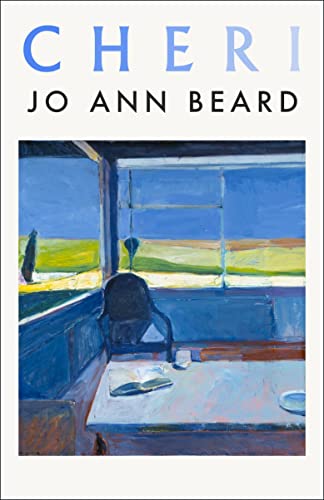 Cheri is an Amtrak ticket-taker who’s diagnosed with breast cancer in her mid-forties. After routine reconstructive surgery goes wrong and she’s left disabled, she returns to the Midwest and buys a home in Iowa. Here she’s supported by her best friends Linda and Wayne, and visited by her daughters Sarah and Katy. “Others have lived. She won’t be one of them. She feels it in her bones, quite literally.” When she hears the cancer has metastasized, she refuses treatment and starts making alternative plans. She’s philosophical about it; “Forty-six years is a long time if you look at it a certain way. Ursa is her seventh dog.”
Beard recounts all of this matter-of-factly (“the diminished lung capacity, the clangorous pain”), drawing on what is known of Cheri Tremble’s life and only adding her own stamp by making up memories that fuel flashbacks as Cheri drifts through pain-filled half-waking. One of these, of falling through the ice on a frozen pond as a child, appears early in the book and recurs at her moment of death. Beard also contrasts onlookers’ compassion or lack thereof.
It’s a potent portrait of everyday suffering and heroism and, in its way, an argument for assisted dying, which mustn’t be cloaked in secrecy as it was for Cheri – “They leave under cover of darkness, like duck hunters or criminals” to meet ‘Dr. Death’ in another state. I finished the story feeling underwhelmed; maybe I’ve simply read too much around the topic, but I couldn’t see how granting the subject interiority (which is what fiction is all about, yes, though the best biographies can do it, too) was enough to set it apart. (New purchase with birthday voucher, Hungerford Bookshop)
All Things Are Too Small: Essays in Praise of Excess by Becca Rothfeld (2024)
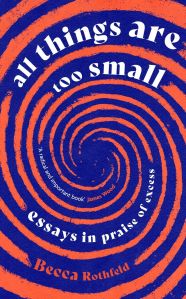 Rothfeld, the Washington Post’s nonfiction book reviewer, is on hiatus from a philosophy PhD at Harvard. Her academic background is clear from her vocabulary. The more accessible essays tend to be ones that were previously published in periodicals. Although the topics range widely – decluttering, true crime, consent, binge eating, online stalking – she’s assembled them under a dichotomy of parsimony versus indulgence. And you know from the title that she errs on the side of the latter. Luxuriate in lust, wallow in words, stick two fingers up to minimalism and mindfulness and be your own messy self. You might boil the message down to: Love what you love, because that’s what makes you an individual. And happy individuals – well, ideally, in an equal society that gives everyone the same access to self-fulfillment and art – make for a thriving culture. That, with some Barthes and Kant quotes.
The writing has verve, from the alliterative word choice to the forcefulness of Rothfeld’s opinions. But in places her points of reference (from classic cinema, especially) are so obscure that I had no way in and the pieces felt like they would never end. My two favourites were “More Is More,” in which she’s as down on fragmentary autofiction (Jenny Offill et al.) as she is on Marie Kondo; and “Normal Novels,” about how she finds Sally Rooney’s self-deprecation and communism problematic. I knew the subject matter well enough to follow the arguments here, even if I ultimately disagreed with them.
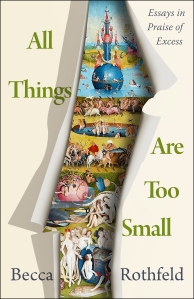
The U.S. cover featuring a Bosch painting is so much better!
Rothfeld is worth reading as a cultural critic, at least in small doses. She is clearly not interested in being a personal essayist, however, as the intimacy she keeps discussing in theory is almost completely absent. A piece on mental health, “Wherever You Go, You Could Leave,” opens with one tantalizing autobiographical line – “My first year of college, I attempted suicide and was promptly hastened home by an ominously smiling administrator” – then proceeds to poke fun at meditation for most of its 40 pages. It was interesting to see her fan-girl over her favourite novel, which I would even try if it wasn’t 480 pages: “I want to be reading Mating [by Norman Rush] constantly; I want to have been reading Mating forever, but always for the first time; I want everything in my life to be Mating and nothing but Mating”. Keep an eye out for the sequel: Actually, Moderation Is Cool: How I Learned to Temper My Expectations.
With thanks to Virago Press for the free copy for review.
Writers & Lovers by Lily King
(This was meant to be one entry in a roundup of mini-reviews, but I found that I had far too much to say about it. On Sunday I’ll feature three more May releases I’ve read.)
1997. Following a breakup and her mother’s sudden death, Casey Peabody is drowning in grief and debt. At 31, she lives in a tiny studio apartment off of her brother’s friend’s house and cycles everywhere. Between shifts waitressing at Iris, a trendy restaurant above a Harvard social club, she chips away at the Cuba-set novel she’s been writing for six years.
Through her writer friend Muriel she meets two love interests at a book launch for Oscar Kolton, a former Boston University professor and novelist who’s been leading a fiction workshop since his wife’s death a few years ago. One is the fortysomething Oscar himself; the other, who initially seems more promising, is Silas, a would-be writer from the workshop. But before they have a chance to see if this will go somewhere, Silas is off. He leaves Casey a voicemail saying he needs to get away for a while. Oh well; just another flake, she thinks.
After he and his adorable young sons come in to the restaurant for brunch one day, her interest is squarely in Oscar. Or, that is, until Silas comes back and she finds herself dating two men at the same time. A museum trip with Silas here, a dinner out with Oscar there. As if her love life isn’t complication enough, before long she finds herself looking for a new job, a place to live, a literary agent, and reassurance that she’ll be okay when she takes advantage of her short-lived health insurance to get some minor medical issues checked out.

I almost passed on reading this one because I’d gotten it in my head that it was nothing more than a romantic comedy with a love triangle. I’m so glad that Kate’s review convinced me to give it a try after all. On the face of it this could hardly be more different from King’s previous novel, Euphoria, about anthropologists doing field work in Papua New Guinea in the 1930s, but King’s attention to the intricacies of human relationships links the two. When I read Euphoria in late 2014, I noted the natives’ practice of cutting off a finger for every close relative lost. Here you also get the sense that everyone has lost someone, and that these losses are as visible as physical traits. Casey is only on her second conversation with Silas when she thinks, “I can tell he lost someone close somehow. You can feel that in people, an openness, or maybe it’s an opening that you’re talking into. With other people, people who haven’t been through something like that, you feel the solid wall. Your words go scattershot off of it.”
There are so many things to love about this novel, including the wonderful/terrible scenes where she rattles off her mother’s story to two doctors and her awful father and stepmother show up for lunch. Count the rest: The Boston-area setting, the restaurant bustle, that feeling we’ve all had of wasting our talents while stuck in the wrong job and the wrong living situation. Casey’s confiding first-person, present-tense narration, the little observations on writers (when John Updike comes into the restaurant she touches his loafer for luck; she nearly swoons when Jayne Anne Phillips is at one of her tables—“Black Tickets is like a prayer book to me”; she thinks she’s blown a high school English teacher interview when she states a dislike for Cormac McCarthy—“he seemed to be alternating between imitating Hemingway and imitating Faulkner”), and even the choice between Silas and Oscar (“Fireworks or coffee in bed”). She doesn’t make the ‘right’ choice I was expecting, but if you’ve been following the clues closely you’ll realize it’s the only one she could have made.
What I loved most, though, was that we see this character at rock bottom but also when things start to go well at long last. “There’s a particular feeling in your body when something goes right after a long time of things going wrong. It feels warm and sweet and loose.” I felt I knew Casey through and through, and I cheered for her as I did for Ana in Dominicana by Angie Cruz. Those who have tried writing a book will probably get even more out of this than I did, but it will resonate for anyone who’s ever felt lost and uncertain about life’s direction. “Isn’t our whole life just one long improvisation?” Casey hears at a writing festival.
Think of this as an older, sadder Sweetbitter, perhaps as written by Elizabeth Strout. It gives you all the feels, as they say.
A real standout and one of my few early favorites from 2020.
My rating: 
With thanks to Picador for the unsolicited copy for review.
Doorstopper of the Month: The Flight Portfolio by Julie Orringer
Julie Orringer’s The Invisible Bridge was the highlight of my 20 Books of Summer last year. I was thus delighted to hear that her second novel, The Flight Portfolio, nearly a decade in the making, was coming out this year, and even more thrilled to receive the review copy I requested while staying at my mother’s in America.
 The Invisible Bridge was the saga of a Hungarian Jewish family’s experiences in the Second World War; while The Flight Portfolio again charts the rise of Nazism and a growing awareness of Jewish extermination, it’s a very different though equally affecting narrative. Its protagonist is a historical figure, Varian Fry, a Harvard-educated journalist who founded the Emergency Rescue Committee to help at-risk artists and writers escape to the United States from France, and many of the supporting characters are also drawn from real life.
In 1940, when Varian is 32, he travels to Marseille to coordinate the ERC’s operations on the ground. Every day his office interviews 60 refugees and chooses 10 to recommend to the command center in New York City. Varian and his staff arrange bribes, fake passports, and exit visas to get Jewish artists out of the country via the Pyrenees or various sea routes. Their famous clients include Hannah Arendt, André Breton, Marc Chagall, André Gide and members of Thomas Mann’s family, all of whom make cameo appearances.

Varian Fry [Public domain]
Like The Invisible Bridge, The Flight Portfolio is a love story, if not in the way you might expect. Soon after he arrives in Marseille, Varian is contacted by a Harvard friend – and ex-lover – he hasn’t heard from in 12 years, Elliott Grant. Grant begs Varian to help him find his Columbia University teaching colleague’s son and get him out of Europe. Even though Varian doesn’t understand why Grant is so invested in Tobias Katznelson, he absorbs the sense of urgency. As Varian and Grant renew their clandestine affair, Tobias’s case becomes a kind of microcosm of the ERC’s work. Amid layers of deception, it stands as a symbol of the value of one human life. Varian gradually comes to accept that he can’t save everyone, but maybe if he can save Tobias he’ll win Grant back.
Nearly eighty years on, this plot strand still feels perfectly timely. Varian is married to Eileen and has been passing for straight, yet he doesn’t fit the stereotype of a homosexual hiding behind marriage to a woman. In fact, the novel makes it plain that Varian was bisexual; he truly loved Eileen, but Grant was the love of his life. Can he face the truth and find courage to live as he truly is? The same goes for Grant, who has an additional secret. Orringer’s Author’s Note, at the end of the book, explains how much of this is historical and how much is made up, and what happened next for Varian. I’ll let you discover it for yourself.

Varian Fry street in Berlin. Alhimik [CC0]
On the whole, though, this is historical fiction at its best. It conveys how places smell and sound with such rich detail. The sorts of descriptive passages one skims over in other books are so gorgeous and evocative here that they warrant reading two or even three times. The story of an accidental hero torn between impossible choices is utterly compelling. I’m convinced, if I wasn’t already, that Julie Orringer is among our finest living writers, and this is my top novel of 2019 so far.
Two favorite passages:
“If we could pin down the moments when our lives bifurcate into before and after—if we could pause the progression of millisecond, catch ourselves at the point before we slip over the precipice—if we could choose to remain suspended in time-amber, our lives intact, our hearts unbroken, our foreheads unlined, our nights full of undisturbed sleep—would we slip, or would we choose the amber?”
“Evening was falling, descending along the Val d’Huveaune like a shadow cloak, like a tissue-thin eyelid hazed with veins. Varian stood at the open window, dressing for dinner; Grant, at the harpsichord downstairs, conjured a Handel suite for the arriving guests. … From outside came the scent of sage and wet earth; a rainstorm had tamped down the afternoon’s dust, and the mistral blew across the valley. A nightingale lit in the medlar tree beneath the window and launched into variegated song. It occurred to Varian that the combination of voices below … made a music soon to be lost forever.”
Page count: 562
My rating:
With thanks to Knopf for the free copy for review.
Next month: Cloud Atlas by David Mitchell
 Bookish Beck = Rebecca Foster. American transplant to England. Freelance proofreader and book reviewer.
 Bookish Beck