September Focus on Short Stories, with Reviews of Bloom and de Kerangal
This is the eighth year in a row in which I’m making a special effort to read short stories in September; otherwise, story collections tend to languish on my shelves (and Kindle) unread. In September 2021 I read 12 collections and in September 2022 it was 11.5; let’s see how many I get to this year!
As someone who doesn’t claim to love short stories, I was surprised to see that I’ve already read 19 collections this year. Some of the highlights have been Old Babes in the Wood by Margaret Atwood, How Strange a Season by Megan Mayhew Bergman, What We Talk about When We Talk about Love by Raymond Carver, Games and Rituals by Katherine Heiny, and Sidle Creek by Jolene McIlwain.
I have a whole shelf of short story options set out for me and will make my selections from there. For now, I have brief reviews of two collections I read during a quick trip to the USA.
A Blind Man Can See How Much I Love You by Amy Bloom (2000)
 My second collection by Bloom this year, after Where the God of Love Hangs Out; somewhat confusingly, the latter reprints two of this volume’s Lionel and Julia stories, so there were actually only six stories here that were new to me (5 x first-person; 3 x third-person). However, they’re all typically great ones. The title story has a mother accompanying her daughter to the medical appointments that will transform Jessie into Jess, her son, and also taking a chance on romance. “Rowing to Eden” explores the dynamic between best friends, one lesbian and one married to a man; the one has already been through breast cancer treatment so can counsel her friend from experience.
In “Stars at Elbow and Foot,” a woman whose baby died goes back to the children’s hospital to volunteer with the disabled. “Hold Tight” also reflects on loss and accidents (but is probably the throw-away story if I had to name one). “The Story,” which closes the book, had me hunting for autobiographical correlations what with its mentions of “Amy.” By far my favourite was “The Gates Are Closing,” in which D.M. is having an affair with the synagogue president’s husband, who has Parkinson’s disease. As Yom Kippur approaches, he gives his mistress an ultimatum. The minor assisted dying theme in this one felt ironically prescient of Bloom’s own experience accompanying her husband to Dignitas (the subject of In Love). As always, Bloom’s work is sensual, wry and emotionally wise. 
Canoes by Maylis de Kerangal (2021; 2023)
[Translated from the French by Jessica Moore]
These eight stories are all in the first person; although I tend to prefer more diversity of narration, the plots are so dissimilar that it makes up for that homogeneity. In an author’s note at the end, de Kerangal writes that her overall theme was voices, especially women’s voices; perhaps ironically, then, the collection uses no speech marks. In “Mountain Stream and Iron Filings,” the narrator’s friend Zoé is on a mission to lower her voice to make it more suitable for radio. “Nevermore” has a woman contributing a recording of herself reading Edgar Allan Poe’s epic poem “The Raven” to an audio library. “A Light Bird,” which I found particularly poignant, is about a widower and his daughter deciding what to do about their late wife’s/mother’s voice on the answering machine.
 “After” has a school leaver partying and figuring out what comes next, “Ontario” revolves around a trip to Canada, and “Arianespace” has an investigator visiting an elderly woman who has reported a UFO sighting. The longest story (billed as a novella), “Mustang,” focuses on a French family that has relocated to Colorado in the 1990s. The mother, recently bereaved, learns to drive their rather impractical American car.
Like Painting Time, the collection is in thrall to questions of deep time. This is clearest in “Bivouac,” in which a woman undergoes a procedure while the dentist tells her about an ancient human jawbone found deep under Paris. Prehistory is even present in the metaphorical language: “the first foothills of the Rockies sketched the backbone of a sleepy stegosaurus who’d escaped extinction” (from “Mustang”). Each story also mentions a canoe, if only in passing (e.g., the dentist’s necklace charm in the first story).
As was my main quibble with Mend the Living, though, de Kerangal is all too fond of arcane vocabulary. I mean, she uses “alveolar” twice in this very short book; there’s also “sagittal slices” and “sinuous mnemic circuits.” Some sentences stretch to fill two-plus pages. So overwriting is a recurrent issue I have with her work, but I would certainly recommend that her fans read her short fiction, which I found more accessible than her novels. 
With thanks to MacLehose Press for the free copy for review. Canoes will be published on 28 September.
Currently reading: Revenge of the Lawn by Richard Brautigan; I Meant It Once by Kate Doyle; The Best Short Stories 2023: The O. Henry Prize Winners, ed. Lauren Groff; Why I Don’t Write by Susan Minot; Hateship, Friendship, Courtship, Loveship, Marriage by Alice Munro; The Human Origins of Beatrice Porter and Other Essential Ghosts by Soraya Palmer (linked stories); Small, Burning Things by Cathy Ulrich.
Resuming soon: The Secrets of a Fire King by Kim Edwards; If I Survive You by Jonathan Escoffery (I read the first two stories ages ago, but its longlisting for the Booker Prize is the impetus I need to pick it back up); Hey Yeah Right Get a Life by Helen Simpson.
Are you a short story fan? Read any good ones recently?
Wellcome Prize Shortlist, Part 1: de Kerangal and Kalanithi
I’m delighted to announce the final members of our Wellcome Book Prize 2017 shadow panel:
Ruby blogs at My Booking Great Blog.
GrrlScientist is an ornithologist and science journalist who was on the judging panel for the 2016 Royal Society Insight Investment Science Book Prize.
Along with Paul and Amy, this brings us up to five people – the same number as the official judging panel.
Luckily, I’ve already read two of the shortlisted titles, one quite recently and one nearly a year and a half ago. Here are the reviews I published on Goodreads at the time. I’ll be getting both books back out of the library soon to have another look before we choose our winner.
Mend the Living by Maylis de Kerangal
(translated from the French by Jessica Moore; published in the USA as The Heart)
[This is the French author’s second novel to be translated into English. It has been made into a film and won the Prix Orange du Livre and the Grand prix RTL du livre. It was also recently shortlisted for the Albertine Prize, an American readers’ choice award for contemporary French fiction. If you’re based in the States, feel free to vote by April 30th!]
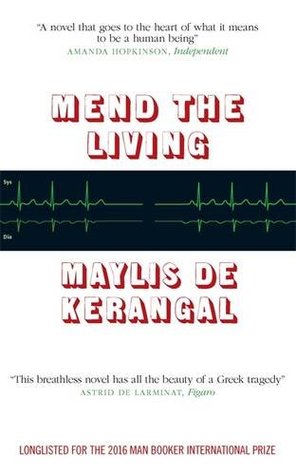 Nineteen-year-old Simon Limbeau is declared brain dead in a French hospital after a car accident, but his heart lives on: metaphorically through the love of his parents, sister, friends, and girlfriend; but also literally, in the recipient of his organ donation. Again and again de Kerangal makes a distinction between the physical reality of organs and what they represent: “Simon’s eyes are not just his nervous retina, his taffeta iris, his pupil of pure black in front of the crystalline – they are also his gaze; his skin isn’t just the threaded mesh of his epidermis, his porous cavities – it’s his light and his touch, the living sensors of his body.”
The novel spends time with Simon’s family, especially his mother, but also with the transplant coordinator, the surgeons, the nurse, and so on. I was reminded of ER as well as the French TV show The Returned – this would work really well on screen, and would be a way of avoiding the more off-putting aspects of the author’s style. She writes long, run-on sentences: sometimes half a page, sometimes even stretching to two pages, and stuffs her prose with abstruse vocabulary (or at least that’s how the translator has rendered it), a lot of it medical but some of it simply inaccessible: “emollient conjugality” plus at least a dozen English words I’d never encountered (e.g. abulic, tumid, atony, claudicant, auscultation, precellence, torticollis, naevi, scialytic).
The worst example of the unnecessary opacity is “the digitigrade gait of the sardana dancer when he’s nearing a quintal, the corpulence of an ex-obese man calibrating him in thickness, in fullness, but without visible excrescence” – in plain English, the guy is stocky.
Read in November 2016.
My rating: 
My gut feeling: The novel gives a vivid sense of the fragility of life and imbues parts of the body with metaphorical meaning. However, I think the style makes it too inaccessible and I can’t see its appeal ever being more than niche.
More reviews:
Annabel’s at Shiny New Books
Carolyn’s at Rosemary and Reading Glasses
When Breath Becomes Air by Paul Kalanithi
[The first posthumous nominee for the Wellcome Book Prize. I’ll be interested to see what I make of this one when I revisit it.]
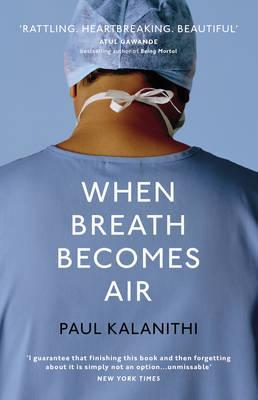 Paul Kalanithi was 36 and just completing his neurosurgery residency in Stanford, California when he was diagnosed with advanced lung cancer that did not respond well to treatment. It came as a complete surprise to this non-smoker, and set his life on a new course. He and his coterie of doctors managed his symptoms so he could operate for as long as possible, but when the time came he knew he wanted to devote his last year to writing this memoir. In addition, he would get a brief, sweet taste of fatherhood: he and his wife Lucy, also in the medical field, decided to have a child, a daughter named Cady.
Kalanithi grew up the son of Indian immigrants in Arizona. “I was driven less by achievement than by trying to understand, in earnest: What makes human life meaningful?” he recalls. Degrees in English literature and human biology were disparate attempts to find an answer. Like Henry Marsh (Do No Harm), he has a surgeon’s knowledge of the anatomy of reasoning, but realizes that does not provide the full picture. He recognizes the responsibility of holding others’ lives in the balance, and regrets occasional failures of empathy.
Those burdens are what make medicine holy and wholly impossible: in taking up another’s cross, one must sometimes get crushed by the weight.
It’s intriguing to see religious language in that statement – indeed, Kalanithi saw his work as a calling, and one with moral connotations. Christian imagery shows up repeatedly:
Instead of being the pastoral figure aiding a life transition, I found myself the sheep, lost and confused.
Openness to human relationality does not mean revealing grand truths from the apse; it means meeting patients where they are, in the narthex or nave, and bringing them as far as you can.
When’s the last time you encountered the word “narthex”?! The vocabulary is striking throughout, as in another favorite passage: “A tureen of tragedy was best allotted by the spoonful. Only a few patients demanded the whole at once; most needed time to digest.”
Kalanithi died in March 2015. In addition to the foreword by Abraham Verghese, there’s a lovely epilogue from his widow, who’s more than competent to carry on his legacy.
I appreciate stories lived on the knife edge of life and death, but I would recommend this to those who don’t normally choose to read illness narratives, simply for the beauty of its prose – a fine blend of literature and medicine – and the wholehearted picture of a life cut short.
Read in October 2015 (Random House were looking for early readers via NetGalley).
My rating: 
My gut feeling: I suspect this is by far the most popular and best-selling title on this year’s shortlist. So many people have taken it to their hearts. It will take a truly special book to knock it from the top spot.
More reviews:
Shadow panelist Paul’s at Nudge
Shadow panelist Ruby’s at My Booking Great Blog
Susan’s at A life in books
Shortlist strategy:
Currently reading: The Tidal Zone by Sarah Moss – about halfway through.
Up next: Whichever of the remaining nonfiction titles turns up to the library for me first!
I’ve also sent off an emergency e-mail to Bodley Head asking for a copy of Ed Yong’s I Contain Multitudes; it’s on loan through my library system until April 19th, which gives me no time to read it even if it comes back on time.
Wellcome Book Prize 2017 Shadow Panel
Newsflash! I’ve started a shadow panel of readers who will make our way through the six medical-themed titles shortlisted for the Wellcome Book Prize and deliberate to choose our own winner before the official prize announcement on Monday, April 24th. I hope to get the panel up to five – I’ve been in contact with a couple of science journalists via Twitter – but for now we are three, including:
Paul Cheney: blogs at Halfman, Halfbook and writes for Nudge’s Book Life section.
Amy Pirt: blogs at This Little Bag of Dreams and writes for Mookychick and g3 magazine.
The Wellcome Book Prize is an annual award sponsored by the Wellcome Trust, a global charitable foundation founded by Sir Henry Wellcome in 1936 and dedicated to improving health. The current incarnation of the prize has been running since 2009 and the winner gets a whopping £30,000. Books are nominated by their publishers, and for the 2017 award cycle they must have been issued in the UK between January 1, 2016 and December 31, 2016.
One thing that’s unique about the Wellcome Prize is that both fiction and nonfiction books are eligible. Here’s how the website describes the aim of the prize:
To be eligible for entry, a book should have a central theme that engages with some aspect of medicine, health or illness. At some point, medicine touches all our lives. Books that find stories in those brushes with medicine are ones that add new meaning to what it means to be human. The subjects these books grapple with might include birth and beginnings, illness and loss, pain, memory, and identity. In keeping with its vision and goals, the Wellcome Book Prize aims to excite public interest and encourage debate around these topics.
So as we’re reading (or looking back at) the six shortlisted books, those are the criteria we’ll be keeping in mind.
Here’s the full 2017 shortlist:
- How to Survive a Plague by David France: a history of the AIDS crisis.
- When Breath Becomes Air* by Paul Kalanithi: a posthumous memoir by a neurosurgeon.
- Mend the Living* by Maylis de Kerangal (trans. Jessica Moore): a novel about a donor heart [published in the USA as The Heart].
- The Tidal Zone by Sarah Moss: a novel about a child who suddenly falls ill.
- The Gene by Siddhartha Mukherjee: a thorough history of genetics.
- I Contain Multitudes by Ed Yong: a survey of the human body’s microbes.

* = the two I’ve already read and reviewed on Goodreads. I’ll get these reviews together for my first shortlist post on Thursday. Next up for me is The Tidal Zone, which I plan to start today. I have the three other nonfiction titles on request from the public library and hope they’ll come in soon – each one is well over 300 pages, so I’ll need plenty of time with them!

For more on this year’s nominees and the official judging panel, see this Guardian article.
What interests you from the Wellcome Book Prize shortlist? Are there some titles you’ve already read? If you’ve reviewed any of these, let me know and I’d be happy to link to your reviews when I post mine.
Also, if you’d like to read any of the shortlisted books along with us over the next five weeks, I’d love to know that you’re taking part and will help share your reviews, so do get in touch!
(A huge thanks to Naomi of The Writes of Woman for advice on running a shadow panel.)
 Bookish Beck = Rebecca Foster. American transplant to England. Freelance proofreader and book reviewer.
 Bookish Beck