Edinburgh Book Festival 2024 (Online): Richard Holloway’s On Reflection
Thanks to Kate for making me aware that the Edinburgh Book Festival was running in hybrid format this year, allowing people hundreds or thousands of miles away to participate. It felt like a return to the good old days of coronavirus lockdown – yes, I know it was very bad for very many people, but one consolation, especially for a thrifty introvert like me, was the chance to attend a plethora of literary and musical events online without leaving my sofa. I donated to live-stream two talks, one by Olivia Laing last week (more on that in an upcoming post on three recent gardening-themed reads) and this one by Richard Holloway on Sunday.
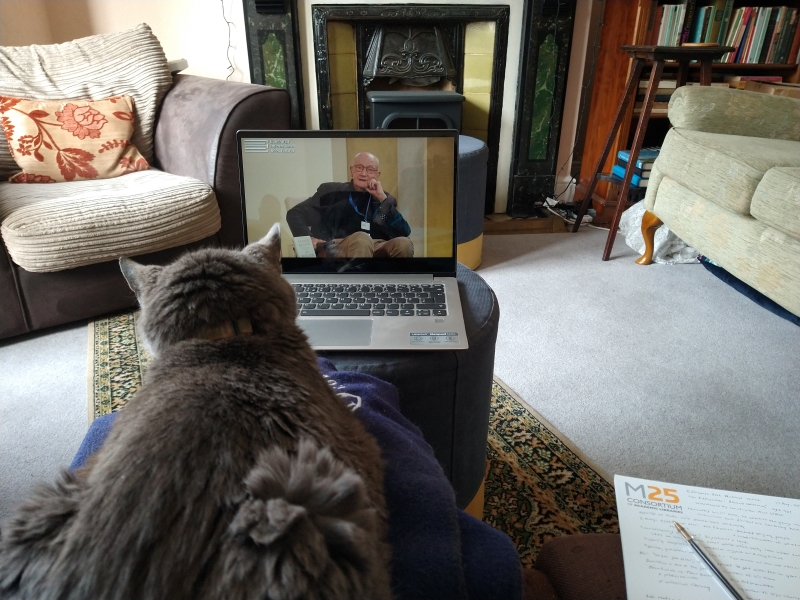
Alfie was rapt, too, of course.
I’ve reviewed several of his books here before (The Way of the Cross, Waiting for the Last Bus and The Heart of Things) and it would be fair to call him one of my most-admired spiritual gurus. At age ninety, he is not just lucid but quick-witted and naughty (I wasn’t expecting two F-bombs from a former bishop). While I have not read his latest book, On Reflection, it sounds like it’s quite similar to The Heart of Things: composed of memories and philosophical musings, with lashings of 20th-century poetry and Scottish history.
Interviewer Alan Little, a broadcaster who is stepping down as Festival chair after a decade, drew Holloway out on topics including faith, poetry, the Scottish reformation, and mortality. Little joked, “as you get older, you’re supposed to get more set in your ways!” while Holloway appears to become ever more liberal. He referred to himself as a “non-believing Christian” who is still steeped in religious culture and language but has adopted a “serene, gracious agnosticism,” which is “as much as the universe affords us.”
Holloway recently reread his first book and, while he admired that young man’s enthusiasm, he disliked the hectoring tone. The opposite of faith isn’t doubt, he remarked, but certainty. Two things prompted him to leave the ministry: the Church’s hatred of gay people and its subordination of women. His guiding principle is simple (reminiscent of Jan Morris’s): let’s be kind to each other and look after one another while we’re here. More existentially, he frames it as: let’s live as if life has meaning, even though he’s not sure that it does. In fact, he theorizes that religion arose from death, because we are the only species that is aware of our mortality and we can’t bear the thought of nothingness.
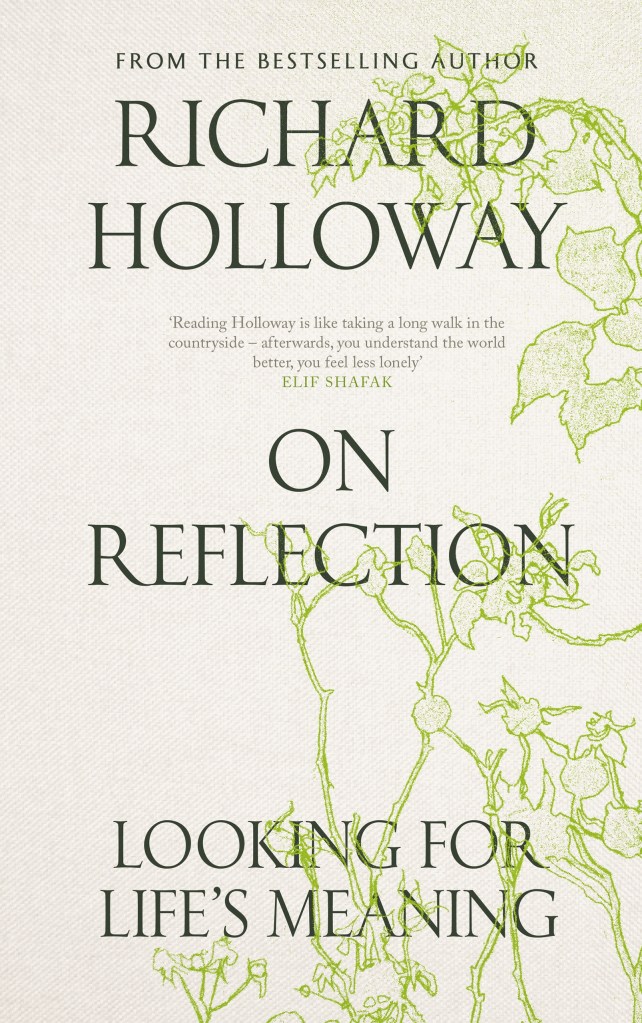
Holloway seems to live and breathe poetry. He expressed his love for W. H. Auden, whom he described as almost “priestly” in his brokenness, struggles, mysticism, and doing of good by stealth (he cared for war orphans and left them money at his death). Although I sometimes feel that Holloway is overly reliant on quotation in his recent books, I appreciate his fervour for poetry. His summation of what it does for him rang true for me as well: “poetry feeds me because it notices things in a particular way.” He added, “at its best, religion is a kind of realized poetry,” exclaiming, if only we could value it as such and not turn it into doctrine.
I wasn’t as interested in the discussion of John Knox and Scottish Presbyterianism, but obviously it was appropriate for the Edinburgh setting. Holloway said that it saddens him that Scotland is losing “the kirk” – as a tradition and in the form of buildings, many of which stand derelict. He read a long passage about Knox’s unfortunate hatred of images (his movement removed or concealed all sacred paintings) and how that rejection comes from the desert religions, which associate emptiness with otherness and the Transcendent.
During the Q&A time, one audience member said that he was heading to a Handel performance next, and hoped for a transcendent experience – but, he asked, being agnostic like Holloway, “what will I transcend to?” The two men seemed to agree that the experience itself is enough. Culture as transmitted by learning is the most distinctive thing about humans, Holloway observed, and Little also spoke passionately about the arts’ role in reconciliation. Several times, Holloway expressed his enduring wonder at the fact that there is something instead of nothing. It still staggers him not just that we’re here, but that we are capable of pondering the meaning of our own existence through events such as this one. That humility, even after his many decades as a respected public thinker, was beautiful to see.
 Bookish Beck = Rebecca Foster. American transplant to England. Freelance proofreader and book reviewer.
 Bookish Beck