Three Cancer Patient Memoirs
There can’t be many of us whose lives haven’t been touched by cancer. Siddhartha Mukherjee, author of The Emperor of All Maladies, estimates that one in three of us will have cancer at some point in life, and that figure is steadily rising to one in two. Cancer hit home for me in late 2010 with my brother-in-law’s diagnosis of a brain tumor and his subsequent death in early 2015. Since then I have been reading cancer and bereavement memoirs almost compulsively, looking for clues to how we can deal with this near-universal phenomenon. Here are three personal stories of cancer that have stuck with me lately.
This Is Cancer: Everything You Need to Know, from the Waiting Room to the Bedroom
By Laura Holmes Haddad
 A stage IV inflammatory breast cancer survivor, Laura Holmes Haddad wrote the “What to Expect” guide she wishes she could have found at the time of her diagnosis in 2012. Throughout this comprehensive, well-structured book, she uses her own experience to set out practical advice for dealing with the everyday medical and emotional realities of cancer. On the technical side, she gives an alphabetical glossary of “Cancerspeak” vocabulary, as well as explanations of different types of scans, chemo drugs, radiation treatments, methods of coping with pain, and options for reconstruction surgery. But she also goes deep into the less obvious aspects of the disease, like hidden financial costs, little-known side effects, and complications that could affect your sleep and travel. Her tips range from the dead simple—bring your own pen for filling out hundreds of pages of forms; schedule little pick-me-ups like a mini-makeover—to major issues like marriage and parenting with cancer.
“Don’t be surprised if this thing—this cancer road trip—leads to places you never could have imagined,” Holmes Haddad writes. “I’m trying to pay it forward to other patients, to help ease some angst, to comfort.” You might be surprised to learn that this is a very pleasant read. It fluidly mixes anecdote with facts and maintains an appropriate tone: forthright and reassuring yet wry, as in the ‘Devil’s Dictionary’ type translations (“DOCTOR: ‘You might feel some discomfort.’ MEANING: ‘This will hurt like hell.’”).
No cancer patient should be without this book. That statement needs no qualifying. Yes, it might be geared more towards women, specifically breast cancer patients, and there’s some U.S.-specific information about health insurance, but much of the guidance is universally applicable. Whether for yourself or to help a family member or friend, you’ll want a copy.
My thanks to publicist Eva Zimmerman for the free e-copy for review. This Is Cancer will be released by Seal Press on Tuesday.
My rating: 
Late Fragments: Everything I Want to Tell You (About This Magnificent Life)
By Kate Gross
 By the end of this charming memoir, I felt I knew Kate Gross as a friend. A high-flying British civil servant who helped Tony Blair found an NGO in Africa, she was shocked to learn in her early thirties that her occasional ‘bottom trouble’ was end-stage colon cancer with liver metastases. “I’m a golden girl, a people-pleaser, something who is used to graft and a pleasant smile being rewarded,” she writes, yet here was a situation she could not control. She died at age 36 in 2014.
In this short, clear-eyed book, she balances a brief recounting of her life with observations about terminal illness and trying to ensure a good future for her five-year-old twin sons. Memoirs by people facing death can often skirt close to cliché, but I felt Gross had fresh things to tell me about many subjects:
Cultivating “bitter gratitude”: “How strange, how brilliant it is that this awareness of wonder, this sense of the sublime, has been so closely intertwined with my illness as it has progressed.”
The value of literature: “Reading is an experience by which we connect ourselves to what we are, to this magnificent, awful life, in which the same grooves are being scored over and over again in different times and tongues.”
How to act around the dying: “we don’t expect great words of wisdom or solace. I just want this shit to be acknowledged”
Gross doesn’t believe in an afterlife beyond her children’s memory and this book—“nothingness-with-benefits.” I could sympathize with her picture of death, “me in the back of a black taxi, leaving an awesome party before the end, just when everyone else was starting to have real fun.” I wish she’d had longer at the party, but I’m glad she left these thoughts behind.
My rating: 
Haematemesis: How One Man Overcame a Fear of Things Medical and Learned to Navigate His Way Around Hospital
By Henry G. Sheppard
 This is a mordantly funny account of one Australian man’s experience with recurrent cancer. In remission since 2007, Sheppard discovered in 2015 that he was once more riddled—that awful word—with leukemia. Having vowed never to go through chemo again, he learned that it had somewhat improved in the intervening years, with the drip treatments now partially replaced by tablets. This time around he ran into a lot of what he calls “Big Hospital Attitude”: scheduling issues with his bone marrow biopsy, nurses who didn’t think he could manage his own insulin treatments, and constant problems with finding veins for his many injections. Was this the much-touted “Patient-Centered Care”? Would he be better off with the “quick and relatively-painless death offered when one is mauled by a pack of wild dogs”?
“Haematemesis” means vomiting blood, and be warned: there is a lot of blood here; if you’re squeamish about needles you may struggle. There is also plenty of scatological humor. But in general I found the tone to be reminiscent of Bill Bryson in a hospital gown, especially when he’s describing squeezing his belly into a CT scanner or recounting his flatulence.
My main complaint is that at 80 pages this feels incomplete, like it’s telling just part of the story. What about his first bout with leukemia, or his earlier life (which, from a look at his Goodreads biography, seems very eventful indeed)? I understand that Sheppard wanted to get this book released while he was still able. I wish him well and hope for a sequel.
My thanks to the author for the free e-copy for review.
My rating: 
Landmark Books from My Early Life
I initially wanted to title this post “Books that Changed My Life,” but soon realized it would probably be more accurate to speak about them as the books that have shaped my life as a keen reader and meant the most to me as the years have passed.
In making this list I was inspired by a book I recently finished, Kate Gross’s memoir Late Fragments, which finishes with a bibliography of books that influenced her during different periods of her life. Gross, who died of colon cancer at age 36 in 2014, divides her reading life into five distinct, whimsically named eras: “With my back to the radiator” (childhood), “The grub years” (adolescence), “Emerging from the cocoon” (early adulthood), “The woman in the arena” (career life) and “End of life book club.”
I’ll do a follow-up post on the key books from my twenties next month, but for now I want to focus on the books that defined my growing-up and teen years.
What Bewick’s Birds was for Jane Eyre, my parents’ book on flower arranging was for me. I couldn’t tell you the title or author, but I think this green fabric covered tome with its glossy pages and lush full-color photographs was the origin of my love of books as physical objects. I must have spent hours paging through the illustrations and breathing in the new-book aroma. I’ve been a book sniffer ever since.
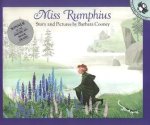 I can’t recall many of the individual picture books my mother read with me when I was little, but one that does stand out in my memory is Miss Rumphius by Barbara Cooney, about an eccentric woman who goes about planting lupines. Again, it’s a gorgeous book filled with flowers – you’d think I might have become a botanist!
 C.S. Lewis’s The Chronicles of Narnia were the first books I ever read by myself, starting at age five. It took me years to get to the allegory-heavy The Last Battle, but I read the other volumes over and over, even after the PBS television movies came out. The Silver Chair was always my favorite, but I’m sure I must have read the first three books 10 or 20 times each.
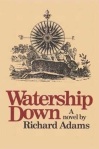 Richard Adams’s Watership Down was the first book I ever borrowed from the adult section of the public library, at age nine. Crossing the big open lobby of the Silver Spring, Maryland library from the children’s room to the imposing stacks of Adult Fiction was like a rite of passage; when I emerged clutching the fat plastic-covered hardback I felt a little bit like a rebel but mostly just pretty darn proud of myself. I inhaled the several hundred pages of this bunny epic and for years afterwards considered it my favorite book.
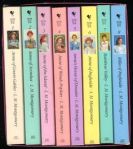 Nowadays I don’t like to commit to series, but as a kid I couldn’t get enough of them: after Narnia, I devoured the Babysitter’s Club and Saddle Club books, the Anastasia Krupnik books, and so on. Whenever I found an author I loved I dutifully read everything they’d written. The Anne of Green Gables series by L.M. Montgomery, in particular, accompanied me through my early teen years. I think I saw the CBC/PBS television miniseries starring Megan Follows first and read the books afterwards. Bereft once the eight-book cycle was over, I read the much darker Emily trilogy, but it just couldn’t live up to the Anne books.
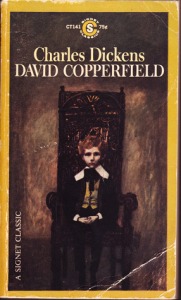 My first foray into the realm of heavy-duty classics was Charles Dickens’s David Copperfield at age 14. I bought a battered secondhand paperback from a library sale and was immediately entranced, from the first line onwards: “Whether I shall turn out to be the hero of my own life, or whether that station will be held by anybody else, these pages must show.” No doubt the idea of discovering my own potential heroism was what drew me in, but I loved everything about this novel: the rich panorama of nineteenth-century life, the vibrant secondary characters, the under-the-surface humor you had to work a little bit to understand, and the sweet second-chance romance. This was the start of my love affair with Victorian literature. I’ve read it three times since then. If ever asked for my favorite book, this is what I name.
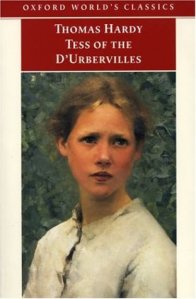 It wasn’t my first Hardy novel (that was Far from the Madding Crowd, another all-time favorite), but Tess of the D’Urbervilles is most memorable for the circumstances in which I read it. At age 19 I accompanied my sister, who’d won a singing contest on local radio, to the Season 2 finale of American Idol in Hollywood. If you were a loyal viewer, you might recall that this was the showdown between Ruben Studdard and Clay Aiken, on whom I had a hopeless crush – it later emerged that he’s gay. I read Tess on the flight to Los Angeles. Stranger pairings have been known, I’m sure, but I’ll never forget that disconnect between bleak England (where I hadn’t yet been at that point) and the sunny entertainment capital.
 Bookish Beck = Rebecca Foster. American transplant to England. Freelance proofreader and book reviewer.
 Bookish Beck