Three on a Theme (Valentine’s Day): “Love” Books by Amy Bloom, George Mackay Brown & Hilary Mantel
Every year I say it: I’m really not a Valentine’s Day person and yet it’s become a tradition to put together a themed post featuring one or more books with “Love” or “Heart” in the title. This is the tenth year in a row, in fact – after 2017, 2018, 2019, 2020, 2021, 2022, 2023, 2024 and 2025. As you might expect, none of the three below contains a straightforward love story. The relationships portrayed tend to be unequal, creepy or doomed, but the solid character work and use of setting and voice was enough to keep me engaged with all of the books.
Love Invents Us by Amy Bloom (1997)
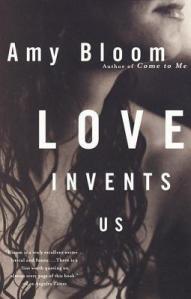 I’ve found Bloom’s short stories more successful than her novels. This is something of a halfway house: linked short stories (one of which was previously published in Come to Me; another that gives the title line to her 2000 collection A Blind Man Can See How Much I Love You) about Elizabeth Taube. When we first meet her on Long Island in the 1960s, she’s a rebellious and sexually precocious Jewish girl; by the time we’ve journeyed through several decades of vignettes, she’s a flighty and psychologically scarred single mother. Stories of her Lolita-esque attractiveness to grown salesmen and teachers, her shoplifting, her casual work for elderly African American Mrs. Hill, and her great love for Horace, nicknamed Huddie, a Black basketball player, are in the first person. The longer second part – about the aftermath of her physical affair with Huddie and her ongoing emotional entanglement with her English teacher, Max Stone – is in the third person yet feels more honest. Liz seems like bad news for everyone she meets. Bloom shows us some of the reasons for what she does, but I still couldn’t absolve her protagonist. I’d also reverse the title: We Invent Love. Liz is responsible for irrevocably altering two lives besides her own based on what she needs to feel secure. This is very much Lorrie Moore territory, but Moore leaves less of a bitter taste. (Secondhand – Community Furniture Project)
A Calendar of Love and Other Stories by George Mackay Brown (1967)
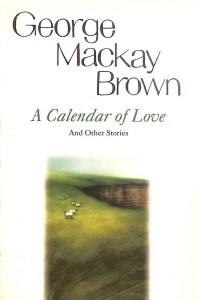 The title story opens a collection steeped in the landscape and history of Orkney. Each month we check in with three characters: Jean, who lives with her ailing father at the pub they run; and her two very different suitors, pious Peter and drunken Thorfinn. When she gives birth in December, you have to page back to see that she had encounters with both men in March. Some are playful in this vein or resemble folk tales: a boy playing hooky from school, a distant cousin so hapless as to father three bairns in the same household, and a rundown of the grades of whisky available on the islands. Others with medieval time markers are overwhelmingly bleak, especially “Witch,” about a woman’s trial and execution – and one of two stories set out like a play for voices. I quite liked the flash fiction “The Seller of Silk Shirts,” about a young Sikh man who arrives on the islands, and “The Story of Jorfel Hayforks,” in which a Norwegian man sails to find the man who impregnated his sister and keeps losing a crewman at each stop through improbable accidents. This is an atmospheric book I would have liked to read on location, but few of the individual stories stand out. (Secondhand – Community Furniture Project, Newbury)
An Experiment in Love by Hilary Mantel (1995)
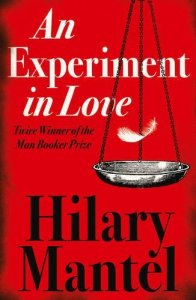 Mantel is best remembered for the Wolf Hall trilogy, but her early work includes a number of concise, sharp novels about growing up in the north of England. Carmel McBain attends a Catholic school in Manchester in the 1960s before leaving to study law at the University of London in 1970. In lockstep with her are a couple of friends, including Karina, who is of indeterminate Eastern European extraction and whose tragic Holocaust family history, added to her enduring poverty, always made her an object of pity for Carmel’s mother. But Karina as depicted by Carmel is haughty, even manipulative, and over the years their relationship swings between care and competition. As university students they live on the same corridor and have diverging experiences of schoolwork, romance, and food. “Now, I would not want you to think that this is a story about anorexia,” Carmel says early on, and indeed, she presents her condition as more like forgetting to eat. But then you recall tiny moments from her past when teachers and her mother shamed her for eating, and it’s clear a seed was sown. Carmel and her friends also deal with the results of the new-ish free love era. This is dark but funny, too, with Carmel likening roast parsnips to “ogres’ penises.” Further proof, along with Every Day Is Mother’s Day, that it’s well worth exploring authors’ back catalogue. (Public library)
Plus a DNF:
 Unexpected Lessons in Love by Bernardine Bishop (2013): I loved Bishop’s The Street, and this posthumous novel initially drew me in with its medical detail (two friends who both had stoma operations) and the exploration of different forms of love – romantic, parental, grandparental – before starting to feel obvious (two adoptions, one historical and one recent), maudlin and overlong. With some skimming, I made it to page 120. (Secondhand – Awesomebooks.com)
Other relevant reading on the go:
I would have tried spinning this one into another thematic trio, but ran out of time…
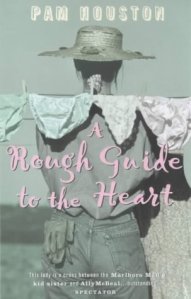 A Rough Guide to the Heart by Pam Houston (1999): A mix of personal essays and short travel pieces. The material about her dysfunctional early family life, her chaotic dating, and her thrill-seeking adventures in the wilderness is reminiscent of the highly autobiographical Waltzing the Cat. Amusingly, this has a previous price label from Richard Booth’s Bookshop in Hay-on-Wye, where it was incorrectly classed as Romance Fiction – one could be excused the mistake based on the title and cover! (Secondhand – Community Furniture Project)
And three books about marriage…
 The Honesty Box by Lucy Brazier – A pleasant year’s diary of rural living and adjusting to her husband’s new diagnosis of neurodivergence.
- Strangers by Belle Burden – A high-profile memoir about her husband’s strange and marriage-ending behaviour (his affair was only part of it) during the 2020 lockdown.
- Mrs. Bridge by Evan S. Connell – For Literary Wives Club in March. I’m in the early pages but it seems comparable to Richard Yates.
Monsters: A Fan’s Dilemma by Claire Dederer
The question posed by Claire Dederer’s third hybrid work of memoir and cultural criticism might be stated thus: “Are we still allowed to enjoy the art made by horrible people?” You might be expecting a hard-line response – prescriptive rules for cancelling the array of sexual predators, drunks, abusers and abandoners (as well as lesser offenders) she profiles. Maybe you’ve avoided Monsters for fear of being chastened about your continuing love of Michael Jackson’s music or the Harry Potter series. I have good news: This book is as compassionate as it is incisive, and while there is plenty of outrage, there is also much nuance.
Dederer begins, in the wake of #MeToo, with film directors Roman Polanski and Woody Allen, setting herself the assignment of re-watching their masterpieces while bearing in mind their sexual crimes against underage women. In a later chapter she starts referring to this as “the stain,” a blemish we can’t ignore when we consider these artists’ work. Try as we might to recover prelapsarian innocence, it’s impossible to forget allegations of misconduct when watching The Cosby Show or listening to Miles Davis’s Kind of Blue. Nor is it hard to find racism and anti-Semitism in the attitude of many a mid-20th-century auteur.

Does “genius” excuse all? Dederer asks this in relation to Picasso and Hemingway, then counteracts that with a fascinating chapter about Lolita – as far as we know, Nabokov never engaged in, or even contemplated, sex with minors, but he was able to imagine himself into the mind of Humbert Humbert, an unforgettable antihero who did. “The great writer knows that even the blackest thoughts are ordinary,” she writes. Although she doesn’t think Lolita could get published today, she affirms it as a devastating picture of stolen childhood.
“The death of the author” was a popular literary theory in the 1960s that now feels passé. As Dederer notes, in the Internet age we are bombarded with biographical information about favourite writers and musicians. “The knowledge we have about celebrities makes us feel we know them,” and their bad “behavior disrupts our ability to apprehend the work on its own terms.” This is not logical, she emphasizes, but instinctive and personal. Some critics (i.e., white men) might be wont to dismiss such emotional responses as feminine. Super-fans are indeed more likely to be women or teenagers, and heartbreak over an idol’s misdoings is bound up with the adoration, and sense of ownership, of the work. She talks with many people who express loyalty “even after everything” – love persists despite it all.

U.S. cover
In a book largely built around biographical snapshots and philosophical questions, Dederer’s struggle to make space for herself as a female intellectual, and write a great book, is a valuable seam. I particularly appreciated her deliberations on the critic’s task. She insists that, much as we might claim authority for our views, subjectivity is unavoidable. “We are all bound by our perspectives,” she asserts; “consuming a piece of art is two biographies meeting: the biography of the artist, which might disrupt the consuming of the art, and the biography of the audience member, which might shape the viewing of the art.”
While men’s sexual predation is a major focus, the book also weighs other sorts of failings: abandonment of children and alcoholism. The “Abandoning Mothers” chapter posits that in the public eye this is the worst sin that a woman can commit. Her two main examples are Doris Lessing and Joni Mitchell, but there are many others she could have mentioned. Even giving more mental energy to work than to childrearing is frowned upon. Dederer wonders if she has been a monster in some ways, and confronts her own drinking problem.

A painting by Cathy Lomax of girls at a Bay City Rollers concert.
Here especially, the project reminded me most of books by Olivia Laing: the same mixture of biographical interrogation, feminist cultural criticism, and memoir as in The Trip to Echo Spring and Everybody; some subjects even overlap (Raymond Carver in the former; Ana Mendieta and Valerie Solanas in the latter – though, unfortunately, these two chapters by Dederer were the ones I thought least necessary; they could easily have been omitted without weakening the argument in any way). I also thought of how Lara Feigel’s Free Woman examines her own life through the prism of Lessing’s.
The danger of being quick to censure any misbehaving artist, Dederer suggests, is a corresponding self-righteousness that deflects from our own faults and hypocrisy. If we are the enlightened ones, we can look back at the casual racism and daily acts of violence of other centuries and say: “1. These people were simply products of their time. 2. We’re better now.” But are we? Dederer redirects all the book’s probing back at us, the audience. If we’re honest about ourselves, and the people we love, we will admit that we are all human and so capable of monstrous acts.
Dederer’s prose is forthright and droll; lucid even when tackling thorny issues. She has succeeded in writing the important book she intended to. Erudite, empathetic and engaging from start to finish, this is one of the essential reads of 2023. 
With thanks to Sceptre for the free copy for review.
Buy Monsters from Bookshop.org [affiliate link]
 Bookish Beck = Rebecca Foster. American transplant to England. Freelance proofreader and book reviewer.
 Bookish Beck