Hungerford Bookshop’s Summer Reading Celebration
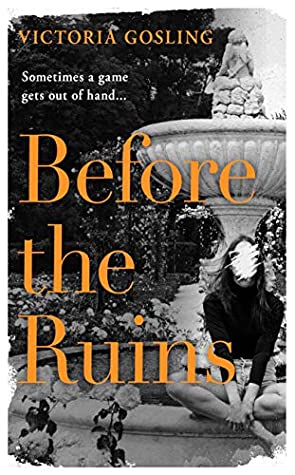
On Saturday evening my nearest indie, Hungerford Bookshop, hosted a Summer Reading celebration with five authors, some of them local, introducing their novels. It was such a delight to be invited! The rain just about held off for the duration of the outdoor event, and it was fun to learn more about new-to-me books over Pimm’s and canapes and pick up some proof copies.
Veronica Henry usually writes English countryside and coastal stories, but this time it’s Thirty Days in Paris, about Juliet, a woman of a certain age who takes a one-month rental in the city to write a novel, having amicably separated from her husband. Henry based the flat on one she stayed in in Paris, and called this novel a wish fulfilment for her.

Ruth Kelly, a ghostwriter (The Prison Doctor, etc.) based in Kintbury, has written her first novel, The Villa, a thriller about a reality TV franchise. The main character is a journalist and the other two POVs are the producer and viewers collectively. She said the book starts with the body and moves backwards.

Jane Dunn is a biographer (of Daphne du Maurier, Antonia White et al.) who pivoted to writing Regency romances, having been inspired by a newfound love of Georgette Heyer. Her books, including An Unsuitable Heiress, feature women who are slightly on the periphery: a widow, illegitimate children, a male impersonator, and so on.
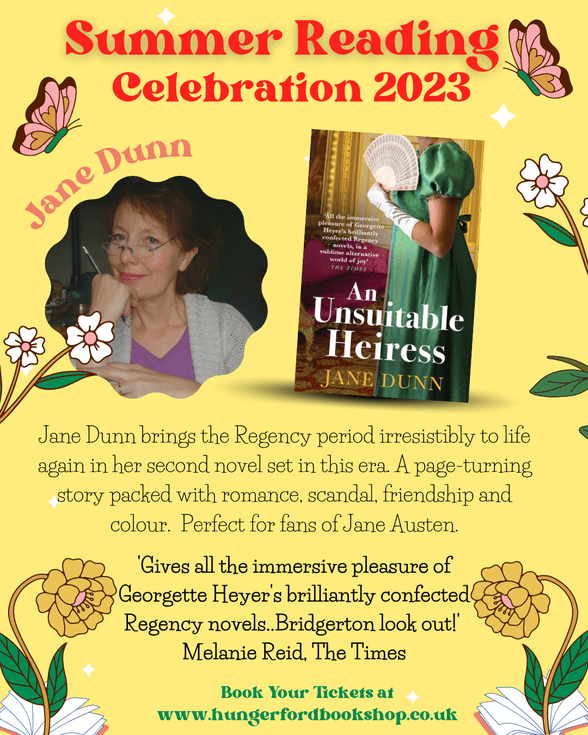
Victoria Gosling was a last-minute fill-in for an author who couldn’t make it. She moved back to Marlborough from Berlin, where she was living when she wrote her book set in Marlborough, Before the Ruins. She called it a slow-burn (Secret History-type) thriller about four people who spent the summer they were 17 squatting in a derelict manor house and have been dealing with the fallout ever since. I’ll get this one out from the library soon.
Lucy Barker’s debut novel, The Other Side of Mrs Wood, is about two warring mediums in 1873. Since I love most things set in the Victorian period, this was the one I’d already heard about and placed an order on through the library. It’s based on real-life mediums Agnes Guppy and Florence Cook and sounds like great fun! The summer reading choices are usually paperbacks, but an exception was made for this one still in hardback.

Which of these take your fancy?
There was also bookshop news and bookseller recommendations. The big announcement was the opening of a new branch in Wantage, taking over a closing-down shop.
Bookseller recommendations:
 Hilary: Briefly, A Delicious Life by Nell Stevens (I’d second that one; here’s my review)
Tessa: The Redemption of Isobel Farrar by Alan Robert Clark
Alison: Shrines of Gaiety by Kate Atkinson
Emma: Beautiful Ruins by Jess Walter (I’ve long been interested in this one)
Alex: The Sanctuary by Andrew Hunter Murray (& Lessons by Ian McEwan in paperback)
Imogen: Little Wing by Freya North (my ears pricked up to hear it’s set on the Isle of Harris)
In Memoriam by Alice Winn: Review & Author Event
I read In Memoriam by Alice Winn last month, then had the chance to see the author in conversation at Hungerford Town Hall, an event hosted by Hungerford Bookshop, on Friday evening. Here’s what I thought of the novel, which is on my Best of 2023 list.
Review
Heartstopper on the Western Front; swoon! It’s literary fiction set in the trenches of WWI, yes, but also a will-they-won’t they romance that opens at an English boarding school. Oh they will (have sex, that is), before the one-third point, but the lingering questions are: will Sidney Ellwood and Henry Gaunt both acknowledge this is love and not just sex, as it is for many teenage boys at their school (either consensually, as buddies; or forced by bullies); and will one or both survive the war? “It was ridiculous, incongruous for Ellwood to be bandying about words like ‘love’ when they were preparing to venture out into No Man’s Land.”
Winn is barely past 30 (and looks like a Victorian waif in her daguerreotype-like author photo), yet keeps a tight control of her tone and plot in this debut novel. She depicts the full horror of war, with detailed accounts of battles at Loos, Ypres and the Somme, and the mental health effects on soldiers, but in between there is light-heartedness: banter, friendship, poetry. Some moments are downright jolly. I couldn’t help but laugh at the fact that Adam Bede is the only novel available and most of them have read it four times. Gaunt is always the more pessimistic of the two, while Ellwood’s initially flippant sunniness darkens through what he sees and suffers.

I only learned from the Acknowledgements and Historical Note that Preshute is based on Marlborough College, a posh school local to me that Winn attended, and that certain particulars are drawn from Siegfried Sassoon, as well as other war literature. It’s clear the book has been thoroughly, even obsessively, researched. But Winn has a light touch with it, and characters who bring social issues into the narrative aren’t just 2D representatives of them but well rounded and essential: Gaunt (xenophobia), Ellwood (antisemitism), Hayes (classism), Devi (racism); not to mention disability and mental health for several.
I also loved how Ellwood is devoted to Tennyson and often quotes from his work, including the book-length elegy In Memoriam itself. This plus the “In Memoriam” columns of the school newspaper give the title extra resonance. I thought I was done with war fiction, but really what I was done with was worthy, redundant Faulks-ian war fiction. This was engaging, thrilling (a prison escape!), and, yes, romantic. (Public library) 
Readalike: The New Life by Tom Crewe, another of my early favourites of 2023, is set in a similar time period and also considers homosexual relationships. It, too, has epistolary elements and feels completely true to the historical record.
Some favourite lines:
“If Ellwood were a girl, he might have held his hand, kissed his temple. He might have bought a ring and tied their lives together. But Ellwood was Ellwood, and Gaunt had to be satisfied with the weight of his head on his shoulder.”
“Gaunt wished the War had been what Ellwood wanted it to be. He wished they could have ridden across a battlefield on horseback, brandishing a sword alongside their gallant king. He put on his gas mask. His men followed.”
Buy In Memoriam from Bookshop.org [affiliate link]
Event
Winn is in the UK on a short book tour; although she is English, she now lives in Brooklyn and recently had a baby. She was in conversation with AJ West, the author of The Spirit Engineer, also set on the cusp of WWI. Unrecognizable from her author photo – now blonde with glasses – she is petite rather than willowy. As I was leaving, two ladies remarked to each other how articulate she was. Indeed, she was well spoken and witty and, I expect, has always been precocious and a high achiever. I think she’s 32. Before this she wrote three novels that remain unpublished. She amazed us all by admitting she wrote the bulk of In Memoriam in just two weeks, pausing only to research trench warfare, then edited it for a year and a half.
West asked her about the genesis of the novel and she explained her obsession with the wartime newspapers of Sassoon’s school and then the letters sent home by soldiers, tracking the shift in tenor from early starry-eyed gallantry to feeling surrounded by death. She noted that it was a struggle for her to find a balance between the horrors of the Front and the fact that these young men come across in their written traces as so funny. She got that balance just right.
Was she being consciously anti-zeitgeist in focusing on privileged white men rather than writing women and minorities back into the narrative, as is so popular with publishers today, West asked? She demurred, but added that she wanted to achieve something midway between being of that time and a 2023 point-of-view in terms of the sexuality. Reading between the lines and from secondary sources, she posited that it was perhaps easier to get away with homosexuality than one might think, in that it wasn’t expected and so long as it was secret, temporary (before marrying a woman), or an experiment, it was tolerated. However, she took poetic licence in giving Gaunt and Ellwood supportive friends.

Speaking of … West (a gay man) jokingly asked Winn if she is actually a gay man, because she got their experiences and feelings spot on. She said that she has some generous friends who helped her with the authenticity of the sex scenes. In the novel she has Ellwood interpret Tennyson’s In Memoriam as crypto-homosexual, but scholars do not believe that it is; Gaunt’s twin sister Maud also, unconsciously in that case, has a Tennysonian name. This was in response to an audience question; this plus another one asking if Winn had read The New Life reassured me that my reaction was well founded! (Yes, she has, and will in fact be in conversation with Crewe in London on the 23rd. She’s also appearing at Hay Festival.)
If you’ve read the book and/or are curious, Winn revealed the inspirations for her three main characters, the real people who are “in their DNA,” as she put it: Gaunt = Robert Graves (half-German, interest in the Greek classics); Ellwood = Sassoon; Maud = Vera Brittain. She read a 5-minute passage incorporating a school scene between Gaunt and Sandys and a letter from the Front. She spoke a little too quickly and softly, such that I was glad I was within the first few rows. However, I’m sure this is a new-author thing and, should you be so lucky as to see her speak in future, you will be as impressed as I was.
Patrick Gale at Marlborough Literature Festival
It’s been a long time since I attended a literary festival in person rather than online. Four of us from my book club went along yesterday evening to the headline event of Marlborough Literature Festival. Marlborough is a pleasant market town in Wiltshire about 40 minutes from Newbury, and I’d like to get back to it sometime soon when things are open so I can explore its secondhand and plastic-free shops.
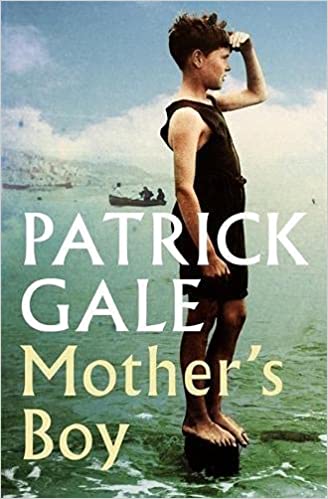
Patrick Gale closed the festival by speaking about his new novel (his 17th), Mother’s Boy. I knew it was a historical novel that covered the Second World War, but I had no idea that it was based on a real person, poet Charles Causley. With Andrew Motion, Gale is a patron of the Charles Causley Trust, which runs an annual poetry competition for children. I hadn’t heard of Causley, but Gale and some members of the audience recall memorizing his poems in school – like Roald Dahl’s, they can have a wicked sense of humour. Causley also wrote in the style of traditional ballads; my husband knows a version of one on a folk album.
Gale called Causley the “least sexy” of the war poets. He was from Launceston, Cornwall and left school at age 15, joining the Navy and later working as a schoolteacher for many years. He lived with his widowed mother and, if you believe the legend, died a virgin. However, Gale unearthed evidence that Causley was in fact a closeted homosexual and had sexual encounters with men during the war. He experienced survivor’s guilt because he escaped his ship’s explosion while he had an on-shore posting so that he could sit his exams.
Equally important to the novel is Causley’s mother, Laura, who grew up in extreme poverty and, after her husband’s death from TB, raised Charles in a slum on a laundress’ salary, even managing to buy him a piano. Launceston was decimated by the two world wars, and essentially colonized by the segregated U.S. Army. Gale made up a Black character named Amos, but gave him a horrific real-life story. Laura would have met Black soldiers and, later, German POWs through her working-class church.
Gale acknowledged that he had to make up more of Laura’s story, relying only on the information about her in Causley’s tiny appointment diaries. In response to an audience question, he said he thinks Causley would be “utterly appalled” at the existence of this novel because he was an intensely private person, but that he’s salved his conscience with the fact that the book is driving people back to Causley’s poems. He wrote this as a novel rather than a biography because he tends to “overempathize” with characters, and likes to go “behind the bedroom door,” as he put it – indeed, one (non-graphic) scene he read was of Charles’s conception, while the other was about Charles learning to read at age five and enjoying his father’s company though he knew he was ill.
Mother’s Boy is most like A Place Called Winter from his oeuvre, Gale remarked, in that it’s historical fiction based on real people – in that earlier case, his own relatives. Gale’s father was the governor of Wandsworth Prison and his mother the daughter of the governor of Liverpool Prison (where he oversaw many hangings). In fact, he’s now at work on a sequel to A Place Called Winter, about his grandparents and parents, and researching from letters.
I was impressed with Gale’s delivery: he spoke engagingly for 45 minutes about the book and its context, peppering in readings and recitations, with no interviewer to prompt him. It was clearly a practiced lecture, but he had no notes and spoke warmly and as if off the cuff.
Are any of these poem titles familiar to you? These were the ones mentioned during last night’s event. (You can listen to Causley reading some of them in his eighties – with his large cat purring in the background – on the Poetry Archive site I linked to above.)
- “Timothy Winters”
- “Rattler Morgan”
- “Eden Rock”
- “The Ballad of a Bread Man”
- “Angel Hill”
I have a copy of Mother’s Boy on hold at the library for me to pick up tomorrow, and we fancy reading A Place Called Winter for book club soon – his Notes from an Exhibition was one of our all-time favourites that we’ve read together.
Are you a Patrick Gale fan? Have you been able to attend any literary events recently?
 Bookish Beck = Rebecca Foster. American transplant to England. Freelance proofreader and book reviewer.
 Bookish Beck