The Wellcome Book Prize 2017 Awards Ceremony
Yesterday evening’s Wellcome Book Prize announcement was my first time attending a literary prize awards ceremony. Despite my nerves going in, there was quite a relaxed atmosphere (I felt almost overdressed in my H&M dress) and it was no different to any party where one struggles to make small talk – except that here all the talk was of books!
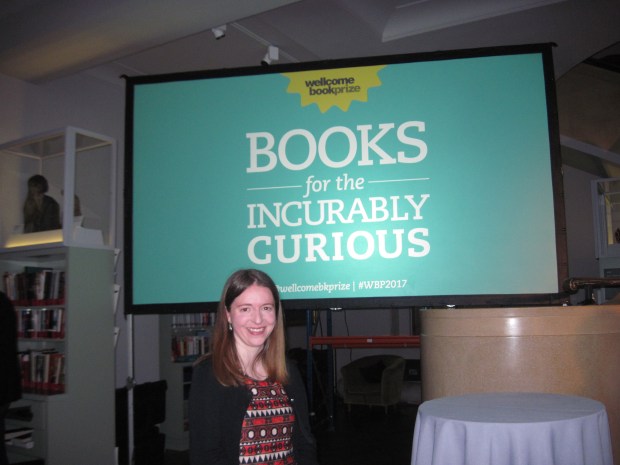
The new high-ceilinged Reading Room at the Wellcome Library (across from London’s Euston station) was a suitably swanky setting, with the unusual collection of health-themed books surrounded by an equally odd set of curios, such as death masks, paintings showing medical conditions, and a columnar red dress designed to resemble a neural tube. There was even a jazz duo playing.


It was especially lovely to meet up with Clare (A Little Blog of Books) and Ruby (My Booking Great Blog) and compare notes on book blogging while nursing a flute of prosecco and some superlative canapés. We also indulged in some subtle celebrity spotting – or, at least, the sort of authors and public figures I consider celebrities: Ned Beauman, Sarah Churchwell, A.C. Grayling, Cathy Rentzenbrink, and Suzanne O’Sullivan, last year’s Wellcome Prize winner. Three of the shortlisted authors were also present.
About 45 minutes into the event, the official proceedings began. Crime writer Val McDermid, the chair of this year’s judging panel, gave introductory remarks about the Prize and the attributes they were looking for when assessing the 140 books in the running this year. She said they were in search of books that went beyond the superficial and revealed more layers upon each rereading – as by now they’ve read the shortlisted books three times.
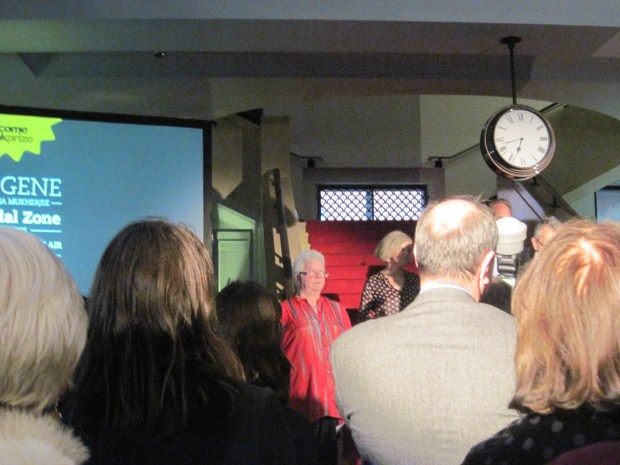
Chair of judges Val McDermid in center; fellow judge and BBC Radio books editor Di Spiers to her left.
Each of the judges then came to the podium to explain what they had all admired about a particular shortlisted book before presenting the author or author’s representative (editor, publisher or, in the case of Paul Kalanithi, his younger brother Jeevan, over from America) with flowers. When McDermid returned to the microphone to announce the winner, she started off by speaking of a book that combined two stories, the medical and the personal. Hmm, this might describe at least four or five of the books from the shortlist, I thought. Could it be When Breath Becomes Air, our shadow panel favorite? Or The Tidal Zone, our runner-up?
Within seconds the wait was over and we learned the actual winner was Mend the Living by Maylis de Kerangal. There was a pleased roar from the room, but also plenty of blinks and head shakes of surprise, I think. De Kerangal gave a few words of thanks, especially to the U.K. translator and publisher who made this edition of her book possible. This was the first work in translation to win the Wellcome Book Prize, and only the second novel (after Turn of Mind by Alice LaPlante in 2011).
Clare and I stuck around for another hour and were unexpectedly asked for book recommendations by a member of the Wellcome legal team who was kind enough to take an interest in us as book bloggers. She confessed that since uni she doesn’t read much anymore, but said that at school she enjoyed Jane Austen and she’s recently read Elena Ferrante’s books. Based on that rather thin history, we suggested she try Zadie Smith, and I also spoke up for Yaa Gyasi’s Homegoing.
On the way out we were given terrific bookish swag bags! Mine contained a paperback reissue copy of The Tidal Zone, a Wellcome Prize bookmark and commemorative booklet, and a blank notebook featuring optician’s glass eyes.

I can’t see such London events ever being frequent for me, especially given the cost of travel in from Newbury, but if a similar opportunity arises again I won’t hesitate to take advantage of it, especially if it means putting faces to names from the U.K. blogging community.
Blog Tour: Foxes Unearthed by Lucy Jones
Cold, delicately as the dark snow
A fox’s nose touches twig, leaf;
[…]
Across clearings, an eye,
A widening deepening greenness,
Brilliantly, concentratedly,
Coming about its own business
~Ted Hughes, “The Thought-Fox” (1957)
Foxes Unearthed, freelance journalist Lucy Jones’s first book, won a Society of Authors’ Roger Deakin Award for nature writing. If you’re familiar with Patrick Barkham’s Badgerlands, you’ll recognize this as a book with a comparable breadth and a similar aim: clearing the reputation of an often unfairly reviled British mammal. Jones ranges from history to science and from mythology to children’s literature in her search for the truth about foxes. Given the media’s obsession with fox attacks, this is a noble and worthwhile undertaking.
 The book proper opens with a visit to Roald Dahl’s house, now a Buckinghamshire museum, where he wrote Fantastic Mr. Fox. Still one of the best-known representations of foxes in British literature, Dahl’s Mr. Fox is a Robin Hood-like hero, outsmarting a trio of mean-spirited farmers to provide a feast for his family. Foxes’ seemingly innate wiliness prompts ambivalent reactions, though; we admire it, but we also view it as a threat or an annoyance. As Jones puts it, the fox of fables and traditional stories is “a villain we cheer for.”
Not everyone cheers, of course. Under Henry VIII, the Vermin Acts of 1532 (not repealed until the 1750s) promised a reward to anyone who killed foxes, then considered a nuisance animal. Fox hunting and the cruel sport of “tossing” have a long history that eventually came up against the movement towards animal welfare, starting with Jeremy Bentham in the 1740s and codified by the 1911 Protection of Animals Act. Meanwhile, Jones notes, children’s books advocating compassion for animals, such as Anna Sewell’s Black Beauty (1877), ensured that the message made it out of the legislative chamber and into everyday life.
The second chapter is a useful survey of fox behavior. Foxes are omnivores, and in recent decades have started to move into Britain’s cities, where they find plenty of food to scavenge. In rural settings, foxes are still the subject of farmers’ loathing even though they rarely take lambs and actually help keep rabbit numbers in check. Still, the stereotype of foxes killing for fun instead of for hunger persists, whereas they in fact cache their surplus food. Chapter 3 asks whether fox numbers have reached pest status and considers various control strategies, from straightforward culling to the non-lethal methods supported by conservationists.
I enjoyed Jones’s meetings with figures from both sides of the debate. She goes along on a fox hunt, but also meets or quotes animal rights activists, academics, and high-profile nature promoters like Chris Packham. All told, though, I felt the book could have been closer to 200 pages than 300. Most chapters are very long, and some could easily be combined and/or shortened. For instance, Chapter 1 relays the amount of information about fox hunting that most readers will be prepared to absorb, yet it’s then the subject of two more chapters.

At the British Wildlife Centre in Surrey. Photo by Chris Foster.
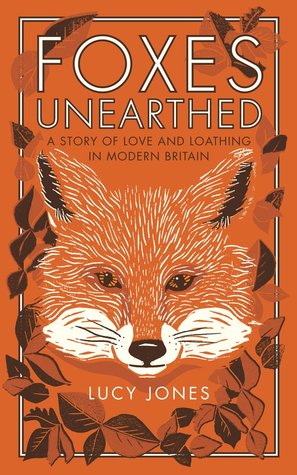
This is an important book for correcting misconceptions, but your enjoyment of it may be in proportion to your personal interest in the subject. In terms of fonts and cover design, though, you’re unlikely to come across a more gorgeous book this year.
Foxes Unearthed was published in paperback by Elliott & Thompson on March 16th. Thanks to Alison Menzies for arranging my free copy for review.
To encounter foxes in fiction, try the following:
- Glow by Ned Beauman
- The Many Selves of Katherine North by Emma Geen
- Midwinter by Fiona Melrose
- The Soho Leopard by Ruth Padel (a poetry book with a sequence on urban foxes)
& the forthcoming How to Be Human by Paula Cocozza (April 6th).
 Bookish Beck = Rebecca Foster. American transplant to England. Freelance proofreader and book reviewer.
 Bookish Beck