The Shortest of the Short: Four Novellas of under 50 Pages

Outside Stamford Library.
It’s a tradition now in its third and last year: I spend one day at the New Networks for Nature conference with my husband, and then (to save money, and because I’ve usually had my fill of stimulating speakers by then) wander around Stamford and haunt the public library on the other day.
 This past Saturday I browsed the charity shops and found a short story collection I’ve been interested in reading, but otherwise just spent hours in Stamford’s library looking through recent issues of the Times Literary Supplement and The Bookseller and reading from the stack of novellas I’d brought with me. I read four in one sitting because all were shorter than 50 pages long: two obscure classics and two nature books.

Fiction:
The Man Who Planted Trees by Jean Giono (1953)
[Translated from the French by Barbara Bray; 46 pages]
 Trees have been a surprise recurring theme in my 2018 reading. This spare allegory from a Provençal author is all about the difference one person can make. The narrator meets a shepherd and beekeeper named Elzéard Bouffier who plants as many acorns as he can; “it struck him that this part of the country was dying for lack of trees, and having nothing much else to do he decided to put things right.” Decades pass and two world wars do their worst, but very little changes in the countryside. Old Bouffier has led an unassuming but worthwhile life.
 There’s not very much to this story, though I appreciated the message about doing good even if you won’t get any recognition or even live to see the fruits of your labor. What’s most interesting about it is the publication history: it was commissioned by Reader’s Digest for a series on “The Most Extraordinary Character I Ever Met,” and though the magazine accepted it with rapture, there was belated outrage when they realized it was fiction. It was later included in a German anthology of biography, too! No one recognized it as a fable; this became a sort of literary in-joke, as Giono’s daughter Aline reveals in a short afterword.
Bartleby the Scrivener by Herman Melville (1853)
[40 pages from my Penguin Classics copy of Billy Budd, Sailor and Other Stories]
 You probably know the basic plot even if you’ve never read the story. Hired as the fourth scrivener in a Wall Street office of law-copyists, Bartleby seems quietly efficient until one day he mildly refuses to do the work requested of him. “I prefer not to” becomes his refrain. First he stops proofreading his copies, and then he declines to do any writing at all. (More and more these days, I find I have the same can’t-be-bothered attitude as Bartleby!) As the employer/narrator writes, “a certain unconscious air … of pallid haughtiness … positively awed me into my tame compliance with his eccentricities.” Farce ensues as he finds himself incapable of getting rid of Bartleby, even after he goes to the extreme of changing the premises of his office. Three times he even denies knowing Bartleby, but still the man is a thorn in his flesh, a nuisance turned inescapable responsibility. A glance at the introduction by Harold Beaver tells me I’m not the first to make such Christian parallels. (This was the first Melville I’ve read since an aborted attempt on Moby-Dick during college.)
Nonfiction:
The Company of Swans by Jim Crumley (1997)
[Illustrated by Harry Brockway, who also did the wood engravings for the Giono; 39 pages]

 Crumley is an underappreciated Scottish nature writer. Here he tells the tale of a pair of mute swans on a loch in Highland Perthshire. He followed their relationship with great interest over a matter of years. First he noticed that their nest had been robbed, twice within a few weeks, and realized otters must be to blame. Then, although it’s a truism that swans mate for life, he observed the cob (male) leaving the pen (female) for another! Crumley was overtaken with sympathy for the abandoned swan and got to feed her by hand and watch her fall asleep. “To suggest there was true communication between us would be outrageous, but I believe she regarded me as benevolent, which was all I ever asked of her,” he writes. Two years later he learns the end of her story. A pleasant ode to fleeting moments of communion with nature.
Favorite passages:
“Swans this wild let you into only a certain portion of their lives. They give you intimate glimpses. But you can never have any part in the business of being a swan. You can offer them no more than the flung tribute of your admiring gaze.”
“I think there is nothing in all nature that outshines that lustrous lacing of curves [of swan necks], nothing in all theatre that outperforms its pivotal tension.”
Holloway by Robert Macfarlane (2013)
[Illustrated by Stanley Donwood; 39 pages]
 In 2011 Macfarlane set out to recreate a journey through South Dorset that he’d first undertaken with the late Roger Deakin in 2005, targeting the sunken paths of former roadways. This is not your average nature or travel book, though; it’s much more fragmentary and poetic than you’d expect from a straightforward account of a journey through the natural world. I thought the stream-of-consciousness style overdone, and got more out of the song about the book by singer-songwriter Anne-Marie Sanderson. (Her Book Songs, Volume 1 EP, which has been one of my great discoveries of the year, is available to listen to and purchase on her Bandcamp page. It also includes songs inspired by Ian McEwan’s Sweet Tooth, Barbara Kingsolver’s The Poisonwood Bible, Sarah Hall’s Haweswater, and Doris Lessing’s Mara and Dann.) The black-and-white illustrations are nicely evocative, though.


Lines I liked:
“paths run through people as surely as they run through places.”
“The holloway is absence; a wood-way worn away by buried feet.”
Have you read any of these super-short novellas? Which one takes your fancy?
New Networks for Nature 2018
This past weekend was my fourth time attending part of Nature Matters, the annual New Networks for Nature conference. I’ve written about it here a couple of times, once when there was a particular focus on nature poetry and another time when it was held in Cambridge. This year it was back in Stamford for a last time for the 10th anniversary. Next year: York.
What’s so special about the conference is its interdisciplinary nature: visual artists, poets, musicians, writers, politicians, academics and conservationists alike attend and present. So although the event might seem geared more towards my biologist husband, there’s always plenty to interest me, too. The roster is a who’s who of British nature writing: Mark Avery, Tim Birkhead, Mark Cocker, Mary Colwell, Miriam Darlington, Richard Kerridge, Peter Marren, Michael McCarthy, Stephen Moss, Adam Nicolson, Katharine Norbury, Ruth Padel, Laurence Rose and Mike Toms were all there this year. I also appreciate the atmosphere of friendly disagreement about what nature is and how best to go about conserving it.
I attended on Friday, a jam-packed day of sessions that began with Bob Gibbons presenting on the flowers and wildlife of Transylvania, a landscape and culture that are still almost medieval in character. Then Jeremy Mynott interviewed Mark Cocker about his latest book, Our Place: Can We Save Britain’s Wildlife before It Is Too Late? I’ve read other Cocker books, but not this one yet. Its main point seems to be that the country’s environmental organizations need to work together. Individuals and NGOs are doing passionate and wonderful things towards nature conservation, Cocker said, but overall “we ain’t getting there.” Bad news doesn’t sell, though, he noted: his book has sold just 6,000 copies compared to 30,000 for Wilding, Isabella Tree’s story of the rewilding success at Knepp.
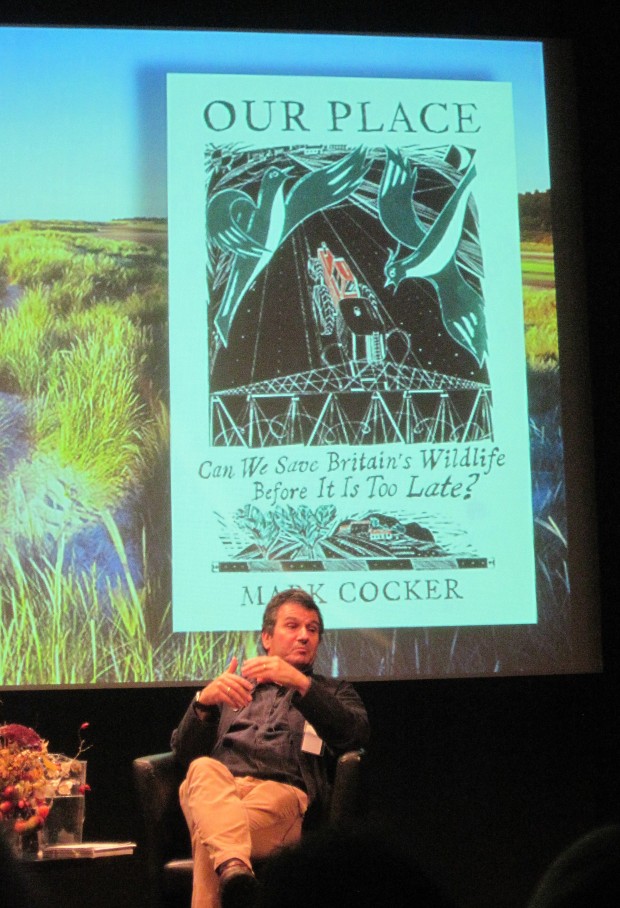
Mark Cocker
Cocker refused to define nature in a one-sentence soundbite, but argued that we have to consider ourselves a part of it rather than thinking about it as a victim ‘out there’ (the closest he came to a definition was “the totality of the system we are a part of”). “Our responsibility, terrifyingly, is unending,” he said – every time you open a new plastic toothbrush, you can’t forget that the old one you throw away will effectively be around forever. Our Place isn’t just composed of polemic, though: it’s structured around six beloved landscapes and finds moments of transcendence in being out in nature. You find hope by walking out the door, feeling the wind on your face and hearing the starling singing, Cocker remarked. He closed by reading a description from the book of the north Norfolk coast.
Either side of lunch were panels on how social media (mostly Twitter, plus smartphone apps) can serve nature and the role that poetry might play in environmental activism, with a brief interlude from visual artist Derek Robertson, who responded to the refugee crisis by traveling to Calais and Jordan and painting human figures alongside migratory birds. In the poetry session I especially enjoyed hearing from Ben Smith, a University of Plymouth lecturer and poet with a debut novel coming out in April 2019 (Doggerland, from Fourth Estate). He recently collaborated with Dr. Lee de Mora on a set of poems inspired by the Earth System Model, which provides the data for the International Panel on Climate Change. Climate modeling might seem an odd subject for poetry, but it provides excellent metaphors for failure and hope in “Spinning Up,” “Data Sets” and “Alternate Histories.”
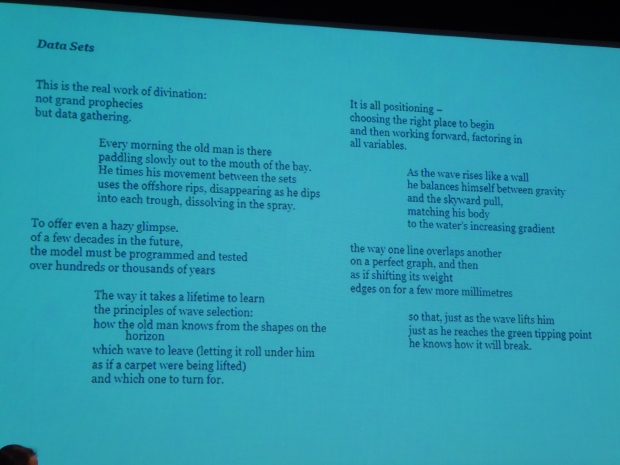
Ben Smith’s poem links unlikely subjects: surfing and climate modeling. Photo by Chris Foster.
Birmingham lecturer Isabel Galleymore, whose debut collection Significant Other is coming out from Carcanet Press in March, talked about how she uses the tropes of love poetry (praise, intimacy, pursuit and loss) when writing about environmental crisis. This shift in her focus began at university when she studied Wordsworth through an ecocritical lens, she said. Jos Smith and Luke Thompson were the other two poets on a panel chaired by Matt Howard. Howard quoted Keats – “We hate poetry that has a design on us” – and asked the poets for reactions. Smith agreed that polemic and poetry don’t mix well, yet said it’s good to have a reason for writing. He thinks it’s best when you can hold two or more ideas in play at a time.
After tea and a marvelous cake spread, it was time for a marathon of three sessions in a row, starting with three short presentations on seabirds: one by a researcher, one by a nature reserve manager, and one by a young artist who produced Chinese-style scroll paintings of the guillemot breeding colonies on Skomer and exhibited them in Sheffield Cathedral.
Next up was a highlight of the weekend: Green Party MP Caroline Lucas and Labour peer Baroness Barbara Young conversed with Michael McCarthy on the topic “Can Conventional Politics Save the Environment?” Both decried short-term thinking, the influence of corporations and the media, and government departments not working together. No one was ever elected on the promise of “less,” McCarthy suggested, but in reply Lucas talked about redefining terms: less of what? more of what? If we think in terms of quality of life, things like green energy and the sharing economy will become more appealing. She also believes that more people care about green issues than we think, but, e.g., a London mum might speak out about air quality without ever using the word “environment.” Baroness Young concluded that “adversarial politics, flip-flopping between parties, isn’t working” and we must get beyond it, at the local level if nothing else. That rang true for me for American politics, too.
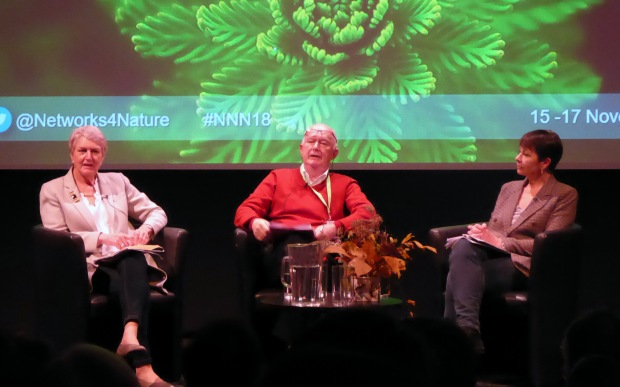
Young, McCarthy and Lucas. Photo by Chris Foster.
Before the day ended with a drinks reception, we were treated to a completely different presentation by Lloyd Buck, who raises and trains birds, mostly for television footage. So, for instance, the greylag geese flying in formation alongside the boat in David Attenborough’s 2012 Sixty Years in the Wild TV special had imprinted on Lloyd’s wife, Rose. Buck spoke about bonding with birds of very different personalities, and introduced the audience to five starlings (who appeared in Poldark), a peregrine, a gyrfalcon, a golden eagle, and Bran the raven, who showed his intelligence by solving several puzzles to find hidden chunks of meat.


I purchased two books of poetry from the bookstall – I had no idea Darlington had written poetry before her nature books – and the conference brochure itself is a wonderful 75-page collection of recent artwork and short nature writing pieces, including most of the presenters but also Patrick Barkham, Tim Dee, Paul Evans, Philip Hoare, Richard Mabey, Helen Macdonald and Chris Packham – a keynote speaker announced for next year. I’ve been skipping through the booklet and have most enjoyed the pieces by Melissa Harrison and Helen Scales so far. Altogether, an inspiring and worthwhile weekend.
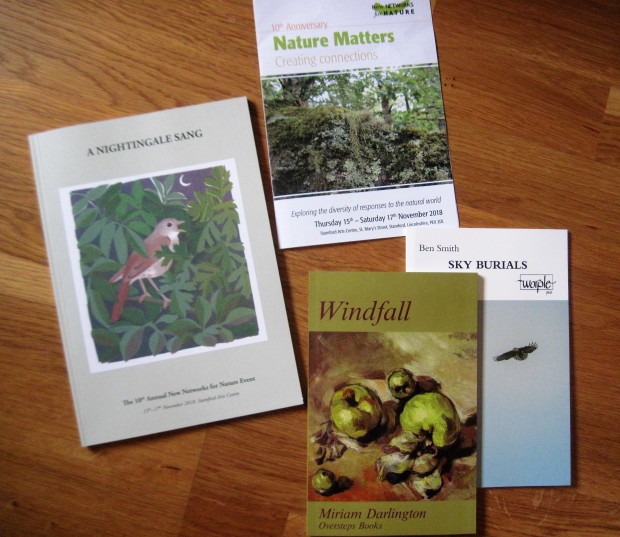
Would any of the conference’s themes or events have interested you?
In Cambridge for “Nature Matters”
We spent a few days last week in Cambridge, England for New Networks for Nature’s interdisciplinary “Nature Matters” conference, this year on the theme of “In Touch with the Wild.” This is the fourth year my husband (a biologist with the University of Reading) has participated, and the third year in a row that I’ve attended for a day. While other years the gathering has been in the small town of Stamford, this year’s temporary move to Cambridge gave us the impetus to finally explore this world-famous city for the first time.
Arriving later than we meant to on a Thursday evening, checking into our noisy hostel and then having to dash out in time for my husband to make the first event (and making a futile attempt to find an open coffee shop where I could while away a couple hours)…this all meant our first impression of the city was not great. However, cheap, terrific Chinese street food on Friday after the conference, followed by a delicious glass of cider in a pub and a sunny day for exploring the bustling city center on Saturday created a more favorable overall feeling.
-
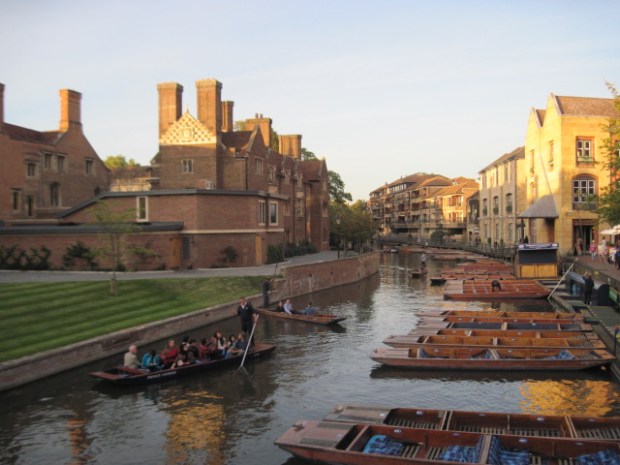
- Venice? No! Cambridge.

-
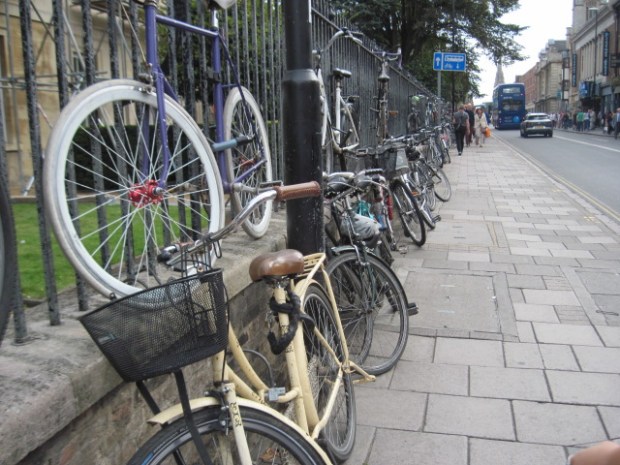
- Everyone cycles.
-

- King’s College.

-
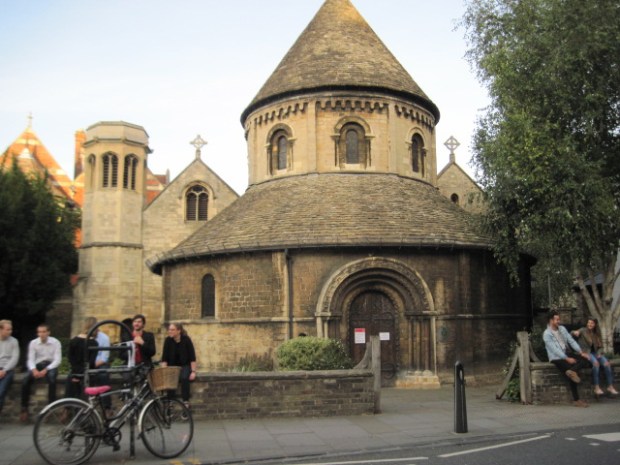
- The Church of the Holy Sepulchre, aka The Round Church.
Last year’s conference highlights for me were a debate about nature’s economic value and a panel on the purpose of nature poetry. This year’s sessions tackled personal connection with nature, rewilding (setting aside tracts of land for wilderness and reintroducing native species that have been driven out or gone locally extinct, such as wolves and wild boar), and coping with a sense of loss. With everyone from geographers to a singer and a painter involved on the day I attended, the conference succeeded in drawing in different fields from the sciences and the arts to provide commentary on ways we might reconnect with nature.
 The day’s first event brought together author William Fiennes, poet Alison Brackenbury, and Cambridge psychologist Laurie Parma. Fiennes spoke about writing an introduction to John Fowles’s long, curmudgeonly essay The Tree. Whereas Fowles denigrates Linnaeus, Fiennes thinks of him as a hero; like Adam in the Bible, Linnaeus knew the value of naming things. “In order to care about something, we first have to notice it,” Fiennes insisted; for him the noticing began when he was a child going round the garden with his father and learning plant names. Rather than thinking of names as a control mechanism, he suggested they can be a first step in “granting [a species] a place in your sensorium.”
 Brackenbury, who comes from four generations of Lincolnshire shepherds, recited from memory seven poems from her latest collection, Skies, several of which reflect on species’ extinctions or comebacks. “Look at them well before they go” is the broadly applicable piece of advice that closes “The Elms.” I especially liked one poem about a starling’s many songs.
Parma relayed the scientific evidence for green spaces mitigating stress and promoting happiness. At an event like this there’s an inevitable feeling that the speakers are preaching to the choir: we already know the personal value of time in nature, as well as the scale of environmental degradation. Still, this came home afresh in the following session as Dr. Stuart Butchart of BirdLife International spoke about the situation in Hawaii, where deforestation, non-native mosquitoes and other invasive animals are rapidly driving native birds to extinction. Photojournalist Toby Smith then questioned whether the nature photographer’s role should be to chronicle nature’s degradation or to celebrate what’s left. Many speakers acknowledged the difficult balance between mourning losses and applauding successes.
I spent most of Saturday scouring Cambridge’s charity shops and made out like a bandit, coming away with 15 books for £15.39. If you happen to find yourself in Cambridge and have seen all you need to of the colleges and the river (it doesn’t take very long), I can recommend Burleigh Street for charity shops but also Mill Road, a slightly more off-the-beaten-path student area of ethnic eateries and cheap stores. Books for Amnesty has an incredible selection; I took advantage of a couple James Lasdun books from their £1 poetry shelf. Best of all was the Salvation Army store, where all books were either 40 or 70 pence. I amassed a huge pile and then put half of it back when I remembered I would have to carry these books the mile or so back into town and then haul them around the whole rest of the day. I also did well at RSPCA’s two shops, one a dedicated bookshop on Mill Road.

Cambridge is certainly rich in secondhand book buying opportunities. Other shops I browsed but didn’t buy from included G. David Books and the tiny Sarah Key Books (also known as “The Haunted Bookshop” – I’d love to know why! – and included on a Guardian list of 10 of the best secondhand bookstores), both on St. Edward’s Passage, and the multi-floored emporium Heffers on St. John’s Street, which has a great selection of board games and gift items as well as new and used books.
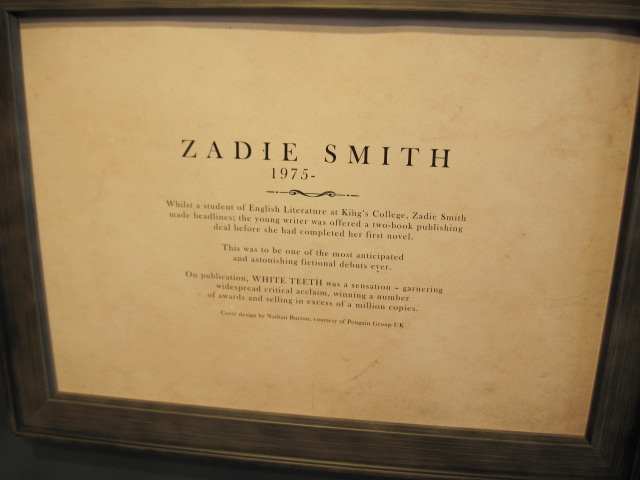
As a literary destination, Cambridge left a bit to be desired, though. There weren’t any literary graves for me to find, nor any notable houses or statues. Many of the college’s famous alumni are known for work in other fields. There’s Newton, Darwin and Hawking in the sciences, for instance – they all appear in this mural in the hostel dining room. Plenty of political figures attended, as well as lots of living authors (Wikipedia has an extensive list; the hostel wall featured Zadie Smith as a fairly recent example of a literary alumna).


So, overall, a nice enough city for a day trip but not somewhere you need to stay much longer. Granted, it was outside of term time so King’s College wasn’t running its usual chapel services, and I never did make it out to the Fitzwilliam Museum. Still, I reckon you’ll find much more to see and do in Oxford, a city I’ve visited again and again ever since my undergraduate study abroad days took me there for weekly theology tutorials.
Your thoughts (on new cities, connecting with nature and secondhand book shopping) are always welcome!
What Is Nature (Poetry) For?
I’ve been pondering this question thanks to an excellent conference my husband and I attended in Stamford in the middle of November: New Networks for Nature. This is the third year my husband (a teaching associate in the biology department at the University of Reading) has participated, and the second year in a row I’ve chosen one day to go. Last year I had the privilege of seeing some truly phenomenal nature writers. Dave Goulson spoke about his efforts to protect bumblebees; Helen Macdonald gave a reading from H is for Hawk; and Paul Evans and Mark Cocker were on a panel about being Guardian country diarists.
This year one of the conference highlights was a debate between Guardian journalist and rewilding proponent George Monbiot (Feral) and Tony Juniper (What Has Nature Ever Done for Us?), former head of Friends of the Earth. The topic: Is nature an economic resource or a thing of intrinsic value? Both gentlemen came out swinging and were at their most convincing.
Unless we make an economic case for preserving nature (pollinators, hydroelectric power, ecotourism), Juniper believes, we will lose it. If we reframe our approach to play on bastard politicians’ turf, Monbiot counters, we’ve already lost our integrity. Nature is worth saving for its own sake; the problem is not our arguments but our lack of power.
I tended to agree with Juniper: we aren’t winning the conservation debate in any other way, so why not introduce financial incentives? This doesn’t stop us from appreciating nature for aesthetic and spiritual reasons; it’s just another strategy.
I amused myself by imagining the opponents as a solitary noble knight waving the flag of idealism (Monbiot) and a new Noah packing nature into a money-papered Trojan horse to trick the pesky government (Juniper).
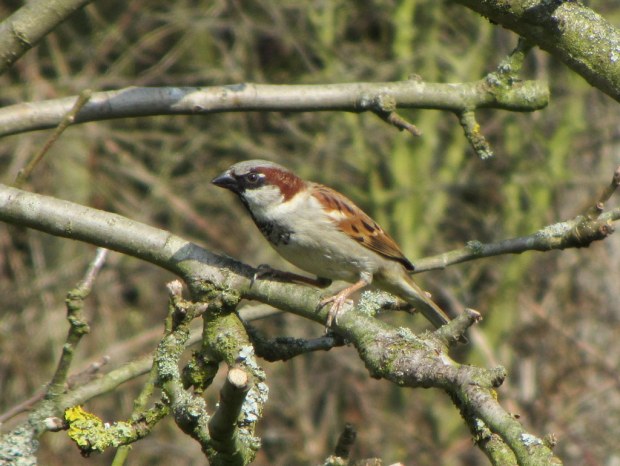
Male house sparrow. Courtesy of Chris Foster
If these two, in a roundabout way, pondered what nature is for, the previous session had asked more specifically what nature poetry is for. Led by Ruth Padel, one of my favorite poets, the roster also included Jo Shapcott and Pascale Petit. Each read from her work for 15 minutes and then together they answered audience questions as a panel.
I’d never heard of Petit but ended up loving her poems – they were the highlight of my day. One was about the piece of land her mother left her in France; she asked herself in what sense she could possess the place, and soon realized that it was really a pair of resident kingfishers who owned it. She writes around her difficult childhood, imagining a father who could never be cruel to birds – but then picturing him polishing off an ortolan bunting as his last meal, as Mitterrand was said to do. Along with birds, big cats provide many of the metaphors in her work, including Aramis, a black jaguar in the Paris Zoo, and the jaguar corridor in Belize.
Padel read “The Alligator’s Great Need and Great Desire,” followed by several poems from The Mara Crossing that she had written for members of the conference steering committee, such as one about storm petrels off the Skelligs and a snippet of biographical verse about Audubon. The lovely “Nocturne” commemorates nightly jellyfish migration, a “ghostly flotilla.”
She also read one that she said was the closest she gets to an angry poem: “The Forest, the Corrupt Official and a Bowl of Penis Soup” (from 2004’s The Soho Leopard), on the absurdity of killing rare animals – in this case the tiger – so their parts can be used in medicine or cuisine. Her final reading, from memory, was “Tiger Drinking at Forest Pool”; I nearly teared up when she spoke of “Sadness healed. Haven, in the mind, // To anyone hurt by littleness.”
Shapcott read two series of wildlife-themed poems. The first set, commissioned by Padel for the Zoological Society of London, was about the slender loris, which is also suffering from its use in traditional medicine as well as habitat loss. The second was a sequence about beekeeping, from the perspective of a woman who has just been left by a beekeeper. “Telling the Bees” reflects the folk belief that you have to inform bees of major events or they will leave; it ends “he’s gone, honeys; now you’re mine.” As the poem cycle continues, the hive becomes incorporated into her body until she can’t be separated from the bees.
Padel prefaced the discussion by asking how poetry should be in the face of extinctions and the destruction of the planet. She believes a sophistication of voice and expression is required; it’s not a matter of grabbing people by the lapels and saying “LOOK AT THIS,” but of putting the details together and being a witness.
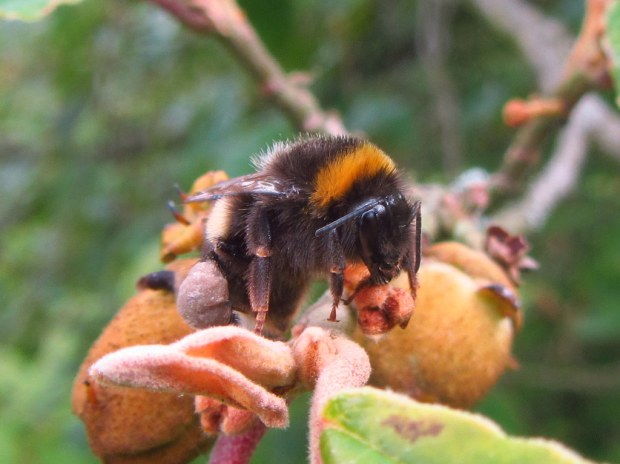
Buff-tailed bumblebee. Courtesy of Chris Foster.
Shapcott echoed her with Heidegger’s query – what is the poet for in a desperate time? She reiterated that the poet should hold up key questions and let them resonate in people’s imaginations, not force-feed answers. Petit added that in her poetry birds are metaphors for the exploitation for the weak. All three agreed poetry is about embodiment, sensory response to the world – essential since we live least in our bodies of any species, Shapcott observed.
The theme of this year’s conference was “Place and Belonging,” and it struck me that all three poets were responding to the idea that nature belongs to us and can be used like any other possession. Instead, they reply, we should think about the places we belong to, and how we can serve rather than exploit nature. But the key is not to spell that out in polemic verse, but rather to speak of life’s particulars and hope that we manage to point to the universal.
I’ll end with part of a stanza from Padel’s “The Watcher” that seems to reinforce the personal, spiritual value of nature that so much of the conference suggested:
Quest for the sacred. And if I
could track that one stork down
on its winter ground, maybe I’d know
what has become of life and me
and where to go. I’d pour libations, follow
the omen, set up sacrifice
to the god of wayfarers, even pay a call
on the seer who decodes
the flight of birds. I’d prophesy.
 Bookish Beck = Rebecca Foster. American transplant to England. Freelance proofreader and book reviewer.
 Bookish Beck