Winter Reads: Claire Tomalin, Daniel Woodrell & Picture Books
Mid-February approaches and we’re wondering if the snowdrops and primroses emerging here in the South of England mean that it will be farewell to winter soon, or if the cold weather will return as rumoured. (Punxsutawney Phil didn’t see his shadow, but that early-spring prediction is only valid for the USA, right?) I didn’t manage to read many seasonal books this year, but I did pick up several short works with “Winter” in the title: a little-known biographical play from a respected author, a gritty Southern Gothic novella made famous through a Jennifer Lawrence film, and two picture books I picked up at the library last week.
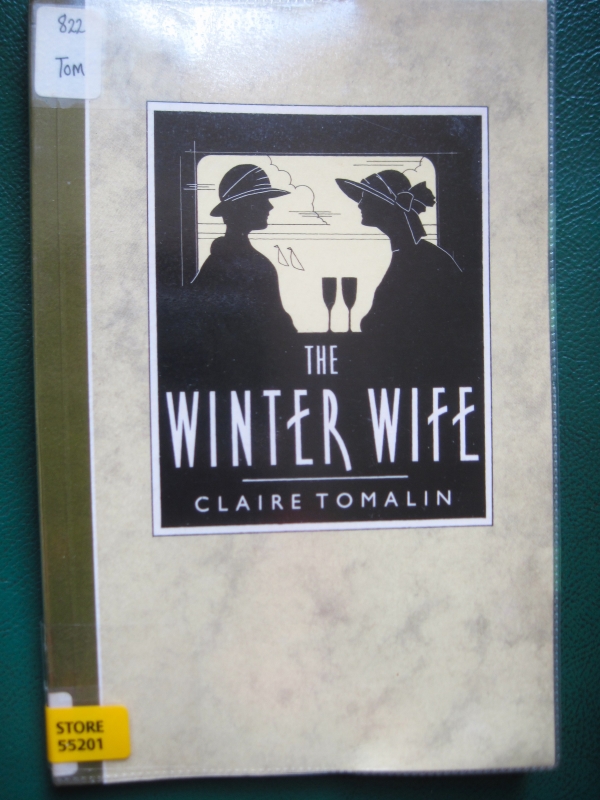
The Winter Wife by Claire Tomalin (1991)
A search of the university library catalogue turned up this Tomalin title I’d never heard of. It turns out to be a very short play (two acts of seven scenes each, but only running to 44 pages in total) about a trip abroad Katherine Mansfield took with her housekeeper?/companion, Ida Baker, in 1920. Ida clucks over Katherine like a nurse or mother hen, but there also seems to be latent, unrequited love there (Mansfield was bisexual, as I knew from fellow New Zealander Sarah Laing’s fab graphic memoir Mansfield and Me). Katherine, for her part, alternately speaks to Ida, whom she nicknames “Jones,” with exasperation and fondness. The title comes from a moment late on when Katherine tells Ida “you’re the perfect friend – more than a friend. You know what you are, you’re what every woman needs: you’re my true wife.” Maybe what we’d call a “work wife” today, but Ida blushes with pride.
Tomalin had already written a full-length biography of Mansfield, but insists she barely referred to it when composing this. The backdrops are minimal: a French sleeper train; Isola Bella, a villa on the French Riviera; and Dr. Bouchage’s office. Mansfield was ill with tuberculosis, and the continental climate was a balm: “The sun gets right into my bones and makes me feel better. All that English damp was killing me. I can’t think why I ever tried to live in England.” There are also financial worries. The Murrys keep just one servant, Marie, a middle-aged French woman who accompanies her on this trip, but Katherine fears they’ll have to let her go if she doesn’t keep earning by her pen.
Through Katherine’s conversations with the doctor, we catch up on her romantic history – a brief first marriage, a miscarriage, and other lovers. Dr. Bouchage believes her infertility is a result of untreated gonorrhea. He echoes Ida in warning Katherine that she’s working too hard – mostly reviewing books for her husband John Middleton Murry’s magazine, but also writing her own short stories – when she should be resting. Katherine retorts, “It is simply none of your business, Jones. Dr Bouchage: if I do not work, I might as well be dead, it’s as simple as that.”
She would die not three years later, a fact that audiences learn through a final flash-forward where Ida, in a monologue, contrasts her own long life (she lived to 90 and Tomalin interviewed her when she was 88) with Katherine’s short one. “I never married. For me, no one ever equalled Katie. There was something golden about her.” Whereas Katherine had mused, “I thought there was going to be so much life then … that it would all be experience I could use. I thought I could live all sorts of different lives, and be unscathed…”
The play is, by its nature, slight, but gives a lovely sense of the subject and her key relationships – I do mean to read more by and about Mansfield. I wonder if it has been performed much since. And how about this for unexpected literary serendipity?
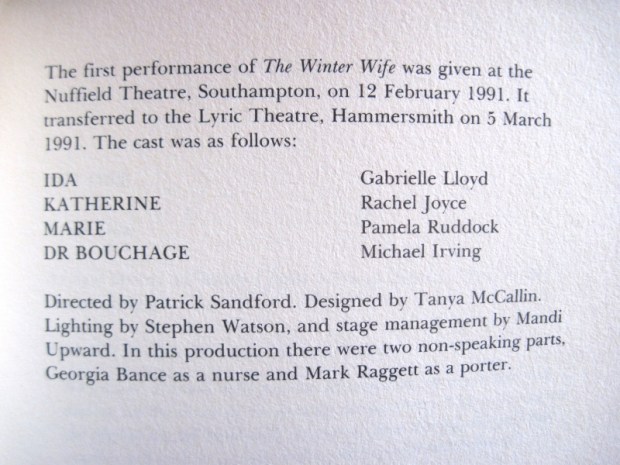
Yes, it’s that Rachel Joyce. (University library) 
Winter’s Bone by Daniel Woodrell (2006)
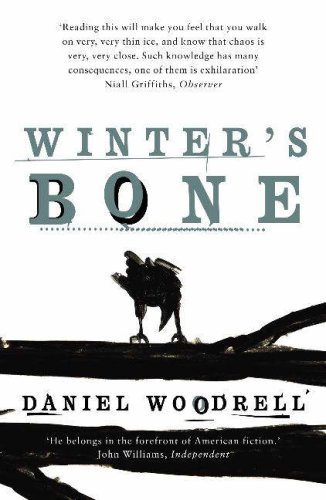 I’d seen the movie but hadn’t remembered just how bleak and violent the story is, especially considering that the main character is a teenage girl. Ree Dolly lives in Ozarks poverty with a mentally ill, almost catatonic mother and two younger brothers whom she is effectively raising on her own. Their father, Jessup, is missing; rumour has it that he lies dead somewhere for snitching on his fellow drug producers. But unless Ree can prove he’s not coming back, the bail bondsman will repossess the house, leaving the family destitute.
Forced to undertake a frozen odyssey to find traces of Jessup, she’s unwelcome everywhere she goes, even among extended family. No one is above hitting a girl, it seems, and just for asking questions Ree gets beaten half to death. Her only comfort is in her best friend, Gail, who’s recently given birth and married the baby daddy. Gail and Ree have long “practiced” on each other romantically. Without labelling anything, Woodrell sensitively portrays the different value the two girls place on their attachment. His prose is sometimes gorgeous –
Pine trees with low limbs spread over fresh snow made a stronger vault for the spirit than pews and pulpits ever could.
– but can be overblown or off-puttingly folksy:
Ree felt bogged and forlorn, doomed to a spreading swamp of hateful obligations.
Merab followed the beam and led them on a slow wamble across a rankled field
This was my second from Woodrell, after the short stories of The Outlaw Album. I don’t think I’ll need to try any more by him, but this was a solid read. (Secondhand – New Chapter Books, Wigtown)
Children’s picture books:
 Winter Sleep: A Hibernation Story by Sean Taylor and Alex Morss [illus. Cinyee Chiu] (2019): My second book by this group; I read Busy Spring: Nature Wakes Up a couple of years ago. Granny Sylvie reassures her grandson that everything hasn’t died in winter, but is sleeping or in hiding beneath the ice or behind the scenes. As before, the only niggle is that European and North American species are both mentioned and it’s not made clear that they live in different places. (Public library)
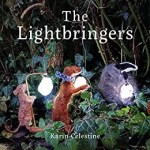 The Lightbringers: Winter by Karin Celestine (2020): An unusual artistic style here: every spread is a photograph of felted woodland creatures. The focus is on midwinter and the hope of the light coming back – depicted as poppy seed heads, lit from within and carried by mouse, hare, badger and more. “The light will always return because it is guarded by small beings and they are steadfast in their task.” The first of four seasonal stories. (Public library)
Any wintry reading (or weather) for you lately?
Autumn Reading: Two Gems by MacNeice and Teale
With bare trees leading down to the canal and frosty temperatures forecast for the weekend, it’s starting to feel more like winter here. I journeyed through a fine autumn with two obscure classics that ended up being  gems.
gems.
Autumn Journal by Louis MacNeice (1939)
 MacNeice, a poet and man of letters from Northern Ireland, wrote this long verse narrative between August 1938 and the turn of the following year. It’s simultaneously about everything and nothing, about everyday life for the common worker and the political rumblings that suggest all is not right in the world. As summer fades and Christmas draws closer, he reflects on his disconnection from Ireland; and on fear, apathy and the longing for purpose.
Two in every four lines rhyme, but the rhyme scheme is so subtle that I was far into the book before I recognized it. I tend not to like prose poems, but this book offers a nice halfway house between complete sentences and a stanza form, and it voices the kinds of feelings we can all relate to. How can this possibly be 80 years old? It is so relevant to our situation now.
we think ‘This must be wrong, it has happened before,
Just like this before, we must be dreaming…’
now it seems futility, imbecility,
To be building shops when nobody can tell
What will happen next.
There are only too many who say ‘What difference does it make
One way or the other?
To turn the stream of history will take
More than a by-election.’
Still there are … the seeds of energy and choice
Still alive even if forbidden, hidden,
And while a man has voice
He may recover music.
The university library copy I borrowed smells faintly of incense, so reading it was rather like slipping into the back pew of an old church and pondering timelessness.
Autumn Across America by Edwin Way Teale (1950)
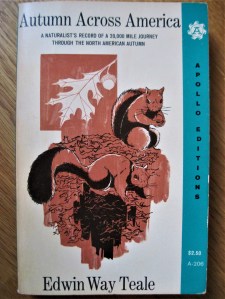 Teale is a lesser-known naturalist who specialized in insects and edited or introduced works by famous natural historians of a previous era like Thoreau, Fabre, Hudson and Muir. In the late 1940s he and his wife Nellie set out on a meandering 20,000-mile road trip from Cape Cod on the Atlantic coast to Point Reyes on the Pacific to track autumn from its first hints to its last gasp. It was the third of four seasonal journeys the Teales undertook in part to distract them from their grief over their son David, who was killed in Germany during WWII. Their route passes through about half the states and experiences nearly every landscape you can imagine, some that are familiar to me and others that would be totally new. They delve in rockpools; observe bird and monarch migration; cross desert, mountains and prairie; and watch sea otters at play.
Although there is a sense of abundance – they see a million ducks in one day, and pass dozens of roadkill jackrabbits – like Aldo Leopold, Teale was an early conservationist who sounded the alarm about flora and fauna becoming rarer: “So much was going even as we watched.” His descriptions of nature are simply gorgeous, while the scientific explanations of leaf color, “Indian summer” and animal communication are at just the right level for the average reader. This was a lucky find at the Book Thing of Baltimore this past spring, and if I ever get the chance, I will delight in reading the other three in the quartet.
Some favorite lines:
“The stars speak of man’s insignificance in the long eternity of time; the desert speaks of his insignificance right now.”
“Those to whom the trees, the birds, the wildflowers represent only ‘locked-up dollars’ have never known or really seen these things. They have never experienced an interest in nature for itself. Whoever stimulates a wider appreciation of nature, a wider understanding of nature, a wider love of nature for its own sake accomplishes no small thing.”
I’m also still reading Led by the Nose: A Garden of Smells by Jenny Joseph, a book about what you see and smell in the garden month by month. I only have the December chapter still to read, followed by some lists of plants set out by ‘when they smell’ and when you plant them. I’ve also been slowly working through A Country Year: Living the Questions by Sue Hubbell, another Book Thing find. After her divorce, Hubbell lived alone on her 90 acres in the Ozarks of Missouri, keeping bees and conscientiously rebuilding a life in communion with nature. I still have the final two sections, “Winter” and “Spring,” left to read.
 Bookish Beck = Rebecca Foster. American transplant to England. Freelance proofreader and book reviewer.
 Bookish Beck