The Party by Tessa Hadley (Blog Tour and #NovNov24)
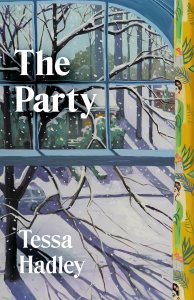 You can count on Tessa Hadley for atmospheric, sophisticated stories of familial and romantic relationships in mid- to late-twentieth-century England. The Party is a novella of sisters Moira and Evelyn, university students on the cusp of womanhood. In 1950s Bristol, the Second World War casts a long shadow and new conflicts loom – Moira’s former beau was sent to Malaya. Suave as they try to seem, with Evelyn peppering her speech with the phrases she’s learning in the first year of her French degree, the girls can’t hide their origins in the Northeast. When Evelyn joins Moira at an art students’ party in a pub, fashionable outfits make them look older and more confident than they really are. Evelyn admits to her classmate, Donald, “I’m always disappointed at parties. I long to be, you know, a succès fou, but I never am.” Then the sisters meet Paul and Sinden, who flatter them by taking an interest; they are attracted to the men’s worldly wise air but also find them oddly odious.
The novella’s three chapters each revolve around a party. First is the Bristol dockside pub party (published as a short story in the New Yorker); second is a cocktail party the girls’ parents are preparing for, giving us a window onto their troubled marriage; finally is a gathering Paul invites them to at the shabby inherited mansion he lives in with his cousin, invalid brother, and louche sister. “We camp in it like kids,” Paul says. “Just playing at being grown up, you know.” During their night spent at the mansion, the sisters become painfully aware of the class difference between them and Paul’s moneyed family. The divide between innocence and experience may be sharp, but the line between love and hatred is not always as clear as they expected. And from moments of decision all the rest of life flows.
In her novels and story collections, Hadley often writes about strained families, young women on the edge, and the way sex can force a change in direction. This was my eighth time reading her, and though The Party is as stylish as all her work, it didn’t particularly stand out for me, lacking the depth of her novels and the concentration of her stories. Still, it would be a good introduction to Hadley or, if you’re an established fan like me, you could read it in a sitting and be reminded of her sharp eye for manners and pretensions – and the emotions they mask.
[115 pages]

With thanks to Anne Cater of Random Things Tours and Jonathan Cape (Penguin) for the proof copy for review.
Buy The Party from Bookshop.org [affiliate link]
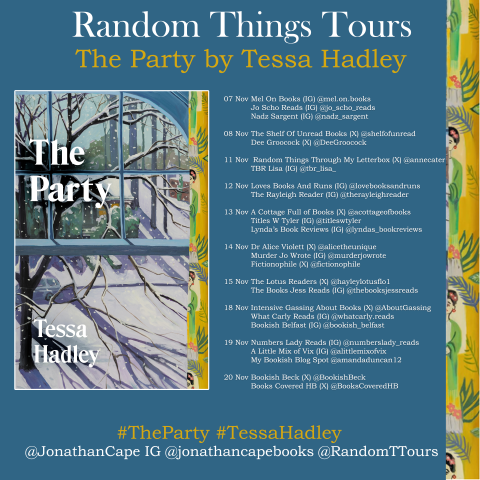
I was delighted to be part of the blog tour for The Party. See below for details of where other reviews have appeared or will appear soon.
20 Books of Summer, 1: Company by Shannon Sanders
I started the summer’s reading right with Company. Shannon Sanders’s energetic debut novel-in-stories traces several generations of the Collins clan, whose experiences at once exemplify African American gentrification and evoke timeless patterns of parental legacy and sibling jealousy. Sisters Cassandra, Fay, Lee and Suzette grew up at their parents’ Atlantic City jazz club before going their separate ways: Cassandra to a PhD and provost position at a college, Fay to painting and the role of family spirit-keeper, Lee to her own brood of four and a no-good jazz musician husband, and Suzette to music and a too-early death. With roots in Mississippi, they have dispersed to Atlanta, New York City and Washington, DC.
We revisit relatives at different points in their lives, mostly between the 1990s and the present day. There are 13 linked stories here, 10 in the third person and three with a first-person narrator. Each focuses on a different individual or set of characters. Celebration scenes make for memorable moments. “Bird of Paradise” is set at the party to commemorate Cassandra’s new position. There’s a Black president at the time and people can’t stop comparing her dress to Michelle Obama’s inaugural ball attire, while she can’t stop fretting that she and her nieces will live up to stereotypes of Black women’s bodies. Later, “La Belle Hottentote” revisits this evening from the nieces’ perspective as they ponder where the family’s money came from. In “Rioja,” Cassandra’s daughter Cecilia, visiting her boyfriend Cole’s family for Thanksgiving, tries not to embarrass him with any pretentious or avant-garde behavior.

The title story, which is among the stand-outs, is the only one to feature the grandparent generation – though Opal and Centennial are but ghosts commenting on the begrudging welcome Fay offers when her niece Aubrey turns up on her doorstep in New Jersey. Fay is the sole sister without partner or children, but she got the family home as a sort of consolation prize and fills its walls with symbolism-heavy portraits of four sisters. My other favorite, alongside this and “Bird of Paradise,” was “The Opal Cleft,” in which Lee’s son Theo hosts his cousin Cyrus (Cassandra’s son) while the latter performs his drag queen act in the area.
I was reminded by turns of Danielle Evans, Kim Coleman Foote and Deesha Philyaw, while final story “The Everest Society,” about Lee’s daughter Mariolive’s desperation to impress the social worker who has to okay her and Dante adopting, recalls Sidik Fofana with its composite picture of their apartment building’s residents. In a few cases I felt that Sanders might have extended the sphere too wide by moving outside the family: “The Gatekeepers” I assume is about a co-worker or neighbor of Cassandra’s; “Mote” is about Cole’s cousin and his partner (and makes the one white woman in the book evil…); and “Dragonflies” features that cousin’s colleague. It’s not to say that these aren’t good stories, but I wondered why they couldn’t have starred extended family members instead.
Trying to get pregnant and the early days of motherhood are recurring concerns, as is the distribution of talent and wealth around the family and beyond. As these characters reach toward the upper middle class, they keep in mind the struggles they came from. Although the family legends morph over the years, shared habits and heirlooms make connections across the generations. Sanders is strong on characterization, scene-setting and social observation; I would happily have spent even longer with the Collins family. I’ll be keen to follow her career in the years to come. 
With thanks to Pushkin Press for the free copy for review.

 Bookish Beck = Rebecca Foster. American transplant to England. Freelance proofreader and book reviewer.
 Bookish Beck