Three for the First Day of Spring: Renkl, Sukegawa and Tucker
I suppose the best kind of spring morning is the best weather God has to offer.
~I Capture the Castle by Dodie Smith
Happy spring! (Although the blossom is fading and, going by the temperature the past few days, you might think it was early summer here.) When I borrowed the psychological thriller The First Day of Spring from the library, I decided to consider that my built-in review deadline. As is my wont, I’ve turned it into a trio with two books more laterally related to spring: a lovely book of miniature autobiographical essays about interactions with family and the natural world, and a short Japanese novel about misfits who find belonging at a pancake restaurant.
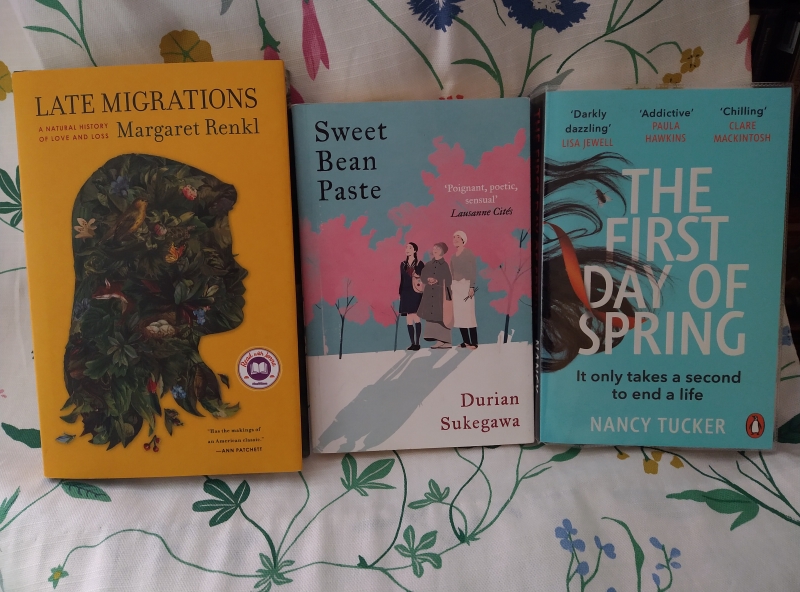
Late Migrations: A Natural History of Love and Loss by Margaret Renkl (2019)
My favorite season is spring—until fall arrives, and then my favorite season is fall: the seasons of change, the seasons that tell me to wake up, to remember that every passing moment of every careening day is always the last moment, always the very last time, always the only instant I will ever take that precise breath or watch that exact cloud scud across that particular blue of the sky.
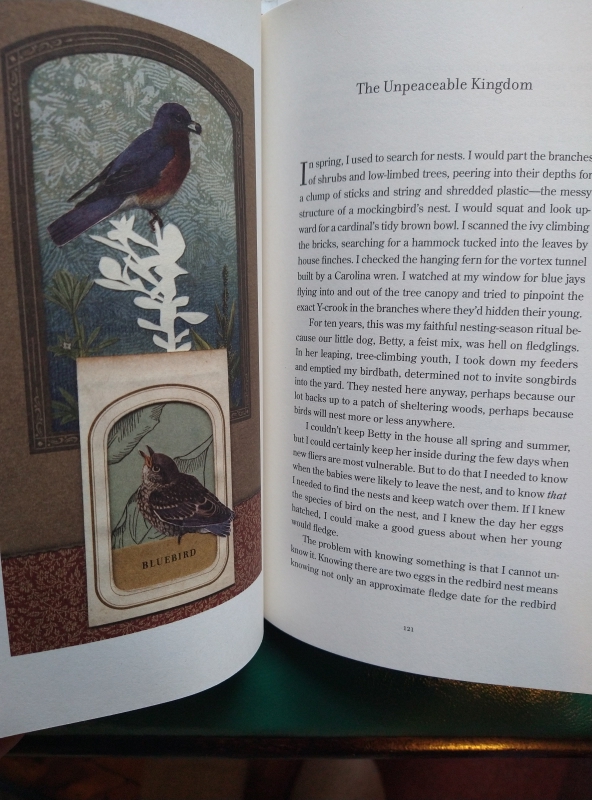
 The memoir in flash essays is one of my favourite niche forms. (Beth-Ann Fennelly and Abigail Thomas also do it exceptionally well.) It took me a long time to promote this book from occasional bedside reading pile to daytime stack, but at a certain point it became impossible to let it out of my hands for very long. I had to smell it and browse her brother Billy’s collage artworks. Each piece is somewhere between a paragraph and several pages long, and they make up a rough chronology of a life, from her grandmother’s memories of the 1930s onward (the passages in italics are interview transcripts) through to the present day.
Renkl grew up in Alabama in the 1960s–70s, in the sort of mildly dysfunctional family that most of us probably have. She contrasts what she knew as a child with what she didn’t. It was a happy childhood but. (Her mother’s recurring mental health problems and racial tensions in the South would be two ways to finish that sentence.) There were hounds and porch seats and three kids in the backseat on vacations. There were funerals and old love songs and Bible verses and playing in the woods. Grandmother tells of births and deaths, and Renkl remembers life’s transitions: getting her first period, being so homesick that she couldn’t finish college in Philadelphia, adjusting to early motherhood and then to an empty nest – an appropriate metaphor because many of the essays are about birds Renkl watches feeding and nesting. She isn’t naïve; she knows nature is cruel. Not every fledgling will survive and majestic hawks will kill equally beautiful songbirds. She realizes how dire the situation is for monarch butterflies, too, but keeps planting milkweed at her Nashville home.
This balancing of appreciation for life and acceptance of death is at its finest in the late pieces on her parents’ death. Her mother, like mine, died suddenly after a stroke, and her words on that loss are exquisite as well as painful. Still, she asserts, “Human beings are creatures made for joy. Against all evidence, we tell ourselves that grief and loneliness and despair are tragedies, unwelcome variations from the pleasure and calm and safety that in the right way of the world would form the firm ground of our being.”
Like Ross Gay and Aimee Nezhukumatathil, Renkl brings a poet’s eye for language and an amateur’s awe at the natural world to her micro-essays. She calls a cedar waxwing “An operatic aria of a bird. A flying jungle flower. A weightless coalescence of air and light and animation.” This is a book to cherish and learn from and reread. (Birthday gift from my sister from my wish list) 
{SPOILERS IN THESE NEXT TWO REVIEWS}
Sweet Bean Paste by Durian Sukegawa (2013; 2017)
[Translated from Japanese by Alison Watts]
 It was the colours (especially that wash of cherry-blossom pink) that first attracted me to this book, and the foodie theme that kept me reading. Sentaro manages a small shop on Cherry Blossom Street, Doraharu, which sells dorayaki – pancakes filled with sweet bean paste (“during cherry-blossom season petals sometimes drifted in, falling into the pancakes as they cooked”). He takes little pride in the work; it’s just a way to keep busy and pay off his debts from the time he was in prison for drug-dealing. When an elderly woman named Tokue offers to make the sweet bean paste for a pittance, he decides to give her a trial even though he usually orders it in bulk. Tokue’s homemade is so much better that the shop is soon making record profits. She trains Sentaro up in the art of making the perfect paste, which to her is a mystical process that involves listening to the beans. Not only does Tokue have new ideas for the menu, but she also makes troubled teenage customers such as Wakana welcome with friendly conversation. Along with Marvy the canary, these three form a fragile little family.
But then rumours start spreading about Tokue and her health, and Doraharu’s owner threatens to shut the place down if Sentaro doesn’t let her go. It turns out that she had Hansen’s disease (the preferred term for leprosy) and lives in a sanatorium. Even though she has long since been cured, there is still a stigma, and when she was young she could only find love and community among her fellow patients. In an Author’s Note, Sukegawa explains that the legislation keeping Hansen’s patients isolated was only repealed in 1996. His philosophy, made explicit in the letters Tokue writes to Sentaro after leaving the shop, is that one doesn’t have to be useful to have a meaningful life; simply being alive and observing is enough. I found Tokue saccharine: too wise, good and all-forgiving. This is easy reading, yet the dialogue felt stiff, the characterization thin, the letters unsubtle, and the detail of confectionery-making too technical. Secondhand – public library book sale) 
The First Day of Spring by Nancy Tucker (2021)
I’d very much admired Tucker’s first two books – The Time in Between, a memoir of her childhood anorexia; and especially That Was When People Started to Worry, case studies of young women’s mental health – so asked my library to purchase her debut novel. Tucker is a trainee clinical psychiatrist. The psychological insight she’s developed professionally and through writing about herself and others served her well in crafting this portrait of a deprived girl who murders other children. I could have included it in my Mother’s Day post because, as in the similarly dark Like Mother (by Jenny Diski), it’s the lack of a mother’s love that leaves the protagonist numb and unsure of how to bring up her own daughter.
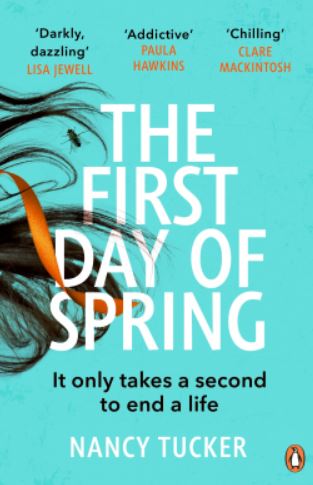 It’s no whodunit because eight-year-old Chrissie admits in the novel’s first line, “I killed a little boy today.” The mystery is why, and how she’s ultimately caught. It’s the first day of spring when she commits that first murder, of a toddler who lives on the same rough housing estate. Her house isn’t much of a home with no money for electricity, no food in the cupboards, an emotionally absent mother and a father who comes and goes without warning. Chrissie is always hungry, always craving. She couldn’t stand that Steven was loved and coddled while she had nothing. Harbouring “a delicious secret” gives her a “belly-fizzing feeling … like sherbet exploding in my guts. … That was all it took for me to feel like I had all the power in the world.” She wants to tell people what she’s done, but knows she mustn’t.
It’s also the first day of spring when five-year-old Molly falls from a seawall and breaks her wrist. Her mum, Julia, panics when she gets a call from child social services. It becomes clear by the second chapter that Julia is the new name Chrissie was given when she left the residential home for child offenders to start a new life. Sure that they’ll blame her and take Molly away, she gets on a train back to her old neighbourhood to see Mam and her childhood best friend, Linda. “I remembered this in Mam – the pull and push, cling and reject.” The subject matter might have become unbearable had Tucker emphasized the salacious details. Instead, she casts a compassionate eye on generational patterns of neglect and incompetence – patterns that can be broken through hard work. It’s riveting reading, and Julia’s love for Molly and Linda’s enduring friendship brought tears to my eyes. (Public library) 
R.I.P., Part II: The Last House on Needless Street
My second contribution to this year’s Readers Imbibing Peril challenge (Part I is here), sliding in late on the final day. I’ve become quite the grump about the immense popularity of Halloween in the UK, even though I loved celebrating it as a kid in the States (dressing up and free candy, what’s not to like) and regularly came up with costumes until I was about 20. Year on year it has been turning into a huge thing over here. Creative outfits and pumpkin carving, fine. But instead it seems that all the worst aspects are on display: cheap plastic tat, misbehaving teenagers, unnecessary gore, wildlife-endangering fake cobwebs. Harrumph.
Anyway, I loved my two final R.I.P. selections, only one of which I managed to finish in time.
The Last House on Needless Street by Catriona Ward (2021)
 This came highly recommended by Annabel and Eleanor (and by my husband, who read it on his phone in less than 24 hours). Ted Bannerman lives the life of a hermit in the titular location, a creepy boarded-up house, with his tantrum-prone daughter, Lauren, and his precocious cat, Olivia, who happens to be highly religious and possibly lesbian. All three share narration duties, along with Dee after she moves into the neighbourhood determined to find out what happened to her little sister, Lulu, who disappeared from a local lake 11 years ago. She thinks Ted is the child abductor – or should that be serial killer? – responsible. As Ward sinks us deeper into Ted’s psyche and peculiar behaviours, we have to assume so, too. But, to put that suspense plot cliché to good use, nothing is what it seems here…
In an afterword, Ward describes this as “a book about survival, disguised as a book about horror.” It’s both, really. There is a touch of supernatural dread, what with the little references to the Breton myth of the death-bringing ankou, but the real horror is how damaged people inflict damage on others – and on themselves. (Content warnings for child abuse, self-harm and suicide.) It’s impressive how acutely Ward depicts mental health while still producing a rollicking story with memorable characters. How could you not love a book with the lines “If there’s anything better than a cat on the bed, I don’t know about it” and “Olivia is not a pet. She’s so much more than that. I expect everyone feels this about their cat”?! I’m not usually one for a psychological thriller, but I’d look out for more from Ward. (Public library) 
 I’m also halfway through High Spirits: A Collection of Ghost Stories (1982) by Robertson Davies and enjoying it immensely. Davies was a Master of Massey College at the University of Toronto. These 18 stories, one for each year of his tenure, were his contribution to the annual Christmas party entertainment. They are short and slightly campy tales told in the first person by an intellectual who definitely doesn’t believe in ghosts – until one is encountered. The spirits are historic royals, politicians, writers or figures from legend. In a pastiche of the classic ghost story à la M.R. James, the pompous speaker is often a scholar of some esoteric field and gives elaborate descriptions. “When Satan Goes Home for Christmas” and “Dickens Digested” are particularly amusing. This will make a perfect bridge between Halloween and Christmas. (National Trust secondhand shop)
Two Novels of Ambivalent Parenthood: The Push & A Lie Someone Told You About Yourself
These 2021 releases I read from the library stood out to me for daring to suggest that sometimes children aren’t little angels and parenthood isn’t all it’s cracked up to be.
The Push by Ashley Audrain
“Do you wish you weren’t a mother?”
“Sometimes I wish I were a different kind of person.”
 A cracking psychological thriller with an unreliable narrator, this is in the same vein as The Woman in the Window, Gone Girl, and A Good Enough Mother. I hardly ever pick up novels that fit into this genre, but these were all well worth making an exception for. The Push feels closer to literary fiction than to crime. Blythe Connor, living alone with her memories, ponders what went wrong with her seemingly perfect family: a handsome architect husband, Fox, and their daughter Violet and baby son Sam. Now reduced to being a stalker and an impersonator, Blythe vows to write everything down as evidence, taking care to note when she first had cause to question whether Violet was normal. A daddy’s girl from the start, Violet never bonded with Blythe and admitted to deliberately hurting other children in her preschool. But how much of what happened next was because of Violet’s nature, and how much was Blythe’s fault for failing to be the mother the girl needed?
The inkblot design of the cover cleverly evokes classical psychological concepts and experiments. A key topic the novel explores is how trauma is passed down through the generations: Blythe had worried that she wasn’t cut out for motherhood, chiefly because her mother and her grandmother both abandoned their daughters. “Blythe, the women in this family, we’re different. You’ll see,” her mother had warned. The exchange between Blythe and her mother that opens my review reiterates her suspicion: some people just aren’t cut out for parenting. Blythe can’t dismiss her daughter as evil because she knows how much guilt rests on her own shoulders, and because she doubts that she saw what she thought she saw. Moreover, the fact that her experience with Sam was completely different makes her feel ambivalent about motherhood: she’s seen how wonderful it can be, but also how it can turn bad. The nuance sets the book apart from run-of-the-mill thrillers. Yet it’s in short, page-turning chapters, so it reads very quickly and would make a great book club selection.
My rating:
A Lie Someone Told You About Yourself by Peter Ho Davies
At its best, autofiction is an intriguing blend of memoir and fiction, all of it true and universal in appeal. Davies’ minimalist approach – short sections skating over the months and years, wryly pulling out representative moments here and there, all in a mere 180 pages – could hardly be more different from Karl Ove Knausgaard’s, but both are equally dedicated to the unique alchemy of crystallizing fatherhood by illuminating its daily heartaches and joys.
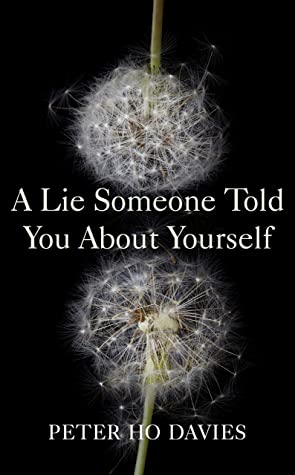 Years ago, “the writer” and his wife were presented with a choice. When genetic tests indicated mosaicism, they terminated their first pregnancy. Instead of a little girl, they later had a baby boy who presented his own challenges, including delayed development and possible ASD. Years later, the abortion still haunts “the father.” He attempts to exorcise his shame (the title = how Anaïs Nin defined it) by volunteering at an abortion clinic. Escorting patients to and from their cars, ignoring the taunts of protestors, he lives out his conviction that you can never fully know what others are going through and why they make the decisions they do.
Davies gets the tone just right in this novella, showing both sides of parenthood and voicing the things you aren’t allowed to think, or at least not to admit to – starting with abortion, which would-be fathers aren’t expected to have strong feelings about. Soon after the writer’s son is born: “He feels about himself for love, the way he might pat his pockets for his wallet and keys. Do I love him yet? Is this love?” As the boy grows into a figure of pathos: “All the things they’ve imagined him growing up to be: A basketball player, a fireman, a chef. [vs. what he actually seems to be] Allergic, friendless, autistic.” Davies also has a gift for zinging phrases, like “the deification of babies” and “the baby-industrial complex” of Babies R Us.
But what I most loved was the rumination on the role that chance plays in a life. “All the coin flips. All the what ifs. Like the litany of prompts he uses in writing class. Heads and tales.” The writer has a background in physics (as Davies himself does), so often brings up Schrödinger’s cat as a metaphor – in any situation, things might have gone either way. Now that the possibilities have narrowed to one and the path has been started, what will you do? The treatment of luck, in particular, led me to think of this as a cross between Larry’s Party by Carol Shields and What Are You Going Through by Sigrid Nunez. The style is similar to Jenny Offill’s; another similar and nearly contemporaneous release is Brood by Jackie Polzin.
I know I read The Fortunes back in 2016 but I retain virtually no memory of it. Davies’s prose, themes, and voice stood out much more for me here. I’ll try his novel The Welsh Girl, too, maybe even for book club later this year. This is an early entry on my Best of 2021 list.
Favorite lines:
“this is also what the internet is for, he thinks. If online porn universalizes shame, social media universalizes judgment. Both exercises in self-gratification.”
“An older colleague told him once cats were baby substitutes. ‘They weigh the same, they sleep on you, they roll around on their backs kicking their legs in the air. They mewl.’”
For more on abortion from a male perspective: The Cider House Rules by John Irving and Ars Botanica by Tim Taranto.
My rating: 
 Bookish Beck = Rebecca Foster. American transplant to England. Freelance proofreader and book reviewer.
 Bookish Beck