Spring Reading: Simon Barnes, Jackie Kay, and Michael Morpurgo
With all the roses in full bloom and the swifts back and nesting in the corner of our eaves, it’s been feeling more like summer than high spring as we approach the end of May. I didn’t amass many spring-themed books this year, but managed to piece together the below trio of library books. They feel quite England- (and Scotland-) specific; I wonder how well these authors are known outside the UK. All: 
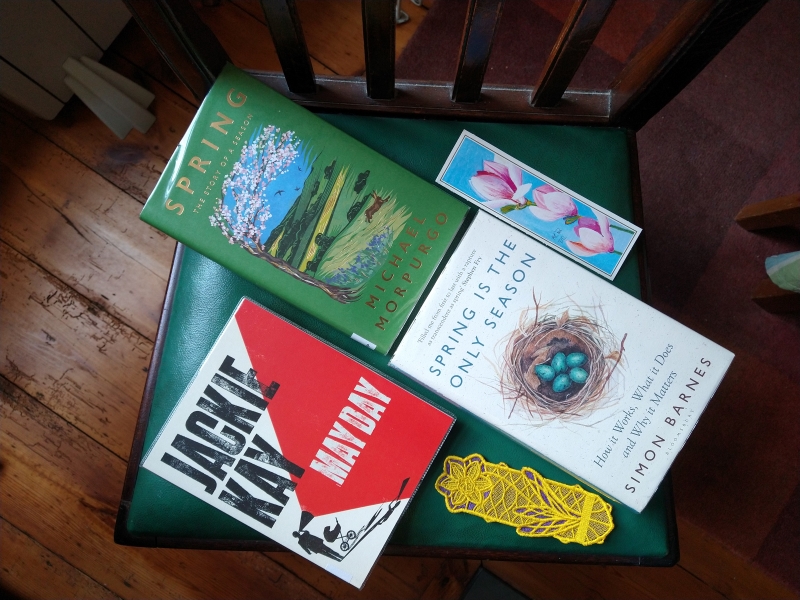
May Day by Jackie Kay (2024)
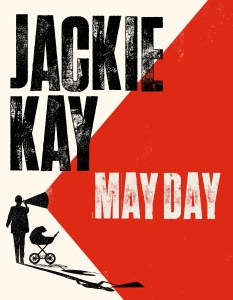 May Day is a traditional celebration for the first day of May, but it’s also a distress signal – as the megaphone and stark font on the cover reflect. Aptly, there are joyful verses as well as calls to arms here. Kay devotes poems to several of her role models, such as Harry Belafonte, Paul Robeson, Peggy Seeger and Nina Simone. But the real heroes of the book are her late parents, who were very politically active, standing up for workers’ rights and socialist values. Kay followed in their footsteps as a staunch attendee of protests. Her mother’s death during the Covid pandemic looms large. There is a touching triptych set on Mother’s Day in three consecutive years; even though her mum is gone for the last two, Kay still talks to her. Certain birds and songs will always remind her of her mum, and “Grief as Protest” links past and future. The bereavement theme resonated with me, but much of the rest made no mark (especially not the poems in dialect) and I don’t find much to admire poetically. I love Kay’s memoir, Red Dust Road, which has been among our most popular book club reads so far, but I’ve not particularly warmed to her poetry despite having read four collections now.
Spring: The Story of a Season by Michael Morpurgo (2025)
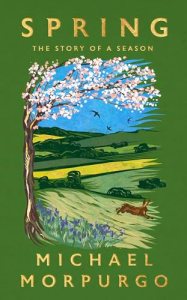 I’d not read Morpurgo before. He’s known primarily as a children’s author; if you’ve heard of one of his works, it will likely be War Horse, which became a play and then a film. This is a small hardback, scarcely 150 pages and with not many words to a page, plus woodcut illustrations interspersed. As revered English nature authors such as John Lewis-Stempel and Richard Mabey have also done, he depicts a typical season through a diary of several months of life on his land. For nearly 50 years, his Devon farm has hosted the Farms for City Children charity he founded. He believes urban living cuts people off from the rhythm of the seasons and from nature generally; “For so many reasons, for our wellbeing, for the planet, we need to revive that connection.” Now in his eighties, he lives with his wife in a small cottage and leaves much of the day-to-day work like lambing to others. But he still loves observing farm tasks and spotting wildlife (notably, an otter and a kingfisher) on his walks. This is a pleasant but inconsequential book. I most appreciated how it captures the feeling of seasonal anticipation – wondering when the weather will turn, when that first swallow will return.
And a skim:
Spring Is the Only Season: How It Works, What It Does, and Why It Matters by Simon Barnes (2025)
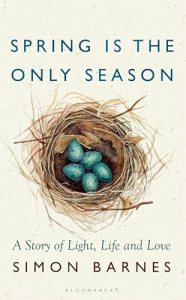 This 400+-page tome has an impressive scope. Like Mark Cocker does in One Midsummer’s Day, Barnes retreats all the way back to the Big Bang and then slowly zooms in, via the evolution of plants and the phenology of birds and insects. He also covers every possible topic you could think of relating to spring: religious festivals, mythology, literature, art, farming, and so on. Had I never read another book on spring, perhaps I would find this compendium satisfying, but it is rather meandering and too many of its points of reference are familiar. Moreover, the overall project is too similar to Tim Dee’s extraordinary Greenery. Alas, Barnes isn’t half the writer Dee is, so this ends up being a rather workmanlike survey. I most enjoyed the chapter-ending “Signs of Spring” lists from his Norfolk home. These more than illustrate how seasonality has gone awry due to climate change; a whole chapter wasn’t necessary to spell it out.
Three on a Theme: English Gardeners (Bradbury, Laing and Mabey)
These three 2024 releases share a passion for gardening – but not the old-fashioned model of bending nature to one’s will to create aesthetically pleasing landscapes. Instead, the authors are also concerned with sustainability and want to do the right thing in a time of climate crisis (all three mention the 2022 drought, which saw the first 40 °C day being recorded in the UK). They seek to strike a balance between human interference and letting a site go wild, and they are cognizant of the wider political implications of having a plot of land of one’s own. All three were borrowed from the public library. #LoveYourLibrary
One Garden against the World: In Search of Hope in a Changing Climate by Kate Bradbury
Bradbury is Wildlife Editor of BBC Gardeners’ World Magazine and makes television appearances in the UK. She’s owned her suburban Brighton home for four years and has tried to turn its front and back gardens into havens, however small, for wildlife. The book covers April 2022 to June 2023, spotlighting the drought summer. “It’s about a little garden in south Portslade and one terrified, angry gardener.” Month by month, present-tense chapters form not quite a diary, but a record of what she’s planting, pruning, relocating, and so on. There is also a species profile at the end of each chapter, usually of an insect (as in the latest Dave Goulson book) – she’s especially concerned that she’s seeing fewer, yet she’s worried for local birds, trees and hedgehogs, too.
Often, she takes matters into her own hands. She plucks caterpillars from vegetation in the path of strimmers in the park and raises them at home; protects her garden’s robins from predators and provides enough food so they can nest and raise five fledglings; undertakes to figure out where her pond’s amphibians have come from; rescues hedgehogs; and bravely writes to neighbours who have scaffolding up (for roof repairs, etc.) beseeching them to put up swift boxes while they’re at it. Sometimes it works: a pub being refurbished by new owners happily puts up sparrow boxes when she tells them the birds have always nested in crevices in the building. Sometimes it doesn’t; people ignore her letters and she can’t seem to help but take it personally.
For individuals, it’s all too easy to be overtaken by anxiety, helplessness and despair, and Bradbury acknowledges that collective action and solidarity are vital. “I am reminded, once again, that it’s the community that will save these trees, not me. I’m reminded that community is everything.” She bands together with other environmentally minded people to resist a local development, educate the public about hedgehogs through talks, and oppose “Drone Bastard,” who flies drones at seagulls nesting on rooftops (not strictly illegal; disappointingly, their complaint doesn’t get anywhere with the police, RSPB or RSPCA).

Along the way, there are a few insights into the author’s personal life. She lives with her partner Emma and dog Tosca and accesses wild walks even right on the edge of a city in the Downs. Separate visits to her divorced parents are chances for more nature spotting – in Suffolk to see her father, she hears her first curlew and lapwings – but also involve some sadness, as her mother has aphasia and fatigue after a stroke.
Nearly every day of the chronology seems to bring more bad news for nature. “It’s hard, sometimes,” she admits, “trying to enjoy natural, wonderful events, trying to keep the clawing sense of unease at bay”. She is staunch in her fond stance: “I will love it, with all my heart, whatever has managed to remain, whatever is left.” And she models through her own amazingly biodiverse garden the ways we can extend refuge to other creatures if we throw out that pointless notion of ‘tidiness.’ “The UK’s 30 million gardens represent 30 million opportunities to create green spaces that hold on to water and carbon, create shade, grow food and provide habitats for wildlife that might otherwise not survive.” Reading this made me feel less guilty about the feral tangle of buddleia, ragwort, hemp agrimony and bindweed overtaking the parts of our back garden that aren’t given over to meadow, pond and hedge. Every time I venture back there I see tons of insects and spiders, and that’s all that matters.
My main critique is that one year would have been adequate, cutting the book to 250 pages rather than 300 and ensuring less repetition while still being a representative time period. But Bradbury is impressive for her vigilance and resolve. Some might say that she takes herself and life too seriously, but it’s really more that she’s aware of the scale of destruction already experienced and realistic about what we stand to lose. 
The Garden Against Time: In Search of a Common Paradise by Olivia Laing
I consider Laing one of our most important public thinkers. I saw her introduce the book via the online Edinburgh Book Festival event “In Search of Eden,” in which she appeared on screen and was interviewed by JC Niala. Laing explained that this is not a totally new topic for her as she has been involved in environmental activism and in herbalism. But in 2020, when she and her much older husband bought a house in Suffolk – the first home she has owned after a life of renting – she started restoring its walled garden, which had been created in the 1960s by Mark Rumary. For a year, she watched and waited to see what would happen in the garden, only removing obvious weeds. This coincided with lockdown, so visits to gardens and archives were limited; she focused more on the creation of her own garden and travelling through literature. A two-year diary resulted, in seven notebooks.
Niala observed that the structure of the book, with interludes set in the Suffolk garden, means that the reader has a place to come back to between the deep dives into history. Why make a garden? she asked Laing. Beauty, pleasure, activity: these would be pat answers, Laing insisted. Instead, as with all her books, the reason is the impulse to make complicated structures. Repetitive tasks can be soothing; “the drudgery can be compelling as well.”
Laing spoke of a garden as both refuge and resistance, a mix of wild and cultivated. In this context, Derek Jarman’s Dungeness garden was a “wellspring of inspiration” for her, “a riposte to a toxic atmosphere” of nuclear power and the AIDS crisis (Rumary, like Jarman, was gay). It’s hard to tell where the beach ends and his garden begins, she noted, and she tried to make her garden similarly porous by kicking a hole in the door so frogs could get in. She hopes it will be both vulnerable and robust, a biodiversity hotspot. With Niala, she discussed the idea of a garden as a return to innocence. We have a “tarnished Eden” due to climate change, and we have to do what we can to reverse that.
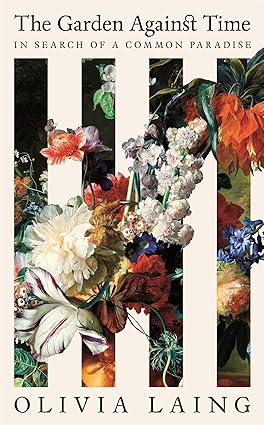
The event was brilliant – just the level of detail I wanted, with Laing flitting between subjects and issuing amazingly intelligent soundbites. The book, though, seemed like page after page about Milton (Paradise Lost) and Iris Origo or the Italian Renaissance. I liked it best when it stayed personal to her family and garden project. There are incredible lyric passages, but just stringing together floral species’ names – though they’re lovely and almost incantatory – isn’t art; it also shuts out those of us who don’t know plants, who aren’t natural gardeners. I wasn’t about to Google every plant I didn’t know (though I did for a few). Also, I have read a lot about Derek Jarman in particular. So my reaction was admiration rather than full engagement, and I only gave the book a light skim in the end. It is striking, though, how she makes this subject political by drawing in equality of access and the climate crisis. (Shortlisted for the Kirkus Prize and the Wainwright Prize.) 
Some memorable lines:
“A garden is a time capsule, as well as a portal out of time.”
“A garden is a balancing act, which can take the form of collaboration or outright war. This tension between the world as it is and the world as humans desire it to be is at the heart of the climate crisis, and as such the garden can be a place of rehearsal too, of experimenting with this relationship in new and perhaps less harmful ways.”
“the garden had become a counter to chaos on a personal as well as a political level”
“the more sinister legacy of Eden: the fantasy of perpetual abundance”
The Accidental Garden: Gardens, Wilderness and the Space in Between by Richard Mabey
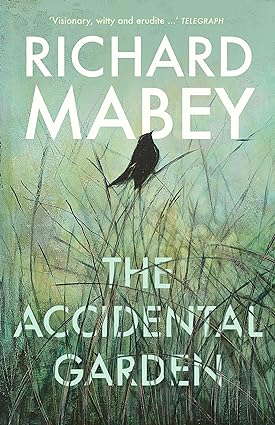 Mabey gives a day-to-day description of a recent year on his two-acre Norfolk property, but also an overview of the past 20 years of change – which of course pretty much always equates to decline. He muses on wildflowers, growing a meadow and hedgerow, bird behaviour, butterfly numbers, and the weather becoming more erratic and extreme. What he sees at home is a reflection of what is going on in the world at large. “It would be glib to suggest that the immeasurably complex problems of a whole world are mirrored in the small confrontations and challenges of the garden. But maybe the mindset needed for both is the same: the generosity to reset the power balance between ourselves and the natural world.” He seeks to create “a fusion garden” of native and immigrant species, trying to intervene as little as possible. The goal is to tend the land responsibly and leave it better off than he found it. As with the Laing, I found many good passages, but overall I felt this was thin – perhaps reflecting his age and loss of mobility – or maybe a swan song. Again, I just skimmed, even though it’s only 160 pages.
Some memorable lines:
“being Earth’s creatures ourselves, we too have a right to a niche. So in our garden we’ve had more modest ambitions, for ‘parallel development’ you might say, and a sense of neighbourliness with our fellow organisms.”
“We feel embattled at times, and that we should try to make some sort of small refuge, a natural oasis.”
“A garden, with its complex interactions between humans and nature, is often seen as a metaphor for the wider world. But if so, is our plot a microcosm of this troubled arena or a refuge from it?”
You might think I would have been more satisfied by Mabey’s contemplative bent, or Laing’s wealth of literary and historical allusions. It turns out that when it comes to gardening, Bradbury’s practical approach was what I was after. But you may gravitate to any of these, depending on whether you want something for the hands, intellect or memory.
I own too many unread books by…
A side effect of packing my library in preparation for moving: I’ve noticed there are certain authors whose works I tend to acquire secondhand and then stockpile rather than read. (I’ve also included in the tallies copies that I know are sitting in boxes in the USA.)
 D.H. Lawrence: 9+ (Aaron’s Rod, Kangaroo, The Lost Girl, The Plumed Serpent, a Complete Poems volume, Sea and Sardinia, a Selected Short Stories volume, Studies in Classic American Literature, The Woman Who Rode Away)
Lawrence was one of my research specialties as an undergraduate, so I read all his major works in my early twenties, as well as some lesser-known stuff, but haven’t felt compelled to pick up anything by him since. I’m not sure I’d care for him anymore, and it’s as if I don’t want to destroy the mystique. Yet I also can’t bring myself to get rid of these.
 T.C. Boyle: 7 (A Friend of the Earth, The Inner Circle, Riven Rock, The Tortilla Curtain, Water Music, The Women, World’s End)
I’ve read five of Boyle’s books and have had a mixed experience, but his plots – whether biographical (Alfred Kinsey! the wives and lovers of Frank Lloyd Wright!) or environmental – tend to attract me. My husband has actually become the bigger fan, so has read 3–4 of these that I haven’t.
 W. Somerset Maugham: 7 (Ashenden, Christmas Holiday, Creatures of Circumstance, Liza of Lambeth, The Magician, The Razor’s Edge, The Summing Up)
I read four of Maugham’s novels between 2014 and 2020. He’s an unappreciated author these days. Back when we had a free bookshop in my local mall, I volunteered weekly and most weeks came away with a backpack full of goodies. One week it was a partial leatherbound set of Maugham, which I’ve since supplemented with other paperbacks.
 Robertson Davies: 6.5 (The Salterton Trilogy, The Deptford Trilogy, The Cornish Trilogy)
I loved Fifth Business and The Rebel Angels, read for subsequent Robertson Davies week challenges run by Lory, but made aborted attempts at both ‘sequels’, so the rest of his three major trilogies remain unread on my shelves.
 Barbara Comyns: 5 (The Juniper Tree, The House of Dolls, Mr Fox, The Skin Chairs, A Touch of Mistletoe)
I blame Liz for this one: after I read Who Was Changed and Who Was Dead during Novellas in November last year, she passed on her Comyns stash in a lovely Christmas parcel. Most are short enough to suit a future #NovNov, but I have The Juniper Tree earmarked for 20 Books of Summer (flora themed) and A Touch of Mistletoe for Christmastide.

 Wendy Perriam: 5 (Absinthe for Elevenses, Breaking and Entering, Cuckoo, Michael, Michael, Sin City)
Again, mostly Liz’s fault. (Though two others came from my Hay-on-Wye haul in September 2020.) I’ve still only read the one novel by Perriam, The Stillness The Dancing, but it was great and made me confident that I’d enjoy engaging with her repeated themes.
 Richard Mabey: 4 (The Common Ground, Gilbert White biography, Nature Cure, The Unofficial Countryside)
Considering that Mabey is the father of modern British nature writing, it’s kind of shocking that I’ve never read anything by him. I’ve put Nature Cure on my bedside pile to start soon.
 Virginia Woolf: 4 (Between the Acts, The Waves, The Years, a volume of her diaries)
I’ve tried The Waves and The Years and didn’t get further than a few pages; I find Woolf unreadably dense in a way I didn’t in my early twenties, when I studied To the Lighthouse (go figure). But there’s still this compulsion to have read them so that I can be a well-rounded literary person.
 Kent Haruf: 3 (Plainsong, Eventide, Benediction)
Our Souls at Night topped my backlist reads in 2020, but an attempt at reading Plainsong soon after failed. I think it was more involved, with more strands, than I was expecting after the simplicity of his novella. So the trilogy, acquired piecemeal secondhand, has languished on my shelves. I’ll try again with Plainsong this year.
 Elizabeth Jane Howard: 3 (Marking Time, Confusion, Casting Off)
I loved sinking into The Light Years, the first volume of The Cazalet Chronicles (read for a book club meeting last January), and even read the first 60 pages of the sequel, Marking Time, but then tailed off – you can see I’m terrible about continuing with series. But I’d like to get back into this one and, when I do, I have Books 2–4 out of five awaiting me.
 Mary Karr: 3 (The Liars’ Club, Cherry, Lit)
Karr was key to the resurgence in popularity of memoirs in the 1990s. I’ve read her book about memoir (as well as a commencement speech she gave, and a volume of her poems), but not yet one of her actual memoirs. I found them all free or secondhand on trips back to the States. I don’t know whether it’s important to go in the chronological order listed above, or if I should just jump in with whichever, maybe Lit, about her struggle with alcoholism.
 Sue Miller: 3 (The Lake Shore Limited, While I Was Gone, The World Below)
After I read Monogamy in December 2020 and it ended up on my Best-of list for that year, I scurried to get hold of a bunch of her other books. I’ve since read The Senator’s Wife, which was a big disappointment, but I’m looking forward to trying more.
 Howard Norman: 3 (Devotion, The Northern Lights, What Is Left the Daughter)
I’ve read six of Norman’s books; he’s an underrated treasure of an author. I have no idea why I haven’t read these yet. Two are marooned in America, but The Northern Lights could make it onto a reading stack anytime. I just need the right excuse, it seems.
I’m thinking back to 2020, when I realized I had four unread Chimamanda Ngozi Adichie books on my shelves. Through various challenges – doorstoppers, summer reads, short stories, novellas – I managed to read them ALL that year, followed by another two in 2021. I don’t usually enjoy binging on particular authors in that way, but her books are different enough from each other (and just so good) that I didn’t mind.
I can’t promise to try the same tactic with these underread authors this year, but I can at least resolve to read one book by each of them, to reduce the backlog.
Do you have particular authors you own a lot by … but fail to read?
New Networks for Nature 2018
This past weekend was my fourth time attending part of Nature Matters, the annual New Networks for Nature conference. I’ve written about it here a couple of times, once when there was a particular focus on nature poetry and another time when it was held in Cambridge. This year it was back in Stamford for a last time for the 10th anniversary. Next year: York.
What’s so special about the conference is its interdisciplinary nature: visual artists, poets, musicians, writers, politicians, academics and conservationists alike attend and present. So although the event might seem geared more towards my biologist husband, there’s always plenty to interest me, too. The roster is a who’s who of British nature writing: Mark Avery, Tim Birkhead, Mark Cocker, Mary Colwell, Miriam Darlington, Richard Kerridge, Peter Marren, Michael McCarthy, Stephen Moss, Adam Nicolson, Katharine Norbury, Ruth Padel, Laurence Rose and Mike Toms were all there this year. I also appreciate the atmosphere of friendly disagreement about what nature is and how best to go about conserving it.
I attended on Friday, a jam-packed day of sessions that began with Bob Gibbons presenting on the flowers and wildlife of Transylvania, a landscape and culture that are still almost medieval in character. Then Jeremy Mynott interviewed Mark Cocker about his latest book, Our Place: Can We Save Britain’s Wildlife before It Is Too Late? I’ve read other Cocker books, but not this one yet. Its main point seems to be that the country’s environmental organizations need to work together. Individuals and NGOs are doing passionate and wonderful things towards nature conservation, Cocker said, but overall “we ain’t getting there.” Bad news doesn’t sell, though, he noted: his book has sold just 6,000 copies compared to 30,000 for Wilding, Isabella Tree’s story of the rewilding success at Knepp.
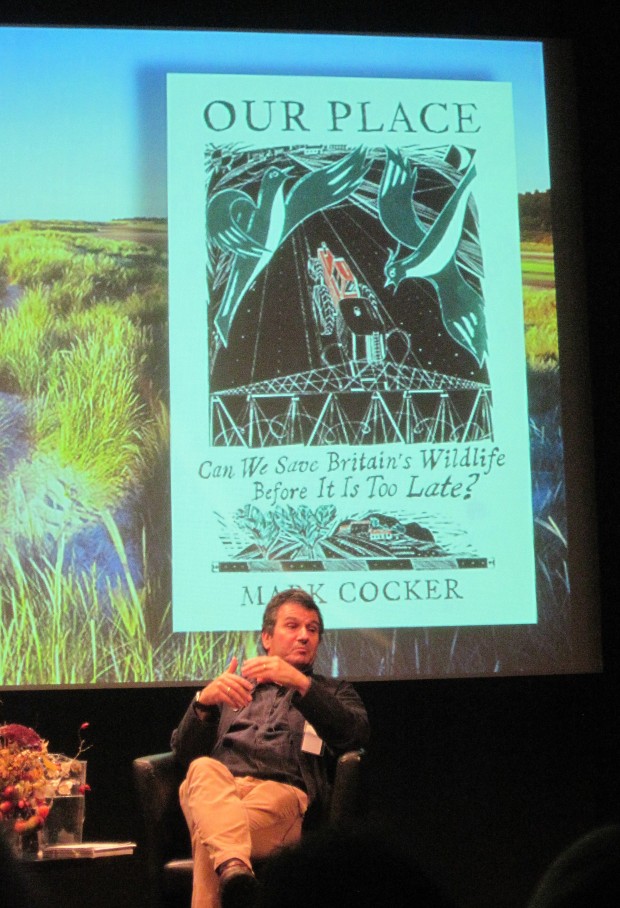
Mark Cocker
Cocker refused to define nature in a one-sentence soundbite, but argued that we have to consider ourselves a part of it rather than thinking about it as a victim ‘out there’ (the closest he came to a definition was “the totality of the system we are a part of”). “Our responsibility, terrifyingly, is unending,” he said – every time you open a new plastic toothbrush, you can’t forget that the old one you throw away will effectively be around forever. Our Place isn’t just composed of polemic, though: it’s structured around six beloved landscapes and finds moments of transcendence in being out in nature. You find hope by walking out the door, feeling the wind on your face and hearing the starling singing, Cocker remarked. He closed by reading a description from the book of the north Norfolk coast.
Either side of lunch were panels on how social media (mostly Twitter, plus smartphone apps) can serve nature and the role that poetry might play in environmental activism, with a brief interlude from visual artist Derek Robertson, who responded to the refugee crisis by traveling to Calais and Jordan and painting human figures alongside migratory birds. In the poetry session I especially enjoyed hearing from Ben Smith, a University of Plymouth lecturer and poet with a debut novel coming out in April 2019 (Doggerland, from Fourth Estate). He recently collaborated with Dr. Lee de Mora on a set of poems inspired by the Earth System Model, which provides the data for the International Panel on Climate Change. Climate modeling might seem an odd subject for poetry, but it provides excellent metaphors for failure and hope in “Spinning Up,” “Data Sets” and “Alternate Histories.”
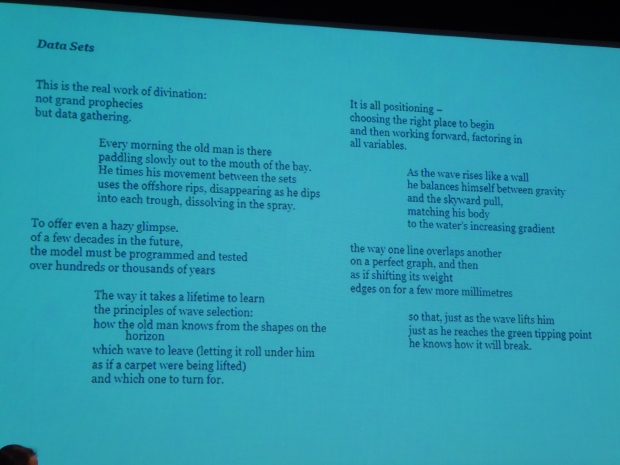
Ben Smith’s poem links unlikely subjects: surfing and climate modeling. Photo by Chris Foster.
Birmingham lecturer Isabel Galleymore, whose debut collection Significant Other is coming out from Carcanet Press in March, talked about how she uses the tropes of love poetry (praise, intimacy, pursuit and loss) when writing about environmental crisis. This shift in her focus began at university when she studied Wordsworth through an ecocritical lens, she said. Jos Smith and Luke Thompson were the other two poets on a panel chaired by Matt Howard. Howard quoted Keats – “We hate poetry that has a design on us” – and asked the poets for reactions. Smith agreed that polemic and poetry don’t mix well, yet said it’s good to have a reason for writing. He thinks it’s best when you can hold two or more ideas in play at a time.
After tea and a marvelous cake spread, it was time for a marathon of three sessions in a row, starting with three short presentations on seabirds: one by a researcher, one by a nature reserve manager, and one by a young artist who produced Chinese-style scroll paintings of the guillemot breeding colonies on Skomer and exhibited them in Sheffield Cathedral.
Next up was a highlight of the weekend: Green Party MP Caroline Lucas and Labour peer Baroness Barbara Young conversed with Michael McCarthy on the topic “Can Conventional Politics Save the Environment?” Both decried short-term thinking, the influence of corporations and the media, and government departments not working together. No one was ever elected on the promise of “less,” McCarthy suggested, but in reply Lucas talked about redefining terms: less of what? more of what? If we think in terms of quality of life, things like green energy and the sharing economy will become more appealing. She also believes that more people care about green issues than we think, but, e.g., a London mum might speak out about air quality without ever using the word “environment.” Baroness Young concluded that “adversarial politics, flip-flopping between parties, isn’t working” and we must get beyond it, at the local level if nothing else. That rang true for me for American politics, too.
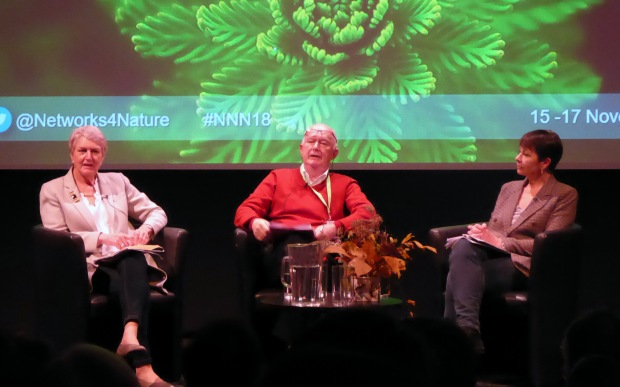
Young, McCarthy and Lucas. Photo by Chris Foster.
Before the day ended with a drinks reception, we were treated to a completely different presentation by Lloyd Buck, who raises and trains birds, mostly for television footage. So, for instance, the greylag geese flying in formation alongside the boat in David Attenborough’s 2012 Sixty Years in the Wild TV special had imprinted on Lloyd’s wife, Rose. Buck spoke about bonding with birds of very different personalities, and introduced the audience to five starlings (who appeared in Poldark), a peregrine, a gyrfalcon, a golden eagle, and Bran the raven, who showed his intelligence by solving several puzzles to find hidden chunks of meat.


I purchased two books of poetry from the bookstall – I had no idea Darlington had written poetry before her nature books – and the conference brochure itself is a wonderful 75-page collection of recent artwork and short nature writing pieces, including most of the presenters but also Patrick Barkham, Tim Dee, Paul Evans, Philip Hoare, Richard Mabey, Helen Macdonald and Chris Packham – a keynote speaker announced for next year. I’ve been skipping through the booklet and have most enjoyed the pieces by Melissa Harrison and Helen Scales so far. Altogether, an inspiring and worthwhile weekend.
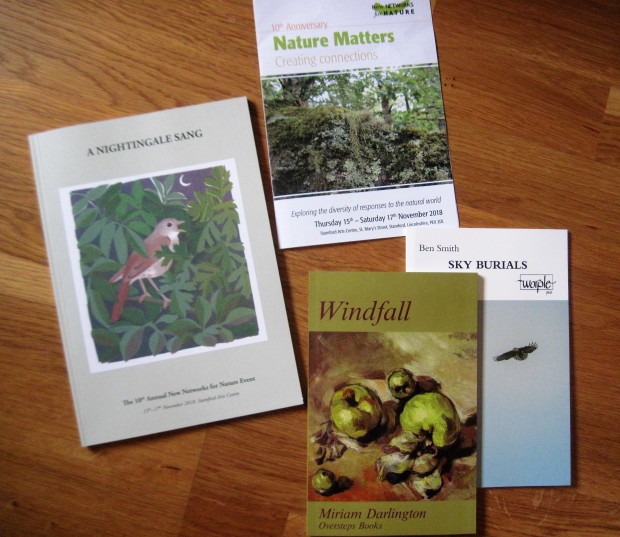
 Bookish Beck = Rebecca Foster. American transplant to England. Freelance proofreader and book reviewer.
 Bookish Beck