October Reading Plans
My plans for the rest of the month’s reading, in pictures.
A handful of October releases (not counting the ones I’ve reviewed in advance for Shelf Awareness et al., one for a blog tour, or what I’ll be reading for November deadlines).


I turn 40 on the 14th, so have made a halfhearted attempt to gather my last four unread from The Novel Cure’s books to read in your thirties before that milestone passes. Whether I’ll actually read them, I’m less sure about. I’ve owned this copy of The Jungle for decades; I’ve not enjoyed Trollope since my student days. Time runs short, anyway, but I’ll see how I get on with the Sinclair at least, and perhaps skim the Trollope to get a sense of why Berthoud and Elderkin chose it for that list.
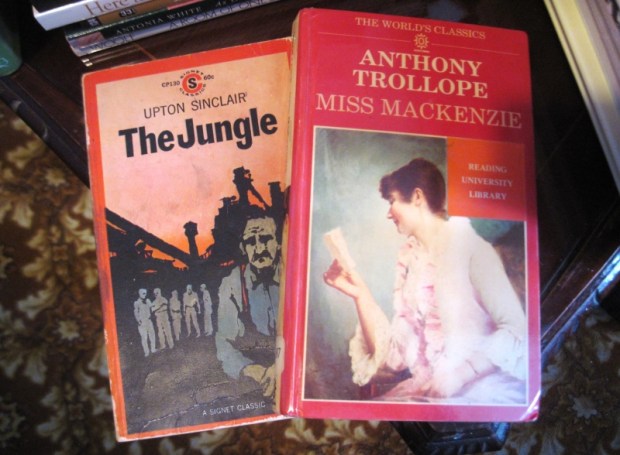
[The others are London Fields by Martin Amis, which is on loan just as I need it, and The Best of It All by Rona Jaffe, which I borrowed once and didn’t get far in; now it appears to have been withdrawn from the system. (My DNF review from 2018: “I read the first chapter and had a weird reverse case of déjà vu: this is awfully similar to Mad Men, Suzanne Rindell’s Three-Martini Lunch, and A.J. Pearce’s Dear Mrs Bird, though of course they would have been based on Jaffe’s novel rather than the other way round. Caroline Bender, fresh out of a broken engagement, arrives for her first day as a typist at a New York City publishing house and has to adjust to the catty office politics. I think I’ll truly enjoy this, but I need to find another time when I can give it my full attention. It’s nearly 450 pages of small print, so I need a chunk of time when I can really sink into it, like a flight or a long train ride.)]
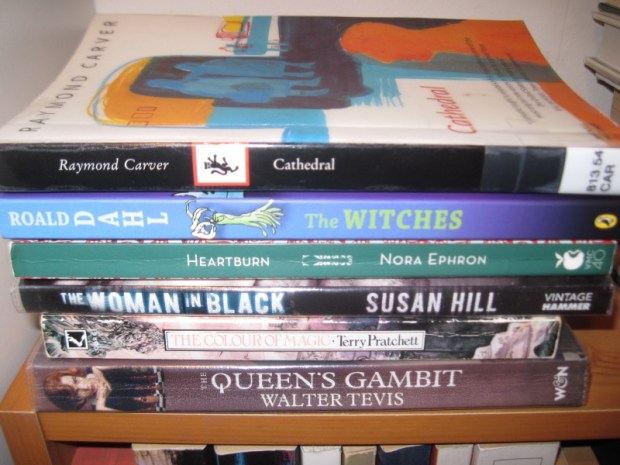
Also in conjunction with that big birthday, I’ve collected some notable 1983 releases, including 5 out of the 10 most popular on Goodreads’ list. (The Ephron and Hill would be rereads for me.) I’ll work on them in these last few months of the year.
A lesser-known Margaret Drabble novel for our women’s classics book club subgroup; Pale Fire for 1962 Club; two potential books for AusReading Month.

Some spooky or death-themed R.I.P. options (I know the challenge technically starts in September, but I only ever think to read such books as Halloween approaches).
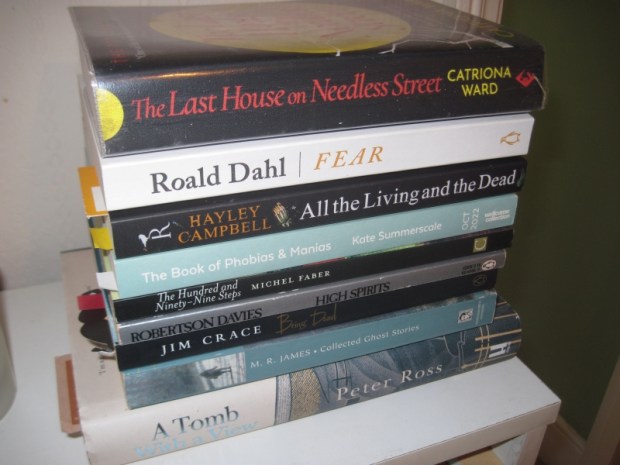
I’ll be spending my birthday weekend in Hay-on-Wye, one of my special places. Here’s my Wales-themed and/or Hay-related pile. I’ll take all of these and probably many of the above as well; I like to have lots to choose from!

Classic of the Month: The Rector’s Daughter by F.M. Mayor
I sought this out because Susan Hill hails it as a forgotten classic and it’s included on a list of books to read in your thirties in The Novel Cure.* It’s a gentle and rather melancholy little 1924 novel about Mary, the plain, unmarried 35-year-old daughter of elderly Canon Jocelyn, a clergyman in the undistinguished East Anglian village of Dedmayne. “On the whole she was happy. She did not question the destiny life brought her. People spoke pityingly of her, but she did not feel she required pity.” That is, until she unexpectedly falls in love. We follow Mary for the next four years and see how even a seemingly small life can have an impact.
 I expect Ella Berthoud and Susan Elderkin chose this as a book for one’s thirties because it’s about a late bloomer who hasn’t acquired the expected spouse and children and harbors secret professional ambitions. The struggle to find common ground with an ageing parent is a strong theme, as is the danger of an unequal marriage. Best not to say too much more about the plot itself, but I’d recommend this to readers of Elizabeth Taylor. I was also reminded strongly at points of A Jest of God by Margaret Laurence and Tender Is the Night by F. Scott Fitzgerald. It’s a short and surprising classic, one well worth rediscovering.
Some favorite lines:
- “she had written almost as a silkworm weaves a cocoon, with no thought of admiration.”
- “after three years in one place, suburban people, whatever their layer in society, become restless and want to move on.”
- “She had found self-pity a quagmire in which it was difficult not to be submerged.”
My rating:
Note: Flora Macdonald Mayor (1872–1932) published four novels and a short story collection. Her life story is vaguely similar to Mary Jocelyn’s in that she was the daughter of a Cambridge clergyman.
*I’ve now read six of the 10 titles on their list. The remaining four, which I’ll probably try to read by the end of next year, are London Fields by Martin Amis, The Best of Everything by Rona Jaffe, The Jungle by Upton Sinclair, and Miss Mackenzie by Anthony Trollope. I own the Sinclair in paperback, the Jaffe is on shelf at my local public library, and I can get the Amis and Trollope from the university library any time.
 Bookish Beck = Rebecca Foster. American transplant to England. Freelance proofreader and book reviewer.
 Bookish Beck