The Booker Prize 2023 Ceremony
Yesterday evening Eleanor Franzen of Elle Thinks and I had the enormous pleasure of attending the Booker Prize awards ceremony at Old Billingsgate in London. I won tickets through “The Booker Prize Book Club” Facebook group, which launched just 10 or so weeks ago but has already garnered over 6000 members from around the world. They ran a competition for shortlist book reviews and probably did not attract nearly as many entries as they expected to. This probably worked to my advantage, but as it’s the only prize I can recall winning for my writing, I am going to take it as a compliment nonetheless! I submitted versions of my reviews of If I Survive You and Western Lane – the only shortlistees that I’ve read – and it was the latter that won us tickets.
We arrived at the venue 15 minutes before the doors opened, sheltering from the drizzle under an overhang and keeping a keen eye on arrivals (Paul Lynch and sodden Giller Prize winner Sarah Bernstein, her partner wearing both a kilt and their several-week-old baby). Elle has a gift for small talk and we had a nice little chat with Jonathan Escoffery and his 4th Estate publicist before they were whisked inside. His head was spinning from the events of the week, including being part of a Booker delegation that met Queen Camilla.


There was a glitzy atmosphere, with a photographer-surrounded red carpet and large banners for each shortlisted novel along the opposite wall, plus an exhibit of the hand-bound editions created for each book. We enjoyed some glasses of champagne and canapés (the haddock tart was the winner) and collared Eric Karl Anderson of Lonesome Reader. It was lovely to catch up with him and Eleanor and do plenty of literary celebrity spotting: Graeme Macrae Burnet, Eleanor Catton, judge Mary Jean Chan, Natalie Haynes, Alan Hollinghurst, Anna James, Jean McNeil, Johanna Thomas-Corr (literary editor of the Sunday Times) and Sarah Waters. Later we were also able to chat with Julianne Pachico, our Sunday Times Young Writer Award shadow panel winner from 2017. She has recently gotten married and released her third novel.

We were allocated to Table 11 in the front right corner. Also at our table were some Booker Prize editorial staff members, the other competition winner (for a video review) and her guest, an Instagram influencer, a Reading Agency employee, and several more people. The three-course dinner was of a very high standard for mass catering and the wine flowed generously. I thoroughly enjoyed my meal. Afterward we had a bit of time for taking red carpet photos and one of Eleanor with the banner for our predicted winner, Prophet Song.


Some of you may have watched the YouTube livestream, or listened to the Radio 4 live broadcast. Nazanin Zaghari-Ratcliffe’s speech was a highlight. She spoke about the secret library at the Iranian prison where she was held for six years. Doctor Thorne by Anthony Trollope, War and Peace by Leo Tolstoy, The Handmaid’s Tale by Margaret Atwood (there was a long waiting list among the prisoners and wardens, she said), and especially The Return by Hisham Matar meant a lot to her. From earlier on in the evening, I also enjoyed judge Adjoa Andoh’s dramatic reading of an excerpt from Possession in honour of the late Booker winner A.S. Byatt, and Shehan Karunatilaka’s tongue-in-cheek reflections on winning the Booker – he warned the next winner that they won’t write a word for a whole year.


There was a real variety of opinion in the room as to who would win. Earlier in the evening we’d spoken to people who favoured Western Lane, This Other Eden and The Bee Sting. But both Elle and I were convinced that Prophet Song would take home the trophy, and so it did. Despite his genuine display of shock, Paul Lynch was well prepared with an excellent speech in which he cited the apocrypha and Albert Camus. In a rapid-fire interview with host Samira Ahmed, he added that he can still remember sitting down and weeping after finishing The Mayor of Casterbridge, age 15 or 16, and hopes that his work might elicit similar emotion. I’m not sure that I plan on reading it myself, but from what I’ve heard it’s a powerfully convincing dystopian novel that brings political and social collapse home in a realistic way.
All in all, a great experience for which I am very grateful! (Thanks to Eleanor for all the photos.)
Have you read Prophet Song? Did you expect it to win the Booker Prize?
Barbara Kingsolver in Conversation about “Unsheltered”
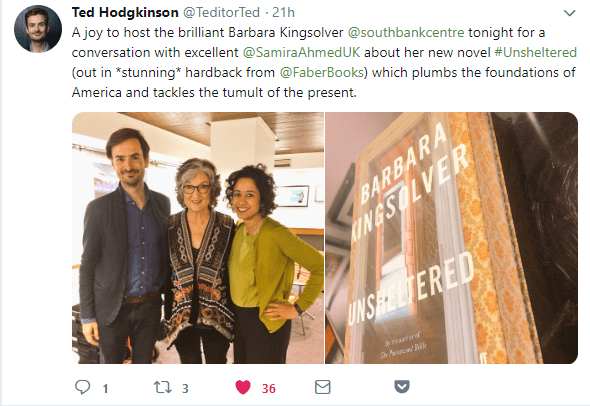
Through a Faber & Faber Twitter giveaway, I won tickets to see Barbara Kingsolver speak about her new novel, Unsheltered, at the Royal Festival Hall in London on Monday the 12th. (Yes, this is the second lot of tickets I’ve won within a month. When all you have to do is reply to a tweet or retweet it, I don’t know why more people don’t enter these competitions!) It was great to meet up with fellow bloggers Clare and Laura – half of my Wellcome Prize shadow panel – to hear Kingsolver chat with Samira Ahmed of Radio 4 and BBC One.
 In person Kingsolver was a delight – warm and funny, with a generic American accent that doesn’t betray her Kentucky roots. In her beaded caftan and knee-high oxblood boots, she exuded girlish energy despite the shock of white in her hair. Although her fervor for the scientific method and a socially responsible government came through clearly, there was a lightness about her that tempered the weighty issues she covers in her novel.
In case you are unfamiliar with it, Unsheltered is the story of two residents of Vineland, New Jersey: in the present day, fifty-something Willa Knox is trying to keep her enlarged nuclear family together in the face of underemployment, a crumbling house, divided political loyalties and serious illness. In a parallel story line set in the 1870s that unfolds in alternating chapters, science teacher Thatcher Greenwood butts heads with his principal over Darwin’s writings and is alarmed by the actions of the town’s dictator-like founder, Charles Landis.
Kingsolver revealed that she always starts with theme rather than character or setting. A novel arises from a compelling question she wants to wrestle with. When she started this one five years ago, she wanted to write about paradigm shift. She felt like the regular rules have failed us, that the world no longer provides the ‘shelter’ we expect – a good job after a degree, a pension at the end of a career, adequate health care, and so on. Consumption and growth, the economic tools we’ve always relied on, won’t work anymore. How will we cope with the end of the world as we know it? Looking for a time period when people were also asked to rise to the occasion upon a shift in worldview, she settled on the 1870s, the decade following the Civil War, when America was divided along nearly the same lines as today.
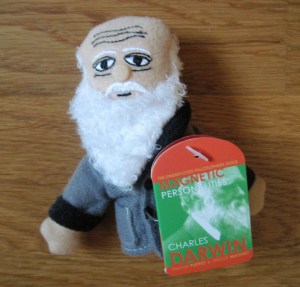
Darwin: “such a sweet guy!” said Kingsolver.
Initially she thought she might make Darwin himself a character, but that would have required setting the book at least partially in England, and she’s come to terms with the fact that she’s an American novelist. Instead, she researched the champions of Darwin in America, starting with Asa Gray. Things didn’t work out with Gray – “it was like dating,” she jokes – but then she came across Mary Treat, a self-taught ‘lady scientist’ who corresponded with Darwin, and made him Thatcher’s neighbour in Vineland.
In the scene Kingsolver read from the historical thread, Mary experiments at letting a carnivorous plant nibble at her finger. The other reading, from the contemporary section, pictured Willa – part of the “sandwich generation,” doing the unpaid labor of caring for an aging relative to make up for a shortfall in the services the state should be providing – facing a pile of bills. “Willa is the peanut butter trying to hold everything together,” Kingsolver said – a feeling familiar to her from when she and her sister cared for their dying mother.
At Ahmed’s leading, Kingsolver also discussed the modern anti-fact movement, female anger and the balance between honoring the past and erasing it (the example Ahmed gave was Laura Ingalls Wilder’s name being taken off of the ALA children’s book medal because she is now considered to have a backward attitude to race). Kingsolver described the novel as her “love letter to millennials” such as her two resilient twenty-something daughters who are having to creatively make up for the ways in which Baby Boomers have ruined the world.
It’s impossible to ignore the similarities between Landis, Vineland’s leader, and Donald Trump. There was much knowing laughter from the audience, in fact, as she described Landis and his megalomaniac behavior. Although she peppered in a few of the more explicit Trump allusions (e.g., “Lock him up!”) later on, she wrote the bulk of the book before his presidential run was ever a possibility. Kingsolver said that this is not the first time that she has anticipated rather than responded to world events: for The Poisonwood Bible she wrote a scene of the death of Mobutu two months before he died in real life.
I reviewed Unsheltered for BookBrowse ( ) and have also been moderating their online book club discussion of it. It’s been fascinating to see the spread of opinions, especially in the thread asking readers to describe the novel in three words. Descriptors have ranged from “preachy,” “political” and “repressive” to “prophetic,” “hopeful” and “truth.” My own three-word summary was “Bold, complex, polarizing.” I sensed that Kingsolver was going to divide readers – American ones, anyway; British readers should be a lot more positive because even centrist politics here start significantly further left, and there is for the most part very little resistance to concepts like socialism and climate change. I have a feeling the site’s users are predominantly middle-class, middle-aged white ladies (which, to be fair, was also true of the London audience), and we know that they’re a bastion of Trump support.
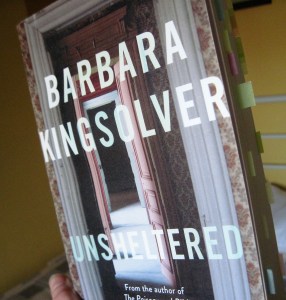
My proof copy of Unsheltered: lots to think about.
It’s clear what Kingsolver’s political leanings would be, but she emphasized the importance of having conversations with family members and neighbors who voted a different way (for Brexit, perhaps) that don’t begin with “You idiot…” “As a novelist you have to generate that absolute empathy” for every character, she insisted, even Willa’s hateful, Fox News-blasting father-in-law, Nick, who’s an example of the ‘pull up the ladder’ type of first-generation immigrant. It’s important to remember that “it’s all coming from a place of fear,” she noted.
“We come to literature with our own nutritional needs,” Kingsolver remarked, and she loves that readers can take such different messages from her writing. Novels don’t give answers but bring you into conversation with yourself, she suggested. In asking “What is the human animal?” and “What can we do about it?” she hopes that she’s expanding our humanity. That is what she believes literary fiction should do, and she argued passionately on its behalf.
Being careful not to give any spoilers about her story lines’ endings during the question time, she said, “I promise I will not leave you in despair.” I hope that, if you haven’t already, you will all read Unsheltered, coming to it with an open mind. It’s one of the most important books of the year.
 Bookish Beck = Rebecca Foster. American transplant to England. Freelance proofreader and book reviewer.
 Bookish Beck