November Releases: Dickens and Prince, Bratwurst Haven, Routes
Here are a few November books I read early for review, or that didn’t quite fit into the month’s other challenges – although, come to think of it, all are technically of novella length! (Come back tomorrow for a roundup of all the random novellas I’ve finished late in the month, and on Thursday for a retrospective of this year’s Novellas in November.)
Dickens and Prince: A Particular Kind of Genius by Nick Hornby
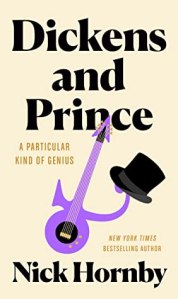 This exuberant essay, a paean to energy and imagination, draws unexpected connections between two of Hornby’s heroes. Both came from poverty, skyrocketed to fame in their twenties, were astoundingly prolific/workaholic artists, valued performance perhaps more highly than finished products, felt the industry was cheating them, had a weakness for women and died at a similar age. Biographical research shares the page with shrewd cultural commentary and glimpses of Hornby’s writing life. Whether a fan of both subjects, either or none, you’ll surely admire these geniuses’ vitality, too. (Full review forthcoming in the December 30th issue of Shelf Awareness.)
Bratwurst Haven: Stories by Rachel King
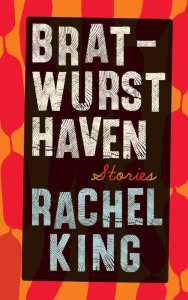 In a dozen gritty linked short stories, lovable, flawed characters navigate aging, parenthood, and relationships. Set in Colorado in the recent past, the book depicts a gentrifying area where blue-collar workers struggle to afford childcare and health insurance. As Gus, their boss at St. Anthony Sausage, withdraws their benefits and breaks in response to a recession, it’s unclear whether the business will survive. Each story covers the perspective of a different employee. The connections between tales are subtle. Overall, an endearing composite portrait of a working-class community in transition. (See my full review for Foreword.)
Routes by Rhiya Pau
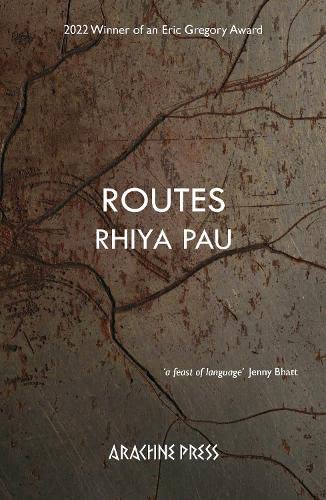 Pau’s ancestors were part of the South Asian diaspora in East Africa, and later settled in the UK. Her debut, which won one of this year’s Eric Gregory Awards (from the Society of Authors, for a collection by a British poet under the age of 30), reflects on that stew of cultures and languages. Colours and food make up the lush metaphorical palette.
When I was small, I spoke two languages.
At school: proper English, pruned and prim,
tip of the tongue taps roof of the mouth,
delicate lips, like lace frilling rims of my white
cotton socks. At home, a heady brew:
Gujarati Hindi Swahili
swim in my mouth, tie-dye my tongue
with words like bandhani.
Alongside loads of alliteration (my most adored poetic technique)—
My goddess is a mother in marigold garland
—there are delightfully unexpected turns of phrase, almost synaesthetic in their blending of the senses:
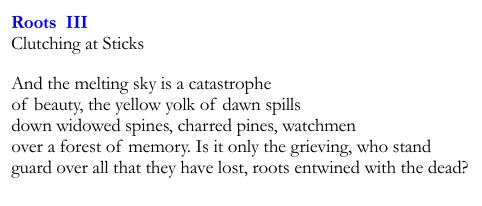
right as I worry I have forgotten the scent
of grief, I catch the first blossom of the season
and we are back circling the Spring.
~
I am a chandelier of possibility.
Besides family history and Hindu theology, current events and politics are sources of inspiration. For instance, “We Gotta Talk About S/kincare” explores the ironies and nuances of attitudes towards Black and Brown public figures, e.g., lauding Barack Obama and Kamala Harris, but former UK Home Secretary Priti Patel? “our forever – guest of honour / would deport her own mother – if she could.” I also loved the playfulness with structure: “Ode to Corelle” employs a typically solemn form for a celebration of crockery, while the yoga-themed “Salutation” snakes across two pages like a curving spine. This reminded me of poetry I’ve enjoyed by other young Asian women: Romalyn Ante, Cynthia Miller, Nina Mingya Powles and Jenny Xie. A fantastic first book. 
With thanks to Arachne Press for the proof copy for review.
Any more November releases you can recommend?
Society of Authors Awards Ceremony & 2022 McKitterick Prize
The Society of Authors, the UK trade union for writers, awards multiple grants and prizes. As I’ve mentioned in a couple of previous posts, I was one of the manuscript judges for its 2022 McKitterick Prize, awarded to a debut novelist aged 40+.

Last night I watched part of the livestream for the SoA Awards ceremony, held at Southwark Cathedral. I had to take the above screenshot! SoA Chair Joanne Harris and keynote speaker Lemn Sissay handed out the prizes to the winners and runners-up. (The full list is available here; I’m particularly delighted that Will McPhail’s In, the first graphic novel nominated for an SoA award, won the £10,000 Betty Trask Prize.)
The McKitterick Prize winner was:
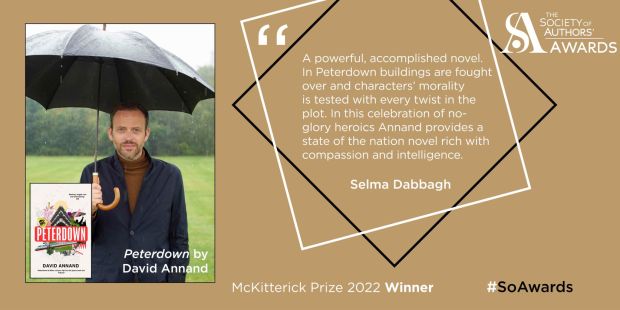
A book I clearly need to source at once!

And the runner-up was:
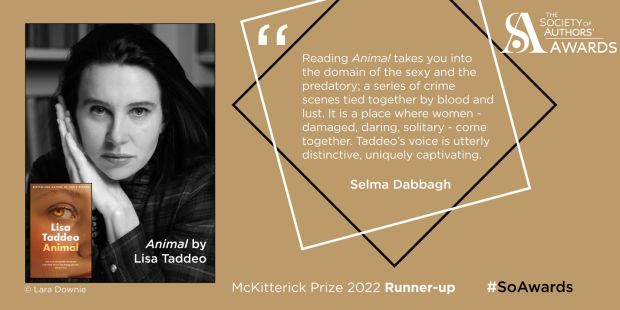
(A controversial novel I’m not so sure I see myself reading.)
Wishing an enjoyable long Jubilee weekend to those in the UK who plan to celebrate. Down with the monarchy, is the general vibe in my household, but we’ll have scones and meet some new neighbours at today’s street party (our first of two) anyway.
McKitterick Prize Shortlist (and Other Society of Authors Awards)
As I announced back in November, I was one of the judges for the 2022 McKitterick Prize. This is one of several prizes administered by the Society of Authors, the UK trade union for writers, which awards various grants and prizes.
The McKitterick Prize has, since 1990, been awarded to a debut novelist aged 40 or over. It’s unique in that it considers unpublished manuscripts as well as published novels – Tom McKitterick, who endowed the Prize, was a former editor of Political Quarterly and had an unpublished novel at the time of his death.
My particular role in the process was helping to assess the unpublished manuscripts and whittling them down to a longlist, which then joined the traditionally published novels for overall judging. I can’t say too much about this process or the particular narratives that I read due to the judges’ nondisclosure agreement, but I’ll make a few general observations.
Almost all of the entries were capably written and would have done fine as self-published novels, but I was looking for a touch of greatness – something that could compete, as is, with published work. For the most part, it was clear which manuscripts were at a different level. In terms of serendipitous moments, I noted multiple “meet the parents” scenes and mentions of moss or witches. Switching between 2–4 time periods was a recurring feature. There were lots of thrillers and dystopian setups, too.
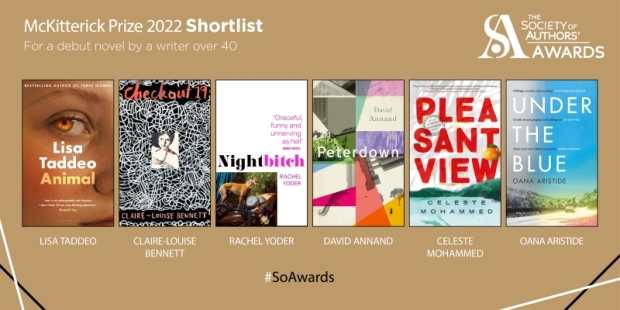
The shortlist was announced this morning. None of the manuscripts made it through, but I’m delighted to see Under the Blue on there. I’ve heard a lot about the Taddeo and Yoder, both of which seem to be divisive. The Mohammed was already on my radar, I’m interested in the Bennett, and the Annand is new to me but I’ll investigate further. Judge Anietie Isong says, “These are deeply engaging works that swell with vitality.”
I was also interested to note the shortlists for the
- Betty Trask Award for a first novel by a writer under 35: it overlaps with the latest Sunday Times Young Writer of the Year Award shortlist on two authors, Nelson and Nolan. I’ve also read the Brown. But I’m rooting for Will McPhail’s In, the first graphic novel to be shortlisted for an SoA award.

- Gordon Bowker Volcano Prize, new this year, for a novel focusing on the experience of travel away from home (in memory of Malcolm Lowry and endowed by Gordon Bowker, his biographer): I’ve read Asylum Road and I think I have Diving for Pearls from NetGalley. I’ve read a nonfiction work by McWatt and would be interested in trying her fiction.

- Paul Torday Memorial Prize, awarded to a first novel by a writer over 60: I’ve only heard of one nominee, The Day I Fell Off My Island by Yvonne Bailey-Smith – that’s because she’s Zadie Smith’s mum.

Winners and runners-up will be announced at the SoA Awards ceremony, to be held at Southwark Cathedral on June 1st – I’ll be watching the livestream.
See any nominees you’ve read? Who would you like to see win?
 Bookish Beck = Rebecca Foster. American transplant to England. Freelance proofreader and book reviewer.
 Bookish Beck