Introducing the 2023 McKitterick Prize Shortlist
For the second year in a row, I was a first-round judge for the McKitterick Prize (for a first novel by a writer over 40), helping to assess the unpublished manuscripts. Perhaps lockdowns gave people time to achieve a long-held goal of writing a novel, because submissions were up by 50%. None of the manuscripts made it through to the shortlist this year or last, but one day it could happen!

The Society of Authors kindly sent me a parcel with five of the shortlisted novels, and I picked up the remaining one from the library this week. Below are synopses from Goodreads and author bios from the SoA:
 The Return of Faraz Ali by Aamina Ahmad (Sceptre): “Sent back to his birthplace—Lahore’s notorious red-light district—to hush up the murder of a girl, a man finds himself in an unexpected reckoning with his past. … Profoundly intimate and propulsive, The Return of Faraz Ali is a spellbindingly assured first novel that poses a timeless question: Whom do we choose to protect, and at what price?”
Aamina Ahmad was born and raised in London, where she worked for BBC Drama and other independent television companies as a script editor. Her play The Dishonoured was produced by Kali Theatre Company in 2016. She has an MFA from the Iowa Writers’ Workshop and is a recipient of a Stegner Fellowship from Stanford University, a Pushcart Prize and a Rona Jaffe Writers Award. Her short fiction has appeared in journals including One Story, the Southern Review and Ecotone. She teaches creative writing at the University of Minnesota.
 When We Were Birds by Ayanna Lloyd Banwo (Hamish Hamilton): “Yejide and Darwin will meet inside the gates of Fidelis, Port Angeles’s largest and oldest cemetery, where the dead lie uneasy in their graves and a reckoning with fate beckons them both. A masterwork of lush imagination and immersive lyricism, When We Were Birds is a spellbinding novel about inheritance, loss, and love’s seismic power to heal.”
Ayanna Lloyd Banwo is a writer from Trinidad and Tobago. She is a graduate of the University of the West Indies and holds an MA in Creative Writing from the University of East Anglia, where she is now a Creative and Critical Writing PhD candidate. Her work has been published in Moko Magazine, Small Axe and PREE, among others, and shortlisted for the Small Axe Literary Competition and the Wasafiri New Writing Prize. When We Were Birds, Ayanna’s first novel, was shortlisted for the Jhalak Prize and won the OCM Bocas Prize for Fiction. She is now working on her second novel. Ayanna lives with her husband in London.
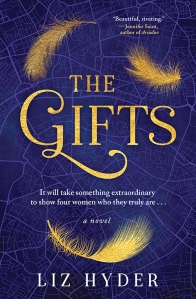 The Gifts by Liz Hyder (Manilla Press): “October 1840. A young woman staggers alone through a forest in the English countryside as a huge pair of impossible wings rip themselves from her shoulders. In London, rumours of a “fallen angel” cause a frenzy across the city, and a surgeon desperate for fame and fortune finds himself in the grips of a dangerous obsession. … [A] spellbinding tale told through five different perspectives …, it explores science, nature and religion, enlightenment, the role of women in society and the dark danger of ambition.”
Liz Hyder has been making up stories for as long she can remember. She has a BA in drama from the University of Bristol and, in early 2018, won the Bridge Award/Moniack Mhor Emerging Writer Award. Bearmouth, her debut young adult novel, won a Waterstones Children’s Book Prize, the Branford Boase Award and was chosen as the Children’s Book of the Year by The Times. Originally from London, she now lives in South Shropshire. The Gifts is her debut adult novel.
 Trespasses by Louise Kennedy (Bloomsbury Publishing): “Set in Northern Ireland during the Troubles, a shattering novel about a young woman caught between allegiance to community and a dangerous passion. … As tender as it is unflinching, Trespasses is a heart-pounding, heart-rending drama of thwarted love and irreconcilable loyalties, in a place what you come from seems to count more than what you do, or whom you cherish.”
Louise Kennedy grew up a few miles from Belfast. She is the author of the Women’s Prize-shortlisted novel Trespasses, and the acclaimed short story collection The End of the World is a Cul de Sac, and is the only woman to have been shortlisted twice for the Sunday Times Audible Short Story Award (2019 and 2020). Before starting her writing career, she spent nearly thirty years working as a chef. She lives in Sligo.
 The Whalebone Theatre by Joanna Quinn (Fig Tree): “One blustery night in 1928, a whale washes up on the shores of the English Channel. By law, it belongs to the King, but twelve-year-old orphan Cristabel Seagrave has other plans. She and the rest of the household … build a theatre from the beast’s skeletal rib cage. … As Cristabel grows into a headstrong young woman, World War II rears its head.”
Joanna Quinn was born in London and grew up in the southwest of England, where her bestselling debut novel, The Whalebone Theatre, is set. Joanna has worked in journalism and the charity sector. She is also a short story writer, published by The White Review and Comma Press, among others. She lives in a village near the sea in Dorset.
 Other Names for Love by Taymour Soomro (Harvill Secker): “A seductive coming-of-age story about queer desire, Other Names for Love is a charged, hypnotic debut novel about a boy’s life-changing summer in rural Pakistan: a story of fathers, sons, and the consequences of desire. … Decades later, Fahad is living abroad when he receives a call from his mother summoning him home. … [A] tale of masculinity, inheritance, and desire set against the backdrop of a country’s violent history, told with uncommon urgency and beauty.”
Taymour Soomro is the author of Other Names for Love and co-editor of Letters to a Writer of Colour. His writing has been published in the New Yorker, the New York Times and elsewhere. He is the recipient of fellowships from the Wisconsin Institute for Creative Writing, Bread Loaf Writers’ Conference and the Sozopol Fiction Seminars. He has degrees from Cambridge University and Stanford Law School and a PhD in creative writing from the University of East Anglia. He currently teaches on the MFA program at Bennington College.
Fellow judge Selma Dabbagh summarises the shortlist thus: “Family estates in rural Pakistan (Other Names for Love) and England (The Whalebone Theatre) fall into decline reflecting the hubris and short-sightedness of their owners[;] in The Return of Faraz Ali, it is the decaying grandeur of the courtesans of Lahore that is lovingly depicted. Whereas in both The Gifts and When We Were Birds, the otherworldly brings new possibilities to the tawdry and impoverished as mystical wings fly over the slums of Victorian London and the graveyards of Trinidad.”
I was already interested in reading a couple of these novels, and was pleased to discover a few new-to-me titles. As it’s also shortlisted for the Women’s Prize (which will be awarded on Wednesday), it seems to make sense to start with Trespasses, and I’m also particularly keen on The Gifts, which sounds like a great holiday read and right up my street, so I’m packing it for our trip to Scotland later this month. One or more of the others might end up on my 20 Books of Summer list. I’ll be sure to follow up with reviews of any I manage to read this summer.
The winner and runner-up will be announced at the SoA Awards ceremony in London on 29 June. I’ll be away at the time but will hope to watch part of the livestream. For more on all of the SoA Awards, see the press release on their website.
See any nominees you’ve read? Who would you like to see win?
Young Writer of the Year Award Shortlist: Larger than an Orange by Lucy Burns
Looking back, being on the 2017 shadow panel for the Sunday Times Young Writer of the Year Award was still one of the best things I’ve achieved in my time as a book blogger. Each year I eagerly look out for this award’s shortlist to see how many titles I’ve read and who I think the judges will choose as the winner. For a couple years the prize has had a higher cash fund thanks to sponsorship from the Charlotte Aitken Trust, and is now, like the McKitterick Prize that I’ve judged the past two years, administered by the Society of Authors.

This year’s four nominees include two novels and two nonfiction works: Oxblood by Tom Benn is said to be a “poignantly rendered exploration of domesticity and violence” and Maddie Mortimer’s Maps of our Spectacular Bodies, which won the Desmond Elliott Prize and was longlisted for the Booker Prize, is a “lyrical and captivating look at mortality, desire and forgiveness”; Lucy Burns’s debut memoir is an examination of abortion through the prism of her personal experience; and Katherine Rundell’s Super-Infinite (winner of the Baillie Gifford Prize for Non-Fiction) is a biography of John Donne.
I was intrigued by the premise (narration by a young woman – and her cancer) of the Mortimer when it was longlisted for the Booker so bought a sale copy with a Christmas voucher, but the style and over-400-page length has been defeating me. I might try again, but for a debut author’s experimental work I think 200 pages would have been sufficient. I’m not keen to try the Benn, but would gladly read the Rundell from the library another time. The final book is one I requested as a review copy.
Larger Than an Orange by Lucy Burns (2021)
I’ve only read one other memoir of an abortion (as opposed to a memoir in which an abortion is simply one event of many), Happening by Annie Ernaux, so it was perhaps inevitable for me to get similar vibes from the two works. Both are fragmentary, spare; matter of fact in tone to avoid melodramatic extremes of emotion. The difference, of course, is that in the 1960s abortion was illegal in France and so ending a pregnancy required clandestine action. However, even in 2017, when the then 26-year-old Burns had a medical abortion in England, where it had been legal for 50 years, she found that the process was invasive and officious. She presents the experience as infantilizing – not trusting the patient, and lacking in compassion. And although it was the only practical choice for her at the time and she remains firmly committed to women’s right to an abortion, it sparked feelings of guilt, shame and depression that lingered and affected her work and personal life. At counselling appointments she expressed disgust at herself, and she became obsessed with looking up American pro-life propaganda and testimonials from former abortion clinic workers online.
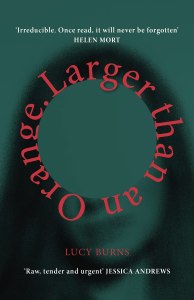 The book is, collage-like, assembled from pieces – sometimes as little as one paragraph or one line to a page – of dated autobiographical material, going back and forth between the summer of the abortion and the few-year aftermath as she suffers with irregular bleeding, chooses a new contraceptive method and has a short-term relationship; transcripts of radio debates; alphabetical lists of predicted search terms and so on. She even requests her medical records, including sections from it plus ultrasound images, and marks her baby’s would-be birthday.
I could imagine this working very well as a play for voices, especially because Burns is in the habit of counting each person she tells about the abortion and referring to them by their number until, at fifty-something, she gives up. Friends, receptionists, the people at work who adjudicate her petition to be granted two weeks’ leave: there are those she tells willingly and those she feels duty-bound to inform to explain her health or behaviour. Some remain a part of her life and others, awkward or judgemental, fade out of it.
This is a powerful read I can’t say I necessarily enjoyed, but did admire for its uncompromising clarity and honesty, and its willingness to probe both sides of ethical issues in a way that ‘good feminists’ might think they cannot.
With thanks to FMcM Associates and Chatto & Windus for the free copy for review.
Tomorrow we’ll hear the Young Writer of the Year results. My feeling is that Katherine Rundell, though already a prize winner for this book and an established author due to her children’s oeuvre, will win for Super-Infinite.
Have you read anything from this year’s shortlist?
November Releases: Dickens and Prince, Bratwurst Haven, Routes
Here are a few November books I read early for review, or that didn’t quite fit into the month’s other challenges – although, come to think of it, all are technically of novella length! (Come back tomorrow for a roundup of all the random novellas I’ve finished late in the month, and on Thursday for a retrospective of this year’s Novellas in November.)
Dickens and Prince: A Particular Kind of Genius by Nick Hornby
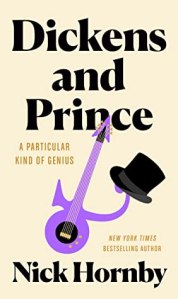 This exuberant essay, a paean to energy and imagination, draws unexpected connections between two of Hornby’s heroes. Both came from poverty, skyrocketed to fame in their twenties, were astoundingly prolific/workaholic artists, valued performance perhaps more highly than finished products, felt the industry was cheating them, had a weakness for women and died at a similar age. Biographical research shares the page with shrewd cultural commentary and glimpses of Hornby’s writing life. Whether a fan of both subjects, either or none, you’ll surely admire these geniuses’ vitality, too. (Full review forthcoming in the December 30th issue of Shelf Awareness.)
Bratwurst Haven: Stories by Rachel King
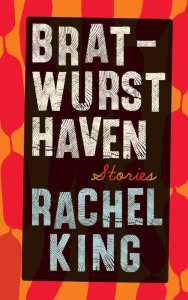 In a dozen gritty linked short stories, lovable, flawed characters navigate aging, parenthood, and relationships. Set in Colorado in the recent past, the book depicts a gentrifying area where blue-collar workers struggle to afford childcare and health insurance. As Gus, their boss at St. Anthony Sausage, withdraws their benefits and breaks in response to a recession, it’s unclear whether the business will survive. Each story covers the perspective of a different employee. The connections between tales are subtle. Overall, an endearing composite portrait of a working-class community in transition. (See my full review for Foreword.)
Routes by Rhiya Pau
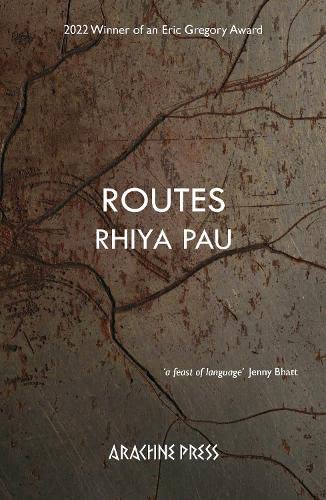 Pau’s ancestors were part of the South Asian diaspora in East Africa, and later settled in the UK. Her debut, which won one of this year’s Eric Gregory Awards (from the Society of Authors, for a collection by a British poet under the age of 30), reflects on that stew of cultures and languages. Colours and food make up the lush metaphorical palette.
When I was small, I spoke two languages.
At school: proper English, pruned and prim,
tip of the tongue taps roof of the mouth,
delicate lips, like lace frilling rims of my white
cotton socks. At home, a heady brew:
Gujarati Hindi Swahili
swim in my mouth, tie-dye my tongue
with words like bandhani.
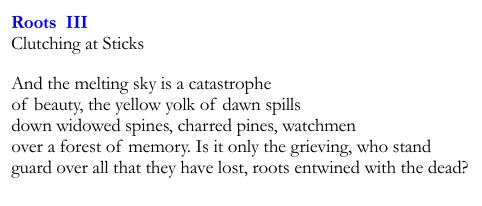
Alongside loads of alliteration (my most adored poetic technique)—
My goddess is a mother in marigold garland
—there are delightfully unexpected turns of phrase, almost synaesthetic in their blending of the senses:
right as I worry I have forgotten the scent
of grief, I catch the first blossom of the season
and we are back circling the Spring.
~
I am a chandelier of possibility.
Besides family history and Hindu theology, current events and politics are sources of inspiration. For instance, “We Gotta Talk About S/kincare” explores the ironies and nuances of attitudes towards Black and Brown public figures, e.g., lauding Barack Obama and Kamala Harris, but former UK Home Secretary Priti Patel? “our forever – guest of honour / would deport her own mother – if she could.” I also loved the playfulness with structure: “Ode to Corelle” employs a typically solemn form for a celebration of crockery, while the yoga-themed “Salutation” snakes across two pages like a curving spine. This reminded me of poetry I’ve enjoyed by other young Asian women: Romalyn Ante, Cynthia Miller, Nina Mingya Powles and Jenny Xie. A fantastic first book. 
With thanks to Arachne Press for the proof copy for review.
Any more November releases you can recommend?
Society of Authors Awards Ceremony & 2022 McKitterick Prize
The Society of Authors, the UK trade union for writers, awards multiple grants and prizes. As I’ve mentioned in a couple of previous posts, I was one of the manuscript judges for its 2022 McKitterick Prize, awarded to a debut novelist aged 40+.

Last night I watched part of the livestream for the SoA Awards ceremony, held at Southwark Cathedral. I had to take the above screenshot! SoA Chair Joanne Harris and keynote speaker Lemn Sissay handed out the prizes to the winners and runners-up. (The full list is available here; I’m particularly delighted that Will McPhail’s In, the first graphic novel nominated for an SoA award, won the £10,000 Betty Trask Prize.)
The McKitterick Prize winner was:
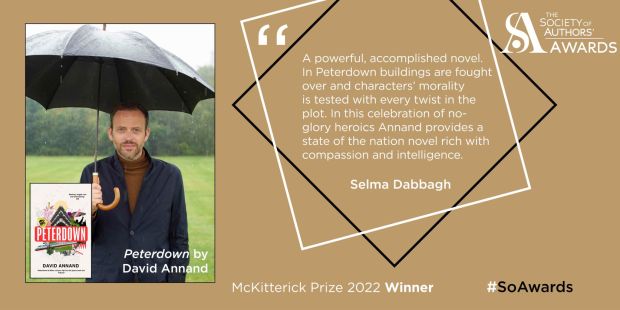
A book I clearly need to source at once!

And the runner-up was:
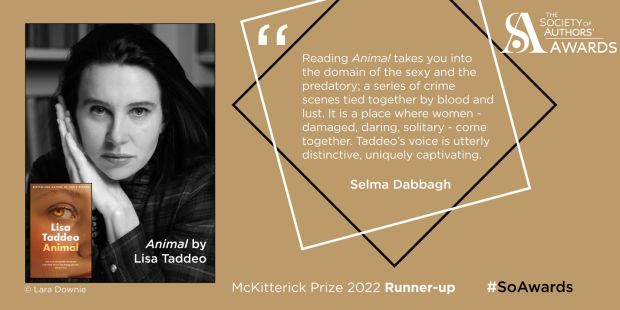
(A controversial novel I’m not so sure I see myself reading.)
Wishing an enjoyable long Jubilee weekend to those in the UK who plan to celebrate. Down with the monarchy, is the general vibe in my household, but we’ll have scones and meet some new neighbours at today’s street party (our first of two) anyway.
McKitterick Prize Shortlist (and Other Society of Authors Awards)
As I announced back in November, I was one of the judges for the 2022 McKitterick Prize. This is one of several prizes administered by the Society of Authors, the UK trade union for writers, which awards various grants and prizes.
The McKitterick Prize has, since 1990, been awarded to a debut novelist aged 40 or over. It’s unique in that it considers unpublished manuscripts as well as published novels – Tom McKitterick, who endowed the Prize, was a former editor of Political Quarterly and had an unpublished novel at the time of his death.
My particular role in the process was helping to assess the unpublished manuscripts and whittling them down to a longlist, which then joined the traditionally published novels for overall judging. I can’t say too much about this process or the particular narratives that I read due to the judges’ nondisclosure agreement, but I’ll make a few general observations.
Almost all of the entries were capably written and would have done fine as self-published novels, but I was looking for a touch of greatness – something that could compete, as is, with published work. For the most part, it was clear which manuscripts were at a different level. In terms of serendipitous moments, I noted multiple “meet the parents” scenes and mentions of moss or witches. Switching between 2–4 time periods was a recurring feature. There were lots of thrillers and dystopian setups, too.
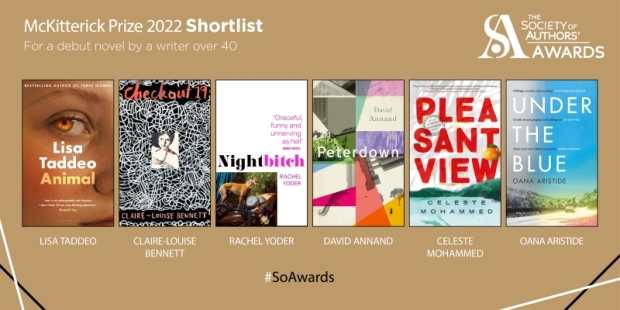
The shortlist was announced this morning. None of the manuscripts made it through, but I’m delighted to see Under the Blue on there. I’ve heard a lot about the Taddeo and Yoder, both of which seem to be divisive. The Mohammed was already on my radar, I’m interested in the Bennett, and the Annand is new to me but I’ll investigate further. Judge Anietie Isong says, “These are deeply engaging works that swell with vitality.”
I was also interested to note the shortlists for the
- Betty Trask Award for a first novel by a writer under 35: it overlaps with the latest Sunday Times Young Writer of the Year Award shortlist on two authors, Nelson and Nolan. I’ve also read the Brown. But I’m rooting for Will McPhail’s In, the first graphic novel to be shortlisted for an SoA award.

- Gordon Bowker Volcano Prize, new this year, for a novel focusing on the experience of travel away from home (in memory of Malcolm Lowry and endowed by Gordon Bowker, his biographer): I’ve read Asylum Road and I think I have Diving for Pearls from NetGalley. I’ve read a nonfiction work by McWatt and would be interested in trying her fiction.

- Paul Torday Memorial Prize, awarded to a first novel by a writer over 60: I’ve only heard of one nominee, The Day I Fell Off My Island by Yvonne Bailey-Smith – that’s because she’s Zadie Smith’s mum.

Winners and runners-up will be announced at the SoA Awards ceremony, to be held at Southwark Cathedral on June 1st – I’ll be watching the livestream.
See any nominees you’ve read? Who would you like to see win?
 Bookish Beck = Rebecca Foster. American transplant to England. Freelance proofreader and book reviewer.
 Bookish Beck