Carol Shields Prize Reading: Daughter and Dances
Two more Carol Shields Prize nominees today: from the shortlist, the autofiction-esque story of a father and daughter, both writers, and their dysfunctional family; and, from the longlist, a debut novel about the physical and emotional rigours of being a Black ballet dancer.
Daughter by Claudia Dey
Like her protagonist, Mona Dean, Dey is a playwright, but the Canadian author has clearly stated that her third novel is not autofiction, even though it may feel like it. (Fragmentary sections, fluidity between past and present, a lack of speech marks; not to mention that Dey quotes Rachel Cusk and there’s even a character named Sigrid.) Mona’s father, Paul, is a serial adulterer who became famous for his novel Daughter and hasn’t matched that success in the 20 years since. He left Mona and Juliet’s mother, Natasha, for Cherry, with whom he had another daughter, Eva. There have been two more affairs. Every time Mona meets Paul for a meal or a coffee, she’s returned to a childhood sense of helplessness and conflict.
I had a sordid contract with my father. I was obsessed with my childhood. I had never gotten over my childhood. Cherry had been cruel to me as a child, and I wanted to get back at Cherry, and so I guarded my father’s secrets like a stash of weapons, waiting for the moment I could strike.
It took time for me to warm to Dey’s style, which is full of flat, declarative sentences, often overloaded with character names. The phrasing can be simple and repetitive, with overuse of comma splices. At times Mona’s unemotional affect seems to be at odds with the melodrama of what she’s recounting: an abortion, a rape, a stillbirth, etc. I twigged to what Dey was going for here when I realized the two major influences were Hemingway and Shakespeare.
 Mona’s breakthrough play is Margot, based on the life of one Hemingway granddaughter, and she’s working on a sequel about another. There are four women in Paul’s life, and Mona once says of him during a period of writer’s block, “He could not write one true sentence.” So Paul (along with Mona, along with Dey) may be emulating Hemingway.
And then there’s the King Lear setup. (I caught on to this late, perhaps because I was also reading a more overt Lear update at the time, Private Rites by Julia Armfield.) The larger-than-life father; the two older daughters and younger half-sister; the resentment and estrangement. Dey makes the parallel explicit when Mona, musing on her Hemingway-inspired oeuvre, asks, “Why had Shakespeare not called the play King Lear’s Daughters?”
Were it not for this intertextuality, it would be a much less interesting book. And, to be honest, the style was not my favourite. There were some lines that really irked me (“The flowers they were considering were flamboyant to her eye, she wanted less flamboyant flowers”; “Antoine barked. He was barking.”; “Outside, it sunned. Outside, it hailed.”). However, rather like Sally Rooney, Dey has prioritized straightforward readability. I found that I read this quickly, almost as if in a trance, inexorably drawn into this family’s drama. 
Related reads: Monsters by Claire Dederer, The Wren, The Wren by Anne Enright, The Wife by Meg Wolitzer, Mrs. Hemingway by Naomi Wood
With thanks to publicist Nicole Magas and Farrar, Straus and Giroux for the free e-copy for review.
Also from the shortlist:
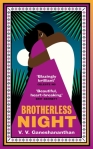 Brotherless Night by V.V. Ganeshananthan – The only novel that is on both the CSP and Women’s Prize shortlists. I dutifully borrowed a copy from the library, but the combination of the heavy subject matter (Sri Lanka’s civil war and the Tamil Tigers resistance movement) and the very small type in the UK hardback quickly defeated me, even though I was enjoying Sashi’s quietly resolute voice and her medical training to work in a field hospital. I gave it a brief skim. The author researched this second novel for 20 years, and her narrator is determined to make readers grasp what went on: “You must understand: that word, terrorist, is too simple for the history we have lived … You must understand: There is no single day on which a war begins.” I know from Laura and Marcie that this is top-class historical fiction, never mawkish or worthy, so I may well try it some other time when I have the fortitude.
Longlisted:
Dances by Nicole Cuffy
This was a buddy read with Laura (see her review); I think we both would have liked to see it on the shortlist as, though we’re not dancers ourselves, we’re attracted to the artistry and physicality of ballet. It’s always a privilege to get an inside glimpse of a rarefied world, and to see people at work, especially in a field that requires single-mindedness and self-discipline. Cuffy’s debut novel focuses on 22-year-old Celine Cordell, who becomes the first Black female principal in the New York City Ballet. Cece marvels at the distance between her Brooklyn upbringing – a single mother and drug-dealing older brother, Paul – and her new identity as a celebrity who has brand endorsements and gets stopped on the street for selfies.
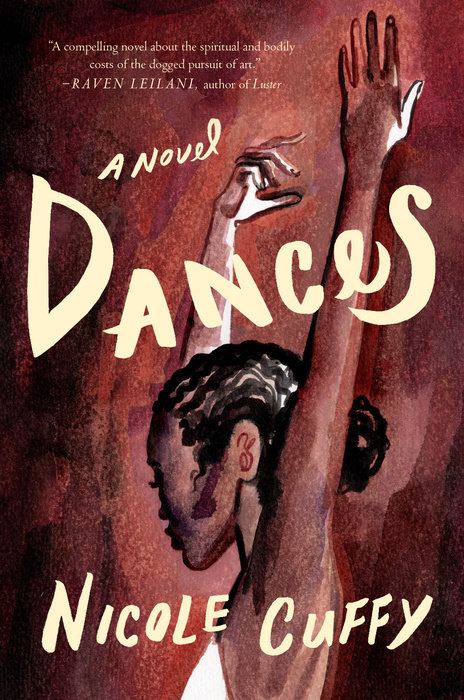
Even though Kaz, the director, insists that “Dance has no race,” Cece knows it’s not true. (And Kaz in some ways exaggerates her difference, creating a role for her in a ballet based around Gullah folklore from South Carolina.) Cece has always had to work harder than the others in the company to be accepted:
Ballet has always been about the body. The white body, specifically. So they watched my Black body, waited for it to confirm their prejudices, grew ever more anxious as it failed to do so, again and again.
A further complication is her relationship with Jasper, her white dance partner. It’s an open secret in the company that they’re together, but to the press they remain coy. Cece’s friends Irine and Ryn support her through rocky times, and her former teachers, Luca and Galina, are steadfast in their encouragement. Late on, Cece’s search for Paul, who has been missing for five years, becomes a surprisingly major element. While the sibling bond helps the novel stand out, I most enjoyed the descriptions of dancing. All of the sections and chapters are titled after ballet terms, and even when I was unfamiliar with the vocabulary or the music being referenced, I could at least vaguely picture all the moves in my head. It takes real skill to render other art forms in words. I’ll look forward to following Cuffy’s career. 
With thanks to publicist Nicole Magas and One World for the free e-copy for review.
Currently reading:
(Shortlist) Coleman Hill by Kim Coleman Foote
(Longlist) Between Two Moons by Aisha Abdel Gawad
Up next:
(Longlist) You Were Watching from the Sand by Juliana Lamy
I’m aiming for one more batch of reviews (and a prediction) before the winner is announced on 13 May.
Paulette Bates Alden: An Underrated Author
I first came across Paulette Alden’s work last June, when she contacted me to ask if I’d like to review her new short story collection, Unforgettable. It’s a self-published book available through Kindle, and in all honesty, given my experience reviewing self-published material for Kirkus and Foreword, I wasn’t expecting much. What a pleasant surprise, then, to find that these were excellent, literary short stories with a strong voice and sense of place. Since then I have read two more Alden books: Crossing the Moon, her memoir of infertility, and Feeding the Eagles, her first short story collection, which shares a protagonist with Unforgettable. Here, in the order in which I have read them, are Alden’s published works:
Unforgettable
 Nine linked stories focus on the life of Miriam Batson, a writer and adjunct professor at a Minnesota college. Now in her late forties, Miriam faces the challenge of caring for her aging mother. Indeed, the final five stories are inspired by Alden’s experience as a caregiver for her late mother, who suffered from dementia. Although it is intriguing to ponder just how autobiographical these stories might be, ultimately it makes little difference to a reader’s enjoyment. The close third-person perspective creates such intimate knowledge of the main character that one cannot help but feel sympathy for her professional and personal struggles.
The opening story, “The Student,” is among the strongest. Miriam learns that Brian, one of the students in her advanced short story class, has attempted suicide – in three different ways. Horror cedes to compassion as she realizes how he must have been suffering, even while keeping up a cheerful exterior in class. As she visits Brian in the hospital during his recovery, Miriam is taken aback by her feelings for him. Hesitant to borrow spiritual language, she still senses that she and Brian have a soul connection. At the same time, she realizes that no relationship is entirely one thing or another; their teacher-student dynamic may resemble a parent-child link, but sex keeps creeping in unexpectedly.
In “Sorrow,” told in the present tense, Miriam learns of the death of one of her black nannies and returns to South Carolina to pay her respects. Filled with memories of segregation, this story shares the social conscience of Kathryn Stockett’s The Help. “Enormously Valuable” returns to the first story’s academic setting, with Miriam receiving notification that someone else – a less experienced man – has gotten the teaching job she applied for. She decides to take legal advice to determine whether this is a case of sex discrimination. This story tips over into melodrama slightly, but is still an affecting look at career disappointment. The themes of bureaucracy and petty infighting in a university English department recall John Williams’s Stoner.
“Swimming, Snow” was commissioned as the Minnesota Center for Book Arts’ 1993 Winter Book. Miriam slowly starts to heal after her father’s death, thanks to the therapeutic effects of activities like massage, classical music, and sex. This one is a perfect segue into the collection’s last five stories, which together reflect on Alden’s experiences as a caregiver during her mother’s final years with dementia.
The title story, the last in the collection, does indeed have a stand-alone feel, combining all the emotions of the previous four into the most shrewdly crafted of the tales, rich with symbolism. It opens with Miriam driving to a monastery for a writing retreat. Although it is April, it is snowing, and Nat King Cole’s song “Unforgettable” is on the radio. Ironically, that title is also the name given to her mother’s nursing home’s remodeling campaign. Miriam has been taking beginner’s Italian lessons; her bewilderment is an echo of her mother’s confusion about language. In addition, Easter is coming up the following week, and the symbology of death and restoration plays a significant role. Miriam can no longer deny that her mother will be dead soon, yet she feels that she will live on – perhaps even through Miriam’s work: “Writing is her religion, her resurrection. Long after her mother is gone, she will have this moment. Her mother will rise from the dead and live again in those words.”
Alden tenderly conveys the overwhelming difficulties and small joys of being the primary caregiver for a loved one with serious health problems. You do not have to share any of Miriam’s experiences to value her insight and admire her courage. I daresay every reader will find at least one aspect of these stories to be, as the title suggests, simply unforgettable.
My rating: 
Crossing the Moon
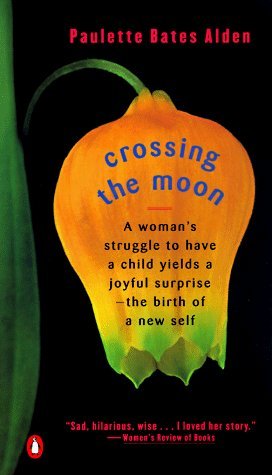 Frank and tender, this is a wonderful memoir about women’s reproductive choices – or the way life sometimes takes those choices out of your hands. Alden was happily married, with a beloved cat named Cecil and her first short story collection coming out soon. At age 39, she still hadn’t thought all that much about motherhood, but suddenly decision time was on her. Despite her ambivalence (“I might never have a child, and the irony is not lost on me, that I’m not even sure I want one”), she went ahead with multiple rounds of infertility treatment, only conceding defeat and grieving her loss when she was 42.
All along she was resisting multiple voices: that of her Southern upbringing, which said all women were supposed to have children; that of feminism, which told her she wasn’t supposed to want what all women are supposed to have. There was also her own inner suspicion that the life she already had was the one she wanted. “From the very start, I had seen writing and motherhood as mutually exclusive.”
I found this a very touching story of learning to love the life you have. “It came to me that it really was a choice between two good things – having a child and not having a child. Our life without a child seemed good to me. I caught a glimpse that it was what was right for us, for the best.”
My rating: 
 Feeding the Eagles
Miriam Batson first appeared in this 1983 collection published by Graywolf Press. Of the 11 stories here, seven are in the third person and four in the first person. They dart back and forth in time: sometimes Miriam is married and back in South Carolina visiting her parents and sister; other times she’s a young graduate student on the way back to California. It was particularly interesting for me, having read Alden’s memoir, to trace the autobiographical roots of many of the stories. I even spotted a couple of lines taken word for word from life: “‘I’ll tell you what I think,’ [Miriam’s] mother says slowly. ‘I think people who don’t have children are the most selfish people in the world.’”
These stories are strong on symbolism and often have memorable endings. For instance, the title phrase seems odd but in context is a beautiful image of turning failure into a positive. Miriam and her husband Ted have gone out fishing from their Minnesota cabin. Ted throws a big fish back, hoping the hook injury wasn’t too deep, but a while later they see it floating on its side. They’re feeling a little guilty – until an eagle drops in and snatches the dead fish. “‘Now you don’t have to feel so bad,’ Ted says. ‘We’re feeding the eagles.’” Elsewhere, Miriam’s grandmother’s wig is a peculiar token of family inheritance, while a snake encountered at a campground is a reminder of excessive sensuality.
As in Unforgettable and Crossing the Moon, the overarching theme of the book is a woman’s identity and how this shifts through life. Miriam is a daughter, a wife, a grown sister, a writer. She is not a mother, a decision that defines her as much as any other. But even within these roles, time creeps in and changes things. With her elderly parents facing bankruptcy, Miriam realizes, “It occurred to me for the first time that maybe my father didn’t know what was going on.” That sense of a turning of the generations, of the child taking on the responsible parent guise, is undoubtedly true to life.
Another central theme is how places of safety and familiarity lose their capacity to reassure us. For Miriam/Alden, the South becomes increasingly foreign but still has a metaphorical hold on her. “Stretching out around us in every direction are the flat Midwestern plains, and it comes to me that I will not live my life as I have always imagined I would—without even thinking of it—in South Carolina.” All the same, as she drives to the old family cabin in South Carolina before it passes out of their hands for good, she thinks how “all of the roads of her life lead back to this one.”
On this reading the story that meant most to me was “At the Beach,” in which Miriam and her sister Linda take a rare vacation together and marvel at how their parents are aging. “Just so you take them in in their old age,” Miriam jokes, but beneath the quip lies deep concern. I could recognize my sister and myself – now separated by an ocean but not so much anymore by the eight years between us – in this sentence: “It seems we talk more now that we are older, now that we live so far apart and have so little time together.”
One thing I love about Alden’s books is how she seems to see life in discrete parts but also, looking back nostalgically, as a coherent narrative that leads logically and inevitably to the present. This makes for a gently bittersweet tone, but I come away sensing gratitude. As my favorite lines from Crossing the Moon have it, “who can say what is ‘best’? Maybe it’s possible to get to a place where what is best is simply what is.”
My rating:
 The Answer to Your Question
I haven’t read this one yet, but I have a copy on my e-reader and am saving it for a rainy day treat. On the surface it sounds completely different from anything else Alden has written. The blurb describes a page-turning thriller about a man who has been accused of murdering four women and his librarian mother’s quest to figure out whether he really did it and why. It won the Kindle Book Review Best Indie Book of 2013 in the suspense category. I feel sure that it will have the same psychological acuity as Alden’s other books.
Who are some of your favorite lesser-known authors? Share them in the comments below!
 Bookish Beck = Rebecca Foster. American transplant to England. Freelance proofreader and book reviewer.
 Bookish Beck