20 Books of Summer, 7–9: Furies, The Earthquake Bird, and Greta & Valdin
It might seem that I’m very behind on 20 Books of Summer, and I am, but that’s mostly because I’ve done my usual trick of starting loads of books at once so that I’m currently in the middle of another nine with no prospect of finishing any particularly soon. I will eventually review more, but probably all in a rush and on the later side. It doesn’t help that quite a few happen to be lacklustre reads, such that I have to push myself through them instead of enjoying spending time with the stack. For today, though, I have a pretty readable trio made up of feminist short stories, a mild Japan-set mystery, and a highly random queer dysfunctional family novel that rose from indie obscurity in New Zealand. (Also a DNF.)
Furies: Stories of the Wicked, Wild and Untamed (2023)
It was my second attempt at this Virago anthology; I borrowed it from the library last year but never opened it, as far as I can remember. Each story is named after a synonym for “virago,” so the focus is on strong and unconventional women, but given that brief there is huge variety, including memoir (Ali Smith’s “Spitfire,” about her late mother’s WAAF service), historical research (CN Lester on sexology and early trans figures, Emma Donoghue on early-twentieth-century activist and lesbian Kathlyn Oliver, Stella Duffy on menopause) and even one graphic short, the mother–daughter horror story “She-Devil” by comics artist Eleanor Crewes.
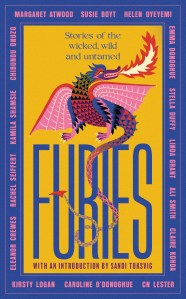 As with any anthology, some pieces stand out more than others. Caroline O’Donoghue, Helen Oyeyemi and Kamila Shamsie’s contributions were unlikely to convert me into a fan. Margaret Atwood is ever sly and accessible, with “Siren” opening with the line “Today’s Liminal Beings Knitting Circle will now be called to order.” I was surprised to get on really well with Kirsty Logan’s “Wench,” about girls ostracized by their religious community because of their desire for each other – I’ll have to read Now She Is Witch, as it’s set in the same fictional world – and Chibundu Onuzo’s “Warrior,” about Deborah, an Israelite leader in the book of Judges. And while I doubt I need to read a whole novel by Rachel Seiffert, I did enjoy “Fury,” about a group of Polish women who fended off Nazi invaders.
A few of my favourites were “Harridan” by Linda Grant, about an older woman who frightens the young couple who share her flat’s garden during lockdown (“this old lady, this hag she sees, this bitter travesty of her celestial youth and beauty is not her. Inside she’s a flame, she’s a pistol”); “Muckraker” by Susie Boyt, in which a woman makes conquests of breast cancer widowers; and “Tygress” by Claire Kohda, where the stereotype of the Asian ‘tiger mother’ turns literal. Duffy’s “Dragon” closes the collection with a very interesting blend of autofiction, interviews and medical reportage about different experiences of objectification in youth and invisibility in ageing. It brings the whole together nicely: “Tell me your tale and, in the telling, feel it all drop away. You are, and you are not, your story. Keep what serves you now, make space for new maybes.” (Free from a neighbour) 
The Earthquake Bird: A Novel of Mystery by Susanna Jones (2001)
 Susanna Jones’s When Nights Are Cold is one of my favourite novels that no one else has ever heard of, so I jumped at the chance to buy a bargain copy of her debut back in 2020. Lucy Fly has lived in Tokyo for ten years, working as a translator of machinery manuals. She wanted to get as far away as possible from her conventional family of six brothers, so she’s less than thrilled to meet fellow Yorkshire lass Lily Bridges, a nurse new to the country and looking for someone to help her find an apartment and learn some basic Japanese. Lucy is a prickly loner with only a few friends – and a lover, photographer Teiji – but she reluctantly agrees to be Lily’s guide.
We know from the start that Lucy is in custody being questioned about events leading up to Lily’s murder. She refuses to tell the police anything, but what we are reading is her confession, in which she does eventually tell all. We learn that there have already been three accidental deaths among her family and acquaintances – she seems cursed to attract them – and that her feelings about Lily changed over the months she showed the woman around. This short and reasonably compelling book gives glimpses of mountain scenery, noodle bars, and spartan apartments. Perhaps inevitably, it reminded me a bit of Murakami. It’s hard to resist an unreliable narrator. However, I felt Jones’s habit of having Lucy speak of herself in the third person was overdone. (Secondhand – Broad Street Book Centre, Hay-on-Wye) 
Greta & Valdin by Rebecca K Reilly (2021; 2024)
 The title characters are a brother and sister in their late twenties who share a flat and a tendency to sabotage romantic relationships. Both are matter-of-factly queer and biracial (Māori/Russian). The novel flips back and forth between their present-tense first-person narration with each short chapter. It takes quite a while to pick up on who is who in the extended Vladisavljevic clan and their New Zealand university milieu (their father is a science professor and Greta an English department PhD and tutor), so I was glad of the character list at the start.
I was expecting a breezy, snarky read and to an extent that’s what I got. Not a whole lot happens; situations advance infinitesimally through quirky dialogue thick with pop culture references. There are some quite funny one-liners, but the plot is so meandering and the voices so deadpan that I struggled to remain engaged. (On her website, Reilly, who is Māori, ascribes the book’s randomness to her neurodivergence.)
The protagonists seem so affectedly cynical that when they exhibit strong feelings for new partners, you’re a bit taken aback. Really, Reilly can do serious? One of the siblings is reunited with a former partner and starts to think about settling down and even adopting a child. This is the last novel I would have expected to end with a wedding, but so it does. If you’re a big fan of Elif Batuman and Naoise Dolan, this might be up your street. Below are some sample lines that should help you make up your mind (quotes unattributed to minimize spoilers).
I don’t really feel like anything these days, just a beautiful husk filled with opinions about globalism and a strong desire to go out for dinner.
I don’t think you’re the weirdest person I’ve ever met even though you do sometimes talk like a philosophical narrator in an independent film.
I’m trying to write my wedding speech, so I don’t go off on a tangent and start listing my favourite Arnold Schwarzenegger movies. I was thinking I could write an acrostic poem, but I’ve made the foolish decision of marrying someone whose name begins with X.
With thanks to Hutchinson Heinemann (Penguin Random House) for the free copy for review.
And a DNF:
 The Lost Love Songs of Boysie Singh by Ingrid Persaud – I thought Persaud’s debut novel, Love after Love, was fantastic, but I was right to be daunted by the length of this follow-up. The strategy is similar to that in Mrs. Hemingway by Naomi Wood: giving sideways looks at a famous man through the women he collected around him. John Boysie Singh was a real-life Trinidadian gangster who was hanged for his crimes in 1957 (as the article reprinted on the first page reveals). The major problem here is that all four of the dialect voices sound much the same, so I couldn’t tell them apart. Each time I opened the book, I had to look back at the blurb to be reminded that Popo was his prostitute mistress while Mana Lala was the mother of his son Chunksee. In the 103 pages I read (less than one-fifth of the total), there were so few chapters by Doris and Rosie that I never got a handle on who they were. Nor did I come to understand, or care about, Boysie. The editor needed to make drastic changes to this to ensure widespread readability. (Signed copy won in a Faber Instagram giveaway)
 Bookish Beck = Rebecca Foster. American transplant to England. Freelance proofreader and book reviewer.
 Bookish Beck