August Thoughts (via Song Lyrics and Book Quotes)
Can’t believe I let the summer slip away again
Like watermelon juice dripping down my chin
It might be light enough for one last swim
If we hurry on down to the shore
A fool would ask for more
A fool would ask for more
~from “August” by Mark Erelli
Summer is winding down here in southern England. The chilly nights and mornings and the huge ripe blackberries tell us autumn will be here soon. Did I make enough of the summer? Or did I so ardently escape the heat, here and in America, that I didn’t let myself enjoy it?
 We didn’t end up making a summer pudding this year. It’s an old-fashioned, grown-up dessert made of almost nothing but white bread and fresh berries, but if you want to taste July in a bowl this is it. Sweetness from strawberries and raspberries; only just palatable sharpness from currants; smoothness from a generous pouring of cream. As my husband says each year, who knows how many more annual summer puddings we’ll get? Food traditions are as important a way of marking the passing of time and the seasons’ gifts as anything else.
~
I’ve had “August” by Mark Erelli, a New England folk singer/songwriter we discovered through The Darwin Song Project, in my head for weeks and weeks. It presents scenes from a languid summer evening that appeal to my nostalgia for my American childhood. More than that, though, its recurring line – “A fool would ask for more” – encourages me to be grateful for what I have and to appreciate these ordinary, fleeting moments.
“You’re one of those people who wants everything but what they have.” So Ruth, dying of breast cancer, skewers her best friend Ann, the narrator of Talk before Sleep by Elizabeth Berg. That line stung a little, because I fear it’s true of me. When I’m in America I’m silently contemptuous of the lavish lifestyle and the can-do attitude; as soon as I’m back in England I stew in my cluttered house and my shabby little life. I envy friends with design magazine-worthy homes (but I don’t want the hassle of owning a house), sweet kids (but I don’t want to have children), stable careers (but I don’t want a regular job), and comfortable habits not needled by environmental and ethical dilemmas (but once you know you can’t go back).
~
My five-year freelancing anniversary passed quietly at the end of July. Being a freelancer has all the perks you’d expect – no boss or co-workers, at least not in the traditional sense; no commute; flexibility; variety – but also some downsides you might not realize. In my case, it means I virtually never leave my house, and I’m sedentary and sitting most of the time. I don’t get vacation time or sick pay, I have to muddle through my taxes in two countries, and I put hours and hours of work into assignments that pay insultingly little.
When asked recently for advice about freelance writing, I warned that it is extremely difficult to make money from writing about books – so if you want to do it, be sure you’re just doing it for the love of books, and secure another source of income. For me that’s proofreading science journal articles. It’s something I’m good at and find just challenging enough to keep me stimulated, but if I’m honest I don’t really care about this work. It’s just a paycheck.
To put it simply, I’m bored. Some of my writing gigs have spanned the full five years, and I’m still doing exactly the same things. I’ve had a couple small pay rises, but I’m not earning significantly more than I was in 2013, even though I was recently named an associate editor at one of the magazines (an honorary title, alas). I feel restless and like I’m just waiting for the smallest signal to tell me I can drop everything. It would be a relief to let it all go. Julia Cameron captures this feeling in The Artist’s Way: “Restive in our lives, we yearn for more, we wish, we chafe. … We want to do something but we think it needs to be the right something, by which we mean something important.”
So really what I should be doing is aiming higher. I’m now a member of the National Book Critics Circle and have access to a document listing the pay rates for big-name venues, places that pay hundreds of dollars for book reviews and $1+/word for literary articles. But it often takes me months to get up the courage to pitch to a new publication, if I ever do it at all.
In Help Me! (out on September 6th), freelance journalist Marianne Power took on a different self-help book each month for a year to see if she could change her life for the better. One particularly rough month was all about Rejection Therapy. “I should have been constantly sending ideas to different publications but I didn’t. … I didn’t want to get rejected because I would take that as a confirmation of all the insecurities I had in my head – that I was a rubbish writer, that I had been lucky to get even this far, that I would never work again.”
That passage certainly resonated for me. No matter how many hundreds of reviews I write, I still barely trust myself to write another successful one. Temporary triumphs fade fast. Getting a pitch accepted at Literary Hub had been one of the highlights of my year, but pretty much as soon as the article was published on the website I felt deflated. It was a flash in the pan; a few comments and retweets and then it was forgotten before you know it.
I didn’t think I was a flighty person who needed a lot of novelty in my life. But Beryl Markham – lion hunter, horse trainer, aviatrix – has been reminding me that even if you have a good life that many would admire, even if you’d be a fool to ask for more, sometimes you still need a change. Here’s a passage from the formidable adventurer’s West with the Night: “I wonder if I should have a change – a year in Europe this time – something new, something better, perhaps. A life has to move or it stagnates. Even this life, I think. … it is no good anticipating regrets. Every tomorrow ought not to resemble every yesterday.”
My 35th birthday is coming up this autumn. It feels like time for a rethink. What do I want every tomorrow to look like? It’s all too easy to stick with what feels like a sure thing instead of launching into something new.
How do you ensure you’re appreciating your life but also challenging yourself with new things?
Two “Summer” Books
With summer winding down, I decided it was time to read a couple of books with the word in the title to try to keep the season alive. These turned out to be charming, low-key English novels that I would recommend to fans of costume dramas. Both: 
I knew very little about Jonathan Smith’s Summer in February when I picked it up in a charity shop. From the ads for the 2013 film adaptation with Dan Stevens, I had in mind that this was an obscure classic. It was actually published in 1995, but is inspired by real incidents spanning 1909 to 1949. It’s set among a group of Royal Academy-caliber artists in Lamorna, Cornwall, including Alfred Munnings, who went on to become the academy’s president.
The crisis comes when Munnings and Captain Gilbert Evans, a local land manager, fall for the same woman. A love triangle might not seem like a very original story idea, but I enjoyed this novel particularly for its Cornish setting (“From dawn to dusk it had rained non-stop, as only Cornwall can”; “The sea was slate grey and the sky streaky bacon”) and for the larger-than-life Munnings, who has a huge store of memorized poetry and is full of outspoken opinions. Two characters describe his contradictions thusly: “I can see he’s crude and loud and unpolished and Joey says he cuts his toenails at picnics but…”; “he’s one in a million, a breath of fresh air, and he’s frank and fearless, which is always a fine thing.” The title refers to the way that love can make any day feel like summer.
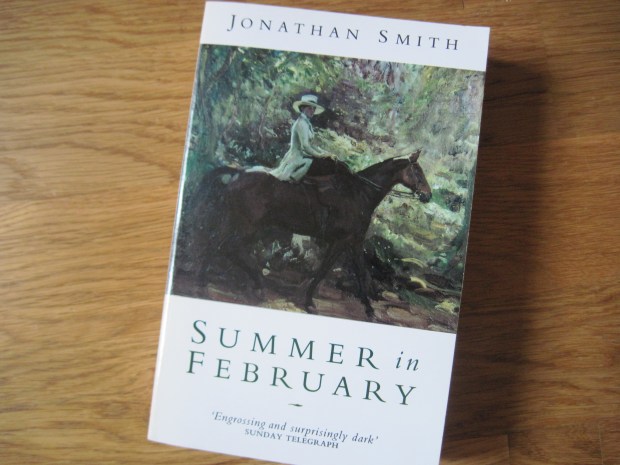
The cover image is the painting Morning Ride by A.J. Munnings.
For more information on Munnings, see here.
For more information on Gilbert Evans, see here. (Beware the spoilers!)
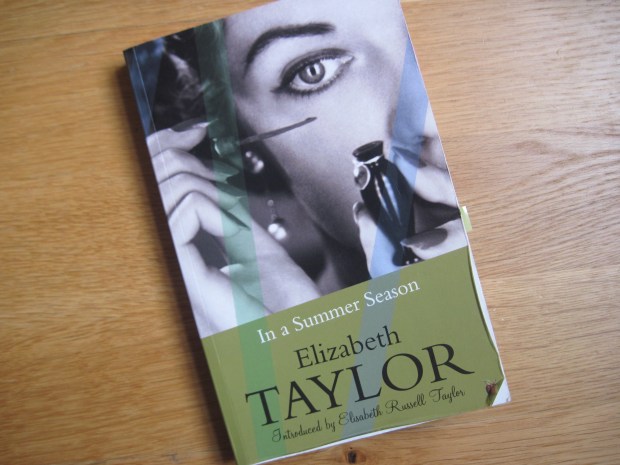
From 1961, In a Summer Season was Elizabeth Taylor’s eighth novel. The ensemble cast is led by Kate Heron – newly remarried to Dermot, a man ten years her junior, after the death of her first husband – and made up of her family circle, a few members of the local community, and her best friend Dorothea’s widower and daughter, who return from living abroad about halfway through the book. Set in the London commuter belt, this is full of seemingly minor domestic dilemmas that together will completely overturn staid life before the end.
From Kate dyeing her hair yet being keen to avoid accusations of “mutton dressed as lamb” to her son Tom’s disgust at his grandfather’s ageing body, old age and wasting one’s time on trivialities are a twin paranoia here. The title is not only a literal note of when much of the action takes place, but also a metaphor for the fleeting nature of happiness (as well as life itself). Kate remembers pleasant days spent with her best friend and their young children: “It was a long summer’s afternoon and it stood for all the others now. There had been many. And she and Dorothea were together day after day. Their friendship was as light and warming as the summer’s air.”
So much happens in the last seven pages. I wished the book could have turned out differently, yet the conclusion effectively sews it all up, and all within a cozy 220 pages. If you enjoy writers like Muriel Spark and Barbara Pym, you must try Elizabeth Taylor. Her work is similarly built around wry, perceptive observations about relationships and ways of life. This was my fourth novel by her, and I’d call it my second favorite so far after Mrs. Palfrey at the Claremont.
(Secondhand books are such good value: These two charity shop paperbacks cost me less than 85 pence in total. Such a low total spend per hour of enjoyment!)
This month I also read The Summer without Men by Siri Hustvedt (discussed here along with a few other recent reads). Earlier in the year I reviewed Ricarda Huch’s The Last Summer, and last year I reviewed the Summer anthology from the Wildlife Trusts. “Summer” turns up fairly frequently in titles of books I’ve read or want to read, in fact. Here’s the whole list!
Have you read any “Summer” books lately?
An Anthology of Summer Reading
In partnership with the UK’s Wildlife Trusts, London-based publisher Elliott & Thompson is celebrating the seasons with a series of anthologies edited by novelist and nature writer Melissa Harrison. My husband had a short piece published in the first volume (Spring), so I was eager to get my hands on a copy of Summer.
 The format in all the books is roughly the same: they’re composed of short pieces that range from one to a few pages and run the gamut from recurring phenological records (Gilbert White and Thomas Furly Forster) and extracts from classic literature (Adam Bede and Far from the Madding Crowd) to recent nature books (Mark Cocker’s Claxton and Paul Evans’s Field Notes from the Edge). In addition, there are new contributions from established writers or talented amateurs, one as young as twelve – heartening proof that young people are still enthused about nature.
With the exception of the poems, none of these entries have titles, and the attribution and date of composition are not given until the very end. The idea behind this pseudo-anonymity, I think, is that if – as I sometimes was – you are patient enough to not skip ahead to discover who wrote it when, you will judge all of the pieces by the same standards. You approach each without expectations, and in many cases may be stumped as to whether the writing is historical or modern. I found W.H. Hudson’s and Mary Webb’s extracts particularly readable, for instance; you wouldn’t guess they’re from the early decades of the twentieth century.
There are 70-some pieces here on a wide variety of subjects, but a few of the ones that struck me were on badger-watching (Caroline Greville, who is writing a memoir on the topic), looking for orchids (environmental journalist Michael McCarthy), moth trapping, and night-time wildlife like glow-worms and bats. I especially appreciated Alexandra Pearce’s essay on the brief life of mayflies and Nicola Chester’s on searching for owls. Of the previously published pieces, Paul Evans’s on ant swarms is a stand-out. My two favorites, though, are from celebrated nature columnist Simon Barnes, who writes about paddling a canoe in Norfolk with his son in search of adventure, and Esther Woolfson, who, as she does in her book Field Notes from a Hidden City, illuminates the unnoticed wildlife of Aberdeen.

Courtesy of Chris Foster
Again and again this message comes through: take the time to look closely and you will find great wonders. “Perhaps as adults our lives are so filled with bills, chores, jobs and other things that we often forget to stop and look at the world around us,” Jan Freedman, curator of natural history at Plymouth City Museum and Art Gallery, astutely notes. Whether it’s lichens or weevils, all you generally have to pay to experience nature’s delights is attention. I loved Alexi Francis’s description of a hare: “Haunches down, nose cross-stitched, it closes its eyes to the sun in a moment of blissful slumber.” Having that moment of communion with nature and then choosing just the right words to capture it is what this book is all about.
Taken together, these pieces truly give the feeling of an English summer. The older writing is remarkably undated, which contributes to a sense of continuity across the centuries. However, the book also evokes more universal notions of summer: those drowsy, leisurely days we gild with nostalgia. As Harrison puts it in her introduction, the longing for summer is really a wish to return to childhood: “Those elysian summers, polished to dazzling brightness by the flow of years, can never be recaptured; but we have this summer, however imperfect we as adults might deem it, and we can go out and seek it at every opportunity we find.”

Courtesy of Chris Foster
As the relatively frequent typos – three in the Barnes piece alone, for example – suggest, the series has been somewhat hastily put together. Nonetheless, these are really rather lovely books. Summer is a perfect bedside companion to dip into as the days warm up. Impossible not to covet the whole four-season set.
With thanks to Marianne Thorndahl at Elliott & Thompson for the free copy for review.
My rating: 
 Bookish Beck = Rebecca Foster. American transplant to England. Freelance proofreader and book reviewer.
 Bookish Beck