Late Summer Novels (Bamford, Ellis, Hornak, King) & Poetry Collections for the Transition into Autumn (Hurst, McNish, Plath)
It’s been feeling autumnal for a few weeks now with the drizzle, chilly mornings and evenings, honking of geese overhead, and harvesting our last garden apples – though it remains warm and summer only officially ended on Monday. I’ve recently finished off a summer-titled trilogy and the second entry in a seasonal quartet. I’m also throwing in a couple fun novels I bought earlier in the year.
Before and after Tuesday’s autumn equinox, a few poetry collections have been my fitting companions for the start of a new season.
Idle Grounds by Krystelle Bamford (2025)
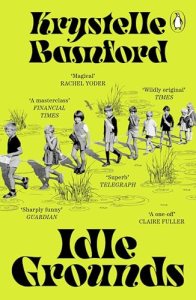 “The following is an account of an afternoon in June in which we sallied forth, and then, for the most part, back.” I was drawn in by the mock-heroic first-person plural voice of a gaggle of cousins at a New England family get-together. It’s 1989 and they’re here for one of the adults’ birthdays, but that’s of no concern to the kids, who are a world unto themselves. In the first chapter, three-year-old Abi goes missing and the rest set out on a quest to rescue her. The shed, the woods, a driveway full of cars, the river: every setting seems to offer adventure, but maybe also danger. And then the oldest boy cousin, Travis, vanishes too. “Intermezzo” chapters offer snippets of family lore – about their grandmother Beezy’s awful novel, The Lilac Swing, and so on – that don’t add much of interest to this meandering novella. To deliver on the promise of the narrative voice, Bamford needed to give her debut a little more: more intrigue, more pivotal scenes, more closeness to a few characters rather than surface descriptions of a bunch, maybe more pages to make something of the not-so-momentous family secrets. As it is, I had to agree with this tongue-in-cheek line on p. 136: “in our depleted state, we thought the very thought you’re thinking now, which is enough already.” (New purchase with voucher – Hungerford Bookshop)
Book 3 of The Summerhouse Trilogy
The Fly in the Ointment by Alice Thomas Ellis (1989)
{BEWARE SPOILERS!}
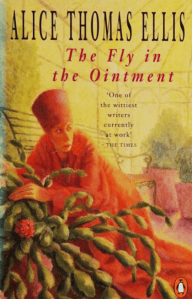 Following The Clothes in the Wardrobe (1987) and The Skeleton in the Cupboard (1988), this novella revisits the run-up to Margaret and Syl’s wedding from Lili’s perspective. It’s the shortest of the three books and adds no new plot details or real character insight, but Lili’s voice is alluring all the same. She’s an incorrigible flirt, or perhaps what we would now call a love (not necessarily sex) addict: “Sometimes I felt I would disappear if I couldn’t see the person opposite falling in love with me. I just wouldn’t be there.” Lili is pivotal to the narrative because of her well-meaning interventions: first, she falsely portrays the coming union as blessed by creating a fake (tissue paper) bloom for the cactus in the summerhouse; then, in agreement with other characters such as Mrs Monro that there shouldn’t be a wedding after all, she decides to sabotage it by ensuring that she and Syl be caught in flagrante in the summerhouse. While this was an interesting project for Ellis to undertake, the first volume was by far my favourite and I didn’t think the second and third wholly necessary. (Secondhand – Regent Books, Wantage)
So Good to See You by Francesca Hornak (2025)
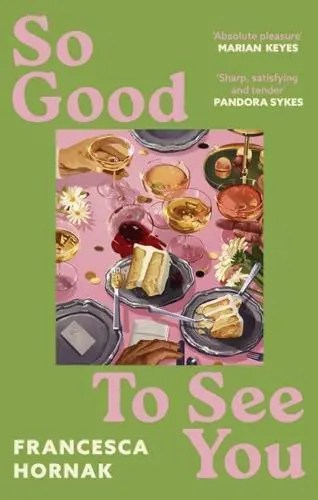 Daniel, Rosie and Serge were good friends at Oxford but since their graduation in 2004 they’ve drifted into indifference and resentment. Daniel is a Hollywood star but still can’t forgive filmmaker Serge for stealing his idea for a biopic of a working-class lad. Serge is on a break from his relationship with Isla, a younger movie makeup artist with whom he has twins. Rosie regrets that her on-again, off-again relationship with Serge meant she wasted prime years. In August 2019, they’re all brought together for Serge’s cousin Caspar’s big gay wedding in Provence. The Campbell cousins come from inherited wealth, but no one knows Serge’s production company is heavily in debt. As best man and “best woman,” Serge and Rosie have to write a joint speech; Daniel has to hide his dependency on alcohol and drugs.
This is a light, Taylor Jenkins Reid-esque soap opera that I swallowed in big gulps. I’d enjoyed Hornak’s Christmas-set debut, Seven Days of Us (2017), but when I looked back at it I realised how identikit the two are: set mostly over a matter of days, with each chapter marked by a precise place and time stamp. I guess she hit on a winning formula and decided to repeat it, but I was disappointed to notice the similarity. In this case, zooming in slows the action and makes the book feel overlong, though it’s perceptive about class, privilege, disappointment, the longing for parenthood, and loyalty among family and friends. (Her previous novel now seems almost prescient with its depiction of a Christmas in quarantine! Perhaps I’ll reread it.) (New purchase with voucher – Hungerford Bookshop) 
Apt Pupil by Stephen King (1982)
(Novella published in Different Seasons under the heading “Summer of Corruption”)
{BEWARE SPOILERS!}
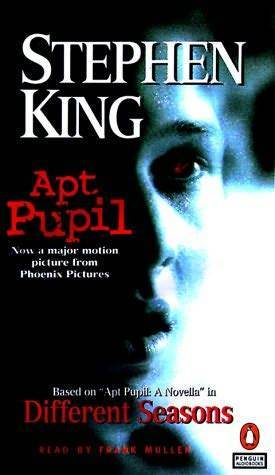 Thirteen-year-old Todd Bowden becomes obsessed with his elderly neighbour, whom he has identified as German concentration camp officer Kurt Dussander, in the summer of 1974. His parents think that he goes over to read to “Mr. Denker,” but in fact he’s extorting sordid war stories out of the old man. When Todd’s grades nosedive, Dussander agrees to impersonate his grandfather at a conference with the school counsellor so his parents remain oblivious. Now each has dirt on the other; blackmail goes both ways. The book suggests Dussander’s ongoing sadism sparks something inexorable in the young man, and both engage in further senseless carnage. I wasn’t sure if it was respectful of King to treat the Holocaust like a contagious sin. As Todd’s (real) grandfather says, “Sometimes the past don’t rest so easy. Why else do people study history?” I don’t think an editor would have let the story stand today. This is not as full-on horror as others I’ve read by King (Misery and Pet Sematary), but still gruesome and – for an animal lover like me – Dussander’s torture of cats and dogs was harder to read about than the murders of unhoused people. A neat connection back to Rita Hayworth and Shawshank Redemption, which I read back in the spring: Dussander mentions that “The banker who bought [the stocks] for me went to jail for murdering his wife a year” later in Maine. (Little Free Library)
Three on a Theme: Autumnal Poetry
Keats described autumn as the season of “mellow fruitfulness,” as I was reminded by Kate Mosse’s Autumn. Fruit and feminism are themes that link these three collections. All:
The Fox’s Wedding by Rebecca Hurst (2022)
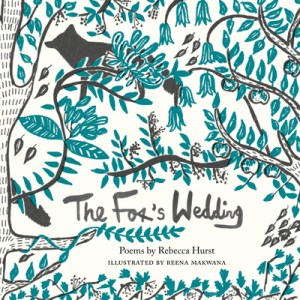 I’ve read Hurst’s debut full-length collection, The Iron Bridge, and jumped at the chance to catch up on her previous chapbook. Its hint of fairy tale menace feels appropriate for early spooky season. A witch turns into a hare and flees in “Familiar.” The girl who will win the hand of “The Frog Prince” spends her evenings “squashing worms and slugs and snails beneath / the crêpe soles of her black school shoes.” Needlecraft recurs: “Once there was a child/ who woke alone in the forest. … S/he took the path of needles / to ask needle-sharp questions.” There are folktale rhythms to “Brothers,” which also mentions gingerbread men. The woods morph with the advance of the year (“let the seasons pleat / folding one year to the next”) and hide creatures real and imagined. “Now it is Michaelmas: the land sun-warm, / fields shorn, blackberries ripe to bursting.” The atmosphere of this pamphlet – defiant, magical, mischievous – casts a spell. (New purchase from The Emma Press)
Plum by Hollie McNish (2017)
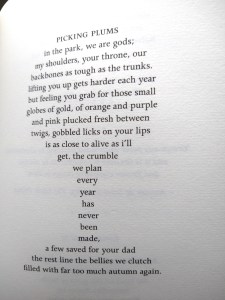
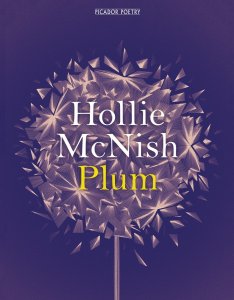 A late tree-shaped poem captures a treasured ritual with her daughter. But if I tell you that “plum” is also the last in a long string of euphemisms for female genitalia in “Voldemort,” that will give a better sense of McNish’s tone, which is often cheeky and snarky. She includes poems she wrote as a child and teenager but also remembers her adolescence from adulthood, pinpointing moments of peer pressure and misogyny that she experienced. She wishes she and her friends had been less obsessed with what boys thought of them and hopes to teach her daughter to stand firm in her own identity. McNish has local roots and is known for her conversational memoirs and her spoken word poetry. Like Harry Baker, Jay Bernard and Kae Tempest’s works, it’s probably not best encountered in print. In performance, fairly simple and repetitive phrasing can come to life. (Secondhand – Library book sale)
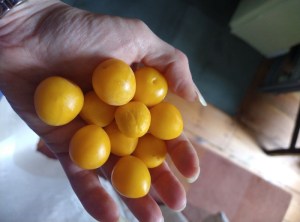
I spend the summer months watching like a hawk for when wild and waste-ground plums ripen and fall so I can scurry around gathering them to eat or freeze for autumn and winter desserts. Our cherry plum tree produced its first fruits this year, too (below).
Crossing the Water by Sylvia Plath (1971)
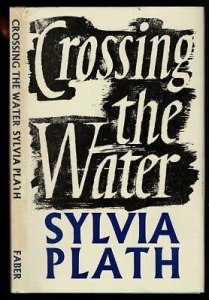 I got less out of this posthumous collection than I did from Ariel and Winter Trees, but there are still striking turns of phrase: “The future is a grey seagull / Tattling in its cat-voice of departure, departure” (from “A Life”) and “At our feet, the weed-moustachioed sea / Exhibits its glaucous silks” (from “Whitsun”). Canada, age, sleep, surgery: the imagery feels a little all over the place. The stand-out poems for me were “Small Hours,” in which marble statues metaphorically watch over the speaker’s troubled insomnia, and “Mirror,” which reflects the unstoppable advance of age and contrasts true self with appearances. Most redolent of autumn were a poem about pheasant hunting and “Blackberrying”:
Nobody in the lane, and nothing, nothing but blackberries,
Blackberries on either side, …
A blackberry alley, going down in hooks, and a sea
Somewhere at the end of it, heaving. Blackberries
Big as the ball of my thumb
The Devon lanes aren’t so empty these days, I can attest! A line from “Last Words” ties in perfectly and is a good resolution for us all: “I should sugar and preserve my days like fruit!” (University library)
I started my preserving late and will not do as much as I have in other years. So far I’ve made apple and tomato chutney and set some rosehip cordial steeping. This afternoon I’m going to attempt rosehip curd – we found a jar of “hagebutten” in a Berlin supermarket this time last year and it was so delicious that we’re going to try to recreate it, though it requires laborious deseeding and mincing plus two boiling stages. More Vitamin C than orange juice, apparently!
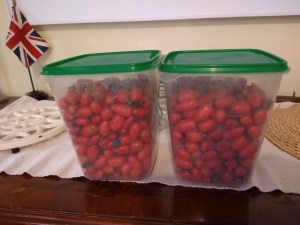
Rosehips ready for preserving!
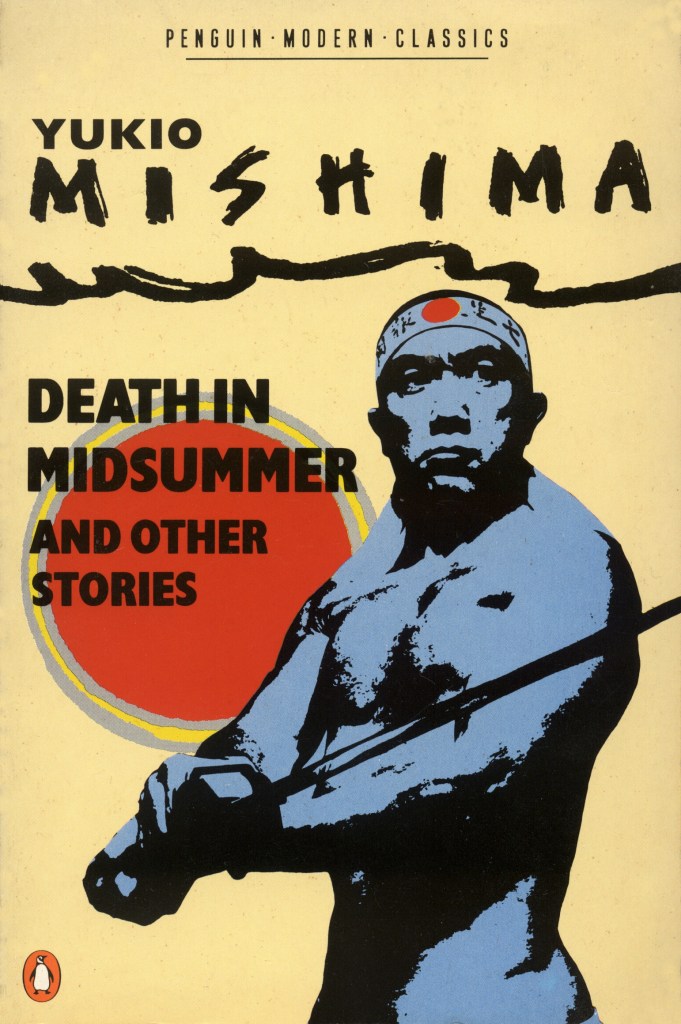
#ShortStorySeptember: “Death in Midsummer” by Yukio Mishima (1952; 1966)
Tomoko Ikuta is on a beach vacation with her three children and sister-in-law, Yasue, who is their de facto nanny and housekeeper. The trip soon turns nightmarish when three family members die in quick succession.
{BEWARE SPOILERS IN THE REMAINDER}
Tomoko is taking a well-deserved nap to escape the punishing sun. Yasue is an attentive babysitter who has already chased after the children and warned them about going any deeper. She’s barely looked away for a second when the six-year-old boy, Kiyoo, and five-year-old girl, Keiko, disappear. Yasue runs into the ocean to find them and is hit by a massive wave that seems to trigger a heart attack. In the ensuing chaos, the missing children are forgotten – even by Tomoko – until it’s far too late.
All of the above happens within the first six pages; the rest is aftermath. The idyllic setting introduced in the story’s first few paragraphs (the beach “unspoiled for sea bathing,” the hotel’s “beautiful” view, the placid image of the mother asleep) feels like mockery when set against the “ridiculous” and “excessive” tragedy that has befallen the family. The husband, Masaru, on the train from Tokyo to join his diminished kin, wishes he could “shout at the other passengers: ‘Listen, everybody. You don’t know it, but I have just lost my sister and two of my three children.” The season itself seems to have betrayed them: “If only summer would end. The very word ‘summer’ carried with it festering thoughts of death.”
Mishima’s vision is of fate as cruel and capricious. As the bereaved parents undertake the necessary funeral preparations, he explores the practicalities and the ironies of the situation:
A death is always a problem in administration. They were frantically busy administering.
Tomoko listened to the subdued humming of the autumn cicadas, and smelled the incense and the cool, shady grass. ‘What a nice place. They’ll have room to play, and they won’t be bored. I can’t help thinking it will be good for them. Strange, isn’t it?’
She’s found a perfect, peaceful spot for her children to spend eternity, since they’ll never get to grow up.
As time passes, the memory of the incident is less painful. What had been unbearable becomes simple reality. But then something curious happens. One family’s losses take on legendary status, transformed into a widespread cautionary tale:
Rather than an injury it became a moral lesson, and it changed from a concrete fact to a metaphor. It was no longer the property of the Ikuta family, it was public. … You have to watch children constantly when you take them to the beach. People drown where you would never think it possible. Not that Masaru and his wife had sacrificed two children and a sister to teach a lesson. The loss of the three had served no other purpose, however; and many a heroic death produces as little.
Yet Mishima also extends an opportunity for redemption when, two years later, the couple returns to the same beach with their remaining son, five-year-old Katsuo, and their new daughter, Momoko. It’s an act of faith and an acceptance that danger is always present and that no parent, however protective, can completely eliminate risk. By inscribing a full circle like that, Mishima emphasizes the severity of the loss but also somehow atones for it.
I found this story so powerful – emotionally charged but understated – that I’m surprised I’d not come across it before in my constant quest to find the best classic grief literature. At 29 pages, it feels just right; a note at the end mentions that it was abridged by translator Edward G. Seidensticker. I’ll be sure to try more by Mishima.
From Death in Midsummer and Other Stories (1966) (Secondhand – Better World Books)

Summer Reads, Part II: Ellis, Faulkner (Reread), Groskop, Ruskovich
Thankfully, since I last wrote about summer, we’ve had abundant rainfall – a cosy wet weekend after nearly two months of drought. Our pond is looking full again and our apple tree is perking up, but it will take much more to fill the country’s coffers. I’ve spent significantly less time outdoors than usual this summer, taking refuge indoors from the unremitting heat and sun. Luckily, there have been plenty of books to keep me company.
Book 2 of The Summerhouse Trilogy
The Skeleton in the Cupboard by Alice Thomas Ellis (1988)
Summer was a dull season. In spring things were growing; in autumn they were harvested; in winter they were waiting. Summer was pointless, designed for idleness. An inbred Yorkshire Puritanism led me to despise it.
{SPOILERS IN THIS ONE}
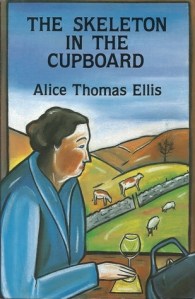 After The Clothes in the Wardrobe (1987), this novella felt conventional and superfluous. Repeating the run-up to Margaret and Syl’s wedding from the perspective of Margaret’s mother-in-law-to-be, Mrs Monro, is only worthwhile in that it allows for two key revelations: one, that Margaret was molested by her father, which goes some way toward explaining her flat affect and inability to love Syl; and two, that Lili also slept with Syl’s father in the summerhouse, long before she bedded Syl himself there on the morning of the wedding. Otherwise, this is a collection of sad and somewhat clichéd meditations on the loneliness of alcoholism-prone older age and widowhood. Provided it doesn’t simply reproduce stereotypes of the seductress, I’m hoping the third volume, from Lili’s perspective, will end up being the most interesting; the middle book of a trilogy always kinda sucks, right? I’ll read Book 3 for one last seasonal instalment before the autumn equinox. (Secondhand – Regent Books, Wantage)
Light in August by William Faulkner (1932)
Memory believes before knowing remembers.
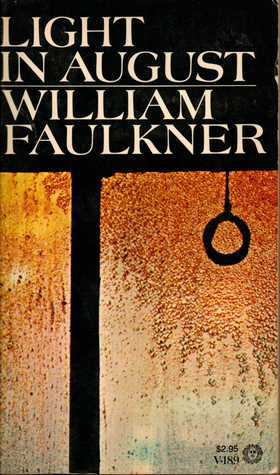 In my second year as a college English major, I took a senior elective on Faulkner & Morrison. Ever since, I’ve remembered this and Song of Solomon as my favourite from each author – the books I’d read again even without them being assigned. For several of the last few Augusts I’ve meant to pick this up, but when I finally did I found Faulkner’s style oppressive and only succeeded in a quick skim. The one thing I’d remembered beforehand is that there is a mixed-race character named Joe Christmas. But the first character we’re introduced to is the indomitable Lena Grove, who’s heavily pregnant and has hitchhiked from Alabama to Mississippi to find her baby daddy. She still believes he’ll do right by her and their child, but the fact that he’s living under an assumed name is our clue that he has no intention of taking responsibility. The plot is set in motion by a misunderstanding: she’s looking for Lucas Burch, but others know there’s a Byron Bunch nearby, and he takes a shine to Lena.
Meanwhile, Burch is going by Joe Brown and rooming with the sadistic Joe Christmas, who gets caught up in bootlegging and murder and goes on the run. The language about his “black blood” driving him to do things, and what happens to him, is awful, but true to its time as well as to Faulkner’s vision of tragic inevitability. I only got the bare bones from a skim, but did love how the novel feels epic yet only spans about a month; it completes a full circle as Lena and her baby move on again, this time to Tennessee. I also liked the neologism in the description of a town’s “garland of Augusttremulous lights.” All told, I’m unlikely to read Faulkner again; he’s like a darker version of Steinbeck, who I’d recommend instead. (Secondhand – Wonder Book and Video)
My original rating: 
My rating now:
One Ukrainian Summer: A memoir about falling in love and coming of age in the former USSR by Viv Groskop (2024)
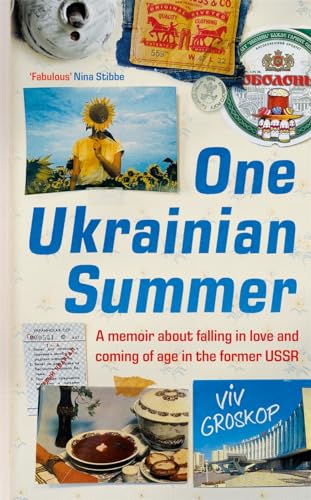 As part of her Russian degree course at Cambridge, Groskop spent a year abroad in St Petersburg, where she also conducted English lessons for adults. She arrived in September 1993 and the next month, in a nightclub, met Bogdan Bogdanovich (“God’s Gift, Son of God’s Gift”), a young man whose rock band called itself “Ukraine answer to Red Hot Chili Pepper.” She would be the solitary groupie on their tour the following summer, but first she had to get through a freezing winter of too much alcohol, too many cigarettes, and turbulent living situations. Her pen portraits of friends and acquaintances are quite amusing. There’s an appealing blend of self-deprecation and nostalgia to her outlook: “I was a clueless, lovesick, pedantic linguist. But I held the future of Ukrainian rock ’n’ roll in my hands.” I never got a particular sense of any of the cities she visits, but the long train ride from Moscow to Kiev is evocative. Each chapter is headed by a vocabulary word, given in Russian and then in the (very similar) Ukrainian. There are lots of Slavic phrases in the text, too, rendered in Roman script. I enjoyed reading them to myself in my head, but none of them has stuck. Let’s see if I can commit this one to memory: “Babine leto” (Ukr.) = “grandmother’s summer,” the equivalent of an Indian summer. Kudos to Groskop and her agents, all of whom donated their proceeds/fees to PEN International, which supports writers at risk. (Public library)
Nightjar: Stories by Emily Ruskovich (2026)
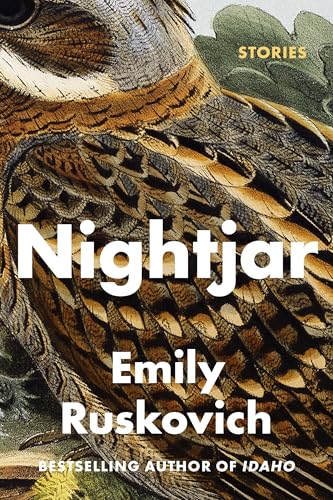 I abandoned Ruskovich’s 2018 debut novel, Idaho, early on, but will absolutely go back to it now because these stories are phenomenal. There are only five, so they tread the border between short story and novella at ~50 pages each and reminded me in their intricacy and depth of short fiction by Lauren Groff and Alice Munro. All are set in the American West and circle themes of loss and remembrance, and they often feature animals prominently. “Victor’s Room” sees a young wife become obsessed with exposing her husband’s false memory of the Oregon house where his brother died in childhood. In “Owl,” the only first-person, historical story, the narrator’s wife is accidentally shot by boys who mistake her for an owl in the night; as she convalesces, her old life lures her back. “Round Lake,” probably my favourite, finds violinist Jade adrift in Tokyo, where she agreed to meet a love interest. There’s water in her ears from an Idaho lake, which she only learned after her swim was where her mother drowned. “Petty Creek Road,” about middle-aged brothers, introduces a subtle note of magic realism (through Will’s premonitions of danger) that is echoed in the final, title story in the tangible reflections that Tess finds each morning in a bucket of water. Jade keeps orphaned hedgehogs, Jane feeds stray cats in “Owl,” and Tess communes with a goat named Panic Boy. The writing and character development are extraordinary, and the question of how memories become stories, or take on physical weight, truly resonated with me.
I’ve included this in my summer round-up because, for me, nightjars are synonymous with warm evenings on Newtown Common, where we go once a year to catch up with nightjars (not the same species as Tess encounters in Montana). This small scrubby nature reserve never fails to turn up several nightjars: unearthly with their gaping mouths, alternating churring and yipping, and jerky flaps against the gathering dusk. We made our annual pilgrimage on 15 July and it didn’t disappoint. (Edelweiss) 
I have a few more summery reads lined up to take me through what I sincerely hope is this season’s last gasp. I’m looking forward to getting out my corduroy coat, wearing hoodies and lap blankets around the house, and eating autumnal goodies based around squash and apples.
Summer Reads, Part I: Buti, Ellis, C. Foster (Reread), Itami, Thomson
The less said about the summer of 2026, the better. It feels like the heat wave will never end. We’ve had 4 mm of rain the whole month. Drought imperils so much. But it’s not right to complain when wildfires rage not so far away. One glance at the news headlines and there’s no avoiding the signs of climate breakdown everywhere. I can’t bear it. I just keep reading.
Year of the Drought by Roland Buti (2015; 2017)
[Translated from French by Charlotte Mandell]
How exhausting was that summer of 1976, always beating down on our heads!
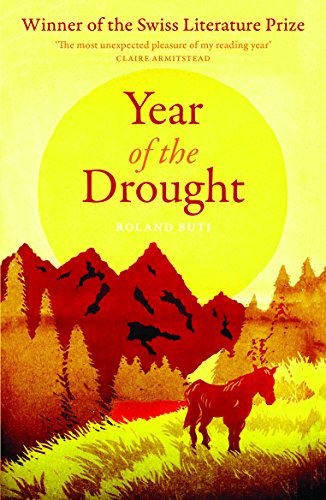 This Swiss novella takes place during the infamous European heat wave that people still talk about half a century later. It’s a perfect febrile setting for 13-year-old Gus’s coming-of-age, which includes a sexual awakening and the dawning realisation that his parents aren’t perfect; that in fact his family is falling apart. The Sutters’ operations embody the move from family smallholding to an industrial model. They keep a small number of cattle but are also experimenting with large-scale henhouses holding thousands of birds. In contrast with that vast flock, about whose welfare the characters seem indifferent, is an injured white dove that Gus finds and keeps as a pet. (A wise choice by Buti: it’s easier to feel compassion for an individual, such as the dove or the old farm horse, Bagatelle, than for a faceless mass.) Helping Gus and his father on the farm is distant cousin Rudy, who has Down’s syndrome; disrupting their routines is Cécile, Gus’s mother’s friend, who has come to stay with them.
Because of the drought, our minds were full of dreams of coolness and moisture
Dreams of rain, dreams of love, dreams of preserving some mythical family happiness that maybe never existed. Like the weather, everything goes wrong – in tragic ways. It’s all so awful I recoiled. Buti jumps ahead several decades to offer a longer view of the land, but I couldn’t ignore how casually the teenage Gus adopted his father’s violent, misogynistic ways. None of what happens bodes well for the future. The one laugh I got out of the experience was the charity shop accidentally labelling the book “Romance fiction.” (Secondhand – BHF, Newbury)
Book 1 of The Summerhouse Trilogy
The Clothes in the Wardrobe by Alice Thomas Ellis (1987)
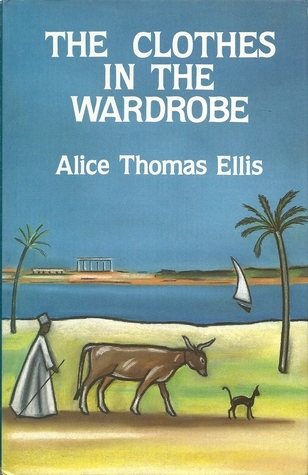 I hadn’t had great luck with Ellis, fiction and nonfiction, before, but I’m so glad I was tempted by this omnibus edition and tried her again. This melancholy, introspective novella was right up my street. Margaret’s yearning for her Egyptian upbringing isn’t the only reason I reached for Moon Tiger as a readalike; Ellis’s tone reminded me of Barbara Comyns and Penelope Lively for its mix of cynicism and nostalgia. Margaret is soon to marry Sylvester, though she doesn’t love him at all and he’s closer to her mother’s age as well as a known womanizer. Perhaps the engagement was her mother’s idea more than her own? The title is an apt symbol for living to someone else’s expectations: “my life fitted me as ill as a garment designed for somebody else,” Margaret thinks. It’s no coincidence that she’s to be married in her mother’s old wedding dress. There are also sartorial metaphors around memory (“Did the elderly have minds like old wardrobes stuffed to overflowing…”) and resistance to ageing. I marked out so many shrewd observations and witty conversations. I empathized with Margaret’s feeling of being trapped in a life she hasn’t chosen.
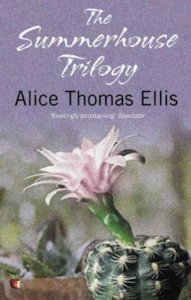 It seems like one of those books where nothing will happen, but there’s actually a surprise ending that looks set to move Margaret onto a different track. As I understand it, the other two volumes repeat the weeks leading up to the wedding from other perspectives: Margaret’s staid mother-in-law-to-be; and her mother’s bohemian friend Lili, who was her bridesmaid back in Egypt and arrives in time to shake things up. I love that premise. The omnibus cover seems random, but the question of whether the cactus in the summerhouse will flower as good luck for the wedding becomes an important plot point. I’ll jump right into Book 2. (Secondhand – Regent Books, Wantage)
The Screaming Sky by Charles Foster (2021)
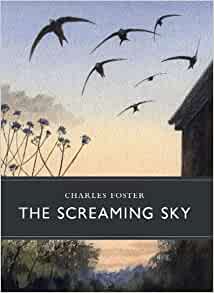 The only thing that has redeemed these dry, scorching days is the swifts screeching across the sky. How can it be that I was once unaware of them? How is it possible for people not to look up for these noisy acrobats whenever they’re outdoors? Somehow, I was oblivious until maybe 10–15 years ago. Now, I always have at least one eye on the sky during these crucial few months. And although this year swifts have been with me since early April (first in Portugal and then in our neighbourhood), I’m already dreading their departure for Africa in a few weeks. They’re still here! I trill to myself each morning. But soon that won’t be true. And with populations in freefall, there may come a day when they don’t return to the UK at all.
Charles Foster is a kindred spirit who sets similar emotional store by the presence or absence of the common swift (Apus apus). I appreciated this when I first read it five years ago (my review), but all the more so now. The monograph takes us through one year with swifts. In the summer, he needs travel no further than his own street in Oxford, but the rest of the time he has to chase them down in continental Europe and central and southern Africa. It’s an old-fashioned quest, a romantic pursuit, a hopeless attempt to keep hold of creatures as fast and elusive as the wind. Foster salts his narrative with all the salient facts but acknowledges that, for all we claim to know about them, these birds retain an essential magic and mystery. “Their power, freedom and joy are the way that everything really is – though we don’t usually see it. It is just that when the swifts scream through the sky, you can’t miss it. That’s how everything, all the time, is meant to be.” (Review copy from Little Toller Books)
My original rating:
My rating now: 
Bonus content:
From Robert Macfarlane’s The Book of Birds (illus. Jackie Morris):
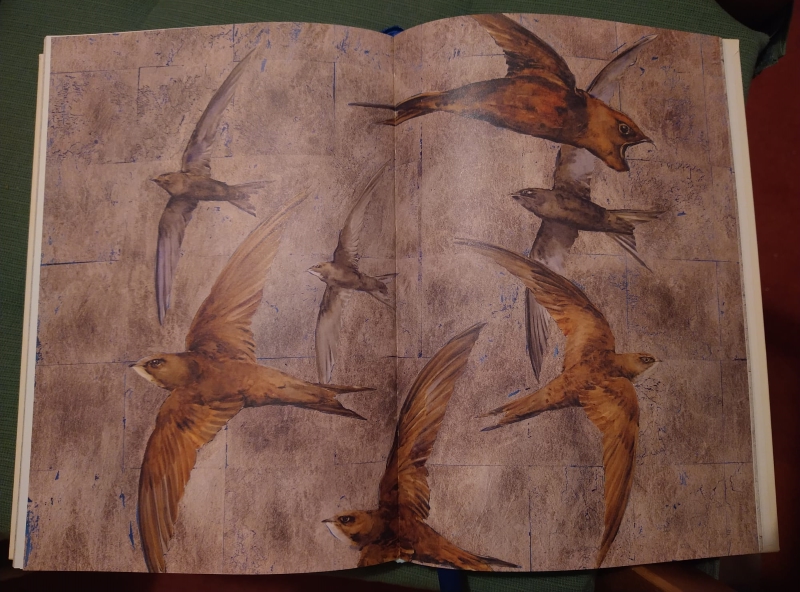
From the Spell Songs album Let the Light In: “Swifts”
& My current earworm, also featuring Kris Drever: a more general reassurance – or at least philosophical acceptance – that change is the one constant in life, in perfect pop song form (“Change”)
And from Ugandan poet Nick Makoha’s The New Carthaginians: “in the first part of the night, I saw the coastal villages, men arguing / about the price of oil and swifts darting into shadows.” (from “Codex© of Birds”)
Kakigori Summer by Emily Itami (2025)
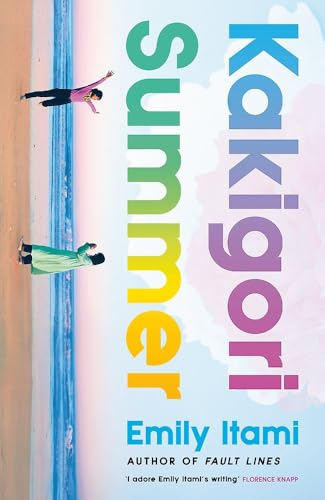 Itami was shortlisted for a Costa Award for her enjoyable 2021 debut, Fault Lines. Kakigori is a flavoured shaved-ice dessert and it’s a great choice of title for this bittersweet – but mostly sweet – story of three sisters raised between Tokyo and London who reunite in Japan to spend a summer together with their prickly great-grandmother, Obaachan, who’s nearing 100. Narration alternates between Rei, the oldest, who has a high-flying finance job and keeps everyone in line; Kiki, who’s a single mother and works in a care home for the elderly; and Ai, a flighty pop star now in disgrace for her affair with a married man. Although there is much joy in their banter, little Hikaru’s antics, and the pursuit of the finest culinary treats, a shadow over it all is their mother’s unexplained death. She went for a swim one day when they were girls and never came back, nor was a body ever found; they have to suspect suicide. (“Well, that’s that, then. Nothing will be all right ever again.”) This easy-reading novel affirms the goodness of life despite the reality of death. Its typically Japanese feasts and funerary rites brought to mind Bryan Washington’s similarly well-balanced Memorial. My only note would be that I’m not sure the voices were distinctive enough to warrant three first-person narrators; third person rotating would probably have done the job. (Public library)
Saltwater: A Midsummer Ghost Story by Elaine Thomson (2026)
“The dead are closer than we think.”
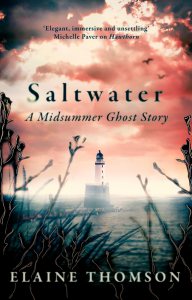 I hadn’t heard of the Scottish island of Stroma, so assumed it was made up. In fact, it’s real, lying between Orkney and the north coast of Caithness on mainland Scotland, but uninhabited as of 1962. Tom Torrance travels by train and boat from Edinburgh a few days before midsummer to oversee the last steps in the construction of the island’s lighthouse and meet with Mr Stevenson (of the famous lighthouse-building clan, which included novelist Robert Louis Stevenson). With him is his brother Jamie; he’s not of much practical help, but they cling to each other because they lost their mother to tuberculosis a week ago. The travelling minister Tom meets on the train gives him a rowan-wood amulet and cautions him that midsummer is a liminal time when the spirit world is close at hand. Tom doesn’t heed the warning. He arrives to find a disaster-prone construction project that has entailed serious injuries and broken machinery. Flora Christie and her grandmother, Thrawn Jean, are local women with healing powers who are treated with suspicion: women, especially those with red hair, are considered bad luck around boats. The men want to seal a “witch bottle” into the wall for good luck. He dismisses their superstitions but at the same time keeps seeing hallucinations of the dead in the waves and on the in-construction edifice. Is it grief, Flora’s special whisky, or a real taste of the supernatural?
This was highly reminiscent of Michelle Paver’s work. The typical Victorian-pastiche ghost story bores me because it’s always just the same: the narrator is a dignified gentleman who can’t possibly be seeing such things, yet documents them and his own horror with great precision. Thomson set herself an interesting challenge, writing a quartet of Scottish ghost stories set at turning points of the year. (This is the second, after Hawthorn.) I probably won’t try the others unless my library acquires them. (Public library)
20 Books of Summer, 4–7: Fadiman; Kingsolver & O’Farrell Rereads; Sullivan
I finished several of these a while ago now, but it’s been a struggle to summon up the motivation to write about them, especially during the heat wave we’re currently experiencing in the southern half of England. You’ve heard a lot from me recently as I’ve been catching up on reviews, so I’ll try to keep these responses to one (long) paragraph each.
Frog and Other Essays by Anne Fadiman (2026)
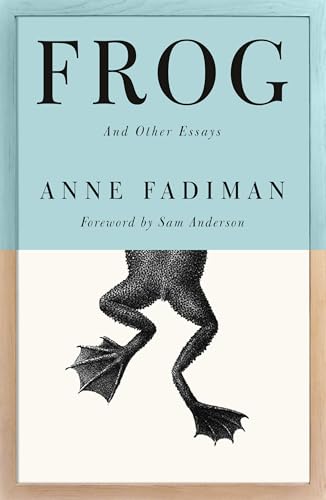 This was one of my Most Anticipated titles of the year because I’ve loved Fadiman’s nonfiction, especially the bookish Ex Libris, which I’ve read twice. Her essays are warm and fluent, braiding memoir and observation in a natural way and drawing readers in whether they share her particular preoccupations or not. “Frog” is about her guilt for not being more attentive to her children’s surprisingly long-lived pet frog, Bunky; “South Polar Times” recounts her obsession with polar exploration and what she discovered in the archives of the magazine Shackleton produced in the 1910s. At the centre of the book is a triptych on modern technology (“My Old Printer”) and language use, especially as she’s experienced it as a Yale professor trying to adjust to pandemic-era teaching (“Screen Share”) and expanded gender possibilities (“All My Pronouns,” which is mostly about getting used to “they” as a singular pronoun for nonbinary individuals). What a relief that advancing age and pedantry didn’t see her joining the anti-woke camp. The final essay, “Yes to Everything,” was – I think – the afterword to her late student Marina Keegan’s The Opposite of Loneliness (2014). For me the highlight was “The Oakling and the Oak,” about Samuel Taylor Coleridge’s disappointing son (“A penumbra of impossible expectation began to settle around Hartley’s head”). There’s a tantalizing parallel here with her own sense of needing to live up to her literary father, Clifton Fadiman, that I wish she’d explored further. So: good stuff here, but only seven essays, all of which were originally published elsewhere. It feels like scraping the barrel. And why the laudatory foreword by someone I’ve never heard of (Sam Anderson)? I ordered this while in the States to get to a free-shipping limit and I’m glad I got the chance to read it, but it’s not a must. Do seek out “Frog” and “Oak,” though. (New purchase – Target.com)
Prodigal Summer by Barbara Kingsolver (2000)
In all her life Lusa had never seen such an oversexed, muggy summer. Just breathing was a torrid proposition.
 Although I remembered this as being in Kingsolver’s top tier of novels, I recalled no details beyond a female ranger who lives in the woods, has an affair with a hunter, and studies coyotes (actually, I thought it was wolves – I was conflating Deanna’s surname, Wolfe, and Sarah Hall’s The Wolf Border, which has a similar setup). I’d forgotten that there are two other strands: Lusa, a Polish-Palestinian entomologist widowed young, inherits her husband’s family farm and tries to make a go of goat breeding despite others’ disapproval; and Garnett, a pious old man trying to resurrect the American chestnut after it was wiped out by blight, has an ongoing low-key feud with his organic orchard-keeping neighbour, Nannie. These threads rotate under the headings “Predators,” “Moth Love,” and “Old Chestnuts.” There are pleasing connections between the main characters, who are also thematically linked by ideological disagreements and the possibility of new life and romance when age or circumstances seemed to disqualify them. Kingsolver writes brilliantly about science, and although she gets a little preachy through Nannie, in a way that presages Unsheltered (“It’s glory, to be part of a bigger something. The glory of an evolving world”), her environmentalist messages are always right on. It’s depressing to note that, more than a quarter-century later, the issues she raises related to food production and pesticide use are worse rather than better. Like Margaret Atwood, she’s a literary prophet of our time. I’m nearly halfway through her upcoming novel, Partita, for a Shelf Awareness review and its protagonist, Livia, seems to be in the lineage of Deanna – an Appalachian girl who tries to exceed her origins. This was a big ol’ satisfying summer read. Whyever didn’t Kingsolver win the Women’s Prize for this one? (Little Free Library)
My original rating: 
My rating now:
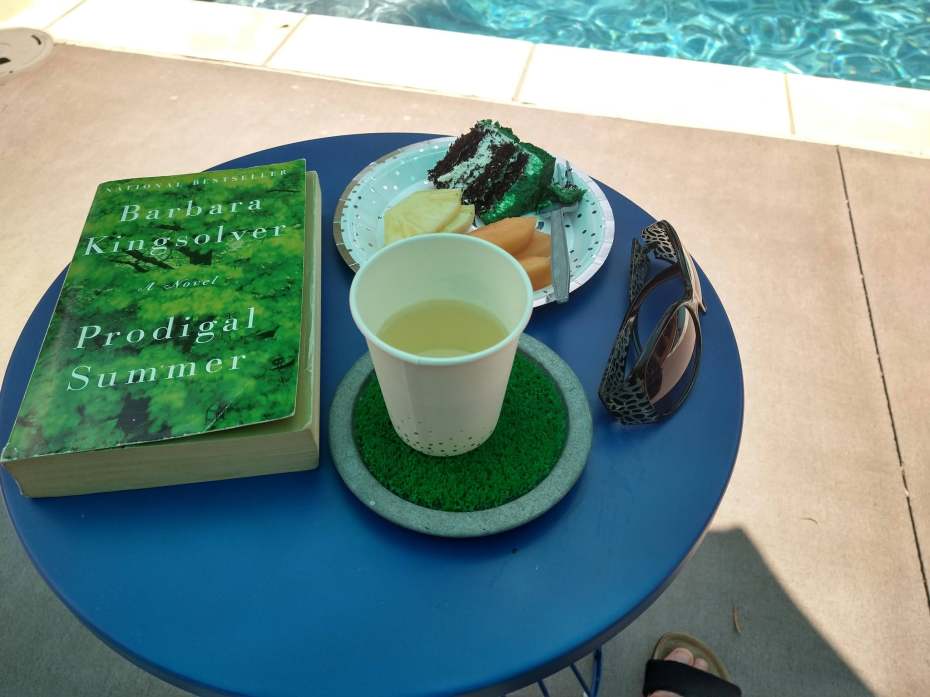
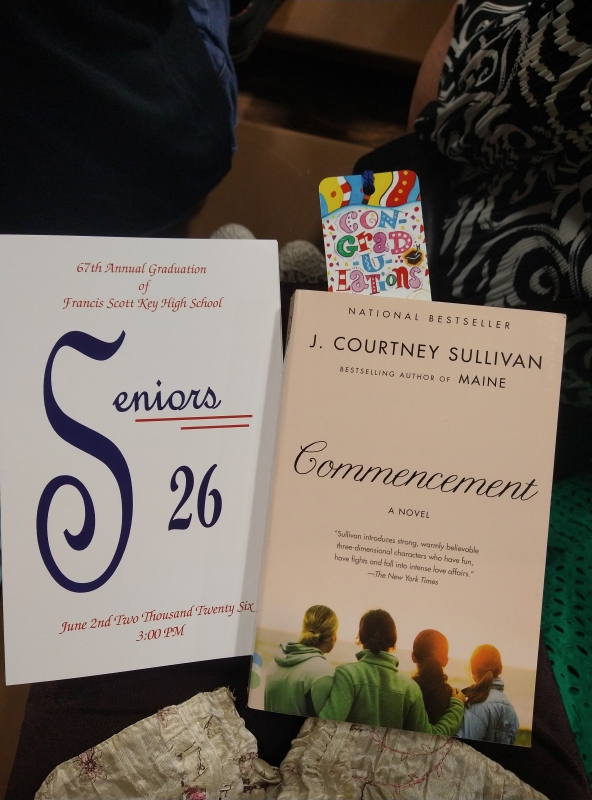
Poolside reading at my nephew’s graduation party.
The Vanishing Act of Esme Lennox by Maggie O’Farrell (2006)
Nothing is our own. We begin in the world as anagrams of our antecedents.
 Another reread. I remembered the mental hospital element but think I may have otherwise had this confused with Sebastian Barry’s The Secret Scripture, which also features historical family secrets and a great big twist. This was our book club selection for June, and although I missed the meeting (which was also our summer social) while I was back visiting my family, I wanted to catch up by reading it again – especially after it earned a perfect score from the rest of the group! In the novel’s present day, vintage clothing store owner Iris is having an affair with a married man and learns that she has a ‘mad’ great-aunt who will soon be her responsibility when the hospital Esme has called home for 60 years closes. Why did Iris’s grandmother, Kitty, hide that she had a sister? With Kitty on a dementia ward, she can’t ask outright. Instead, narration alternates between the sisters’ growing-up years in India and Edinburgh – where flighty, rebellious Esme caught boys’ eyes while obedient Kitty didn’t – and Iris and Esme embarking on a tentative relationship. The use of the present tense for both, as well as the fragments of memory we gradually work out are Kitty’s, create a continuous narrative so gripping that I could easily have consumed it in one sitting had I not had other commitments. Grief, parenting, male privilege, family legacies, and a freedom of spirit that might today be branded neurodivergence are strong elements. It’s appalling how women have been punished for breaking the rules, but the other ensuing betrayals are just as shocking. This must have one of THE best surprise endings out there. I can’t believe I’d forgotten the details. After a couple of lacklustre early novels, O’Farrell’s career truly took off with this one. Now to reread her other gems. (Borrowed from a book club friend)
My original rating:
My rating now: 
Commencement by J. Courtney Sullivan (2009)
Smith had left its mark on her, so that the place would always feel like home
 I’ve had a mixed experience with Sullivan’s novels, but this debut was a delight. Let’s start with the clever title: An American graduation ceremony is called “commencement,” so it marks both an ending and a beginning. For four friends who meet at Smith College, a women-only institution, in the late 1990s, their student experiences have effects that carry on into their ‘real’ lives afterwards. We watch how their relationships with each other, and with family members and partners, shift over the course of nearly a decade. Sally arrives on campus bereft from the death of her mother, but she doesn’t let her sadness corrode her ambition or her kind heart. Bree is engaged to a man when she comes up from Savannah but leaves in a committed relationship with a woman. April was raised by a single mother and has always been a strident feminist, but graduates with plans to go to extremes in drawing attention to the plight of sex workers. The framing story of the friends gathering for Sally’s wedding introduces us first to Celia, who is in some sense still living the student life in the small New York City apartment she brings one-night stands back to after drunken evenings. The wedding ends up in a huge fight between the four, and as the years pass they split off into pairs and trios of loyalty before a crisis brings them back together. It’s a little far-fetched how this all plays out, but I was invested enough in all four characters that I was happy to go along with it. Sullivan went to Smith (I also attended what was a women’s college at the time, Hood), so you have to wonder if anything was autobiographical for her. She weaves in various women’s issues, such as sexual assault and decisions about career and motherhood. I applaud Sullivan for mentioning support for trans men on campus, though her discussion does seem of its time and today I think the debate would be more around allowing trans women to attend. I chose this to read because my recent USA trip was for my nephew’s high school graduation. It’s perfect for Curtis Sittenfeld fans. (Secondhand purchase – 2nd & Charles)
Summer Reading 2025: Anthony, Espach, Han & Teir
In the UK, summer doesn’t officially end until the 22nd, so even though I’ve been doing plenty of baking with apples and plums and we’ve had squashes delivered in our vegetable box, I’ve taken advantage of that extra time to finish a couple more summery books. This year I’m featuring four novels ranging in location from Rhode Island to Finland. I’ve got all the trappings of summer: a swimming pool, a wedding, a beach retreat, and a summer house.
The Most by Jessica Anthony (2024)
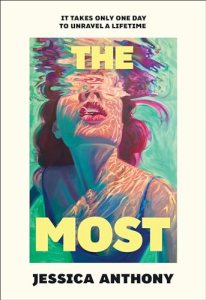 I can’t resist a circadian narrative. This novella takes place in Delaware on one day in early November 1957, but flashbacks and close third-person narration reveal everything we need to know about Virgil and Kathleen Beckett and their marriage. I’m including it in my summer reading because it’s set on an unseasonably warm Sunday and Kathleen decides to spend the entire day in their apartment complex’s pool. The mother of two drifts back in memory to her college tennis-playing days and her first great love, Billy Blasko, a Czech tennis coach who created a signature move called “The Most,” which means “bridge” in his language – the idea is to trap your opponent and then drop a bomb on them. Virgil, who after taking their two boys to church goes golfing with his insurance sales colleagues as is expected of him, loves jazz music and has just been sent the secret gift of a saxophone. Both spouses are harbouring secrets and, as Laika orbits the Earth overhead, they wonder if they can break free from the capsules they’ve built around their hearts and salvage their relationship. The storytelling is tight even as the book loops around the same events from the two perspectives. This was really well done, and a big step up from Enter the Aardvark. (Public library)
The Wedding People by Alison Espach (2024)
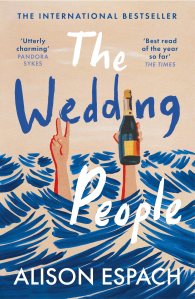 You’ve all heard about this one, right? It’s been a Read with Jenna selection and the holds are stacking up in my library system. No wonder it’s been hailed as a perfect summer read: it’s full of sparkling banter; heartwarming, very funny and quite sexy. And that despite a grim opening situation: Phoebe flies from St. Louis to Newport and checks into a luxury hotel, intending to kill herself. She’s an adjunct professor whose husband left her for their colleague after their IVF attempts failed, and she feels she’ll never finish writing her book, become a mother or find true love again. Little does she know that a Bridezilla type named Lila who’s spent $1 million of her inheritance on a week-long wedding extravaganza (culminating in a ceremony at The Breakers mansion) meant to book out the entire hotel. Phoebe somehow snagged the room with the best view. Lila isn’t about to let anyone ruin her wedding.
What follows is Cinderella-like yet takes into account the realities of bereavement, infidelity, infertility and blended families. Because of the one-week format, Phoebe’s depression is defused more quickly than is plausible, but I was relieved that Espach doesn’t plump for a full-blown happy ending. I did also find the novel unnecessarily crass in places, especially the gag about the car. Still, this has all the wit of Katherine Heiny and Curtis Sittenfeld. I’d recommend it if you enjoyed Dream State or Consider Yourself Kissed, and it’s especially reminiscent of Sorrow and Bliss for the mixture of humour and frank consideration of mental health. It’s as easy to relate to Phoebe’s feelings (“How much of her life had she spent in this moment, waiting for someone else to decide something conclusive about her?”; “It is so much easier to sit in things and wait for someone to save us”) as it is to laugh at the one-liners. “Garys are not wonderful. That’s just not what they are meant to be” particularly tickled me because I know a few Garys in real life. (Public library)
The Summer I Turned Pretty by Jenny Han (2008)
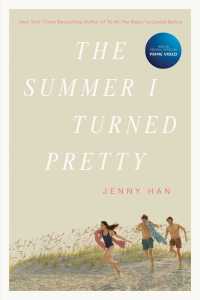 Every summer Belly and her mother and brother have joined her mother’s best friend Susannah and her sons Conrad and Jeremiah at their beach house. She’s had a crush on Conrad for what’s felt like forever, but she’s only ever been his surrogate little sister, fun for palling around with but never taken seriously. This summer is different, though: Belly is turning 16, it’s Conrad’s last summer before college, and his family seems to be falling apart. The novel kept being requested off me and I puzzled over how it could have eight reservations on it until I realized there’s an Amazon Prime Video adaptation now in its third and final season. I reckon the story will work better on screen because Belly’s narration was the main issue for me. She’s ever so shallow, so caught up in boys that she doesn’t realize Susannah is sick again. Her fixation on the brooding Conrad doesn’t make sense when she could have affable Jeremiah or sweet, geeky Cam, who met her through Latin club and liked her before she grew big boobs. He’s who she’s supposed to be with in this kind of story, right? I think this would appeal to younger, boy-crazy teens, but it just made me feel old and grumpy. (Public library)
The Summer House by Philip Teir (2017; 2018)
[Translated from Swedish by Tiina Nunnally]
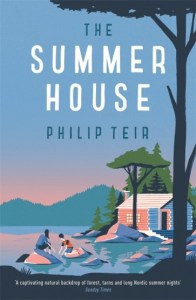 The characters are Finland-Swedish, like the author. Erik and Julia escape Helsinki with their children, Alice and Anton, to spend time at her father’s summer house. Erik has just lost his job in IT for a large department store, but hasn’t told Julia yet. Julia is working on a novel, but distracted by the fact that her childhood friend Marika, the not so secret inspiration for a character in her previous novel, is at another vacation home nearby with Chris, her Scottish partner. These two and their hangers-on have a sort of commune based around free love and extreme environmental realism: the climate crisis will not be solved (“accepting the grief instead of talking about hope all the time”) and the only thing to do is participate in de-civilisation. But like many a cult leader, Chris courts young female attention and isn’t the best role model. Both couples are strained to breaking point.
Meanwhile, Chris and Marika’s son, Leo, has been sneaking off with Alice; and Erik’s brother Anders shows up and starts seeing the widowed therapist neighbour. This was a reasonably likeable book about how we respond to crises personal and global, and how we react to our friends’ successes and problems – Erik is jealous of his college buddy’s superior performance in a tech company. But I thought it was a little aimless, especially in its subplots, and it suffered in comparison with Leave the World Behind, which has quite a similar setup but a more intriguing cosmic/dystopian direction. (Secondhand – Community Furniture Project, Newbury)
Any final summer books for you this year?
#WITMonth, II: Bélem, Blažević, Enríquez, Lebda, Pacheco and Yu (#17 of 20 Books)
Catching up with my Women in Translation month coverage, which concluded (after Part I, here) with five more short novels ranging from historical realism to animal-oriented allegory, plus a travel book.
The Rarest Fruit, or The Life of Edmond Albius by Gaëlle Bélem (2023; 2025)
[Translated from French by Hildegarde Serle]
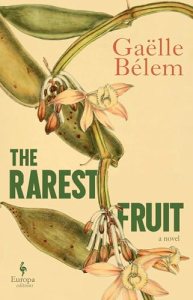 A fictionalized biography, from infancy to deathbed, of the Black botanist who introduced the world to vanilla – then a rare and expensive flavour – by discovering that the plant can be hand-pollinated in the same way as pumpkins. In 1829, the island colony of Bourbon (now the French overseas department Réunion) has just been devastated by a cyclone when widowed landowner Ferréol Bellier-Beaumont is brought the seven-week-old orphaned son of one of his sister’s enslaved women. Ferréol, who once hunted rare orchids, raises the boy as his ward. From the start, Edmond is most at home in the garden and swears he will follow in his guardian’s footsteps as a botanist. Bélem also traces Ferréol’s history and the origins of vanilla in Mexico. The inclusion of Creole phrases and the various uses of plants, including for traditional healing, chimed with Jason Allen-Paisant’s Jamaica-set The Possibility of Tenderness, and I was reminded somewhat of the historical picaresque style of Slave Old Man (Patrick Chamoiseau) and The Secret Diaries of Charles Ignatius Sancho (Paterson Joseph). The writing is solid but the subject matter so niche that this was a skim for me.
With thanks to Europa Editions, who sent an advanced e-copy for review.
In Late Summer by Magdalena Blažević (2022; 2025)
[Translated from Croatian by Anđelka Raguž]
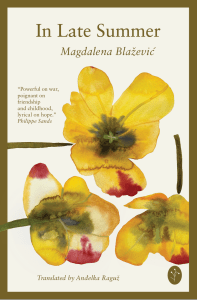 “My name is Ivana. I lived for fourteen summers, and this is the story of my last.” Blažević’s debut novella presents the before and after of one extended family, and of the Bosnian countryside, in August 1993. In the first half, few-page vignettes convey the seasonality of rural life as Ivana and her friend Dunja run wild. Mother and Grandmother slaughter chickens, wash curtains, and treat the children for lice. Foodstuffs and odours capture memory in that famous Proustian way. I marked out the piece “Camomile Flowers” for its details of the senses: “Sunlight and the scent of soap mingle. … The pantry smells like it did before, of caramel, lemon rind and vanilla sugar. Like the period leading up to Christmas. … My hair dries quickly in the sun. It rustles like the lace, dry snow from the fields.” The peaceful beauty of it all is shattered by the soldiers’ arrival. Ivana issues warnings (“Get ready! We’re running out of time. The silence and summer lethargy will not last long”) and continues narrating after her death. As in Sara Nović’s Girl at War, the child perspective contrasts innocence and enthusiasm with the horror of war. I found the first part lovely but the whole somewhat aimless because of the bitty structure.
With thanks to Linden Editions for the free copy for review.
Somebody Is Walking on Your Grave: My Cemetery Journeys by Mariana Enríquez (2013; 2025)
[Translated from Spanish by Megan McDowell]
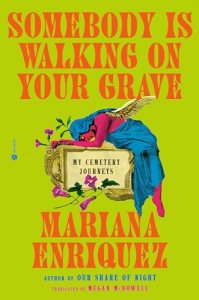 This made it onto my Most Anticipated list for the second half of the year due to my love of graveyards. Because of where Enríquez is from, a lot of the cemeteries she features are in Argentina (six) or other Spanish-speaking countries (another six including Chile, Cuba, Mexico, Peru and Spain). There are 10 more locations besides, and her journeys go back as far as 1997 in Genoa, when she was 25 and had sex with Enzo up against a gravestone. I took the most interest in those I have been to (Edinburgh) or could imagine myself travelling to someday (New Orleans and Savannah; Highgate in London and Montparnasse in Paris), but thought that every chapter got bogged down in research. Enríquez writes horror, so she is keen to visit at night and relay any ghost stories she’s heard. But the pages after pages of history were dull and outweighed the memoir and travel elements for me, so after a few chapters I ended up just skimming. I’ll keep this on my Kindle in case I go to one of her other destinations in the future and can read individual essays on location. (Edelweiss download)
Voracious by Małgorzata Lebda (2016; 2025)
[Translated from Polish by Antonia Lloyd-Jones]
Like the Blažević, this is an impressionistic, pastoral work that contrasts vitality and decay in short chapters of one to three pages. The narrator is a young woman staying in her grandmother’s house and caring for her while she is dying of cancer; “now is not the time for life. Death – that’s what fills my head. I’m at its service. Grandma is my child. I am my grandmother’s mother. And that’s all right, I think.” The house has just four inhabitants – the narrator, Grandma Róża, Grandpa, and Ann – and seems permeable: to the cold, to nature. Animals play a large role, whether pets, farmed or wild. There’s Danube the hound, the cows delivered to the nearby slaughterhouse, and a local vixen with whom the narrator identifies.
 Lebda is primarily known as a poet, and her delight in language is evident. One piece titled “Opioid,” little more than a paragraph long, revels in the power of language: “Grandma brings a beautiful word home … the word not only resonates, but does something else too – it lets light into the veins.” The wind is described as “the conscience of the forest. It’s the circulatory system. It’s the litany. It’s scented. It sings.”
In all three Linden Editions books I’ve read, the translator’s afterword has been particularly illuminating. I thought I was missing something, but Lloyd-Jones reassured me it’s unclear who Ann is: sister? friend? lover? (I was sure I spotted some homoerotic moments.) Lloyd-Jones believes she’s the mirror image of the narrator, leaning toward life while the narrator – who has endured sexual molestation and thyroid problems – tends towards death. The animal imagery reinforces that dichotomy.
The narrator and Ann remark that it feels like Grandma has been ill for a million years, but they also never want this time to end. The novel creates that luminous, eternal present. It was the best of this bunch.
With thanks to Linden Editions for the free copy for review.
Full review forthcoming for Foreword Reviews:
Pandora by Ana Paula Pacheco (2023; 2025)
[Translated from Portuguese by Julia Sanches]
 The Brazilian author’s bold novella is a startling allegory about pandemic-era hazards to women’s physical and mental health. Since the death of her partner Alice to Covid-19, Ana has been ‘married’ to a pangolin and a seven-foot-tall bat. At a psychiatrist’s behest, she revisits her childhood and interrogates the meanings of her relationships. The form varies to include numbered sections, the syllabus for Ana’s course “Is Literature a personal investment?”, journal entries, and extended fantasies. Depictions of animals enable commentary on economic inequalities and gendered struggles. Playful, visceral, intriguing.
#17 of my 20 Books of Summer:
Invisible Kitties by Yu Yoyo (2021; 2024)
[Translated from Chinese by Jeremy Tiang]
 Yu is the author of four poetry collections; her debut novel blends autofiction and magic realism with its story of a couple adjusting to the ways of a mysterious cat. They have a two-bedroom flat on a high-up floor of a complex, and Cat somehow fills the entire space yet disappears whenever the woman goes looking for him. Yu’s strategy in most of these 60 mini-chapters is to take behaviours that will be familiar to any cat owner and either turn them literal through faux-scientific descriptions, or extend them into the fantasy realm. So a cat can turn into a liquid or gaseous state, a purring cat is boiling an internal kettle, and a cat planted in a flowerbed will produce more cats. Some of the stories are whimsical and sweet, like those imagining Cat playing extreme sports, opening a massage parlour, and being the god of the household. Others are downright gross and silly: Cat’s removed testicles become “Cat-Ball Planets” and the narrator throws up a hairball that becomes Kitten. Mixed feelings, then. (Passed on by Annabel – thank you!)
I’m really pleased with myself for covering a total of 8 books for this challenge, each one translated from a different language!
Which of these would you read?
20 Books of Summer, 13–16: Tony Chan, Jen Hadfield, Kenward Anthology, Catherine Taylor
Three from my initial list (all nonfiction) and one substitute picked up at random (poetry). These are strongly place-based selections, ranging from Sheffield to Shetland and drawing on travels while also commenting on how gender and dis/ability affect daily life as well as the experience of nature.
Four Points Fourteen Lines by Tony Chan (2016)
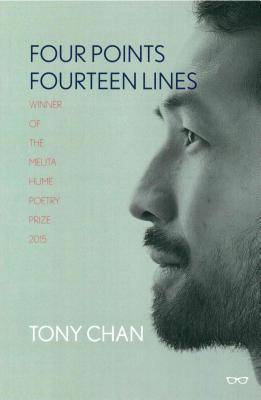 Chan is a schoolteacher who, in 2015, left his day job to undertake a 78-day solo walk between “the four extreme cardinal points of the British mainland”: Dunnet Head (North) to Ardnamurchan Point (West) in Scotland, down to Lowestoft Ness (East) in Suffolk and across to Lizard Point, Cornwall (South). It was a solo trek of 1,400 miles. He wrote one sonnet per day, not always adhering to the same rhyme scheme but fitting his sentiments into 14 lines of standard length. He doesn’t document much practical information, but does admit he stayed in decent hotels, ate hot meals, etc. Each poem is named for the starting point and destination, but the topic might be what he sees, an experience on the road, a memory, or whatever. “Evanton to Inverness” decries a gloomy city; “Inverness to Foyers” gives thanks for his shoes and lycra undershorts. He compares Highlanders to heroic Trojans: “Something sincere in their browned, moss-green tweeds, / In their greeting voice of gentle tenor. / From ancient Hector or from ancient clans, / Here live men most earnest in words and deeds.” None of the poems are laudable in their own right, but it’s a pleasant enough project. Too often, though, Chan resorts to outmoded vocabulary to fit the form or try to prove a poetic pedigree (“Suddenly comes an Old Testament of deluge and / Tempest, deluding the sense wholly”; “I know these streets, whence they come and whither / They run”; “I learnt well some verses of Tennyson / Years ago when noble dreams were begat”) when he might have been better off varying the form and/or using free verse. (Signed copy from Little Free Library)
Storm Pegs: A Life Made in Shetland by Jen Hadfield (2024)
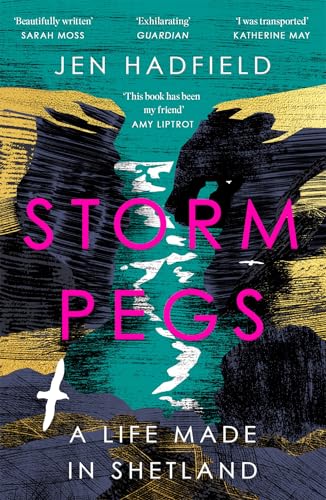 This is not so much a straightforward memoir as a set of atmospheric vignettes, each headed by a relevant word or phrase in the Shaetlan dialect. Hadfield, who is British Canadian, moved to the islands in her late twenties in 2006 and soon found her niche. “My new life quickly debunked those Edge-of-the-World myths – Shetland was too busy to feel remote, and had too strong a sense of its own identity to feel frontier-like.” It’s gently ironic, she notes, that she’s a terrible sailor and gets vertigo at height yet lives somewhere with perilous cliff edges that is often reachable only by sea. Living in a trailer waiting for her home to be built on West Burra, she feels the line between indoors and out is especially thin. It’s a life of wild swimming, beachcombing, fresh fish, folk music, seabirds, kind neighbours, and good cheer that warms long winter nights. After the isolation of the pandemic period comes the unexpected joy of a partner and a pregnancy in her mid-forties. Hadfield is a Windham-Campbell Prize-winning poet, and her lyrical prose is full of lovely observations that made me hanker to return to Shetland – it’s been 19 years since my only visit, after all. This was a slow read I savoured for its language and sense of place.
With thanks to Picador for the free paperback copy for review.
From Shetland authors, I have also reviewed:
Orchid Summer by Jon Dunn (Hadfield mentions him)
Sea Bean by Sally Huband (Hadfield meets her)
The Valley at the Centre of the World by Malachy Tallack
Moving Mountains: Writing Nature through Illness and Disability, ed. Louise Kenward (2023)
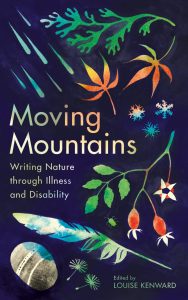 I often read memoirs about chronic illness and disability – the sort of narratives recognized by the Barbellion and ACDI Literary Prizes – and the idea of nature essays that reckon with health limitations was an irresistible draw. The quality in this anthology varies widely, from excellent to barely readable (for poor prose or pretentiousness). I’ll be kind and not name names in the latter category; I’ll only say the book has been poorly served by the editing process. The best material is generally from authors with published books: Polly Atkin (Some of Us Just Fall; see also her recent response to the Raynor Winn fiasco), Victoria Bennett (All My Wild Mothers), Sally Huband (as above!), and Abi Palmer (Sanatorium). For the first three, the essay feels like an extension of their memoir, while Palmer’s inventive piece is about recreating seasons for her indoor cats. My three favourite entries, however, were Louisa Adjoa Parker’s poem “This Is Not Just Tired,” Nic Wilson’s “A Quince in the Hand” (she’s an acquaintance through New Networks for Nature and has a memoir out this summer, Land Beneath the Waves), and Eli Clare’s “Moving Close to the Ground,” about being willing to scoot and crawl to get into nature. A number of the other pieces are repetitive, overlong or poorly shaped and don’t integrate information about illness in a natural way. Kudos to Kenward for including BIPOC and trans/queer voices, though. (Christmas gift from my wish list)
The Stirrings: Coming of Age in Northern Time by Catherine Taylor (2023)
“A typical family and an ordinary story, although neither the family nor the story seems commonplace when it is your family and your story.”
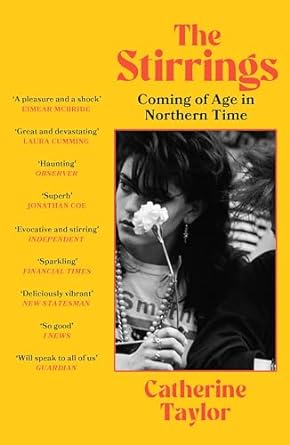 Taylor, who was born in New Zealand and grew up in Sheffield, won the Ackerley Prize for this memoir. (After Dunmore and King, this is the third in my intended four-in-a-row on the 20 Books of Summer Bingo card, fulfilling the “Book published in summer” category – August 2023.) It is bookended by two pivotal summers: 1976, the last normal season in her household before her father left; and 1989, the “Second Summer of Love,” when she had an abortion (the subject of “Milk Teeth,” the best individual chapter and a strong stand-alone essay). In between, fear and outrage overshadow her life: the Yorkshire Ripper is at large, nuclear war looms, mines are closing and protesters meet with harsh reprisals, and her own health falters until she gets a diagnosis of Graves’ disease. Then, in her final year at Cardiff, one of their housemates is found dead. Taylor draws reasonably subtle links to the present day, when fascism, global threats, and femicide are, unfortunately, as timely as ever. She’s the sort of personality I see at every London literary event I attend: Wellcome Book Prize ceremonies, Weatherglass’s Future of the Novella event, and so on. I got the feeling this book is more about bearing witness to history than revealing herself, and so I never warmed to it or to her on the page. But if you’d like to get a feel for the mood of the times, or you have experience of the settings and period, you may well enjoy it more than I did. (New purchase from Bookshop.org with a Christmas book token)
Three Days in June vs. Three Weeks in July
Two very good 2025 releases that I read from the library. While they could hardly be more different in tone and particulars, I couldn’t resist linking them via their titles.
Three Days in June by Anne Tyler
(From my Most Anticipated list.) A delightful little book that I loved more than I expected to, for several reasons: the effective use of a wedding weekend as a way of examining what goes wrong in marriages and what we choose to live with versus what we can’t forgive; Gail’s first-person narration, a rarity for Tyler* and a decision that adds depth to what might otherwise have been a two-dimensional depiction of a woman whose people skills leave something to be desired; and the unexpected presence of a cat who brings warmth and caprice back into her home. (I read this soon after losing my old cat, and it was comforting to be reminded that cats and their funny ways are the same the world over.)
From Tyler’s oeuvre, this reminded me most of The Amateur Marriage and has a surprise Larry’s Party-esque ending. The discussion of the outmoded practice of tapping one’s watch is a neat tie-in to her recurring theme of the nature of time. And through the lunch out at a chic crab restaurant, she succeeds at making the Baltimore setting essential rather than incidental, more so than in much of her other work.
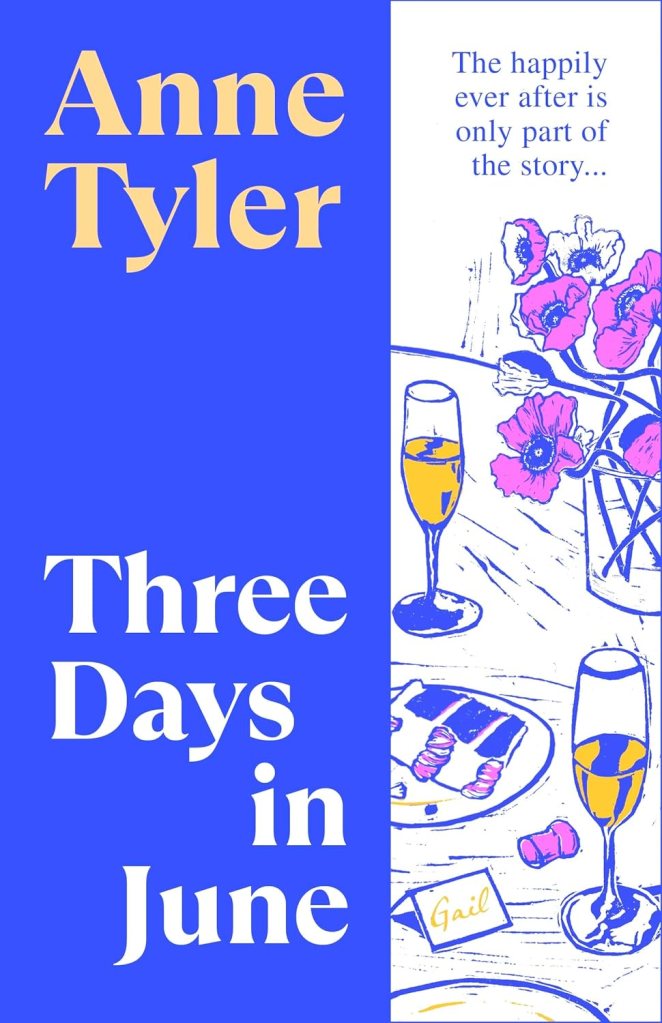
Gail is in the sandwich generation with a daughter just married and an old mother who’s just about independent. I appreciated that she’s 61 and contemplating retirement, but still feels as if she hasn’t a clue: “What was I supposed to do with the rest of my life? I’m too young for this, I thought. Not too old, as you might expect, but too young, too inept, too uninformed. How come there weren’t any grownups around? Why did everyone just assume I knew what I was doing?”
My only misgiving is that Tyler doesn’t quite get it right about the younger generation: women who are in their early thirties in 2023 (so born about 1990) wouldn’t be called Debbie and Bitsy. To some degree, Tyler’s still stuck back in the 1970s, but her observations about married couples and family dynamics are as shrewd as ever. Especially because of the novella length, I can recommend this to readers wanting to try Tyler for the first time.
*I’ve noted it in Earthly Possessions. Anywhere else?
Three Weeks in July: 7/7, The Aftermath, and the Deadly Manhunt by Adam Wishart and James Nally
July 7th is my wedding anniversary but before that, and ever since, it’s been known as the date of the UK’s worst terrorist attack, a sort of lesser 9/11 – and while reading this I felt the same way that I’ve felt reading books about 9/11: a sort of awed horror. Suicide bombers who were born in the UK but radicalized on trips to Islamic training camps in Pakistan set off explosions on three Underground trains and one London bus. I didn’t think my memories of 7/7 were strong, yet some names were incredibly familiar to me (chiefly Mohammad Sidique Khan, the leader of the attacks; Jean Charles de Menezes, the innocent Brazilian electrician shot dead on a Tube train when confused with a suspect in the 21/7 copycat plot – police were operating under a new shoot-to-kill policy and this was the tragic result).
 Fifty-two people were killed that day, ranging in age from 20 to 60; 20 were not UK citizens, hailing from everywhere from Grenada to Mauritius. But a total of 770 people were injured. I found the authors’ recreation of events very gripping, though do be warned that there is a lot of gruesome medical and forensic detail about fatalities and injuries. They humanize the scale of events and make things personal by focusing on four individuals who were injured, even losing multiple limbs in some cases, but survived and now work in motivational speaking, disability services or survivor advocacy.
What really got to me was thinking about all the hundreds of people who, 20 years on, still live with permanent pain, disability or grief because of the randomness of them or their loved ones getting caught up in a few misguided zealots’ plot. One detail that particularly struck me: with the Tube tunnels closed off at both ends while searchers recovered bodies, the temperature rose to 50 degrees C (122 degrees F), only exacerbating the stench. The book mostly avoids cliches and overwriting, though I did find myself skimming in places. It is based on the research done for a BBC documentary series and synthesizes a lot of material in an engaging way that does justice to the victims.
Have you read one or both of these?
Could you see yourself picking one of them up?
20 Books of Summer 2025 Plans
It’s my eighth year participating in the 20 Books of Summer challenge, this year co-hosted by Annabel and Emma after Cathy stepped down. #20BooksofSummer2025 starts on 1 June and runs through 31 August. In some previous years I have chosen a theme, even something as simple as “books by women.” Last year I combined two criteria and managed to get through 20 hardback books I owned by women. The problem with setting even simple boundaries like that is that I seem to almost immediately lose interest. Even more dangerous to pick 20 specific books, lest I go off them right away. Nonetheless, that’s what I’ve done. Expect substitutions galore, however; most years I read only half (or less) of what I’ve earmarked.

My only firm rule is that all 20 books must be from my own shelves. Ideally, they wouldn’t overlap with my usual reviewing commitments, book club reads, or other themed challenges (e.g., June: Reading the Meow, Father’s Day, Scotland holiday; August: Women in Translation), though it would be no problem if they did. I’m the only one enforcing this!
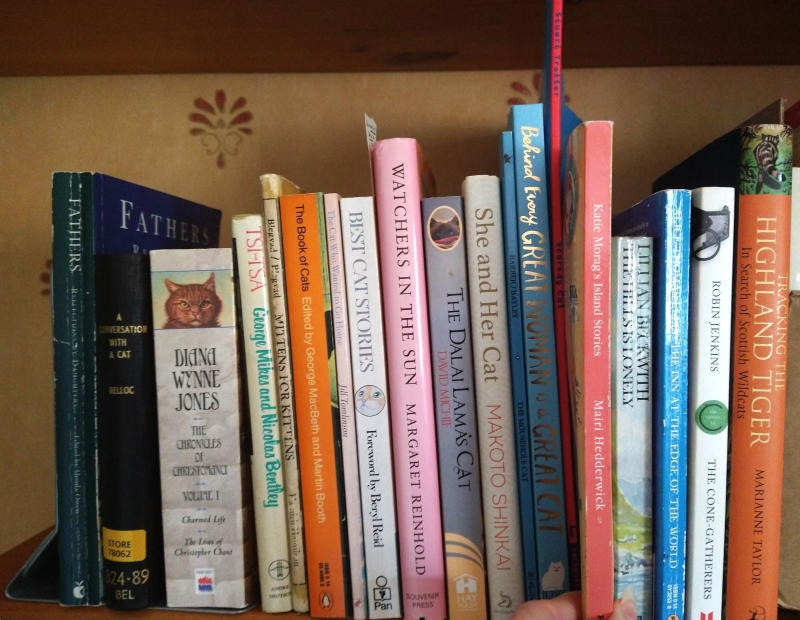
Other themed June reading options.
I like to work towards multiple goals, so I’ve chosen five books each in four categories.
Books I acquired new this year:
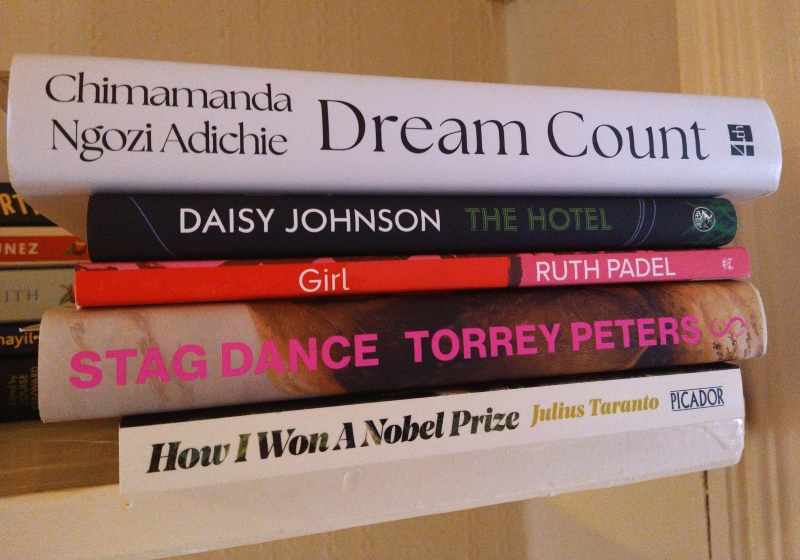
Dream Count by Chimamanda Ngozi Adichie (Hungerford Bookshop) – I pre-ordered this, a super-rarity for me, and read the first 20-some pages before petering out. I think it’s fair to say it won’t be a favourite of hers for me, but I’d still like to read it in its publication year.
The Hotel by Daisy Johnson (Hungerford Bookshop with Christmas gift token) – Creepy short stories by an author whose long-form fiction I’ve really enjoyed. Also counts toward my low-key goal of reducing the list of authors by whom I own two or more unread books.
Girl by Ruth Padel (Hungerford Bookshop with Christmas gift token) – A poetry collection about girlhood through history and in myth. A repeat appearance on my summer reading list; I reviewed her Emerald in 2021. Good to add it in for variety, and a quick win length-wise.
Stag Dance by Torrey Peters (Bookshop.org) – I bought this to show solidarity with trans women after a short-sighted legal ruling here in the UK. Detransition, Baby was awesome but I haven’t managed to get into this yet. It contains three long short stories plus a novella.
How I Won a Nobel Prize by Julius Taranto (Hungerford Bookshop with Christmas gift token) – I believe it was Susan’s review that put this on my radar, though the title and the fact that it’s an academic satire would have been enough to get it onto my TBR.
Catch-up review copies:
A couple of these date back to 2023…
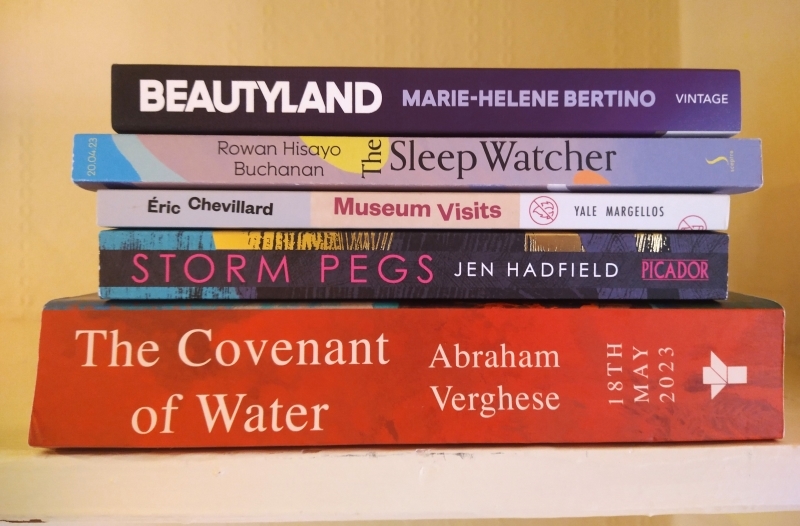
Beautyland by Marie-Helene Bertino – “At the moment when Voyager 1 is launched into space … , a baby of unusual perception is born to a single mother in Philadelphia. Adina Giorno … recognizes that she is different: She possesses knowledge of a faraway planet. The arrival of a fax machine enables her to contact her extraterrestrial relatives.” Quirky; well received by blog and Goodreads friends.
The Sleep Watcher by Rowan Hisayo Buchanan – I’ve read her other two novels but for some reason didn’t pick this up when it was first sent to me. “When she is sixteen, Kit suffers a summer of sleeplessness that isn’t quite what it seems; her body lies in bed while she wanders through her family home, the streets of her run-down seaside town and into the houses of friends and strangers.” Bonus points for being set during summer.
Museum Visits by Éric Chevillard – My one selection in translation. This hybrid collection of short pieces might be deemed essays or stories. “This ensemble of comic miniatures compiles reflections on chairs, stairs, stones, goldfish, objects found, strangers observed, scenarios imagined, reasonable premises taken to absurd conclusions, and vice versa.”
Storm Pegs by Jen Hadfield – New in paperback. I knew I had to read a Shetland-set memoir, and had enjoyed Hadfield’s piece in the Antlers of Water anthology. “In prose as rich and magical as Shetland itself, Hadfield transports us to the islands as a local; introducing us to the remote and beautiful archipelago where she has made her home”.
The Covenant of Water by Abraham Verghese – Cutting for Stone is brilliant but I was daunted by the even greater heft of this follow-up. I hope I’ll find just the right time to sink into it. “Spanning the years 1900 to 1977,” set “on India’s Malabar Coast, and follows three generations of a family that suffers a peculiar affliction: in every generation, at least one person dies by drowning—and in Kerala, water is everywhere.”
Summer-themed books / four in a row on the Bingo card:
I’d be aiming to complete the second row with this quartet:
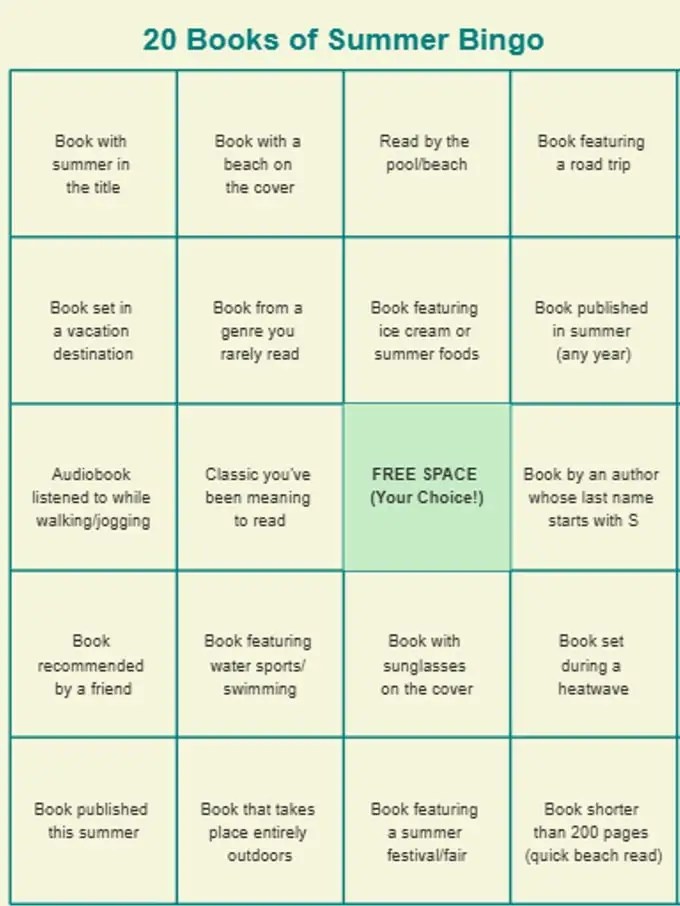
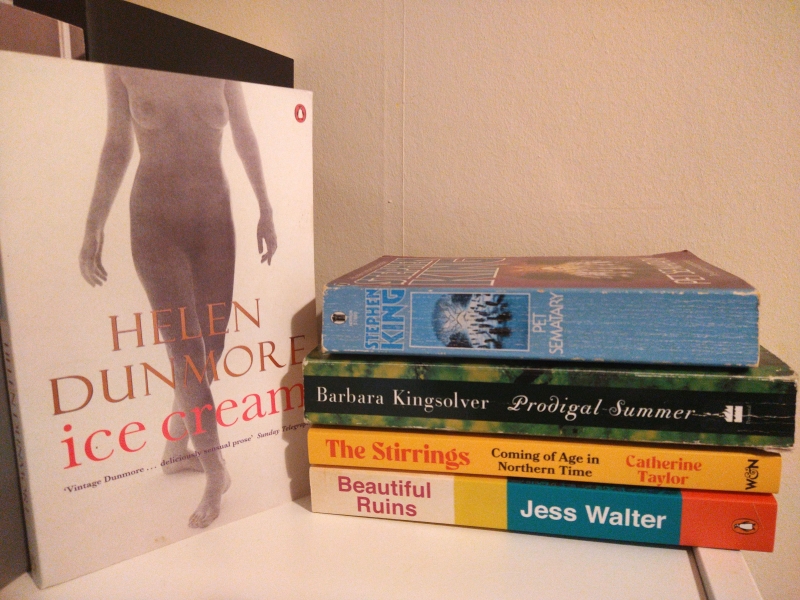
(Book set in a vacation destination)
Beautiful Ruins by Jess Walter (40th birthday gift from my husband, purchased from Hungerford Bookshop) – “the story of an almost-love affair that begins on the Italian coast in 1962 and resurfaces fifty years later in Hollywood. From the lavish set of Cleopatra to the shabby revelry of the Edinburgh Fringe Festival to the backlots of contemporary Hollywood, this is a dazzling, yet deeply human roller coaster of a novel.”
(Book from a genre you rarely read)
Pet Sematary by Stephen King (Little Free Library) – I’ve only ever read King’s book on writing, which of course is not representative of his oeuvre. Sounds like this could be a good introduction to his horror work. Rural Maine + dead animals in the woods + grief theme. A chunky but lightweight paperback; I fancy it for my solo train ride home from Edinburgh.
(Book featuring ice cream or summer foods)
Ice Cream by Helen Dunmore (Community Furniture Project) – A short story collection, facing out because the spine is faded to illegibility rather than to show off the naked lady. I’ve enjoyed Dunmore’s stories before (Love of Fat Men). The plots are described as “ranging from … the death of a lighthouse keeper’s wife to the birth of babies from the Superstock catalogue.”
(Book published in summer)
The Stirrings by Catherine Taylor (Bookshop.org with Christmas gift token) – This was originally published in August 2023, and it’s also set mostly during two pivotal summers: “the scorching summer of 1976 – the last Catherine Taylor would spend with both her parents in their home in Sheffield” and “1989’s ‘Second Summer of Love’, a time of sexual awakening for Catherine, and the unforeseen consequences that followed it.”
Plus my one reread of the challenge:
Prodigal Summer by Barbara Kingsolver (Little Free Library) – “From her outpost in an isolated mountain cabin, Deanna Wolfe, a reclusive wildlife biologist, watches a den of coyotes that have recently migrated into the region. She is caught off-guard by a young hunter who invades her most private spaces and confounds her self-assured, solitary life.”
I have a number of other potential summery reads, too.
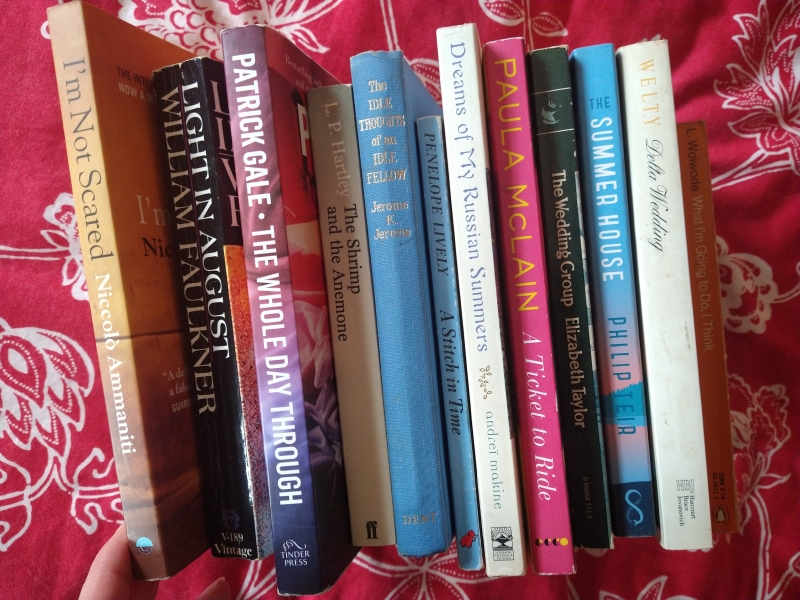
“Just because” books
At the start of the year, I pulled out two huge piles of books I had no particular excuse to read yet was keen to get to. My plan was to pick up one per week or so. Of course, I’ve not so much as opened one yet. Three of these are from that stack, with two more from my BIPOC shelf.
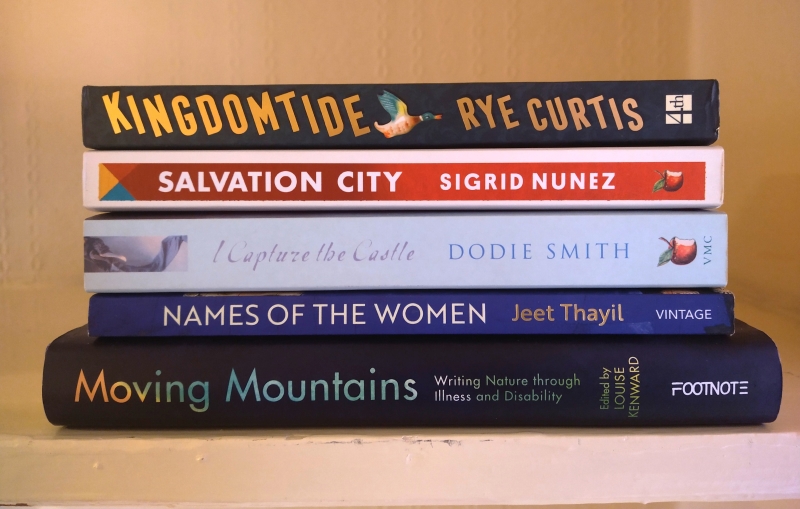
Kingdomtide by Rye Curtis (passed on by Laura T. – thank you!) – I’ve meant to read this for ages, plus it sounds like a good readalike for Heartwood. “The sole survivor of a plane crash, seventy-two-year-old Cloris Waldrip finds herself lost and alone in the unforgiving wilderness of Montana’s rugged Bitterroot Range … Intertwined with her story is Debra Lewis, a park ranger struggling with addiction, a recent divorce, and a new mission: to find and rescue Cloris.”
Salvation City by Sigrid Nunez (new from Amazon some years back) – I love Nunez and aim to read all of her books. This sounds very different from the four I know! “His family’s sole survivor after a flu pandemic …, Cole Vining is lucky to have found refuge with the evangelical Pastor Wyatt and his wife in a small town in southern Indiana. As the world outside has grown increasingly anarchic, Salvation City has been spared much of the devastation, and its residents have renewed their preparations for the Rapture.”
I Capture the Castle by Dodie Smith (charity shop, possibly a decade ago?) – One I’ve always meant to read. My token classic for this challenge, though there are plenty more to choose from on the bookcase in the lounge, e.g. an Austen for Brona’s #ReadAusten25 challenge. “Through six turbulent months of 1934, 17-year-old Cassandra Mortmain keeps a journal, filling three notebooks with sharply funny yet poignant entries about her home, a ruined Suffolk castle, and her eccentric and penniless family.”
Names of the Women by Jeet Thayil (gift from my wish list several years ago) – A novella on the stack will be welcome; this is “about the women whose roles were suppressed, reduced or erased in the Gospels. … Together, the voices of the women dare us to reimagine the story of the New Testament in a way it has never before been told.”
Moving Mountains, ed. Louise Kenward (gift from my wish list last year) – “A first-of-its-kind anthology of nature writing by authors living with chronic illness and physical disability. Through 25 pieces, the writers … offer a vision of nature that encompasses the close up, the microscopic, and the vast.” It will be nice to have a book of short nature pieces on the go.
The above list is more fiction-heavy than usual for me, with a number of chunksters – but also four short fiction collections and a poetry collection to balance out the length. Inspired by Eleanor, I decided to ensure at least 25% were by authors of colour.
If I need to draw on back-ups, I have many more between my “just because” stack, my Women’s Prize nominees shelf, and the rest of my BIPOC authors area.


This happens to be my 1,500th blog post!!
What do you make of my lists? See any options that I should prioritize instead?
 Bookish Beck = Rebecca Foster. American transplant to England. Freelance proofreader and book reviewer.
