Six Degrees of Separation: From Hamnet to Paula
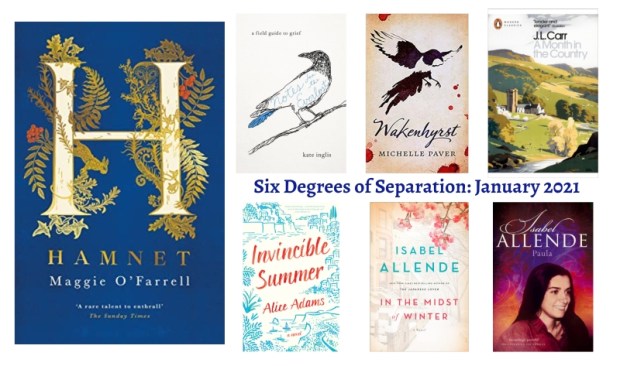
 I was slow off the mark this month, but here we go with everyone’s favorite book blogging meme! This time we start with Hamnet, Maggie O’Farrell’s Women’s Prize-winning novel about the death of William Shakespeare’s son. (See Kate’s opening post.) Although I didn’t love this as much as others have (my review is here), I was delighted for O’Farrell to get the well-deserved attention – Hamnet was also named the Waterstones Book of the Year 2020.
 #1 I’ve read many nonfiction accounts of bereavement. One that stands out is Notes from the Everlost by Kate Inglis, which is also about the death of a child. The author’s twin sons were born premature; one survived while the other died. Her book is about what happened next, and how bereaved parents help each other to cope. An excerpt from my TLS review is here.
 #2 Also featuring a magpie on the cover, at least in its original hardback form, is Wakenhyrst by Michelle Paver (reviewed for R.I.P. this past October). I loved that Maud has a pet magpie named Chatterpie, and the fen setting was appealing, but I’ve been pretty underwhelmed by all three of Paver’s historical suspense novels for adults.
 #3 One of the strands in Wakenhyrst is Maud’s father’s research into a painting of the Judgment Day discovered at the local church. In A Month in the Country by J. L. Carr (reviewed last summer), a WWI veteran is commissioned to uncover a wall painting of the Judgment Day, assumed to be the work of a medieval monk and long ago whitewashed over.
 #4 A Month in the Country spans one summer month. Invincible Summer by Alice Adams, about four Bristol University friends who navigate the highs and lows of life in the 20 years following their graduation, checks in on the characters nearly every summer. I found it clichéd; not one of the better group-of-friends novels. (My review for The Bookbag is here.)
 #5 The title of Invincible Summer comes from an Albert Camus quote: “In the midst of winter, I found there was, within me, an invincible summer. And that makes me happy.” Inspired by the same quotation, then, is In the Midst of Winter by Isabel Allende, a recent novel of hers that I was drawn to for the seasonal link but couldn’t get through.
 #6 However, I’ve enjoyed a number of Allende books over the last 12 years or so, both fiction and non-. One of these was Paula, a memoir sparked by her twentysomething daughter’s untimely death in the early 1990s from complications due to the genetic condition porphyria. Allende told her life story in the form of a letter composed at Paula’s bedside while she was in a coma.
So, I’ve come full circle with another story of the death of a child, but there’s a welcome glimpse of the summer somewhere there in the middle. May you find your own inner summer to get you through this lockdown winter.
Join us for #6Degrees of Separation! (Hosted on the first Saturday of each month by Kate W. of Books Are My Favourite and Best.) Next month’s starting point is Redhead at the Side of the Road by Anne Tyler.
Have you read any of my selections? Are you tempted by any you didn’t know before?
Summery Reads, Part II: Sun and Summer Settings
Typically for the late August bank holiday, it’s turned chilly and windy here, with a fair bit of rain around. The past two weeks have felt more like autumn, but I’ve still been seeing out the season with a few summery reads.
What makes for good summer reading? I love reading with the seasons, picking up a book set during a heat wave just as the temperature is at a peak, but of course there can also be something delicious about escaping by reading about Arctic cold. Marcie of Buried in Print wrote here that she likes her summer books to offer just the right combination of the predictable and the unexpected, and that probably explains why I’m more likely to dip into genre fiction in the summer than at any other time of year. To her criteria I would also add addictiveness and a strong sense of place so as to be transporting – especially important this year when so many of us haven’t been able to have the vacations we might have planned on.
My best two summer binge reads this year were Rodham and Americanah; my two summery classics, though more subtle, were also perfect. Mostly Dead Things by Kristen Arnett, which I’m reading for a Shiny New Books review, has also felt apt for its swampy Florida setting. More recently, I picked up a couple of books with “sun” in the title, plus two novels set entirely in the course of one summer. Two of my selections are also towards my project of reading all of the Women’s Prize winners by November so I can vote on my all-time favorite.
Here comes the sun…
Half of a Yellow Sun by Chimamanda Ngozi Adichie (2006)
 Adichie filters an epic account of Nigeria’s civil war through the experience of twin sisters, Olanna and Kainene, and those closest to them. The wealthy chief’s daughters from Lagos drift apart: Olanna goes to live with Odenigbo, a math professor; Kainene is a canny businesswoman with a white lover, Richard Churchill, who is fascinated by Igbo art and plans to write a book about his experiences in Africa. Gradually, though, he realizes that the story of Biafra is not his to tell.
The novel alternates between the close third-person perspectives of Olanna, Richard and Ugwu, Odenigbo’s houseboy, and moves between the early 1960s and the late 1960s. These shifts underscore stark contrasts between village life and sophisticated cocktail parties, blithe prewar days and witnessed atrocities and starvation. Kainene runs a refugee camp, while Ugwu is conscripted into the Biafran army. Violent scenes come as if out of nowhere, as suddenly as they would have upturned real lives. A jump back in time reveals an act of betrayal by Odenigbo, and apparently simple characters like Ugwu are shown to have hidden depths.
In the endmatter of my paperback reissue, Adichie writes, “If fiction is indeed the soul of history, then I was equally committed to the fiction and the history, equally keen to be true to the spirit of the time as well as to my artistic vision of it.” Copious research must have gone into a book about events that occurred before her birth (both of her grandfathers died in the conflict), but its traces are light; this is primarily about storytelling and conveying emotional realities rather than ensuring readers grasp every detail of the Biafran War. This was my second attempt to read the novel, and while again I did not find it immediately engaging, by one-quarter through it had me gripped. I’m a firm Adichie fan now, and look forward to reading her other three new-to-me books sooner rather than later.
Orange Prize (now Women’s Prize) for Fiction winner, 2007
Source: Birthday gift from my wish list some years back
My rating: 
The Shadow of the Sun: My African Life by Ryszard Kapuściński (1998)
[Translated from the Polish by Klara Glowczewska in 2001]
 Kapuściński was a foreign correspondent in Africa for 40 years and lent his name to an international prize for literary reportage. This book of essays spans several decades and lots of countries, yet feels like a cohesive narrative. The author sees many places right on the cusp of independence or in the midst of coup d’états – including Nigeria, a nice tie-in to the Adichie. Living among the people rather than removed in some white enclave, he develops a voice that is surprisingly undated and non-colonialist. While his presence as the observer is undeniable – especially when he falls ill with malaria and then tuberculosis – he lets the situation on the ground take precedence over the memoir aspect. I’m only halfway through, but I fully expect this to stand out as one of the best travel books I’ve ever read.
Evocative opening lines:
“More than anything, one is struck by the light. Light everywhere. Brightness everywhere. Everywhere, the sun.”
Source: Free bookshop
It happened one summer…
A Crime in the Neighborhood by Suzanne Berne (1997)
 Berne, something of a one-hit wonder, is not among the more respected Women’s Prize alumni – look at the writers she was up against in the shortlist and you have to marvel that she was considered worthier than Barbara Kingsolver (The Poisonwood Bible) and Toni Morrison (Paradise). However, I enjoyed this punchy tale. Marsha remembers the summer of 1972, when her father left her mother for Aunt Ada and news came of a young boy’s sexual assault and murder in the woods behind a mall. “If you hadn’t known what had happened in our neighborhood, the street would have looked like any other suburban street in America.”
Laid up with a broken ankle from falling out of a tree, 10-year-old Marsha stays out of the way of her snide older twin siblings and keeps a close eye on the street’s comings and goings. Like Harriet the Spy or Jimmy Stewart’s convalescent character in Rear Window, she vows to note anything relevant in her Book of Evidence to pass on to the police. Early on, her suspicion lands on Mr. Green, the bachelor who lives next door. Feeling abandoned by her father and underappreciated by the rest of her family, Marsha embellishes the facts to craft a more exciting story, not knowing or caring that she could ruin another person’s life.
The novel is set in Montgomery County, Maryland, where I grew up, and the descriptions of brutally humid days fit with my memory of the endless summer days of a childhood in the Washington, D.C. area. Although I usually avoid child narrators, I’ve always admired novels that can point to the dramatic irony between what a child experiences at the time and what a person can only understand about their situation when looking back. Stylish and rewarding.
Orange Prize (now Women’s Prize) for Fiction winner, 1999
Source: Free bookshop
My rating:
Modern Lovers by Emma Straub (2016)
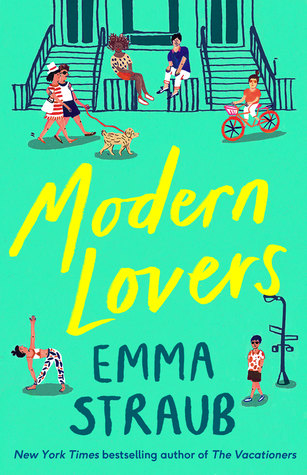 Just as the Berne is a coming-of-age story masquerading as a mystery, from the title and cover this looked like it would be chick lit, but – though it has an overall breezy tone – it’s actually pretty chewy New York City literary fiction that should please fans of The Nest and/or readers of Jennifer Egan and Ann Patchett.
Elizabeth Marx and Zoe Kahn-Bennett have been best friends ever since starting the student band Kitty’s Mustache at Oberlin. Now in their forties with a teenager each, they live half a block apart in Brooklyn. Zoe and her wife Jane run a neighborhood restaurant, Hyacinth; their daughter Ruby is dragging her feet about college and studying to retake the SAT over the summer. Elizabeth, a successful real estate agent, still keeps the musical flame alive; her husband Andrew, her college sweetheart from the band, is between jobs, not that his parents’ money isn’t enough to keep him afloat forever; their son, Harry, is in puppy love with Ruby.
Several things turn this one ordinary-seeming summer on its head. First, a biopic is being made about the Kitty’s Mustache singer turned solo star turned 27 Club member, Lydia, and the filmmaker needs the rest of the band on board – and especially for Elizabeth to okay their use of the hit song she wrote that launched Lydia’s brief career. Second, Andrew gets caught up in a new cult-like yoga studio run by a charismatic former actor. Third, the Kahn-Bennetts have marital and professional difficulties. Fourth, Harry and Ruby start sleeping together.
Short chapters flip between all the major characters’ perspectives, with Straub showing that she completely gets each one of them. The novel is about reassessing as one approaches adulthood or midlife, about reviving old dreams and shoring up flagging relationships. It’s nippy and funny and smart and sexy. I found so many lines that rang true:
Elizabeth was happy in her marriage, she really was. It was just that sometimes she thought about all the experiences she’d never gotten to have, and all the nights she’d listened to the sound of her husband’s snores, and wanted to jump out a window and go home with the first person who talked to her. Choices were easy to make until you realized how long life could be.
Andrew was always surprised by people’s ages now. When he was a teenager, anyone over the age of twenty looked like a grown-up, with boring clothes and a blurry face, only slightly more invisible than Charlie Brown’s teacher, but life had changed. Now everyone looked equally young, as if they could be twenty or thirty or even flirting with forty, and he couldn’t tell the difference. Maybe it was just that he was now staring in the opposite direction.
“I mean, it’s never too late to decide to do something else. Becoming an adult doesn’t mean that you suddenly have all the answers.”
I’ll definitely read more by Straub. I’d especially recommend picking this up if you enjoyed Writers & Lovers.
Source: Free bookshop
My rating:
What was your best summery read this year?
Summery Classics by J. L. Carr and L. P. Hartley
“Do you remember what that summer was like? – how much more beautiful than any since?”
These two slightly under-the-radar classics made for perfect heatwave reading over the past couple of weeks: very English and very much of the historical periods that they evoke, they are nostalgic works remembering one summer when everything changed – or could have.
A Month in the Country by J. L. Carr (1980)
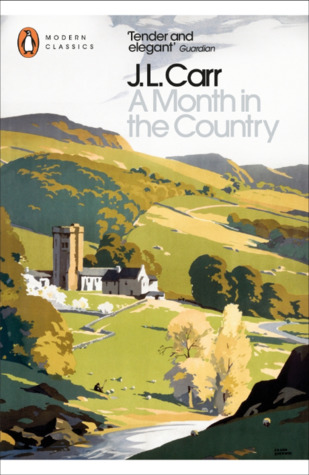 Summer 1920, North Yorkshire. Tom Birkin, a First World War veteran whose wife has left him, arrives in Oxgodby to uncover the local church’s wall painting of the Judgment Day, assumed to be the work of a medieval monk and long since whitewashed over. With nothing waiting for him back in London and no plans beyond this commission, he gives himself over to the daily rhythms of working, eating and sleeping – “There was so much time that marvelous summer.” This simple life is punctuated by occasional incidents like a Sunday school hayride and picnic, and filling in as a lay preacher at a nearby chapel. Also embarked on a quest into the past is Charles Moon, who is searching for the grave of their patroness’ ancestor in the churchyard. Moon, too, has a war history he’d rather forget.
Though it barely exceeds 100 pages, this novella is full of surprises – about Moon, about the presumed identity and fate of the centuries-dead figures he and Birkin come to be obsessed with, and about the emotional connection that builds between Birkin and Reverend Keach’s wife, Alice. “It is now or never; we must snatch at happiness as it flies,” Birkin declares, but did he take his own advice? There is something achingly gorgeous about this not-quite-love story, as evanescent as ideal summer days. Carr writes in a foreword that he intended to write “a rural idyll along the lines of Thomas Hardy’s Under the Greenwood Tree.” He indeed created something Hardyesque with this tragicomic rustic romance; I was also reminded of another very English classic I reviewed earlier in the year: Cider with Rosie by Laurie Lee.
Source: Free bookshop
My rating: 
A contemporary readalike: The Offing by Benjamin Myers
The Go-Between by L. P. Hartley (1953)
Summer 1900, Norfolk. Twelve-year-old Leo Colston is invited to spend the several July weeks leading up to his birthday at his school friend Marcus Maudsley’s home, Brandham Hall. Although the fatherless boy is keenly aware of the class difference between their families, in a year of learning to evade bullies he’s developed some confidence in his skills and pluck, fancying himself an amateur magician and gifted singer. Being useful makes him feel less like a charity case, so he eagerly agrees to act as “postman” for Marcus’s older sister, Marian, who exchanges frequent letters with their tenant farmer, Ted Burgess. Marian, engaged to Hugh, a viscount and injured Boer War veteran, insists the correspondence is purely business-related, but Leo suspects he’s abetting trysts the family would disapprove of.
 Leo is right on the cusp of adolescence, a moment of transition that mirrors the crossing into a new century. As he glories in the summer’s mounting heat, “a liberating power with its own laws,” and mentally goads the weather into hitting ever greater extremes, he pushes against the limits of his innocence, begging Ted to tell him about “spooning” (that is, the facts of life). The heat becomes a character in its own right, gloweringly presiding over the emotional tension caused by secrets, spells and betrayals. And yet this is also a very funny novel: I loved Leo’s Franglais conversations with Marcus, and the confusion over mispronouncing “Hugh” as “you.” In places the tone even reminded me of Cold Comfort Farm.
Like A Month in the Country, this autobiographical story is an old man’s reminiscences, going back half a century in memory – but here Leo gets the chance to go back in person as well, seeing what has become of Brandham Hall and meeting one of the major players from that summer drama that branded him for life. I thought this masterfully done in every way: the class divide, the picture of childhood tipping over into the teenage years, the oppressive atmosphere, the comical touches. You know from the famous first line onwards (“The past is a foreign country: they do things differently there”) that this will juxtapose past and present – which, of course, has now become past and further past – in a powerful way, similar to Moon Tiger, my favorite fiction read of last year. I’ll be exploring more of Hartley’s work.
(Note: Although I am a firm advocate of DNFing if a book is not working for you, I would also like to put in a good word for trying a book again another time. Ironically, this had been a DNF for me last summer: I found the prologue, with all its talk of the zodiac, utterly dull. I had the same problem with Cold Comfort Farm, literally trying about three times to get through the prologue and failing. So, for both, I eventually let myself skip the prologue, read the whole novel, and then go back to the prologue. Worked a treat.)
Source: Ex-library copy bought from Lambeth Library when I worked in London
My rating: 
A contemporary readalike: Atonement by Ian McEwan
Summery Reads of 2020, Part I
Reading with the seasons, I’ve picked up a few books with “summer” or sunshine in their titles. I’ll have more to write up later in August, including novels set during the summer months.
A Summer Bird-Cage by Margaret Drabble (1963)
 Sarah Bennett, who went straight from university in Oxford to Paris for want of a better idea of what to do with her life, is called home to Warwickshire to be a bridesmaid in the wedding of her older sister, Louise, to Stephen Halifax, a wealthy novelist. Afterwards, Sarah decides to move to London and share a flat with a friend whose marriage has recently ended. As the months pass, she figures out life as a single girl in a big city and attends parties hosted by Louise – back from an extended European honeymoon – and others. Sarah eventually works out, from gossip and from confronting Louise herself, that her sister’s marriage isn’t as idyllic as it appeared. Both sisters find themselves at a loss as for what to do next.
Although Drabble’s debut novel is low on action, its characters are sharply drawn and she delights in placing them in situations and conversations where their true values will emerge. I could relate to Sarah for her bookishness, her observant nature, and her feeling that her best days of being a student are behind her. Drabble was only 24 when this was published; though she was already married and a mother, her distinguished university career (a double first from Cambridge) wasn’t long behind her. Given that Drabble’s sister is novelist A.S. Byatt, it’s impossible not to speculate about the autobiographical inspiration for this picture of sisters who are subconscious rivals and don’t even seem to enjoy spending casual time together.
What with the sisters sharing the maiden name Bennett, you also can’t help but think of one of the classic sister novels, Pride and Prejudice. Drabble makes her debt obvious when Sarah goes over to Louise’s for dinner and comments on the “charming convention of the scene – sisters idling away an odd evening in happy companionship. It was like something out of Middlemarch or even Jane Austen.” I was also reminded of the sister pair in Deerbrook: one got all the beauty, but the other seems much more interesting.
The title comes from a John Webster quotation: “’Tis just like a summer bird-cage in a garden: / the birds that are without are desperate to get / in, and the birds that are within despair and / are in a consumption for fear that they will never / get out.” In other words, it’s easy to miss, and idealize, what you don’t have. Sarah still thinks she can have it all; Louise has realized the choices life forces on you. In modern parlance, this is about adulting and FOMO. It still feels relevant, in a way that seems to anticipate the work of Sally Rooney.
My rating:
Rise and Shine by Anna Quindlen (2006)
 Another sisters novel, and the first book in my Journey through the Day with Books challenge. Meghan Fitzmaurice is a household name as the host of America’s most popular morning talk show, Rise and Shine, but her star fades rapidly when, her microphone still on after she thinks they’ve gone to a commercial break, she murmurs “f***ing a**hole” about a guest who is, admittedly, a creep. It turns out her outburst didn’t come out of nowhere: the night before, her husband, Evan, had announced he was leaving her. Meghan goes to Jamaica to regroup, leaving her younger sister, Bridget, a social worker in the Bronx, to figure out what happened and create a semblance of normalcy for her beloved nephew, Meghan’s college-age son Leo, who’s just back from an exchange program at a farm outside Barcelona.
I liked the New York City setting and the central sister relationship – “Sisters tend to get stuck in their roles and they don’t always know how to get out of them. The pretty one. The practical one,” their aunt Maureen, who raised them after their parents’ deaths, says – but the plot hereafter veers between thin and melodramatic. I didn’t warm to Bridget’s boyfriend Irving, a hardboiled older cop, and I get a little nervous about white ladies creating stereotypical African American characters and giving them names like Tequila (Bridget’s receptionist at the women’s shelter) and Princess Margaret (Tequila’s daughter).

In a nice bit of symmetry, though, the book’s end finds a subdued Meghan hosting a late-night show called Day’s End. I didn’t like this nearly as much as her nonfiction (I loved Lots of Candles, Plenty of Cake), but I would read more by Quindlen: I also have a copy of One True Thing, and I have heard that her recent fiction is good.
My rating: 
And a skim from the library that ties in nicely with the cover image above:
The Butterfly Isles: A Summer in Search of Our Emperors and Admirals by Patrick Barkham (2010)
 In 2009, Barkham set out to revive the childhood butterfly-watching hobby he’d shared with his father. The UK is home to 59 species, a manageable number to attempt to see in a season, although it does require a fair bit of travel and insider knowledge. I’ve read too much general history about the human relationship with butterflies (via Rainbow Dust by Peter Marren, which came out a few years later, and An Obsession with Butterflies by Sharman Apt Russell, which Barkham mentions in a Recommended Reading section at the end of the book) to engage with all the context he includes; I focused on the nitty-gritty of the quest running from mid-March to August. I’ll leave it to readers to discover whether he succeeds or not. Nice additions here are the color plates of all the species in question, and the line drawings by Helen Macdonald, yet to come to prominence in her own right – with H Is for Hawk in 2014.
A favorite passage: “Butterflies are symbols of freedom and happiness, sunshine and summer days. They are tokens of romance”
My rating:
Have you been reading anything particularly fitting for summer this year?
This Year’s Summer-Themed Reading: Lippman, Lively, Nicholls & More
Sun, warmth and rival feelings of endlessness and evanescence: here were three reads that were perfect fits for the summer setting.
Sunburn by Laura Lippman (2018)
 While on a beach vacation in 1995, a woman walks away from her husband and daughter and into a new life as an unattached waitress in Belleville, Delaware. Polly has been known by many names, and this isn’t the first time she’s left a family and started over. She’s the (literal) femme fatale of this film noir-inspired piece, as bound by her secrets as is Adam Bosk, the investigator sent to trail her. He takes a job as a chef at the diner where Polly works, and falls in love with her even though he may never fully trust her. Insurance scams and arson emerge as major themes.
I liked the fact that I recognized many of the Maryland/Delaware settings, and that the setup is a tip of the hat to Anne Tyler’s excellent Ladder of Years, which was published in the year this is set. It is a quick and enjoyable summer read that surprised me with its ending, but I generally don’t find mysteries a particularly worthwhile use of my reading time. Put it down to personal taste and/or literary snobbery.
Heat Wave by Penelope Lively (1996)
 My fourth Lively book, and the most enjoyable thus far. Pauline, a freelance copyeditor (“Putting commas into a novel about unicorns”) in her fifties, has escaped from London to spend a hot summer at World’s End, the Midlands holiday cottage complex she shares with her daughter Teresa, Teresa’s husband Maurice, and their baby son Luke. Maurice is writing a history of English tourism and regularly goes back to London for meetings or receives visits from his publishers, James and Carol. Pauline, divorced from a philandering husband, recognizes the signs of Maurice’s adultery long before Teresa does, and uneasily ponders how much to hint and how much to say outright.
The last line of the first chapter coyly promises an “agreeable summer of industry and companionship,” but the increasing atmospheric threats (drought or storms; combine harvesters coming ever nearer) match the tensions in the household. I expected this to be one of those subtle relationship studies where ultimately nothing happens. That’s not the case, though; if you’ve been paying good attention to the foreshadowing you’ll see that the ending has been on the cards.
I loved the city versus country setup of the novel, especially the almost Van Gogh-like descriptions of the blue sky and the golden wheat, and recognized myself in Pauline’s freelancer routines. Her friendships with bookseller Hugh and her client, novelist Chris Rogers, might be inconsequential to the plot but give Pauline a life wider than the confines of the cottage, and the frequent flashbacks to her marriage to Harry show what she had to overcome to earn a life of her own.
This was a compulsive read that was perfect for reading during the hottest week of our English summer. I’d recommend it to fans of Tessa Hadley, Susan Hill and Polly Sansom.
Sweet Sorrow by David Nicholls (2019)
 The title is a snippet from Romeo and Juliet, which provides the setup and subject matter for this novel about first love during the golden summer of 1997, when Charlie Lewis and Fran Fisher are 16. Charlie thinks he’s way too cool for the thespians, but if he wants to keep seeing Fran he has to join the Full Fathom Five Theatre Co-operative for the five weeks of rehearsals leading up to performances. Besides, he doesn’t have anything better to do – besides watching his dad get drunk on the couch and scamming the petrol station where he works nights. Charlie starts off as the most robotic Benvolio imaginable, but Fran helps bring him up to scratch with her private tutoring (which is literal as well as a euphemism).
Glimpses of the present day are an opportunity for nostalgia and regret, as Charlie/Nicholls coyly insists that first love means nothing: “love is boring. Love is familiar and commonplace for anyone not taking part, and first love is just a gangling, glandular incarnation of the same. … first love wasn’t real love anyway, just a fraught and feverish, juvenile imitation of it.” I enjoyed the teenage boy perspective and the theatre company shenanigans well enough, but was bored with the endless back story about Charlie’s family: his father’s record shops went bankrupt; his mother left him for another golf club colleague and took his sister; he and his depressed father are slobby roommates subsisting on takeaways and booze; blah blah blah.
It’s possible that had I read or seen R&J more recently, I would have spotted some clever parallels. Honestly? I’d cut 100+ pages (it should really be closer to 300 pages than 400) and repackage this as YA fiction. If you’re looking for lite summer fare reminiscent of Rachel Joyce and, yes, One Day, this will slip down easily, but I feel like I need to get better about curating my library stack and weeding out new releases that will be readable but forgettable. I really liked Us, which explains why I was willing to take another chance on Nicholls.
Note: There is a pretty bad anachronism here: a reference to watching The Matrix, which wasn’t released until 1999 (p. 113, “Cinnamon” chapter). Also a reference to Hobby Lobby, which as far as I know doesn’t exist in the UK (here it’s Hobbycraft) (p. 205, “Masks” chapter). I guess someone jumped the gun trying to get this ready for its U.S. release.
Favorite summery passage: “This summer’s a bastard, isn’t it? Sun comes out, sky’s blue if you’re lucky and suddenly there are all these preconceived ideas of what you should be doing, lying on a beach or jumping off a rope swing into the river or having a picnic with all your amazing mates, sitting on a blanket in a meadow and eating strawberries and laughing in that mad way, like in the adverts. It’s never like that, it’s just six weeks of feeling like you’re in the wrong place … and you’re missing out. That’s why summer’s so sad – because you’re meant to be so happy. Personally, I can’t wait to get my tights back on, turn the central heating up. At least in winter you’re allowed to be miserable” (Fran)
Plus a couple of skims:
The Sun Does Shine: How I Found Life and Freedom on Death Row by Anthony Ray Hinton with Lara Love Hardin (2018)
 I’d heard about Hinton’s case: he spent nearly 30 years on death row in Alabama for crimes he didn’t commit. In 1985 he was convicted of two counts of robbery and murder, even though he’d been working in a locked warehouse 15 miles away at the time the restaurant managers were shot. His mother’s gun served as the chief piece of evidence, even though it didn’t match the bullets found at the crime scenes. “My only crime was … being born black in Alabama,” Hinton concludes. He was a convenient fall guy, and his every appeal failed until Bryan Stevenson of the Equal Justice Initiative (and author of Just Mercy, which I’d like to read) took on his case.
It took another 16 years and an appeal to the U.S. Supreme Court, but Hinton was finally released and now speaks out whenever he can about justice for those on death row, guilty or innocent. Almost the most heartbreaking thing about the book is that his mother, who kept the faith for so many years, died in 2012 and didn’t get to see her son walk free. I love the role that literature played: Hinton started a prison book club in which the men read Go Tell It on the Mountain and To Kill a Mockingbird and discussed issues of race and injustice. Although he doesn’t say very much about his life post-prison, I did note how big of an adjustment 30 years’ worth of technology was for him.
I don’t set a lot of stock by ghostwritten or co-written books, and found the story much more interesting than the writing here (though Hardin does a fine job of recreating the way a black man from the South speaks), so I just skimmed the book for the basics. I was impressed by how Hinton avoided bitterness and, from the very beginning, chose to forgive those who falsely accused him and worked to keep him in prison. “I was afraid every single day on death row. And I also found a way to find joy every single day. I learned that fear and joy are both a choice.” The book ends with a sobering list of all those currently on death row in the United States: single-spaced, in three columns, it fills nine pages. Lord, have mercy.
The Last Supper: A Summer in Italy by Rachel Cusk (2009)
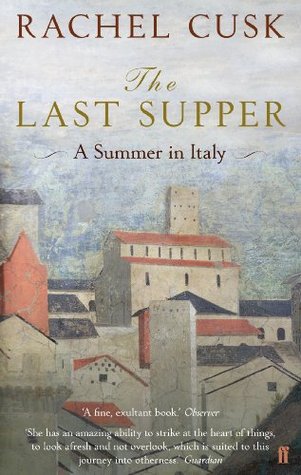 Having moved away from Bristol, Cusk and her family (a husband and two children) decided to spend a summer in Italy before deciding where to go next. They took the boat to France then drove, made a stop in Lucca, and settled into a rented house on the eastern edge of Tuscany. It proceeded to rain for 10 days. Cusk learns to speak the vernacular of football and Catholicism – but Italian eludes her: “I too feel humbled, feel childlike and impotent. It is hard to feel so primitive, so stupid.” They glory in the food, elemental and unpretentious; they try a whole spectrum of gelato flavors. And they experience as much culture as they can: “we will learn to fillet an Italian city of its artworks with the ruthless efficiency of an English aristocrat de-boning a Dover sole.” A number of these masterpieces are reproduced in the text in black and white. In the grip of a heatwave, they move on to Rome, Naples and Capri.
If I’d been able to get hold of this for my trip to Milan (it was on loan at the time), I might have enjoyed it enough to read the whole thing. As it is, I just had a quick skim through. Cusk can write evocatively when she wishes to (“We came here over the white Apuan mountains, leaving behind the rose-coloured light of the coast … up and up into regions of dazzling ferocity where we wound among deathly white peaks scarred with marble quarries, along glittering chasms where the road fell away into nothingness and we clung to our seats in terror”), but more often resorts to flat descriptions of where they went and what they did. I’m pretty sure Transit was a one-off and I’ll never warm to another Cusk book.
DNFs: Alas, One Summer: America, 1927 by Bill Bryson and The Go-Between by L. P. Hartley were total non-starters. Maybe some other day (make that year).
See also my 2017 and 2018 “summer” reads, all linked by the season appearing in the title.
Have you read any summer-appropriate books lately?
August Thoughts (via Song Lyrics and Book Quotes)
Can’t believe I let the summer slip away again
Like watermelon juice dripping down my chin
It might be light enough for one last swim
If we hurry on down to the shore
A fool would ask for more
A fool would ask for more
~from “August” by Mark Erelli
Summer is winding down here in southern England. The chilly nights and mornings and the huge ripe blackberries tell us autumn will be here soon. Did I make enough of the summer? Or did I so ardently escape the heat, here and in America, that I didn’t let myself enjoy it?
 We didn’t end up making a summer pudding this year. It’s an old-fashioned, grown-up dessert made of almost nothing but white bread and fresh berries, but if you want to taste July in a bowl this is it. Sweetness from strawberries and raspberries; only just palatable sharpness from currants; smoothness from a generous pouring of cream. As my husband says each year, who knows how many more annual summer puddings we’ll get? Food traditions are as important a way of marking the passing of time and the seasons’ gifts as anything else.
~
I’ve had “August” by Mark Erelli, a New England folk singer/songwriter we discovered through The Darwin Song Project, in my head for weeks and weeks. It presents scenes from a languid summer evening that appeal to my nostalgia for my American childhood. More than that, though, its recurring line – “A fool would ask for more” – encourages me to be grateful for what I have and to appreciate these ordinary, fleeting moments.
“You’re one of those people who wants everything but what they have.” So Ruth, dying of breast cancer, skewers her best friend Ann, the narrator of Talk before Sleep by Elizabeth Berg. That line stung a little, because I fear it’s true of me. When I’m in America I’m silently contemptuous of the lavish lifestyle and the can-do attitude; as soon as I’m back in England I stew in my cluttered house and my shabby little life. I envy friends with design magazine-worthy homes (but I don’t want the hassle of owning a house), sweet kids (but I don’t want to have children), stable careers (but I don’t want a regular job), and comfortable habits not needled by environmental and ethical dilemmas (but once you know you can’t go back).
~
My five-year freelancing anniversary passed quietly at the end of July. Being a freelancer has all the perks you’d expect – no boss or co-workers, at least not in the traditional sense; no commute; flexibility; variety – but also some downsides you might not realize. In my case, it means I virtually never leave my house, and I’m sedentary and sitting most of the time. I don’t get vacation time or sick pay, I have to muddle through my taxes in two countries, and I put hours and hours of work into assignments that pay insultingly little.
When asked recently for advice about freelance writing, I warned that it is extremely difficult to make money from writing about books – so if you want to do it, be sure you’re just doing it for the love of books, and secure another source of income. For me that’s proofreading science journal articles. It’s something I’m good at and find just challenging enough to keep me stimulated, but if I’m honest I don’t really care about this work. It’s just a paycheck.
To put it simply, I’m bored. Some of my writing gigs have spanned the full five years, and I’m still doing exactly the same things. I’ve had a couple small pay rises, but I’m not earning significantly more than I was in 2013, even though I was recently named an associate editor at one of the magazines (an honorary title, alas). I feel restless and like I’m just waiting for the smallest signal to tell me I can drop everything. It would be a relief to let it all go. Julia Cameron captures this feeling in The Artist’s Way: “Restive in our lives, we yearn for more, we wish, we chafe. … We want to do something but we think it needs to be the right something, by which we mean something important.”
So really what I should be doing is aiming higher. I’m now a member of the National Book Critics Circle and have access to a document listing the pay rates for big-name venues, places that pay hundreds of dollars for book reviews and $1+/word for literary articles. But it often takes me months to get up the courage to pitch to a new publication, if I ever do it at all.
In Help Me! (out on September 6th), freelance journalist Marianne Power took on a different self-help book each month for a year to see if she could change her life for the better. One particularly rough month was all about Rejection Therapy. “I should have been constantly sending ideas to different publications but I didn’t. … I didn’t want to get rejected because I would take that as a confirmation of all the insecurities I had in my head – that I was a rubbish writer, that I had been lucky to get even this far, that I would never work again.”
That passage certainly resonated for me. No matter how many hundreds of reviews I write, I still barely trust myself to write another successful one. Temporary triumphs fade fast. Getting a pitch accepted at Literary Hub had been one of the highlights of my year, but pretty much as soon as the article was published on the website I felt deflated. It was a flash in the pan; a few comments and retweets and then it was forgotten before you know it.
I didn’t think I was a flighty person who needed a lot of novelty in my life. But Beryl Markham – lion hunter, horse trainer, aviatrix – has been reminding me that even if you have a good life that many would admire, even if you’d be a fool to ask for more, sometimes you still need a change. Here’s a passage from the formidable adventurer’s West with the Night: “I wonder if I should have a change – a year in Europe this time – something new, something better, perhaps. A life has to move or it stagnates. Even this life, I think. … it is no good anticipating regrets. Every tomorrow ought not to resemble every yesterday.”
My 35th birthday is coming up this autumn. It feels like time for a rethink. What do I want every tomorrow to look like? It’s all too easy to stick with what feels like a sure thing instead of launching into something new.
How do you ensure you’re appreciating your life but also challenging yourself with new things?
Two “Summer” Books
With summer winding down, I decided it was time to read a couple of books with the word in the title to try to keep the season alive. These turned out to be charming, low-key English novels that I would recommend to fans of costume dramas. Both:
I knew very little about Jonathan Smith’s Summer in February when I picked it up in a charity shop. From the ads for the 2013 film adaptation with Dan Stevens, I had in mind that this was an obscure classic. It was actually published in 1995, but is inspired by real incidents spanning 1909 to 1949. It’s set among a group of Royal Academy-caliber artists in Lamorna, Cornwall, including Alfred Munnings, who went on to become the academy’s president.
The crisis comes when Munnings and Captain Gilbert Evans, a local land manager, fall for the same woman. A love triangle might not seem like a very original story idea, but I enjoyed this novel particularly for its Cornish setting (“From dawn to dusk it had rained non-stop, as only Cornwall can”; “The sea was slate grey and the sky streaky bacon”) and for the larger-than-life Munnings, who has a huge store of memorized poetry and is full of outspoken opinions. Two characters describe his contradictions thusly: “I can see he’s crude and loud and unpolished and Joey says he cuts his toenails at picnics but…”; “he’s one in a million, a breath of fresh air, and he’s frank and fearless, which is always a fine thing.” The title refers to the way that love can make any day feel like summer.
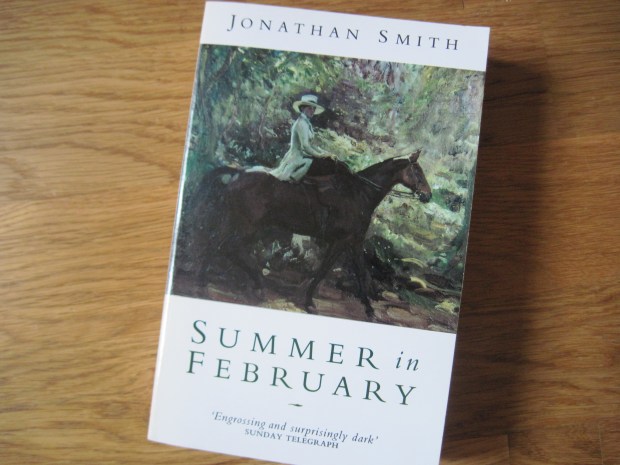
The cover image is the painting Morning Ride by A.J. Munnings.
For more information on Munnings, see here.
For more information on Gilbert Evans, see here. (Beware the spoilers!)
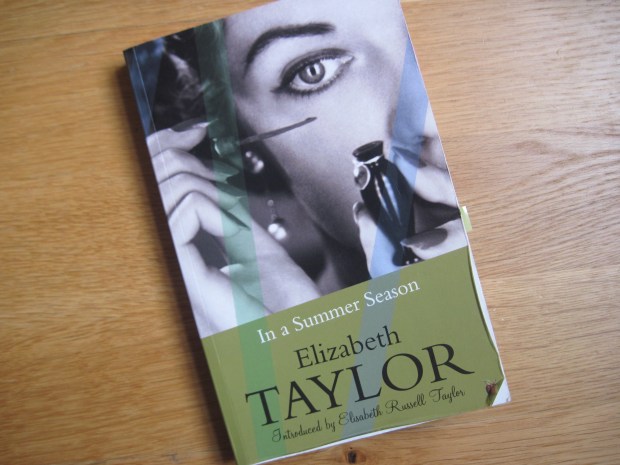
From 1961, In a Summer Season was Elizabeth Taylor’s eighth novel. The ensemble cast is led by Kate Heron – newly remarried to Dermot, a man ten years her junior, after the death of her first husband – and made up of her family circle, a few members of the local community, and her best friend Dorothea’s widower and daughter, who return from living abroad about halfway through the book. Set in the London commuter belt, this is full of seemingly minor domestic dilemmas that together will completely overturn staid life before the end.
From Kate dyeing her hair yet being keen to avoid accusations of “mutton dressed as lamb” to her son Tom’s disgust at his grandfather’s ageing body, old age and wasting one’s time on trivialities are a twin paranoia here. The title is not only a literal note of when much of the action takes place, but also a metaphor for the fleeting nature of happiness (as well as life itself). Kate remembers pleasant days spent with her best friend and their young children: “It was a long summer’s afternoon and it stood for all the others now. There had been many. And she and Dorothea were together day after day. Their friendship was as light and warming as the summer’s air.”
So much happens in the last seven pages. I wished the book could have turned out differently, yet the conclusion effectively sews it all up, and all within a cozy 220 pages. If you enjoy writers like Muriel Spark and Barbara Pym, you must try Elizabeth Taylor. Her work is similarly built around wry, perceptive observations about relationships and ways of life. This was my fourth novel by her, and I’d call it my second favorite so far after Mrs. Palfrey at the Claremont.
(Secondhand books are such good value: These two charity shop paperbacks cost me less than 85 pence in total. Such a low total spend per hour of enjoyment!)
This month I also read The Summer without Men by Siri Hustvedt (discussed here along with a few other recent reads). Earlier in the year I reviewed Ricarda Huch’s The Last Summer, and last year I reviewed the Summer anthology from the Wildlife Trusts. “Summer” turns up fairly frequently in titles of books I’ve read or want to read, in fact. Here’s the whole list!
Have you read any “Summer” books lately?
An Anthology of Summer Reading
In partnership with the UK’s Wildlife Trusts, London-based publisher Elliott & Thompson is celebrating the seasons with a series of anthologies edited by novelist and nature writer Melissa Harrison. My husband had a short piece published in the first volume (Spring), so I was eager to get my hands on a copy of Summer.
 The format in all the books is roughly the same: they’re composed of short pieces that range from one to a few pages and run the gamut from recurring phenological records (Gilbert White and Thomas Furly Forster) and extracts from classic literature (Adam Bede and Far from the Madding Crowd) to recent nature books (Mark Cocker’s Claxton and Paul Evans’s Field Notes from the Edge). In addition, there are new contributions from established writers or talented amateurs, one as young as twelve – heartening proof that young people are still enthused about nature.
With the exception of the poems, none of these entries have titles, and the attribution and date of composition are not given until the very end. The idea behind this pseudo-anonymity, I think, is that if – as I sometimes was – you are patient enough to not skip ahead to discover who wrote it when, you will judge all of the pieces by the same standards. You approach each without expectations, and in many cases may be stumped as to whether the writing is historical or modern. I found W.H. Hudson’s and Mary Webb’s extracts particularly readable, for instance; you wouldn’t guess they’re from the early decades of the twentieth century.
There are 70-some pieces here on a wide variety of subjects, but a few of the ones that struck me were on badger-watching (Caroline Greville, who is writing a memoir on the topic), looking for orchids (environmental journalist Michael McCarthy), moth trapping, and night-time wildlife like glow-worms and bats. I especially appreciated Alexandra Pearce’s essay on the brief life of mayflies and Nicola Chester’s on searching for owls. Of the previously published pieces, Paul Evans’s on ant swarms is a stand-out. My two favorites, though, are from celebrated nature columnist Simon Barnes, who writes about paddling a canoe in Norfolk with his son in search of adventure, and Esther Woolfson, who, as she does in her book Field Notes from a Hidden City, illuminates the unnoticed wildlife of Aberdeen.

Courtesy of Chris Foster
Again and again this message comes through: take the time to look closely and you will find great wonders. “Perhaps as adults our lives are so filled with bills, chores, jobs and other things that we often forget to stop and look at the world around us,” Jan Freedman, curator of natural history at Plymouth City Museum and Art Gallery, astutely notes. Whether it’s lichens or weevils, all you generally have to pay to experience nature’s delights is attention. I loved Alexi Francis’s description of a hare: “Haunches down, nose cross-stitched, it closes its eyes to the sun in a moment of blissful slumber.” Having that moment of communion with nature and then choosing just the right words to capture it is what this book is all about.
Taken together, these pieces truly give the feeling of an English summer. The older writing is remarkably undated, which contributes to a sense of continuity across the centuries. However, the book also evokes more universal notions of summer: those drowsy, leisurely days we gild with nostalgia. As Harrison puts it in her introduction, the longing for summer is really a wish to return to childhood: “Those elysian summers, polished to dazzling brightness by the flow of years, can never be recaptured; but we have this summer, however imperfect we as adults might deem it, and we can go out and seek it at every opportunity we find.”

Courtesy of Chris Foster
As the relatively frequent typos – three in the Barnes piece alone, for example – suggest, the series has been somewhat hastily put together. Nonetheless, these are really rather lovely books. Summer is a perfect bedside companion to dip into as the days warm up. Impossible not to covet the whole four-season set.
With thanks to Marianne Thorndahl at Elliott & Thompson for the free copy for review.
My rating: 
 Bookish Beck = Rebecca Foster. American transplant to England. Freelance proofreader and book reviewer.
