#DoorstoppersInDecember: Book of Lives by Margaret Atwood & The End of Mr. Y by Scarlett Thomas
Later than intended, I’m reporting back on Margaret Atwood’s memoir, which I started in late November, and a long-neglected 500+-page novel I plucked from my shelves. Both offered page-turning intrigue and a blend of history, magic, and pure weirdness. Many thanks to Laura for hosting Doorstoppers in December, which encouraged me to pick them up!
Book of Lives: A Memoir of Sorts by Margaret Atwood (2025)
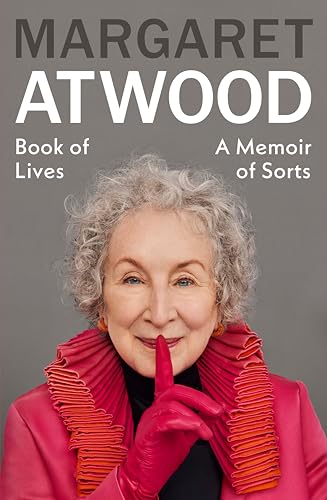 I gave some initial thoughts about the book here to tie in with Margaret Atwood Reading Month. What I said then proved true of the book as a whole: it’s delightful though dense with detail and historical context. I did get a little bogged down in the names and details of decades worth of publishing, but there is some tasty gossip, such as the fact that Margaret Laurence spread mean rumours about her (and was a drunk) but later changed her ways. It’s been a lucky window of time for Atwood to live through: she has known simplicity and the need for do-it-yourself practicality, but has also experienced privilege, even luxury (multiple homes and worldwide travel). Mostly, she had the good fortune of being at the start of Canada’s literary boom. In the early 1960s, only five Canadian novels were published per year. Through her involvement with literary magazines and House of Anansi Press and her books on Susanna Moodie and the tropes of Canadian literature, she helped create the scene.
There are frequent mentions of how people or events made their way into her fiction and poetry. Coyly, she writes, “I just have a teeming imagination. Also, like all novelists, I’m a kleptomaniac.” The page or two of context on each book is illuminating and it never becomes the tedious “I published this book … then I published this book” that she mentioned wanting to avoid in the introduction. Rather, these sections made me want to go reread lots of her books to appreciate them anew. I was also reminded how often she’s been ahead of her time, with topics and details that seem prophetic (she proposed Payback before the financial crisis hit, for instance). Some elements felt particularly timely: she experienced casual misogyny and an alarming number of near-misses – she says things like “I won’t give his name … you know who you are … though you’re probably dead” – and, through her involvement in bird conservation, she’s well aware of the disastrous environmental trajectory we’re on.
For a memoir, this is not especially forthcoming about the author’s inner life and emotions. Where it is, she masks the material in a layer of technique. So when she’s confessing to having an affair while married to Jim Polk (whom she met at Harvard), she writes it like a fairytale scene in which she went into the woods with a wolf. When she was fretting about Graeme Gibson’s reluctance to divorce her first wife and marry her, she imagines letters to her ‘inner advice columnist’. (Note: Gibson was her long-time partner and his sons were like her stepchildren but they never did marry – and he only ‘allowed’ her the one child, though she wanted two of her own. One ‘Jess Gibson’ has a speculative short story collection, The Good Eye, coming out in May 2026. No doubt her work will be compared with her mother’s, but bully for her for not using the name Atwood to try to ride her coattails.)
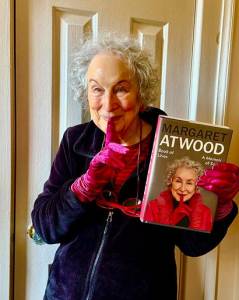
A cute pic from her Substack in November
One of the successful literary touches is the recurring “We Nearly Lose Graeme” segments about his risky behaviour and various mishaps. He had dementia and mini strokes before suffering a major one while in London with her for The Testaments tour; he died five days later. Her reflections on his death are poignant, but generic: “We can all believe three things simultaneously: The person is in the ground. The person is in the Afterlife. The person is in the next room. You keep expecting to see him. Even when you know it’s coming, a death is a shock.” At the crucial moment, she turns to the first-person plural and the second person.
I skimmed some of the bits about Graeme’s earlier life and the behind-the-scenes of publishing; I felt that he and many of her literary pals are more important to her than they are to readers. But that’s okay. The same goes for her earlier life; I noted that the account of her time as a summer camp counsellor felt more detailed than necessary. However, with her gift for storytelling, even the smallest incident can be rendered amusing. She looks for the humour, coincidence, or irony in any situation, and her summations and asides are full of dry humour. Some examples:
- “Spoiler: Jim and I eventually got married, one of the odder things to happen to both of us.”
- “After a while, the hand [at the window of her Harvard student accommodation] went away. It’s what you wish for in a disembodied hand.”
- “Eventually the iguana [inherited from her roommate] was given a new home at a zoo among other iguanas, where it was probably happier. Hard to tell.”
It’s not a book for the casual reader who kinda liked one or two Atwood novels; it’s more for the diehard fans among us, and offers a veritable trove of stories and photographs. But don’t expect a tell-all. Think of this more as a companion to her oeuvre. The title feels literal in that it’s as if she’s lived several lives: the wilderness kid, the literary ingénue, the family and career woman, the philanthropist and elder stateswoman. She doesn’t try to pull all of her incarnations into one, instead leaving all of the threads trailing into the beyond. If anything, “Peggy Nature” (her name from summer camp) is the role that has persisted. I probably liked the childhood material most, which makes sense as it’s what she’s looking back on with most fondness. Towards the close, Atwood mentions her heart condition and seems perfectly accepting of the fact that she won’t be around for much longer. But her body of work will endure. I’m so grateful for it and for the gift of this self-disclosure, however coy. (Can I be greedy and hope for another novel?) She leaves this message: “We scribes and scribblers are time travellers: via the magic page we throw our voices, not only from here to elsewhere, but also from now to a possible future. I’ll see you there.” [570 pages] (Public library) 
The End of Mr. Y by Scarlett Thomas (2006)
 This is a mash-up of the campus novel, the Victorian pastiche, and the time travel adventure. Ariel Manto is a PhD student working on thought experiments. Inciting incidents come thick and fast: her supervisor disappears, the building that houses her office partially collapses as it’s on top of an old railway tunnel, and she finds a copy of Thomas Lumas’s vanishingly rare The End of Mr. Y in a box of mixed antiquarian stock going for £50 at a secondhand bookshop. Rumour has it the book is cursed, and when Ariel realises that the key page – giving a Victorian homoeopathic recipe for entering the “Troposphere,” a dream/thought realm where one travels through time and space – has been excised, she knows the quest has only just begun. It will involve the book within a book, Samuel Butler novels, a theologian and a shrine, lab mice plus the God of Mice, and a train line whose destinations are emotions.
The plot is pretty bonkers and I’m not sure I can satisfactorily explain its internal logic now, but as is true of the best doorstoppers, it absorbed me completely. I read it very quickly (for me) and even read 120 pages in one sitting thanks to my cat pinning me to the sofa. It also felt prescient in discussing “machine consciousness” – a topic adjacent to artificial intelligence. Ariel is a Disaster Woman avant la lettre, living on noodles and cut-price wine. Her current ‘relationship’ consisting of rough sex with a married professor is the latest in a string of unhealthy connections. But time travel offers the possibility not just of reversing her own mistakes, but of going right back to the start of humanity. Verging on steampunk, this was much better than the other Thomas novels I’ve read, The Seed Collectors and Oligarchy. It was longlisted for the Orange (Women’s) Prize and would be a great choice for readers of Nicola Barker and Susanna Clarke. [502 pages] (Secondhand – Book-Cycle, Exeter; it’s been on my shelves since 2016!) 
Mrs. Shields & Me: (Re)reading Carol Shields in 2020
It’s pure happenstance that I started reading Carol Shields’s work in 2006.

2005: When I first returned to England for my MA program at Leeds, I met a PhD student who was writing a dissertation on contemporary Canadian women writers. At that point I could literally name only one – Margaret Atwood – and I hadn’t even read anything by her yet.
2006: Back in the States after that second year abroad, living with my parents and killing time until my wedding, I got an evening job behind the circulation desk of the local community college library. A colleague passed on four books to me one day. By tying them up in a ribbon, she made a gift out of hand-me-downs: The Giant’s House, The Secret History, and two by Shields: Happenstance and The Stone Diaries. I’ve gone on to read most or all of the books by these authors, so I’m grateful to this acquaintance I’ve since lost touch with.
The inspiration for my post title.
Starting in June this year, I joined Marcie of Buried in Print in reading or rereading six Shields novels. She’s been rereading Shields for many years, and I benefited from her insight and careful attention to connections between the works’ characters and themes during our buddy reads. I’d treated myself to a secondhand book binge in the first lockdown, including copies of three Shields novels I’d not read before. We started with these.
Small Ceremonies (1976)
Shields’s debut ended up being my surprise favorite. A flawless novella, it brings its many elements to a satisfying conclusion and previews the author’s enduring themes in 180 pages. Judith is working on a third biography, of Susanna Moodie, and remembering the recent sabbatical year that she and her husband, a Milton scholar, spent with their two children in Birmingham. High tea is a compensating ritual she imported from a dismal England. She also brought back an idea for a novel. Meanwhile family friend Furlong Eberhardt, author of a string of twee, triumphantly Canadian novels, is casting around for plots.
 What ensues is something of a sly academic comedy à la David Lodge, laced with Shields’s quiet wisdom on marriage, parenting, the writer’s vocation, and the difficulty of ever fully understanding another life. Specific links to her later work include a wonderful dinner party scene with people talking over each other and a craft project.
The Box Garden (1977)
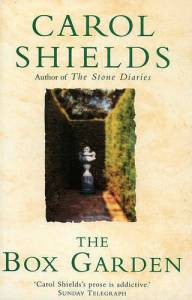 The companion novel to Small Ceremonies is narrated by Judith’s sister Charleen, a poet and single mother who lives in Vancouver and produces the National Botanical Journal. I imagined the sisters representing two facets of Shields, who had previously published poetry and a Moodie biography. Charleen is preparing to travel to Toronto for their 70-year-old mother’s wedding to Louis, an ex-priest. Via flashbacks and excruciating scenes at the family home, we learn how literally and emotionally stingy their mother has always been. If Charleen’s boyfriend Eugene’s motto is to always assume the best of people, her mother’s modus operandi is to assume she’s been hard done by.
The title comes from the time when a faithful Journal correspondent, the mysterious Brother Adam, sent Charleen some grass seed to grow in a window box – a symbol of thriving in spite of restrictive circumstances. I thought the plot went off in a silly direction, but loved the wedding reception. Specific links to Shields’s later work include a botanical hobby, a long train journey, and a final scene delivered entirely in dialogue. 
A Celibate Season (1991)
“We’re suffering a communication gap, that’s obvious.”
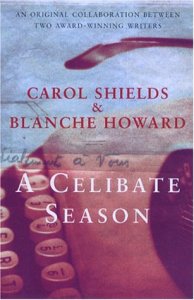 This epistolary novel was a collaboration: Blanche Howard wrote the letters by Jocelyn (“Jock”), who’s gone to Ottawa to be the legal counsel for a commission looking into women’s poverty, while Shields wrote the replies from her husband Charles (“Chas”), an underemployed architect who’s keeping the home fire burning back in Vancouver. He faces challenges large and small: their daughter’s first period versus meal planning (“Found the lentils. Now what?”). The household starts comically expanding to include a housekeeper, Chas’s mother-in-law, a troubled neighbor, and so on.
Both partners see how the other half lives. The misunderstandings between them become worse during their separation. Howard and Shields started writing in 1983, and the book does feel dated; they later threw in a jokey reference to the unreliability of e-mail to explain why the couple are sending letters and faxes. Two unsent letters reveal secrets Jock and Chas are keeping from each other, which felt like cheating. I remained unconvinced that so much could change in 10 months, and the weird nicknames were an issue for me. Plus, arguing about a solarium building project? Talk about First World problems! All the same, the letters are amusing.
Rereads
Happenstance (1980/1982)
 This was the first novel I read by Shields. My Penguin paperback gives the wife’s story first and then you flip it over to read the husband’s story. But the opposite reflects the actual publishing order: Happenstance is Jack’s story; two years later came Brenda’s story in A Fairly Conventional Woman. The obvious inheritor of the pair is A Celibate Season with the dual male/female narratives, and the setups are indeed similar: a man is left at home alone with his teenage kids, having to cope with chores and an unexpected houseguest.
What I remembered beforehand: The wife goes to a quilting conference; an image of a hotel corridor and elevator.
Happenstance
Jack, a museum curator in Chicago, is writing a book about “Indian” trading practices (this isn’t the word we’d use nowadays, but the terminology ends up being important to the plot). He and his best friend Bernie, who’s going through a separation, are obsessed with questions of history: what gets written down, and what it means to have a sense of the past (or not). I loved all the little threads, like Jack’s father’s obsession with self-help books, memories of Brenda’s vivacious single mother, and their neighbor’s failure as Hamlet in a local production. I also enjoyed an epic trek in the snow in a final section potentially modeled on Ulysses. 
A Fairly Conventional Woman
“Aside from quiltmaking, pleasantness was her one talent. … She had come to this awkward age, forty, at an awkward time in history – too soon to be one of the new women, whatever that meant, and too late to be an old-style woman.”
Brenda is in Philadelphia for a quilting conference. Quilting, once just a hobby, is now part of a modern art movement and she earns prizes and hundreds of dollars for her pieces. The hotel is overbooked, overlapping with an International Society of Metallurgists gathering, and both she and Barry from Vancouver, an attractive metallurgist in a pinstriped suit whom she meets in the elevator, are driven from their shared rooms by roommates bringing back one-night stands. This doesn’t add anything to the picture of a marriage in Jack’s story and I only skimmed it this time. It’s a wonder I kept reading Shields after this, but I’m so glad I did! 
I reviewed these last two earlier this year. They were previously my joint favorites of Shields’s work, linked by a gardening hobby, the role of chance, and the unreliability of history and (auto)biography. They remain in my top three.
 The Stone Diaries (1995)
What I remembered beforehand: a long train ride, a friend who by the feeling ‘down there’ thought that someone had had sex with her the night before, and something about the Orkney Islands.

 Larry’s Party (1997)
What I remembered beforehand: a food poisoning incident (though I’d thought it was in one of Shields’s short stories), a climactic event involving a garden maze, a chapter entitled “Larry’s Penis,” and the closing dinner party scene.

Looking back: Fortunately, in the last 15 years I’ve done something to redress my ignorance, discovering Canadian women writers whom I admire greatly: Elizabeth Hay, Margaret Laurence, Mary Lawson and especially Margaret Atwood and Carol Shields.
Looking out: “I am watching. My own life will never be enough for me. It is a congenital condition, my only, only disease in an otherwise lucky life. I am a watcher, an outsider whether I like it or not, and I’m stuck with the dangers that go along with it. And the rewards.”
- That’s Judith on the last page of Small Ceremonies. It’s also probably Shields. And, to an extent, it seems like me. A writer, but mostly a reader, absorbing other lives.
Looking forward: I’m interested in rereading Shields’s short stories and Mary Swann (to be reissued by World Editions in 2021). And, though I’ve read 13 of her books now, there are still plenty of unread, lesser-known ones I’ll have to try to find secondhand one day. Her close attention to ordinary lives and relationships and the way we connect to the past makes her work essential.
 Bookish Beck = Rebecca Foster. American transplant to England. Freelance proofreader and book reviewer.
 Bookish Beck