My Best Backlist Reads of the Year
Like many bloggers and other book addicts, I’m irresistibly drawn to the new books released each year. However, I consistently find that many memorable reads were published earlier. A few of these are from 2022 or 2023 and most of the rest are post-2000; the oldest is from 1910. These 14 selections (alphabetical within genre but in no particular rank order), together with my Best of 2024 post coming up on Tuesday, make up about the top 10% of my year’s reading. Repeated themes included adolescence, parenting (especially motherhood) and trauma. The two not pictured below were read electronically.

Fiction
Fun facts:
- I read 4 of these for book club (Forster, Mandel, Munro and Obreht)
- 3 (Mandel, McEwan and Obreht) were rereads
- I read 2 as part of my Carol Shields Prize shadowing (Foote and Zhang)
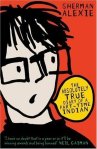 The Absolutely True Diary of a Part-Time Indian by Sherman Alexie: Groundbreaking for both Indigenous literature and YA literature, this reads exactly like a horny 14-year-old boy’s diary, but “Junior” (Arnold Spirit, Jr.) is also self-deprecating and sweetly vulnerable. Poverty, alcoholism, casinos: they don’t feel like clichés of Indian reservations because Alexie writes from experience and presents them matter-of-factly. Junior moves to a white high school and soon becomes adept at code-switching (and cartooning). Heartfelt; spot on.
 The Street by Bernardine Bishop: A low-key ensemble story about the residents of one London street: a couple struggling with infertility, a war veteran with dementia, and so on. Most touching is the relationship between Anne and Georgia, a lesbian snail researcher who paints Anne’s portrait; their friendship shades into quiet, middle-aged love. Beyond the secrets, threats and climactic moments is the reassuring sense that neighbours will be there for you. Bishop’s style reminds me most of Tessa Hadley’s. A great discovery.
 Coleman Hill by Kim Coleman Foote: Is this family memoir? Or autofiction? Foote draws on personal stories but also invokes overarching narratives of Black migration and struggle. The result is magisterial, a debut that is like oral history and a family scrapbook rolled into one, with many strong female characters. Like a linked story collection, it pulls together 15 vignettes from 1916 to 1989 and told in different styles and voices, including AAVE. The inherited trauma is clear, yet Foote weaves in counterbalancing lightness and love.
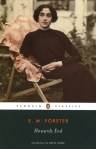 Howards End by E.M. Forster: Rereading for book club, I was so impressed by its complexities – the illustration of class, the character interactions, the coincidences, the deliberate doublings and parallels. It covers so many issues, always without a heavy touch. So many sterling sentences: depictions of places, observations of characters, or maxims that are still true of life. Well over a century later and the picture of well-meaning wealthy intellectuals’ interference making others’ lives worse is just as cutting.
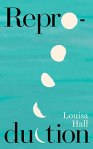 Reproduction by Louisa Hall: Procreation. Duplication. Imitation. All three connotations are appropriate for the title of an allusive novel about motherhood and doppelgangers. A pregnant writer starts composing a novel about Mary Shelley and finds the borders between fiction and (auto)biography blurring. It’s a recognisable piece of autofiction, with a sublime clarity as life is transcribed to the page exactly as it was lived. A tale of transformation – chosen or not – and peril in a country hurtling toward self-implosion. Brilliantly envisioned.
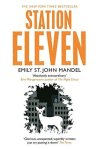 Station Eleven by Emily St. John Mandel: This has persisted as a definitive imagination of post-apocalypse life. On a reread, I was captivated by the different layers of the nonlinear story, from celebrity gossip to a rare graphic novel series, and the links between characters and storylines. Mandel also seeds subtle connections to later work. Themes that struck me were the enduring power of art and the value of the hyperlocal. It seems prescient of Covid-19, but more so of climate collapse. An ideal blend of the literary and the speculative.
 On Chesil Beach by Ian McEwan: A perfect novella. Its core is the July 1962 night when Edward and Florence attempt to consummate their marriage, but it stretches back to cover everything we need to know about them – their family dynamics, how they met, what they want from life – and forward to see their lives diverge. Is love enough? It’s a maturing of the author’s vision: tragedy is not showy and grotesque like in his early work, but quiet, hinging on the smallest action, the words not said. This absolutely flayed me emotionally on a reread.
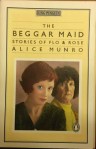 The Beggar Maid by Alice Munro: Linked short stories about a hardscrabble upbringing in small-town Ontario and a woman’s ongoing search for love. Rose’s stepmother Flo is resentful and stingy. She feels she’s always been hard done by, and takes it out on Rose. From early on, we know Rose makes it out of West Hanratty and gets a chance at a larger life, that her childhood becomes a tale of deprivation. Each story is intense, pitiless, and practically as detailed as an entire novel. Rich in insight into characters’ psychology.
 The Tiger’s Wife by Téa Obreht: Natalia, a medical worker in a war-ravaged country, learns of her grandfather’s death away from home. The only one who knew the secret of his cancer, she sneaks away from an orphanage vaccination program to reclaim his personal effects, hoping they’ll reveal something about why he went on this final trip. On this reread I was utterly entranced, especially by the sections about The Deathless Man. I had forgotten the medical element, which of course I loved. My favourite Women’s Prize winner.
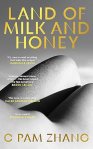 Land of Milk and Honey by C Pam Zhang: On a smog-covered planet where 98% of crops have failed, scarcity reigns – but there is a world apart, a mountaintop settlement at the Italian border where money can buy anything. The 29-year-old Chinese American chef’s job is to produce lavish, evocative multi-course meals. Her relationship with her employer’s 21-year-old daughter is a passionate secret. Each sentence is honed to flawlessness, with paragraphs of fulsome descriptions of meals. A striking picture of desire at the end of the world.
Nonfiction
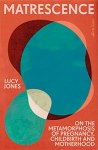 Matrescence: On the Metamorphosis of Pregnancy, Childbirth and Motherhood by Lucy Jones: A potent blend of scientific research and stories from the frontline. Jones synthesizes a huge amount of information into a tight narrative structured thematically but also proceeding chronologically through her own matrescence. The hybrid nature of the book is its genius. There’s a laser focus on her physical and emotional development, but the statistical and theoretical context gives a sense of the universal. For anyone who’s ever had a mother.
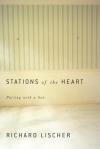 Stations of the Heart: Parting with a Son by Richard Lischer: Lischer opens by looking back on the day when his 33-year-old son Adam called to tell him his melanoma was back. Tests revealed metastases everywhere, including in his brain. The next few months were a Calvary of sorts, and Lischer, an emeritus professor at Duke Divinity School, draws deliberate parallels with biblical and liturgical preparations for Good Friday. His prose is a just right match: stately, resolute and weighted with spiritual allusion, yet never morose.
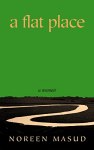 A Flat Place by Noreen Masud: A travel memoir taking in flat landscapes of the British Isles. But flatness is a psychological motif as well as a topographical reality. Growing up with a violent Pakistani father and passive Scottish mother, Masud chose the “freeze” option in fight-or-flight situations. A childhood lack of safety, belonging and love left her with complex PTSD. Her portrayals of sites and journeys are engaging and her metaphors are vibrant. Geography, history and social justice are a backdrop for a stirring personal story.
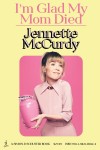 I’m Glad My Mom Died by Jennette McCurdy: True to her background in acting and directing, the book is based around scenes and dialogue, and present-tense narration mimics her viewpoint starting at age six. Much imaginative work was required to make her chaotic late-1990s California household, presided over by a hoarding Mormon cancer survivor, feel real. Abuse, eating disorders, a paternity secret: The mind-blowing revelations keep coming. So much is sad. And yet it’s a very funny book in its observations and turns of phrase.
What were some of your best backlist reads this year?
Three on a Theme: Tiger Novels (Polly Clark, Tania James, Téa Obreht)
I was sent Loot for review, picked The Tiger’s Wife – a reread for me – as our February book club book, and then couldn’t resist making it a trio with Tiger as it was also a good excuse to pick up a book that had sat on my shelves unread for several years. In all three, the tiger is an emblem of wildness and mystery – and often of danger, too (“you must rid us of this devil in his fiery pajamas,” the village priest begs the hunter in The Tiger’s Wife).
Tiger by Polly Clark (2019)
 I was fully engaged with the 150 or so pages of Part I, which is narrated by Dr Frieda Bloom, a zookeeper knowledgeable about and fascinated by bonobos. She’s also a morphine addict who continues to justify using at work (not to mention stealing from the veterinary supplies) until she is caught and fired. It’s all in response to a random act of violence: a man attacked her outside a Tube station late one night and she was lucky to have survived the head injury. In ignominy, she moves from a prestigious research institute to a rundown local zoo where the star new acquisition is an injured tiger named Luna. She develops an amazing rapport with Luna, even spending time in the enclosure with her. Meanwhile, the macho behaviour of her colleague Gabriel makes it seem like Frieda could be a victim again at any time.
But then we jump back in time and to the Russian taiga to meet, through third-person segments, a conservationist who hears about a mighty Siberian tigress, and a mother and daughter who encounter her for themselves. This turns out to be “the Countess,” Luna’s mother, and Frieda, a few years on now, travels to Russia herself to bring back one of Luna’s cubs. The focus, as the title signals, is on the tiger herself, but my interest was only ever in Frieda, and it was a little confusing how quickly she switches allegiance from primates to tigers. More first-person narration might have kept me engaged, or maybe a different order to the sections? Anything to keep me latching onto Frieda and missing her for most of the book. (Instagram giveaway win) 
Loot by Tania James (2023)
A halfhearted skim. It’s a shame that when I was offered this for review I didn’t remember I’d read something by Tania James before. The Tusk that Did the Damage, from 2016, is a composite picture of the state of wildlife conservation in India told from three perspectives: an elephant named The Gravedigger, a poacher, and a documentary filmmaker. That was a book I had to force myself through because of the lacklustre storytelling and character development, and I found the same here. Historical fiction can be tedious when it assumes that an unusual setting and intriguing incident are enough to maintain reader interest. Abbas, a woodcarver, is only 17 when he is taken to the sultan’s palace to be apprenticed to a French clockmaker. Together, they create the real-life automaton known as Tippoo’s Tiger and held at the V&A Museum. When the automaton is plundered, Abbas sets out on a quest to rescue it. I never warmed to any of the characters here, even though du Leze’s adopted daughter Jehanne is a promising one. If it’s automata that intrigue you, read The Weather Woman instead. 

[Now on the Carol Shields Prize for Fiction longlist]
With thanks to Harvill Secker for the free copy for review.
The Tiger’s Wife by Téa Obreht (2011)
What I remembered: a wartime Eastern European (Bosnian?) story that incorporated legends.
What I rediscovered:
Natalia, a medical worker in a war-ravaged country, learns of her grandfather’s death away from home. The only one who knew the secret of his cancer, she sneaks away from an orphanage vaccination program to reclaim his personal effects, hoping they’ll reveal something about why he went on this final trip. Something is missing from his belongings: his beloved copy of The Jungle Book, which sparked a lifelong fascination with tigers. When war broke out mid-century and a tiger escaped from the zoo, he was nine years old. He and the butcher’s wife, a pregnant, deaf-mute Muslim woman with whom he communicated by scratching images in the dirt, were thrilled by the tiger’s nocturnal skulking rather than frightened like the rest of the villagers. Her outcast status led people to ignore the fact that she was a victim of domestic violence and to spin tales about her unnatural connection with the tiger, spreading rumours about the child she was carrying (“The Tiger’s Wife”).
 In the years to come, during Natalia’s grandfather’s career as a doctor, he had several encounters with Gavran Gailé, “The Deathless Man,” a troubadour who seemed, vampire- or zombie-like, to survive every attempt on his life. In service to his uncle, Gavran Gailé read people’s coffee grounds to inform them of their impending death, but his own cup was bare and unbreakable. Natalia’s grandfather, a man of science, didn’t believe Gavran Gailé’s claims and agreed to a wager. Gavran Gailé would walk into a lake, tied up in chains attached to cement blocks, and pull on a rope when he started drowning. His pledge was his cup; the doctor’s was The Jungle Book, his most treasured possession. But as promised, Gavran Gailé spent an hour underwater and emerged from the lake none the worse the wear.
Natalia knows her grandfather’s final journey must have been to meet The Deathless Man, who collected on his pledge. She’ll have her own encounter with him before the end.
This is a demanding read, in that there are not a lot of orienting details and the several storylines surge in and out through flashbacks and oral storytelling. It takes effort and commitment to keep reading in the hope that everything will come together. This was a flop for my book club in that only three people had read it so we decided it wasn’t worth meeting. One who did finish it commented that it felt like three separate stories, and I see what she means. Obreht could certainly have made the links and chronology more obvious. Instead, each chapter is such a honed and self-contained narrative, often focused on a different peripheral character, that the book almost reads like a set of linked short stories. On this reread I was absolutely entranced, especially by the sections about The Deathless Man. I had forgotten the medical element, which of course I loved.
It can be depressing looking back at amateur reviews I wrote in my pre-freelancing days because I have not notably advanced since then. This response I wrote when I read the brand-new book in 2011 is allusive, opinionated, and admirably absent of dull plot summary. Could I do any better now if I tried? (Though I think I maybe misunderstood the ending back then.)
Had I reread this sooner, it would have been tough to choose between it and Larry’s Party, my ultimate selection, for the Women’s Prize Winners 25th anniversary reader vote. Were I to vote again today, I’d join Laura in choosing The Tiger’s Wife instead. (Public library)
My original rating (2011): 
My rating now: 
Eleanor recently reviewed it, too.
There was a clear winner here: The Tiger’s Wife!
See also Laura’s fab series on tiger novels from her old blog. This is the first post and there are more listed in the right-hand sidebar.
I searched my Goodreads library for others I’ve read and the only books she didn’t cover were Nick Harkaway’s Tigerman, a disappointment after Angelmaker; and (nonfiction) Margaux Fragoso’s Tiger, Tiger (title from a William Blake line), a memoir of childhood sexual abuse, and Ruth Padel’s Tigers in Red Weather, a travelogue – it happens to share a title with Liza Klausmann’s novel, which is likewise named after a line in the Wallace Stevens poem “Disillusionment of Ten O’Clock.”
Book Serendipity, January to February 2024
I call it “Book Serendipity” when two or more books that I read at the same time or in quick succession have something in common – the more bizarre, the better. This is a regular feature of mine every couple of months. Because I usually have 20–30 books on the go at once, I suppose I’m more prone to such incidents. The following are in roughly chronological order.
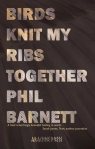
- I finished two poetry collections by a man with the surname Barnett within four days in January: Murmur by Cameron Barnett and Birds Knit My Ribs Together by Phil Barnett.

- I came across the person or place name Courtland in The Optimist’s Daughter by Eudora Welty, then Cortland in a story from The Orange Fish by Carol Shields, then Cotland (but where? I couldn’t locate it again! Was it in Elizabeth Is Missing by Emma Healey?).
- The Manet painting Olympia is mentioned in Christmas Holiday by W. Somerset Maugham and The Paris Novel by Ruth Reichl (both of which are set in Paris).


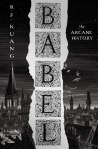
- There’s an “Interlude” section in Babel by R.F. Kuang and The Vulnerables by Sigrid Nunez.
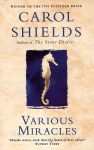
- The Morris (Minor) car is mentioned in Elizabeth Is Missing by Emma Healey and Various Miracles by Carol Shields.
- The “flour/flower” homophone is mentioned in Babel by R.F. Kuang and Various Miracles by Carol Shields.
- A chimney swift flies into the house in Cat and Bird by Kyoko Mori and The Optimist’s Daughter by Eudora Welty.
- A character named Cornelius in The Fruit Cure by Jacqueline Alnes and Wellness by Nathan Hill.
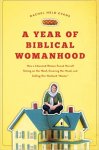
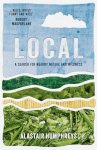
- Reading two year challenge books at the same time, A Year of Biblical Womanhood by Rachel Held Evans and Local by Alastair Humphreys, both of which are illustrated with frequent black-and-white photos by and of the author.
- A woman uses a bell to summon children in one story of Universally Adored and Other One Dollar Stories by Elizabeth Bruce and The Optimist’s Daughter by Eudora Welty.
- Apple turnovers get a mention in A Year of Biblical Womanhood by Rachel Held Evans and Wellness by Nathan Hill.
- A description of rolling out pie crust in A Year of Biblical Womanhood by Rachel Held Evans and Cat and Bird by Kyoko Mori.

- The idea of a house giving off good or bad vibrations in Wellness by Nathan Hill and a story from Various Miracles by Carol Shields.

- Emergency C-sections described or at least mentioned in Brother Do You Love Me by Manni Coe, The Unfamiliar by Kirsty Logan, Wellness by Nathan Hill, and lots more.
- Frustration with a toddler’s fussy eating habits, talk of “gentle parenting” methods, and mention of sea squirts in Wellness by Nathan Hill and Matrescence by Lucy Jones.
- The nickname “Poet” in The Tidal Year by Freya Bromley and My Friends by Hisham Matar.
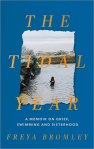
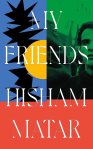
- A comment about seeing chicken bones on the streets of London in The Tidal Year by Freya Bromley and Went to London, Took the Dog by Nina Stibbe.
- Swans in poetry in The Tidal Year by Freya Bromley and Egg/Shell by Victoria Kennefick.
- A mention or image of Captcha technology in Egg/Shell by Victoria Kennefick and Went to London, Took the Dog by Nina Stibbe.
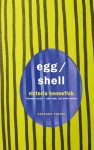

- An animal automaton in Loot by Tania James and Egg/Shell by Victoria Kennefick.
- A mention of Donna Tartt in The Tidal Year by Freya Bromley, Looking in the Distance by Richard Holloway, and Matrescence by Lucy Jones.
- Cathy Rentzenbrink appears in The Tidal Year by Freya Bromley and Went to London, Took the Dog by Nina Stibbe.
 Dialogue is given in italics in the memoirs The Tidal Year by Freya Bromley and The Unfamiliar by Kirsty Logan.
- An account of a man being forced to marry the sister of his beloved in A Year of Biblical Womanhood by Rachel Held Evans, Wellness by Nathan Hill, and The Tiger’s Wife by Téa Obreht.
- Saying that one doesn’t want to remember the loved one as ill (but really, not wanting to face death) so not saying goodbye (in Cat and Bird by Kyoko Mori) or having a closed coffin (Wellness by Nathan Hill).
- An unhappy, religious mother who becomes a hoarder in Wellness by Nathan Hill and I’m Glad My Mom Died by Jennette McCurdy.
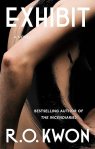
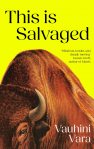
- Characters called Lidija and Jin in Exhibit by R. O. Kwon and Lydia and Jing in the first story of This Is Salvaged by Vauhini Vara.
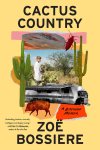
- Distress at developing breasts in Cactus Country by Zoë Bossiere and I’m Glad My Mom Died by Jennette McCurdy.
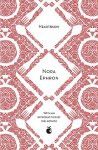
- I came across mentions of American sportscaster Howard Cosell in Heartburn by Nora Ephron and Stations of the Heart by Richard Lischer (two heart books I was planning on reviewing together) on the same evening. So random!
- Girls kissing and flirting with each other (but it’s clear one partner is serious about it whereas the other is only playing or considers it practice for being with boys) in Cactus Country by Zoë Bossiere and Winter’s Bone by Daniel Woodrell.
- A conversion to Catholicism in Places I’ve Taken My Body by Molly McCully Brown and Stations of the Heart by Richard Lischer.
- A zookeeper is attacked by a tiger when s/he goes into the enclosure (maybe not the greatest idea!!) in Tiger by Polly Clark and The Tiger’s Wife by Téa Obreht.
- The nickname Frodo appears in Tiger by Polly Clark and Brother Do You Love Me by Manni Coe.
- Opening scene of a parent in a coma, California setting, and striking pink and yellow cover to Death Valley by Melissa Broder and I’m Glad My Mom Died by Jennette McCurdy.

- An Englishman goes to Nigeria in Howards End by E.M. Forster and Immanuel by Matthew McNaught.
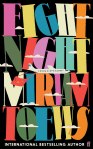 The Russian practice of whipping people with branches at a spa in Tiger by Polly Clark and Fight Night by Miriam Toews.
- A mother continues washing her daughter’s hair until she is a teenager old enough to leave home in Mrs. March by Virginia Feito and I’m Glad My Mom Died by Jennette McCurdy.
- Section 28 (a British law prohibiting the “promotion of homosexuality” in schools) is mentioned in A Bookshop of One’s Own by Jane Cholmeley, Some Kids I Taught and What They Taught Me by Kate Clanchy, and Brother Do You Love Me by Manni Coe.
- Characters named Gord (in one story from Various Miracles by Carol Shields, and in Fight Night by Miriam Toews), Gordy (in The Absolutely True Diary of a Part-Time Indian by Sherman Alexie), and Gordo (in Blood Red by Gabriela Ponce).

- Montessori and Waldorf schools are mentioned in Cactus Country by Zoë Bossiere and When Fragments Make a Whole by Lory Widmer Hess.
- A trailer burns down in The Absolutely True Diary of a Part-Time Indian by Sherman Alexie and Cactus Country by Zoë Bossiere.
What’s the weirdest reading coincidence you’ve had lately?
My Most Anticipated Releases of the Second Half of 2019
Although over 90 books from the second half of the year are already on my radar, I’ve managed to narrow it down to the 15 July to November releases that I’m most excited about. I have access to a few of these already, and most of the rest I will try requesting as soon as I’m back from Milan. (These are given in release date order within thematic sections; the quoted descriptions are from the publisher blurbs on Goodreads.)
[By the way, here’s how I did with my most anticipated releases of the first half of the year:
- 16 out of 30 read; of those 9 were somewhat disappointing (i.e., 3 stars or below) – This is such a poor showing! Is it a matter of my expectations being too high?
- 10 I still haven’t managed to find
- 1 print review copy arrived recently
- 1 I have on my Kindle to read
- 1 I skimmed
- 1 I lost interest in]
Fiction
 The Lager Queen of Minnesota by J. Ryan Stradal [July 23, Pamela Dorman Books] Stradal’s Kitchens of the Great Midwest (2015) is one of my recent favorites. This one has a foodie theme again, and sounds a lot like Louise Miller’s latest – two sisters: a baker of pies and a founder of a small brewery. “Here we meet a cast of lovable, funny, quintessentially American characters eager to make their mark in a world that’s often stacked against them.”
 Hollow Kingdom by Kira Jane Buxton [August 6, Grand Central Publishing / Headline Review] As soon as I heard that this was narrated by a crow, I knew I was going to have to read it. (And the Seattle setting also ties in with Lyanda Lynn Haupt’s book.) “Humanity’s extinction has seemingly arrived, and the only one determined to save it is a foul-mouthed crow whose knowledge of the world around him comes from his TV-watching education.”
 Inland by Téa Obreht [August 13, Random House / Weidenfeld & Nicolson] However has it been eight years since her terrific debut novel?! “In the lawless, drought-ridden lands of the Arizona Territory in 1893, two extraordinary lives collide. … [L]yrical, and sweeping in scope, Inland subverts and reimagines the myths of the American West.” The synopsis reminds me of Eowyn Ivey’s latest.
 A Door in the Earth by Amy Waldman [August 27, Little, Brown and Company] I loved The Submission, Waldman’s 2011 novel about a controversial (imagined) 9/11 memorial. “Parveen Shamsa, a college senior in search of a calling, feels pulled between her charismatic and mercurial anthropology professor and the comfortable but predictable Afghan-American community in her Northern California hometown [and] travels to a remote village in the land of her birth to join the work of his charitable foundation.” (NetGalley download)
 Bloomland by John Englehardt [September 10, Dzanc Books] “Bloomland opens during finals week at a fictional southern university, when a student walks into the library with his roommate’s semi-automatic rifle and opens fire. In this richly textured debut, Englehardt explores how the origin and aftermath of the shooting impacts the lives of three characters.” (print review copy from publisher)
 The Dutch House by Ann Patchett [September 25, Harper / Bloomsbury UK] I’m more a fan of Patchett’s nonfiction, but will keep reading her novels thanks to Commonwealth. “At the end of the Second World War, Cyril Conroy combines luck and a single canny investment to begin an enormous [Philadelphia] real estate empire … Set over … five decades, The Dutch House is a dark fairy tale about two smart people who cannot overcome their past.”
Medical themes
 Will My Cat Eat My Eyeballs?: Big Questions from Tiny Mortals about Death by Caitlin Doughty [September 10, W.W. Norton / September 19, Weidenfeld & Nicolson] I’ve read Doughty’s previous books about our modern attitude towards mortality and death customs around the world. She’s wonderfully funny and iconoclastic. Plus, how can you resist this title?! Although it sounds like it’s geared towards children, I’ll still read the book. “Doughty blends her mortician’s knowledge of the body and the intriguing history behind common misconceptions … to offer factual, hilarious, and candid answers to thirty-five … questions.”
 The Undying: Pain, Vulnerability, Mortality, Medicine, Art, Time, Dreams, Data, Exhaustion, Cancer, and Care by Anne Boyer [September 17, Farrar, Straus and Giroux] “A week after her forty-first birthday, the acclaimed poet Anne Boyer was diagnosed with highly aggressive triple-negative breast cancer. … A genre-bending memoir in the tradition of The Argonauts, The Undying will … show you contemporary America as a thing both desperately ill and occasionally, perversely glorious.” (print review copy from publisher)

From the author’s Twitter page.
Breaking and Mending: A doctor’s story of burnout and recovery by Joanna Cannon [September 26, Wellcome Collection] I haven’t gotten on with Cannon’s fiction, but a memoir should hit the spot. “A frank account of mental health from both sides of the doctor-patient divide, from the bestselling author of The Trouble with Goats and Sheep and Three Things About Elsie, based on her own experience as a doctor working on a psychiatric ward.”
 The Body: A Guide for Occupants by Bill Bryson [October 3, Doubleday / Transworld] His last few books have been somewhat underwhelming, but I’d read Bryson on any topic. He’s earned a reputation for making history, science and medicine understandable to laymen. “Full of extraordinary facts and astonishing stories, The Body: A Guide for Occupants is a brilliant, often very funny attempt to understand the miracle of our physical and neurological makeup.”
 The Depositions: New and Selected Essays on Being and Ceasing to Be by Thomas Lynch [November 26, W.W. Norton] Lynch is such an underrated writer. A Michigan undertaker, he crafts essays and short stories about small-town life, the Irish-American experience and working with the dead. I discovered him through Greenbelt Festival some years back and have read three of his books. Some of what I’ve already read will likely be repeated here, but will be worth a second look anyway.
Other Nonfiction
 Confessions of a Bookseller by Shaun Bythell [August 29, Profile Books] The Diary of a Bookseller was a treat in 2017. I’ve read the first two-thirds of this already while in Milan, and I wish I was in Wigtown instead! This sequel picks up in 2015 and is very much more of the same – the daily routines of buying and selling books and being out and about in a small town – so it’s up to you whether that sounds boring or comforting. I’m finding it strangely addictive. (NetGalley download)
 We Are the Weather: Saving the Planet Begins at Breakfast by Jonathan Safran Foer [September 17, Farrar, Straus and Giroux / October 10, Hamish Hamilton] Foer’s Eating Animals (2009) was a hard-hitting argument against eating meat. In this follow-up he posits that meat-eating is the single greatest contributor to climate change. “With his distinctive wit, insight and humanity, Jonathan Safran Foer presents this essential debate as no one else could, bringing it to vivid and urgent life, and offering us all a much-needed way out.”
 Surfacing by Kathleen Jamie [September 19, Sort of Books] Jamie is a Scottish poet who writes exquisite essays about the natural world. I’ve read her two previous essay collections, Findings and Sightlines, as well as a couple of volumes of her poetry. “From the thawing tundra linking a Yup’ik village in Alaska to its hunter-gatherer past to the shifting sand dunes revealing the impressively preserved homes of neolithic farmers in Scotland, Jamie explores how the changing natural world can alter our sense of time.”
 Unfollow by Megan Phelps-Roper [October 8, Farrar, Straus and Giroux / riverrun] Ties in with my special interest in women’s religious memoirs. “In November 2012, at the age of twenty-six, [Phelps-Roper] left [Westboro Baptist Church], her family, and her life behind. Unfollow is a story about the rarest thing of all: a person changing their mind. It is a fascinating insight into a closed world of extreme belief, a biography of a complex family, and a hope-inspiring memoir of a young woman finding the courage to find compassion.”
 Bookish Beck = Rebecca Foster. American transplant to England. Freelance proofreader and book reviewer.
 Bookish Beck