Library Checkout: May 2017
We fly to America tomorrow morning, but, as you can see, despite my best efforts I’ve managed to leave behind a sizeable pile of library books for when I get back.
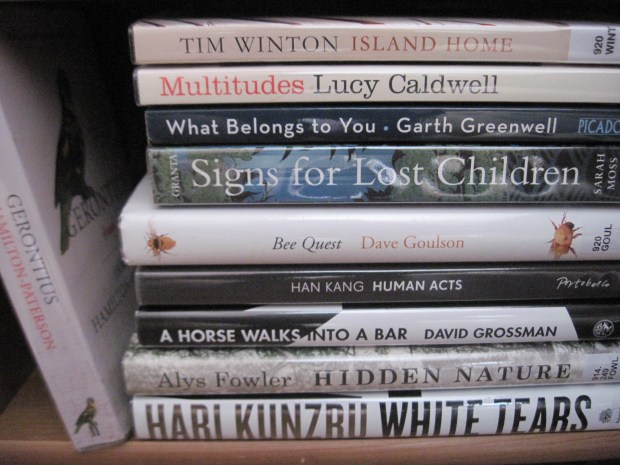
And that’s not to mention this gorgeous set of review copies awaiting my return!

I’ve added in ratings and links to any reviews of books I haven’t already featured here in some way.
LIBRARY BOOKS READ
- Ashland & Vine by John Burnside

- The Otters’ Tale by Simon Cooper

- Glad of These Times by Helen Dunmore [poetry]
- The Valentine House by Emma Henderson
- Bodies of Light by Sarah Moss
- Mothering Sunday by Graham Swift

- Gizelle’s Bucket List: My Life with a Very Large Dog by Lauren Fern Watt

SKIMMED ONLY
- A Smell of Burning: The Story of Epilepsy by Colin Grant

- Sculptor’s Daughter: A Childhood Memoir by Tove Jansson
- In the Bonesetter’s Waiting-Room: Travels through Indian Medicine by Aarathi Prasad
- Where Poppies Blow: The British Soldier, Nature, the Great War by John Lewis-Stempel
CHECKED OUT, TO BE READ
- Multitudes: Eleven Stories by Lucy Caldwell
- Hidden Nature: A Voyage of Discovery by Alys Fowler
- Bee Quest: In Search of Rare Bees by Dave Goulson
- What Belongs to You by Garth Greenwell
- A Horse Walks into a Bar by David Grossman
- Gerontius by James Hamilton-Paterson
- Human Acts by Han Kang
- White Tears by Hari Kunzru
- Signs for Lost Children by Sarah Moss
- Island Home: A Landscape Memoir by Tim Winton
As to America: I hope you would agree I have been very restrained in only requesting three books to borrow from my parents’ local public library. The Coates and Shapiro are extremely short memoirs I should have no trouble getting through, and the Strayed, a collection of advice columns, is the kind of book that I can dip in and out of. My Kindle and my personal library will more than make up for any further shortfall in reading material.
ON HOLD, TO BE CHECKED OUT
- Between the World and Me, Ta-Nehisi Coates
- Tiny Beautiful Things, Cheryl Strayed
IN THE RESERVATION QUEUE
- Hourglass, Dani Shapiro
(Hosted by Charleen of It’s a Portable Magic.)
Have you been taking advantage of your local libraries? What appeals from my lists?
Midwinter Cedes to Spring
I’ve marked the turn of the seasons by following a ‘Midwinter’ book with a ‘Spring’ one.
Moominland Midwinter by Tove Jansson
 My third and favorite Moomins book (so far).
Moomins are supposed to sleep through the winter, but this year young Moomintroll awakens and finds himself in a “strange and dangerous” world transformed by snowdrifts. He can’t get his parents to wake up so is effectively a temporary orphan, surrounded by peculiar creatures from Jansson’s menagerie, this time including a dim-witted squirrel, invisible shrews, a glum little dog who wishes he could run with wolves, and the Dweller Under the Sink (with its exceptionally bushy eyebrows).
While Moomintroll searches for totems of familiarity—
He looked at the cupboard in the corner and thought of how nice it was to know that his own old bath-gown was hanging inside it. That something certain and cosy still remained in the middle of all the new and worrying things.
—Too-ticky has the opposite mindset: “All things are so very uncertain, and that’s exactly what makes me feel reassured.” She goes fishing under the ice, builds a life-size horse out of snow, and assembles tree trunks and old furniture for the midwinter ritual of a huge bonfire.
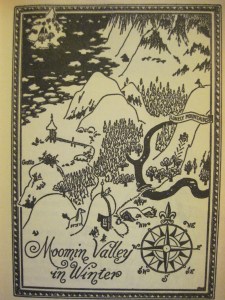 When they receive a visit from the Hemulen, who’s keen on skiing and declares the indoors too stuffy in winter, the creatures quickly tire of his energetic optimism. The truth is that they like sitting around being miserable. “I’m cold! I’m lonely! I want the sun back again!” Moomintroll pouts, but even he is too affable to make the Hemulen leave.
Of course the spring finally arrives, as it does every year, but it’s depressingly long in coming and for Moomintroll becomes a matter of faith. I love the strangeness of Jansson’s imagination, the balance of melancholy and comedy, and the little philosophical nuggets buried along the way – children and adult readers alike will get a lot out of this. It doesn’t talk down to children with a rosy message about everything being alright.
My rating:
Spring: An anthology for the changing seasons, edited by Melissa Harrison
Although this was the first of the Wildlife Trusts anthologies published in 2016, I got a late start last year so am reading this as the final of four. In common with the other volumes, it’s a terrific mix of contemporary and historical writing, big names and newcomers, observation and reflection. Compared with the other books, it seems to have more about WT sites in particular, with a few pieces from current volunteers or former employees. I also noticed that there’s a bit more of a focus on birds – with essays on the chiffchaff, the birds encountered on the Cley Marshes, cuckoo festivals, young dippers, and a tawny owl chick.
 That said, there’s still plenty of variety here, with everything from spring flora* to adders fueling the generally two- to three-page essays. I especially liked Kate Long’s piece on filming hedgehogs at night and Vijay Medtia’s on how people of color living in cities have little access to nature; he recalls spotting a magpie with a twig in its beak at a train station and having to ask someone what it was called. Of the previously published authors, I enjoyed hearing more from Rob Cowen and Miriam Darlington and laughed at Will Cohu’s ice cream and underwear metaphors applied to varieties of cherry trees.
You can’t beat George Orwell on toad sex, and it’s fun to encounter excerpts from classic novels in the context of a nature book: The Wind in the Willows, Lorna Doone, and Jane Eyre (which, shamefully, I didn’t recognize until Lowood was mentioned in the last paragraph). I think my favorite piece of all, though, was Jo Sinclair’s about watching spring’s arrival after a major operation and noting nature’s inscrutable jumble of beauty and brutality.
And my favorite passage:
Year after year all this loveliness for eye and ear recurs: in early days, in youth, it was anticipated with confidence; in later years, as the season approaches, experience and age qualify the confidence with apprehension lest clouds of war or civil strife, or some emergency of work, or declining health, or some other form of human ill may destroy the pleasure or even the sight of it: and when once again it has been enjoyed we have a sense of gratitude greater than in the days of confident and thoughtless youth. Perhaps the memory of those days, having become part of our being, helps us in later life to enjoy each passing season.
(from Sir Edward Grey’s The Charm of Birds, 1927)
This passage from Reverend Francis Kilvert’s diary (April 14, 1871) makes me look forward to our trip to nearby Hay-on-Wye next month: “The village is in a blaze of fruit blossom. Clyro is at its loveliest. What more can be said?” Simply that these anthologies are an essential companion to the seasons.
*Like my husband’s piece, positioned right before the R.D. Blackmore extract.
(See also my reviews of Summer, Autumn and Winter.)
My rating:
Three Perfect November Reads
It occurred to me that I’ve read three novels with “November” in the title. They’re extremely different from each other: one’s a melancholy 1930s American classic; one’s a quirky Icelandic road trip; and the last is a darker entry in a beloved Scandinavian children’s series. All are interesting books, though, and worth reading if you’re in the right mood.
Now in November by Josephine Johnson
(Reviewed here in full back in May.)
 Missouri-born Johnson was just 24 years old when she published Now in November, which won the 1935 Pulitzer Prize. The novel is narrated by the middle Haldmarne daughter, Marget, looking back at a grueling decade on the family farm. The arrival of Grant Koven, a neighbor in his thirties hired to help with hard labor, seems like the only thing that might break the agricultural cycle of futile hope and disappointment. Marget quickly falls in love with him, but it takes her a while to realize that her two sisters are smitten too. They all keep hoping their fortunes will change, but as drought settles in, things only get worse. This is an atmospheric and strangely haunting novel. The plot is simple enough, but the writing elevates it into something special. The plaintive tone, folksy metaphors, and philosophical earnestness all kept me eagerly traveling along with Marget to see where the tragic story might lead.
Butterflies in November by Auður Ava Ólafsdóttir
 This is a whimsical, feminist road trip novel. The unnamed narrator is a translator based in Reykjavík. When her best friend slips on an icy sidewalk and breaks her arm, it falls to the narrator to care for the friend’s deaf-mute four-year-old son, Tumi. Leaving behind romantic troubles and boosted by not one but two lottery wins, she and the boy set off on a snowy voyage around Iceland’s Ring Road, with plenty of madcap adventures ahead. The plot is rather scattered and uneven, with uproarious mishaps followed by tedious passages. However, in this kooky fictional world where “nothing is as it should be any more,” where butterflies are still flying in November, the narrator’s tragicomic travels should still strike a chord. Recommended for fans of zany Scandinavian fiction such as The Hundred-Year-Old Man Who Climbed Out of the Window and Disappeared by Jonas Jonasson, or Doppler by Erlend Loe. (See my full review at For Books’ Sake.)
Moominvalley in November by Tove Jansson
 Jansson said that after the Second World War she was depressed and wanted to write about something naïve and innocent. She wrote the first book of the Moomins series in 1945, about a family of hippo-like white trolls. But the Moomins do not appear in this book at all. It is November, the days are closing in, and no one knows where they have gone and when they might come back. A series of visitors journey to Moominvalley and find the house empty, cold and strange; these interlopers try to make their own merriment with a picnic and a party, but it all falls flat. The book felt unique to me for its Scandinavian qualities: the strange sprite-like creatures, woodland settings and short winter days, and the slight air of depression. As with the best children’s fiction, there is much here to entertain adults. Perhaps the most fun aspect of the book is Jansson’s original black and white line drawings of her peculiarly loveable creations.
Favorite passage: “The quiet transition from autumn to winter is not a bad time at all. It’s a time for protecting and securing things and for making sure you’ve got in as many supplies as you can. It’s nice to gather together everything you possess as close to you as possible, to store up your warmth and your thoughts and burrow yourself into a deep hole inside, a core of safety where you can defend what is important and precious and your very own. Then the cold and the storms and the darkness can do their worst. They can grope their way up the walls looking for a way in, but they won’t find one, everything is shut, and you sit inside, laughing in your warmth and your solitude, for you have had foresight.”
 Bookish Beck = Rebecca Foster. American transplant to England. Freelance proofreader and book reviewer.
 Bookish Beck