The Fruit Cure by Jacqueline Alnes (Blog Tour)
Jacqueline Alnes was a college runner until she experienced a strange set of neurological symptoms: fainting, blurred vision, speech problems and seizures. Initially diagnosed with vestibular neuronitis, she later got on a waiting list for a hospital epilepsy unit. Her symptoms ebbed and flowed over the next few years. Sometimes she was well enough to get back to running – she completed a marathon in Washington, D.C. – but occasionally she was debilitated. Study abroad in Peru exacerbated her problems because of altitude sickness. She also spent time in a wheelchair. Chronic illness left her open to depression and self-harm, including disordered eating. This turned more extreme when she was drawn into the bizarre world of fruitarianism, which offered her structure and black-and-white logic.

Alongside her own story, Alnes tells that of a few eccentrics who were key in popularizing the all-fruit diet. In the 1950s, Essie Honiball (author of I Live on Fruit), an anorexic teacher pregnant by a married man, was preyed on by quack doctor Cornelius Dreyer, who had previously had patients die under his care. Dreyer was based in South Africa, but there were parallel movements in other countries, too. Veganism and the raw food diet came under the same general umbrella, but were not as exclusive. The other main characters in the narrative are “Freelee” (Leanne Ratcliffe) and “Durianrider” (Harley Johnstone), founders of the 30 Bananas a Day website, which swayed Alnes when she was desperate for a cure. They spread their evangelistic message via blogs, vlogs and conferences. Like any cult-like body, theirs hinged on control and fell victim to infighting and changes of direction over the years.
Alnes clearly hopes her own experience will be instructive, exposing the dangers of extreme treatments for vulnerable people:
Scammy cures have been here since the beginning of time and will continue to exist for as long as people do, but the more we can work to make our systems of healing more equitable for people, no matter [their] race, gender, class, sexual orientation, or body size, the less people will get caught up in harmful practices that end up hurting them in the end.
She effectively employs metaphors from the Book of Genesis, likening early-years Durianrider and Freelee to Adam and Eve (them of the forbidden fruit) and pondering her own illness-origin story:
There are endless ways to write an origin story. Over the years, I’ve succumbed to the temptation of rewriting this beginning, as if returning to that first night [she fell ill] will give me answers or allow me to change what happened. Instead, holes in the narrative emerge.
As will be familiar to readers of stories of chronic illness and disability, no clear answers emerge here. Alnes’ condition is up and down and there’s been no definitive cure. Like Essie, she was lured into adhering slavishly to a fruitarian diet for a time, but she now has a healthier, more flexible attitude towards food. I found I wasn’t particularly interested in reading about the central cranks, preferring to skip over the biographical material to follow the thread of Alnes’ own journey instead. The whole book seems a little too niche; a more generalist work about various radical health cures and their proponents may have engaged me more. Still, it was a reasonably interesting case study.
With thanks to Melville House Press for the proof copy for review.
Buy The Fruit Cure from Bookshop UK [affiliate link]
Related reading:
Heal Me by Julia Buckley
I was pleased to be part of the blog tour for The Fruit Cure. See below for details of where other reviews have appeared or will be appearing soon.

We Are the Weather by Jonathan Safran Foer
I’ve read all of Jonathan Safran Foer’s major releases, from Everything Is Illuminated onwards, and his 2009 work Eating Animals had a major impact on me. (I included it on a 2017 list of “Books that (Should Have) Literally Changed My Life.”) It’s an exposé of factory farming that concludes meat-eating is unconscionable, and while I haven’t gone all the way back to vegetarianism in the years since I read it, I eat meat extremely rarely, usually only when a guest at others’ houses, and my husband and I often eat vegan meals at home.
 When I heard that Foer’s new book, We Are the Weather: Saving the Planet Begins at Breakfast, would revisit the ethics of eating meat, I worried it might feel redundant, but still wanted to give it a try. Here he examines the issue through the lens of climate change, arguing that slashing meat consumption by two-thirds or more (by eating vegan until dinner, i.e., for two meals a day) is the easiest way for individuals to decrease their carbon footprint. I don’t disagree with this proposal. It would be churlish to fault a reasonable suggestion that gives ordinary folk something concrete to do while waiting (in vain?) for governments to act.
My issues, then, are not with the book’s message but with its methods and structure. Initially, Foer successfully makes use of historical parallels like World War II and the civil rights movement. He rightly observes that we are at a crucial turning point and it will take self-denial and joining in with a radical social movement to protect a whole way of life. Don’t think of living a greener lifestyle as a sacrifice or a superhuman feat, Foer advises; think of it as an opportunity for bravery and for living out the convictions you confess to hold.
As the book goes on, however, the same reference points come up again and again. It’s an attempt to build on what’s already been discussed, but just ends up sounding repetitive. Meanwhile, the central topic is brought in as a Trojan horse: not until page 64 (of 224 in the main text) does Foer lay his cards on the table and admit “This is a book about the impacts of animal agriculture on the environment.” Why be so coy when the book has been marketed as being about food choices? The subtitle and blurb make the topic clear. “Our planet is a farm,” Foer declares, with animal agriculture the top source of deforestation and methane emissions.
Fair enough, but as I heard a UK climate expert explain the other week at a local green fair, you can’t boil down our response to the climate crisis to ONE strategy. Every adjustment has to work in tandem. So while Foer has chosen meat-eating as the most practical thing to change right now, the other main sources of emissions barely get a mention. He admits that car use, number of children, and flights are additional areas where personal choices make a difference, but makes no attempt to influence attitudes in these areas. So diet is up for discussion, but not family planning, commuting or vacations? This struck me as a lack of imagination, or of courage. Separating Americans from their vehicles may be even tougher than getting them to put down the burgers. But that doesn’t mean it’s not worth trying.
 Part II is a bullet-pointed set of facts and statistics reminiscent of the “Tell the Truth” section in the Extinction Rebellion handbook. It’s an effective strategy for setting things out briefly, yet sits oddly between narrative sections of analogies and anecdotes. My favorite bits of the book were about visits to his dying grandmother back at the family home in Washington, D.C. It took him many years to realize that his grandfather, who lost everything in Poland and began again with a new wife in America, committed suicide. This family history,* nestled within the canon of Jewish stories like Noah’s Ark, Masada and the Holocaust, dramatizes the conflict between resistance and self-destruction – the very battle we face now.
 Part IV, Foer’s “Dispute with the Soul,” is a philosophical dialogue in the tradition of Talmudic study, while the book closes with a letter to his sons. Individually, many of these segments are powerful in the way they confront hypocrisy and hopelessness with honesty. But together in the same book they feel like a jumble. Although it was noble of Foer to tackle the subject of climate change, I’m not convinced he was the right person to write this book, especially when we’ve already had recent works like The Uninhabitable Earth by David Wallace-Wells. Arriving at a rating has been very difficult for me because I support the book’s aims but often found it a frustrating reading experience. Still, if it wakes up even a handful of readers to the emergency we face, it will have been worthwhile.
My rating: 
A favorite passage: “Climate change is not a jigsaw puzzle on the coffee table, which can be returned to when the schedule allows and the feeling inspires. It is a house on fire.”
 *I’m looking forward to his mother Esther Safran Foer’s family memoir, I Want You to Know We’re Still Here: A Post-Holocaust Memoir, which is coming out from Tim Duggan Books on March 31, 2020.
We Are the Weather is published today, 10th October, in the UK by Hamish Hamilton (my thanks for the proof copy for review). It came out in the States from Farrar, Straus and Giroux last month.
Rebecca Stott, Duke Special & More at Greenbelt 2018
After five years away, we finally made it back to Greenbelt, a progressive Christian summer arts festival held on the grounds of Boughton House, on the Bank Holiday. The festival is a mixture of talks, music, performances and more, and given how much we’d paid and how far we’d traveled just for the one day, we tried to pack in as much as possible.

We started the day with “Beyond Forgiveness,” a presentation by Jo Berry and Pat Magee. Berry’s father, a Tory MP, was killed when the IRA bombed the Conservative Party conference in Brighton in 1984. Magee spent 14 years in prison for his role in the bombing. When he got out of jail, he met Berry at her request and they talked and listened to each other for several hours. For the first time, Magee said, he could see her father as a real person and realized that the IRA had been just as guilty of dehumanizing and misrepresenting people as the English were. Berry, too, felt that “I’d met my enemy and seen his humanity.” The two have now shared a stage more than 200 times, speaking about the value of empathy in healing broken relationships while also addressing imbalances of power that lead to violence.
To my surprise, cookery displays and musical comedy seemed to be the order of the day. A model kitchen is a new addition to the festival, giving celebrity chefs hour-long sessions to demonstrate a particular dish. Jack Monroe, promoting her new book Cooking on a Bootstrap, cooked a sausage lasagna. She made us all laugh with her idea of “the inverse sausage fallacy” – the cheaper a sausage is, the better it tastes because of all the salt, sugar and spices added to cheaper bits of meat. She started writing recipes when she was a single mother on the dole, and so she encouraged audience members to donate nice things you would like to eat, as well as everyday hygiene products, to food banks. For a “What Vegans Eat” session, Brett Cobley (aka EpiVegan) made a pea and asparagus risotto and answered questions about protein sources, egg replacements, plant milks and harder-to-find ingredients.
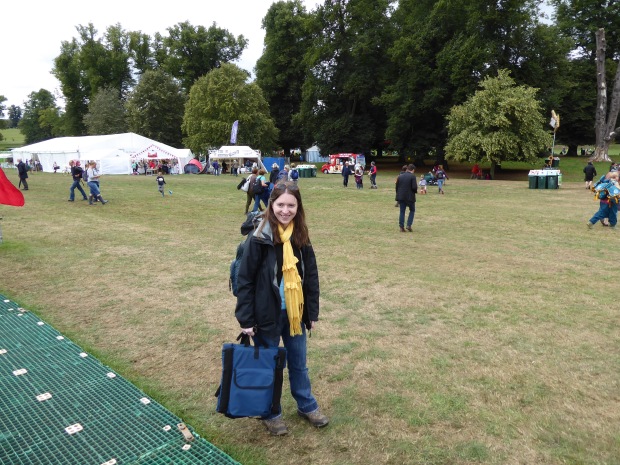
Uproarious musical comedy came in the form of Harry & Chris, who made up impromptu raps about New Year’s Day, the Teletubbies and phobias, and Flo & Joan, who sang about divorce statistics, unnecessary inventions for women, and sex robots (the show was fairly crude and came with an 18+ warning). The overall musical highlight of the day was Duke Special, a Greenbelt favorite we’ve seen play quite a number of times now. His pop combines his smooth Belfast tenor with music hall and Big Band stylings, and his songs are often drawn from poetry and 1920s–40s songbooks. His latest project, Hallow, is a beautiful set of Michael Longley poems set to music. He played “Another Wren” and “Emily Dickinson” from that album, various covers (including two bizarre ditties by Ivor Cutler), and crowd favorites “Last Night I Nearly Died,” “Freewheel” and “Our Love Goes Deeper than This.” We also sampled performances by Martyn Joseph, Wallis Bird and CC Smugglers.
Duke Special was a good bridge between music and literature. From the literature program I also saw Rabbi Jonathan Wittenberg speak on “Things My Dog Has Taught Me about Being a Better Human,” the title of his recent book. (His dog Mitzpah had a special dispensation to join him on stage; no animals are allowed on site otherwise!) The rabbi spoke about lessons in listening, attention, trust and seizing the moment. Mitzi and his previous dog Safi have also given him a connection with the rest of creation. Although he lives in the London suburbs and has an inner-city synagogue, they have accompanied him on long walks in Scotland and Germany. Wittenberg was a warm and witty speaker and I very much liked the sound of his book. It could make a good follow-up to The Power of Dog.
My other festival highlight was Rebecca Stott, in conversation with Radio 4 presenter Malcolm Doney. I read her Costa Prize-winning memoir In the Days of Rain: A daughter. A father. A cult in April and it’s been one of my stand-out reads of the year so far. The book conveys a huge amount of information about the Exclusive Brethren and Stott’s family history but never loses sight of what is most important: what it was like to be in a cult and have your life defined by its rules and its paranoia about the outside world. Stott remembers 6 a.m. Sunday communion services and her constant terror of being left behind in the Rapture.
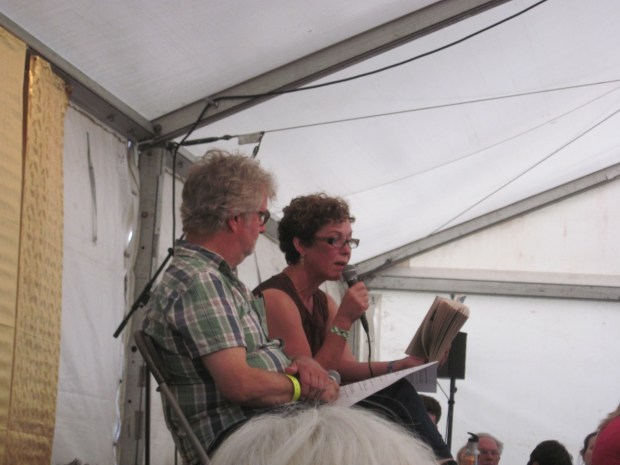
Rebecca Stott reading from In the Days of Rain.
Unfortunately, the talk didn’t add much to my experience of reading her book. The interviewer, catering to those who haven’t read the book yet, led her through her whole story bit by bit, and because I’d read it fairly recently it was all familiar. However, Stott spoke wonderfully and was full of wry compassion for her younger self. I was most interested to hear about the book’s aftermath: she’s received 300 letters from ex-Brethren that her daughter is transcribing to send to a Brethren Church archive in Manchester. When asked during a Q&A where she sees cult tendencies today, she mentioned Trump supporters!


Whereas I read In the Days of Rain from the library, I happen to own two Stott books I haven’t read yet, so I cheekily brought along my paperback of Ghostwalk for signing. She was intrigued to see the older cover design and told me she thinks the prose style in her debut novel is much richer than in Rain, and she hopes I’ll like it. I thanked her for the talk, told her how much I’d enjoyed her memoir, and recommended her two books vaguely about cults: Educated by Tara Westover, which she already knew well, having done some events with Westover, and The Incendiaries by R.O. Kwon, which was new to her (my blog tour review is coming up on Monday). I caught myself using the word “brilliant” three times in speaking about Stott’s work and these other books – nuance and vocabulary alike clearly go out the window when nervously speaking to admired authors!
Some readers of this blog would have been delighted by the event I rushed to straight after Stott’s talk: Jon McGregor giving readings from Reservoir 13, with Sigur Rós-esque backing and interlude music from Haiku Salut. I heard about the police reconstruction with actors from Manchester, and collecting bilberries on the heath in August. Unfortunately, I found it just as dull read aloud as I did when I tried the book last year, and I left early.
During bits of down time I pulled out a Katherine Mansfield story collection I found in a charity shop last week and read “Bank Holiday” and “The Garden Party.” The former is a very short piece whose carnival atmosphere rises to a note of indeterminate striving:
“And up, up the hill come the people, with ticklers and golliwogs, and roses and feathers. Up, up they thrust into the light and heat, shouting, laughing, squealing, as though they were being pushed by something, far below, and by the sun, far ahead of them – drawn up into the full, bright, dazzling radiance to…what?”
 It was my first time reading the famous “The Garden Party,” which likewise moves from a blithe holiday mood into something weightier. The Sheridans are making preparations for a lavish garden party dripping with flowers and food. Daughter Laura is dismayed when news comes that a man from the cottages has been thrown from his horse and killed, and thinks they should cancel the event. Everyone tells her not to be silly; of course it will go on as planned. The story ends when, after visiting his widow to hand over leftover party food, she unwittingly sees the man’s body and experiences an epiphany about the simultaneous beauty and terror of life. “Don’t cry,” her brother says. “Was it awful?” “No,” she replies. “It was simply marvellous.” Mansfield is especially good at first and last paragraphs. I’ll read more by her someday.
 Bookish Beck = Rebecca Foster. American transplant to England. Freelance proofreader and book reviewer.
 Bookish Beck