20 Books of Summer, 6–7: Helen Dunmore and Stephen King
At least, I managed a pretty terrific pair, and completed half of my intended 4-in-a-row (the second row) on the Bingo card.


(Book featuring ice cream or summer foods)
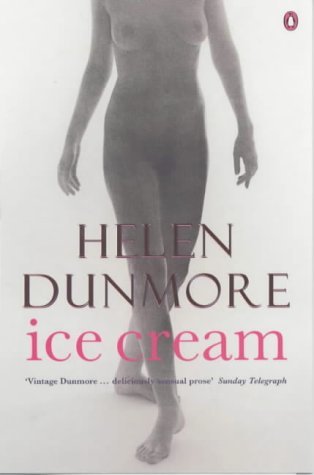
Ice Cream by Helen Dunmore (2000)
These 18 pieces are quite varied: a few have historical settings, two are written in the second person, and several return to the life of Ulli (a recurring character from Love of Fat Men), a Finnish teenager who faces an unexpected pregnancy. Even the slight-seeming ones are satisfying slices of fiction. The title story and its follow-up, “Be Vigilant, Rejoice, Eat Plenty” advocate sensual indulgence, which I guess is the reason for the cover image – which I couldn’t decide whether to hide or flaunt as I was reading it in public.
 Often, there is a hint of menace, whether the topic is salmon fishing, raspberry picking or the history of a lost ring. “The Clear and Rolling Water” has the atmosphere of a Scottish folk ballad, which made it perfect reading for our recent holiday to Scotland. “Leonardo, Michelangelo, SuperStork” and “Mason’s Mini-break” stand out for their dystopian and magic realist touches, respectively. In the former, couples are only allowed to conceive via state- sanctioned services; in the latter, an arrogant Booker Prize-winning author is patronizing when he meets a would-be writer while on holiday in Yorkshire.
Two of my favourites were “The Lighthouse Keeper’s Wife” and “Swimming into the Millennium,” which might have been written by Helen Simpson. All are of a high standard, and though they don’t fit together per se and mostly won’t stay with me, I really do rate Dunmore as a short story writer. (Secondhand – Community Furniture Project, Newbury) 
(Book from a genre you rarely read)
Pet Sematary by Stephen King (1983)
 I’d only ever read King’s On Writing and worried I wouldn’t be able to handle his fiction. I could never watch a horror film, but somehow the same content was okay in print. For half the length or more, it’s more of a mildly dread-laced, John Irving-esque novel about how we deal with the reality of death. Dr. Louis Creed and his family – wife Rachel, five-year-old daughter Ellie, two-year-old son Gage and cat Church (short for Winston Churchill) – have recently moved from Chicago to Maine for him to take up a post as head of University Medical Services. Their 83-year-old neighbour across the street, Judson Crandall, becomes a sort of surrogate father to Louis, warning them about the dangerous highway that separates their houses and initiating them with a tour of the pet cemetery and Micmac burial ground that happen to be on their property. Things start getting weird early on: Louis’s first day on the job sees a student killed by a car while jogging; the young man’s cryptic dying words are about the pet cemetery, and he then visits Louis in a particularly vivid dream.
The family surname is no coincidence. “I believe that we go on,” Louis says when Ellie asks him about what happens when we die. “But as to what it’s like, I have no opinion.” So King interrogates what it would be like for the dead to go on literally instead of just figuratively in the remembrance of loved ones. Would bringing the dead back be a cure for grief or a horrible mistake? This sleepy New England town harbours many cautionary tales, and the Creeds have more than their fair share of sorrow. Rachel witnessed her sister’s death from a long illness when she was just a child and has always repressed her memories of it.
Louis is a likable protagonist whose vortex of obsession and mental health (“He walked the balance-beam of rationality”) is gripping. As can be the case with genre fiction, King prioritizes readability over writing quality, though I did pick out an occasional glistening metaphor. It doesn’t get gruesome or schlocky until right towards the end. In the last quarter, which I read on the long train ride home from Edinburgh, I couldn’t get the book closer to my face or the pages turning any faster. It helped that it was a beat-up small-format paperback. When we arrived into London I was about six pages from the end and it was so frustrating to have to wait until I got on my next train to read the rest.


This also counted towards one of my low-key ongoing challenges: reading works published in my birth year. I could imagine the Eighties stylings of an adaptation, especially Rachel’s power suit and pumps when she’s on her race-against-the-clock flight and road trip. I did find the book dated in some of its Murakami-like descriptions (“The … double doors were set into a grassy rise of hill, a shape as natural and as attractive as the swell of a woman’s breast”) and cringey sex scenes, and I wondered if King would get away with using imagery of the Windigo these days. Still, on this evidence, I’ll seek out more of his classic horror – do give me your recommendations. So long as they’re this addictive (and no scarier), I’m game. Pet Sematary was sterling entertainment, but also surprisingly poignant. A message I took away: you just have to live with the pain of loss, not fight it or deny it. “When it started not to hurt, it started not to matter.” (Little Free Library) 
Winter Reading, Part II: “Snow” Books by Coleman, Rice & Whittell
Here I am squeaking in on the day before the spring equinox – when it’s predicted to be warmer than Ibiza here in southern England, as headlines have it – with a few snowy reads that have been on my stack for much of the winter. I started reading this trio when we got a dusting back in January, in case (as proved to be true) it was our only snow of the year. I have an arresting work of autofiction that recreates a period of postpartum psychosis, a mildly dystopian novel by a First Nations Canadian, and a snow-lover’s compendium of science and trivia.
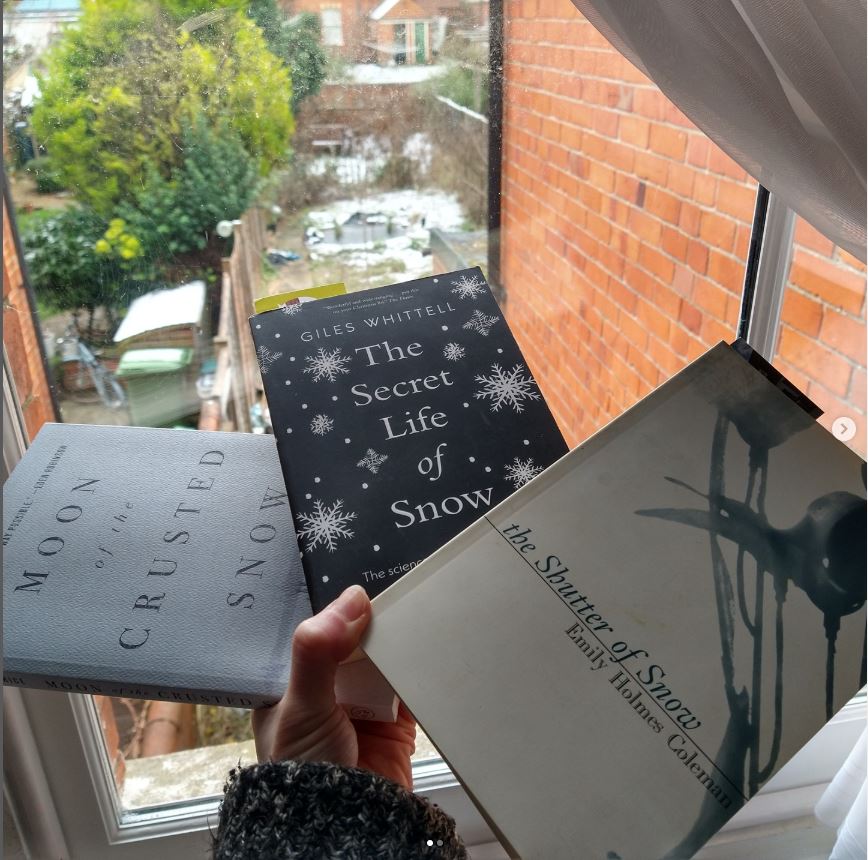
 As it happens, I’ll be starting the spring in the middle of We Do Not Part by Han Kang, which is austerely beautiful and eerily snowy: its narrator traverses a blizzard to rescue her friend’s pet bird; and the friend’s mother recalls a village massacre that left piles of snow-covered corpses. Here Kang muses on the power of snow:
Snow had an unreality to it. Was this because of its pace or its beauty? There was an accompanying clarity to snow as well, especially snow, drifting snow. What was and wasn’t important were made distinct. Certain facts became chillingly apparent. Pain, for one.
The Shutter of Snow by Emily Holmes Coleman (1930)
 Coleman (1899–1974), an expatriate American poet, was part of the Paris literary milieu in the 1920s and then the London scene of the 1930s. (She worked with T.S. Eliot on editing Djuna Barnes’s Nightwood, for instance.) This novella, her only published work of fiction, was based on her experience of giving birth to her son in 1924, suffering from puerperal fever and a mental breakdown, and being incarcerated in Rochester State Hospital. Although the portrait of Marthe Gail is in the omniscient third person, the stream-of-consciousness style – no speech marks or apostrophes, minimal punctuation – recalls unreliable first-person narration. Marthe believes she is Jesus Christ. Her husband Christopher visits occasionally, hoping she’ll soon be well enough to come home to their baby. It’s hard to believe this was written a century ago; I could imagine it being published tomorrow. It is absolutely worth rediscovering. While I admired the weird lyrical prose (“in his heart was growing a stern and ruddy pear … He would make of his heart a stolen marrow bone and clutch snow crystals in the night to his liking”; “This earth is made of tar and every morsel is stuck upon it to wither … there were orange peelings lying in the snow”), the interactions between patients, nurses and doctors got tedious. (Secondhand – Community Furniture Project, Newbury)
Moon of the Crusted Snow by Waubgeshig Rice (2018)
 A mysterious total power outage heralds not just the onset of winter or a temporary crisis but the coming of a new era. For this Anishinaabe community, it will require a return to ancient nomadic, hunter-gatherer ways. I was expecting a sinister dystopian; while there are rumours of a more widespread collapse, the focus is on adaptation versus despair, internal resilience versus external threats. Rice reiterates that Indigenous peoples have often had to rebuild their worlds: “Survival had always been an integral part of their culture. It was their history. The skills they needed to persevere in this northern terrain … were proud knowledge held close through the decades of imposed adversity.” As an elder remarks, apocalypse is nothing new. I was more interested in these ideas than in how they played out in the plot. Evan works snow-ploughs until, with food running short and many falling ill, he assumes the grim task of an undertaker. I was a little disappointed that it’s a white interloper breaks their taboos, but it is interesting how he is compared to the mythical windigo in a dream sequence. As short as this novel is, I found it plodding, especially in the first half. It does pick up from that point (and there is a sequel). I was reminded somewhat of Sherman Alexie. It was probably my first book by an Indigenous Canadian, which was reason enough to read it, though I wonder if I would warm more to his short stories. (Birthday gift from my wish list last year)
The Secret Life of Snow: The science and the stories behind nature’s greatest wonder by Giles Whittell (2018)
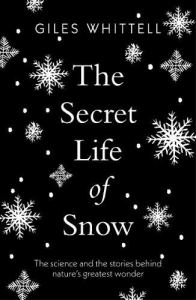 This is so much like The Snow Tourist by Charlie English it was almost uncanny. Whittell, an English journalist who has written history and travel books, is a snow obsessive and hates that, while he may see a few more major snow events in his lifetime, his children probably won’t experience any in their adulthood. Topics in the chatty chapters include historical research into snowflakes, meteorological knowledge then and now and the ongoing challenge of forecasting winter storms, record-breaking snowfalls and the places still most likely to have snow cover, and the depiction of snow in medieval paintings (like English, he zeroes in on Bruegel) and Bond films. There’s a bit too much on skiing for my liking: it keeps popping up in segments on the Olympics, avalanches, and how famous snow spots are reckoning with their uncertain economic future. It’s a fun and accessible book with many an eye-popping statistic, but, coming as it did a decade after English’s, does sound the alarm more shrilly about the future of snow. As in, we’ll get maybe 15 more years (until 2040), before overall warming means it will only fall as rain. “That idea, like death, is hard to think about without losing your bearings, which is why, aware of my cowardice and moral abdication, I prefer to think of the snowy present and recent past rather than of the uncertain future.” (Secondhand – Community Furniture Project, Newbury)
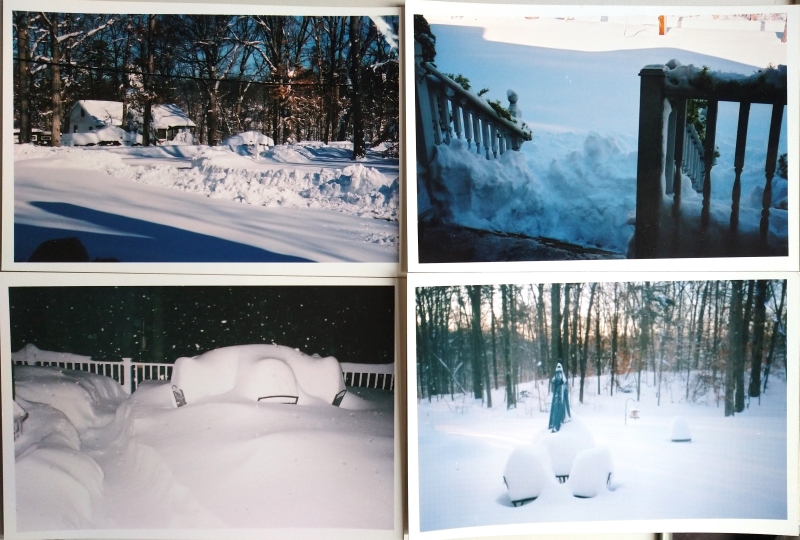
Whittell’s mention of the U.S. East Coast “Snowmaggedon” of February 2010 had me digging out photos my mother sent me of the aftermath at our family home of the time.
Any wintry reading (or weather) for you lately? Or is it looking like spring?
 Bookish Beck = Rebecca Foster. American transplant to England. Freelance proofreader and book reviewer.
 Bookish Beck