I didn’t expect these two novels to have anything in common, but in fact they’re both about lonely, introverted librarians who have cause to plunge into memories of a lost relationship. (They also had a couple of random tiny details in common, for which see my next installment of Book Serendipity.) Tonally, however, they couldn’t be more different, and while the one worked for me the other did not at all. You might be surprised which! Read on…
Speak to Me by Paula Cocozza
I adored Cocozza’s debut, How to Be Human, so news of her follow-up was very exciting. The brief early synopses made it sound like it couldn’t be more up my street what with the theme of a woman frustrated by her husband’s obsession with his phone – I’m a smartphone refusenik and generally nod smugly along to arguments about how they’re an addiction that encourages lack of focus and time wasting. But it turns out that was only a peripheral topic; the novel is strangely diffuse and detached.
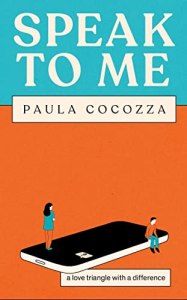 Susan is a middle-aged librarian and mother to teenage twin boys. She lives with them and her husband Kurt on a partially built estate in Berkshire full of soulless houses of various designs. Their “Beaufort” is not a happy place, and their marriage is failing, for several reasons. One is tech guru Kurt’s phone addiction. Susan refers to each new model as “Wendy,” and for her the last straw is when he checks it during the middle of sex on her 50th birthday. She joins a forum for likeminded neglected family members, and kills several Wendys by burial, washing machine, or sledgehammer.
But as the story goes on, Kurt’s issues fade into the background and Susan becomes more obsessed with the whereabouts of a leather suitcase that went missing during their move. The case contains letters and souvenirs from her relationship with Antony, whom she met at 16. She’s convinced that Kurt is hiding it, and does ever odder things in the quest to get it back, even letting herself into their former suburban London home. Soon her mission shifts: not only does she want Antony’s letters back; she wants Antony himself.
The message seems a fairly obvious one: the characters have more immediate forms of communication at their disposal than ever before, yet are not truly communicating with each other about what they need and want from life, and allowing secrets to come between them. “We both act as if talking will destroy us, but surely silence will, more slowly, and we will be undone by all the things we leave unsaid,” Susan thinks about her marriage. Nostalgia and futurism are both held up as problematic. Fair enough.
However, Susan is unforthcoming and delusional – but not in the satisfying unreliable narrator way – and delivers this piecemeal record with such a flat affect (reminding me of no one more than the title character from Kazuo Ishiguro’s Klara and the Sun; Susan even says, “Why do I feel scared that someone will find me out every time I tick the box that says ‘I am not a robot’?”) that I lost sympathy early on and couldn’t care what happened. A big disappointment from my Most Anticipated list.
With thanks to Tinder Press for the proof copy for review.
The Librarianist by Patrick deWitt
Bob Comet, a retired librarian in Portland, Oregon, gets a new lease on life at age 71. One day he encounters a lost woman with dementia and/or catatonia in a 7-Eleven and, after accompanying her back to the Gambell-Reed Senior Center, decides to volunteer there. A plan to read aloud to his fellow elderly quickly backfires, but the resident curmudgeons and smart-asses enjoy his company, so he’ll just come over to socialize.
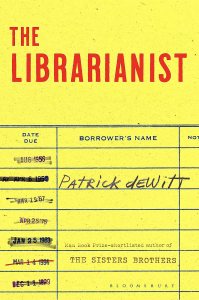 If it seems this is heading in a familiar A Man Called Ove or The Secret Diary of Hendrik Groen direction, think again. Bob has a run-in with his past that leads into two extended flashbacks: one to his brief marriage to Connie and his friendship with his best man, Ethan, in 1960; the other to when he ran away by train and bus at age 11.5 and ended up in a hotel as an assistant to two eccentric actresses and their performing dogs for a few days in 1945.
Imagine if Wes Anderson directed various Dickens vignettes set in the mid-20th-century Pacific Northwest – Oliver Twist with dashes of Great Expectations and Nicholas Nickleby. That’s the mood of Bob Comet’s early adventures. Witness this paragraph:
The next day Bob returned to the beach to practice his press rolls. The first performance was scheduled to take place thirty-six hours hence; with this in mind, Bob endeavored to arrive at a place where he could achieve the percussive effect without thinking of it. An hour and a half passed, and he paused, looking out to sea and having looking-out-to-sea thoughts. He imagined he heard his name on the wind and turned to find Ida leaning out the window of the tilted tower; her face was green as spinach puree, and she was waving at him that he should come up. Bob held the drum above his head, and she nodded that he should bring it with him.
(You can just picture the Anderson staginess: the long establishing shots; the jump cuts to a close-up on her face, then his; the vibrant colours; the exaggerated faces. I got serious The Grand Budapest Hotel vibes.) This whole section was so bizarre and funny that I could overlook the suspicion that deWitt got to the two-thirds point of his novel and asked himself “now what?!” The whole book is episodic and full of absurdist dialogue, and delights in the peculiarities of its characters, from Connie’s zealot father to the diner chef who creates the dubious “frizzled beef” entrée. And Bob himself? He may appear like a blank, but there are deep waters there. And his passion for books was more than enough to endear him to me:
“Bob was certain that a room filled with printed matter was a room that needed nothing.”
[Ethan:] “‘I keep meaning to get to books but life distracts me.’ ‘See, for me it’s just the opposite,’ Bob said.”
“All his life he had believed the real world was the world of books; it was here that mankind’s finest inclinations were represented.”
Weird and hilariously deadpan in just the way you’d expect from the author of The Sisters Brothers and French Exit, this was the pop of fun my summer needed. (See also Susan’s review.)
With thanks to Bloomsbury for the proof copy for review.
Would you read one or both of these?
 Bookish Beck = Rebecca Foster. American transplant to England. Freelance proofreader and book reviewer.
 Bookish Beck
Thanks for the link, Rebecca. Excellent Wes Anderson comparison! I grew very fond of Bob.
LikeLiked by 1 person
I loved that last scene when he’s bobbing for apples on Halloween and everyone’s calling his name. Maybe it helps that both my dad and my stepfather are a Bob!
LikeLiked by 1 person
I don’t think either of these is for me, although I do love the line you quoted about worrying about being found out when ticking the ‘I am not a robot’ box!
LikeLiked by 1 person
I had this awful feeling that there was going to be some twist whereby Susan was actually an AI … although maybe that would have at least made the novel interesting 😉
LikeLiked by 1 person
Well “Speak to Me” doesn’t speak to me – I think I’d find it hard to relate to the main character in any way
LikeLiked by 1 person
In that she was a librarian frustrated with several aspects of her life, I found her situation sympathetic, and yet what she did about it was strange and boring to read about!
LikeLike
The Librarianist is on my read soon pile. Looking forward to it.
LikeLiked by 1 person
Such fun! Let me know if you see the Wes Anderson connection.
LikeLiked by 1 person
The Librarianist – great title and now a great draw for me following your review, thanks!
LikeLiked by 1 person
So pleased you’re interested!
LikeLiked by 1 person
Nice reviews. Speak to Me is a new one for me. The Librarianist I’m still debating. I AM a librarian so those books sometimes….. LOL
LikeLiked by 1 person
I doubt Cocozza is much known outside the UK. I’m a former library assistant and loved all the library references in the deWitt!
LikeLiked by 1 person
I will most likely listed to The Libraraianist
LikeLike
The Librarianist is on my holds list at the library. I’m looking forward to it. I’ve never read him before but have meant to for years.
LikeLiked by 1 person
I like his style in general but have enjoyed some of his books more than others. You’d be able to tell pretty quickly whether you liked his sense of humor.
LikeLiked by 1 person
De Witt wrote The Sisters Brothers, so I wouldn’t expect anything very straightforward from him. I didn’t like The Sisters Brothers as much as a lot of people did, but your comparisons make it sound more interesting to me.
LikeLiked by 1 person
I’d like to reread The Sisters Brothers. I haven’t read it since it first came out and was nominated for the Booker Prize. I saw him give a reading and sit on a panel for the shortlisted writers but can’t remember much about the event.
LikeLiked by 1 person
It just wasn’t my cup of tea. I probably read it for my Booker Prize project.
LikeLike
It’s a very particular kind of deadpan humor. I can see how it wouldn’t suit everyone.
LikeLike
I really don’t like it, though, when people make up words. What the heck is a Librarianist? A few years ago I saw a book called The Documentalist, and the title just about drove me crazy. He was talking about a tech writer, which is what I used to be.
LikeLike
I guess “The Librarian” would have been a pretty boring title!
LikeLiked by 1 person
Maybe, and someone already used it this year.
LikeLike
I was disappointed in The Librarianist. It began so well, but though the episodes themselves were as readable as what had gone before, I found the delving into Bob’s past contributed little to his story. I thought de Witt had several stories here and decided to amalgamate them into one slightly unsatisfactory whole.
LikeLiked by 1 person
I can understand that. The events did seem a random assemblage … but maybe all our lives are like that?
LikeLiked by 1 person
Indeed. But to devote such uneven weight to those several aspects of the story , while a true reflection of how we view our own lives, leads to a clunky and unbalanced story. In my view.
LikeLiked by 1 person
I started The Librarianist last month but stopped after about thirty pages as my attention went elsewhere. I will go back to it though as he has never disappointed in the past.
LikeLiked by 1 person
It seems like your sense of humour! I hope you enjoy it if you get to try it again.
LikeLiked by 1 person
[…] that made me laugh: Notes from a Small Island by Bill Bryson, The Librarianist by Patrick deWitt, two by Katherine Heiny, Motherland Fatherland Homelandsexuals by Patricia […]
LikeLike
[…] Keeping it simple again this year with one post covering all genres: the 24 (or, actually 26) current-year releases that stood out the most for me. (No rankings; anything from my Best of First Half that didn’t make it through can be considered a runner-up, along with The Librarianist.) […]
LikeLike