July Releases: Speak to Me & The Librarianist
I didn’t expect these two novels to have anything in common, but in fact they’re both about lonely, introverted librarians who have cause to plunge into memories of a lost relationship. (They also had a couple of random tiny details in common, for which see my next installment of Book Serendipity.) Tonally, however, they couldn’t be more different, and while the one worked for me the other did not at all. You might be surprised which! Read on…
Speak to Me by Paula Cocozza
I adored Cocozza’s debut, How to Be Human, so news of her follow-up was very exciting. The brief early synopses made it sound like it couldn’t be more up my street what with the theme of a woman frustrated by her husband’s obsession with his phone – I’m a smartphone refusenik and generally nod smugly along to arguments about how they’re an addiction that encourages lack of focus and time wasting. But it turns out that was only a peripheral topic; the novel is strangely diffuse and detached.
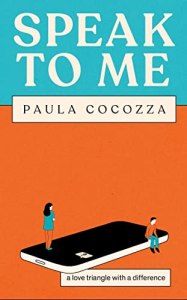 Susan is a middle-aged librarian and mother to teenage twin boys. She lives with them and her husband Kurt on a partially built estate in Berkshire full of soulless houses of various designs. Their “Beaufort” is not a happy place, and their marriage is failing, for several reasons. One is tech guru Kurt’s phone addiction. Susan refers to each new model as “Wendy,” and for her the last straw is when he checks it during the middle of sex on her 50th birthday. She joins a forum for likeminded neglected family members, and kills several Wendys by burial, washing machine, or sledgehammer.
But as the story goes on, Kurt’s issues fade into the background and Susan becomes more obsessed with the whereabouts of a leather suitcase that went missing during their move. The case contains letters and souvenirs from her relationship with Antony, whom she met at 16. She’s convinced that Kurt is hiding it, and does ever odder things in the quest to get it back, even letting herself into their former suburban London home. Soon her mission shifts: not only does she want Antony’s letters back; she wants Antony himself.
The message seems a fairly obvious one: the characters have more immediate forms of communication at their disposal than ever before, yet are not truly communicating with each other about what they need and want from life, and allowing secrets to come between them. “We both act as if talking will destroy us, but surely silence will, more slowly, and we will be undone by all the things we leave unsaid,” Susan thinks about her marriage. Nostalgia and futurism are both held up as problematic. Fair enough.
However, Susan is unforthcoming and delusional – but not in the satisfying unreliable narrator way – and delivers this piecemeal record with such a flat affect (reminding me of no one more than the title character from Kazuo Ishiguro’s Klara and the Sun; Susan even says, “Why do I feel scared that someone will find me out every time I tick the box that says ‘I am not a robot’?”) that I lost sympathy early on and couldn’t care what happened. A big disappointment from my Most Anticipated list.
With thanks to Tinder Press for the proof copy for review.
The Librarianist by Patrick deWitt
Bob Comet, a retired librarian in Portland, Oregon, gets a new lease on life at age 71. One day he encounters a lost woman with dementia and/or catatonia in a 7-Eleven and, after accompanying her back to the Gambell-Reed Senior Center, decides to volunteer there. A plan to read aloud to his fellow elderly quickly backfires, but the resident curmudgeons and smart-asses enjoy his company, so he’ll just come over to socialize.
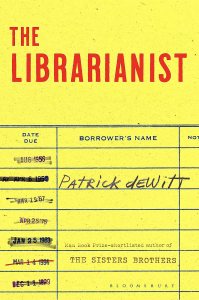 If it seems this is heading in a familiar A Man Called Ove or The Secret Diary of Hendrik Groen direction, think again. Bob has a run-in with his past that leads into two extended flashbacks: one to his brief marriage to Connie and his friendship with his best man, Ethan, in 1960; the other to when he ran away by train and bus at age 11.5 and ended up in a hotel as an assistant to two eccentric actresses and their performing dogs for a few days in 1945.
Imagine if Wes Anderson directed various Dickens vignettes set in the mid-20th-century Pacific Northwest – Oliver Twist with dashes of Great Expectations and Nicholas Nickleby. That’s the mood of Bob Comet’s early adventures. Witness this paragraph:
The next day Bob returned to the beach to practice his press rolls. The first performance was scheduled to take place thirty-six hours hence; with this in mind, Bob endeavored to arrive at a place where he could achieve the percussive effect without thinking of it. An hour and a half passed, and he paused, looking out to sea and having looking-out-to-sea thoughts. He imagined he heard his name on the wind and turned to find Ida leaning out the window of the tilted tower; her face was green as spinach puree, and she was waving at him that he should come up. Bob held the drum above his head, and she nodded that he should bring it with him.
(You can just picture the Anderson staginess: the long establishing shots; the jump cuts to a close-up on her face, then his; the vibrant colours; the exaggerated faces. I got serious The Grand Budapest Hotel vibes.) This whole section was so bizarre and funny that I could overlook the suspicion that deWitt got to the two-thirds point of his novel and asked himself “now what?!” The whole book is episodic and full of absurdist dialogue, and delights in the peculiarities of its characters, from Connie’s zealot father to the diner chef who creates the dubious “frizzled beef” entrée. And Bob himself? He may appear like a blank, but there are deep waters there. And his passion for books was more than enough to endear him to me:
“Bob was certain that a room filled with printed matter was a room that needed nothing.”
[Ethan:] “‘I keep meaning to get to books but life distracts me.’ ‘See, for me it’s just the opposite,’ Bob said.”
“All his life he had believed the real world was the world of books; it was here that mankind’s finest inclinations were represented.”
Weird and hilariously deadpan in just the way you’d expect from the author of The Sisters Brothers and French Exit, this was the pop of fun my summer needed. (See also Susan’s review.)
With thanks to Bloomsbury for the proof copy for review.
Would you read one or both of these?
Summery Reading, Part I: The Greengage Summer & Sunburn by Watson
Brief thoughts on a first pair of summer-themed reads: coming-of-age stories about teenage girls who trade England for somewhere more exciting – France or Greece – for a summer and awaken to the complications of sex when let down by the adults in their lives. Both: 
The Greengage Summer by Rumer Godden (1958)
 We wanted to read something by Godden in my book club’s women’s classics subgroup, and decided on this almost purely for the evocative title. Cecil is the second of five children who run amok at a French hotel while their father is botanizing in Tibet and their mother in hospital with an infected horsefly bite. Hotel staff and hangers-on are engaged in all sorts of shenanigans – affairs and casual molestation of the maids, for instance – and the children, caught up in the thrill of it, attach themselves to Eliot, the English lover of Mademoiselle Zizi. The adults get Cecil and her older sister, Joss, drunk on champagne. Joss is the belle of the ball and attracts an inappropriate suitor; Cecil gets her first period and tells Eliot, of all people. It’s a familiar message in mid-century fiction, I suppose: loss of sexual innocence leads to disaster. I found this quite melodramatic, with a sudden ending; it didn’t live up to the terrific premise. I was similarly underwhelmed by Black Narcissus. (University library)
Sunburn by Andi Watson; illus. Simon Gane (2022)
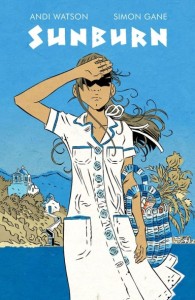 We open in suburban London in what appears to be the 1950s. Sixteen-year-old Rachel is offered a lucky escape from a summer of working at the butcher shop to stay with her parents’ friends, the Warners, at their home on a Greek island. Their life is a heady mix of languorous shopping, swimming and nightly parties. There’s a big contrast between the sophisticated expats and the local peasantry. When Rachel meets Ben, a fellow English teenager, it seems like her idyllic summer is complete, but things sour between them. Over the course of the book, Rachel realizes that not all grown-ups can be trusted. The plot took a twist I wasn’t expecting, which is always refreshing, but I should probably have been ready for it based on the depictions. The graphic novel is all in shades of blue, with white and light brown accents, as befitting the Greek flag and scenery. A problem I had was that most of the characters look the same – the artist has just the one way of drawing faces, so Rachel, Mrs. Warner and Ben have pretty much identical features. I would have catalogued this in YA. (Public library)
Both at least had a steamy summer atmosphere! My next seasonal read, picked up from the library today, will be One Midsummer’s Day by Mark Cocker, which is all about swifts. We have a pair nesting in our eaves again this year – hurrah! – and have been enjoying watching their (albeit diminished) screaming parties tear down the streets on warm summer evenings.
Any “summer” or “sun” books for you this year?
 Bookish Beck = Rebecca Foster. American transplant to England. Freelance proofreader and book reviewer.
 Bookish Beck