A year club hosted by Karen and Simon is always a great excuse to read more classics. Between my shelves and the library, I had six options for 1937. But I started reading too late, and had too many books on the go, to finish more than one – a reread. No matter; it was a good one I was glad to revisit, and I’ll continue with the other reread at my own pace.
Of Mice and Men by John Steinbeck
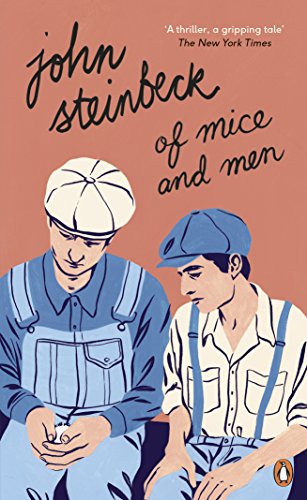 Are teenagers doomed to dislike the books they read in school? I think this must have been on the curriculum for 11th grade English. It was my third Steinbeck novella after The Red Pony and The Pearl, so to me it confirmed that he wrote contrived, depressing stuff with lots of human and animal suffering. Not until I read The Grapes of Wrath in college and East of Eden (THE Great American Novel) five years ago did I truly recognize Steinbeck’s greatness.
George and Lennie are itinerant farm workers in Salinas Valley, California. Lennie is a gentle giant, intellectually disabled and aware of his own strength when hauling sacks of barley but not when stroking mice and puppies. George looks after Lennie as a favour to Aunt Clara and they’re saving up to buy their own smallholding. This dream is repeated to the point of legend, somewhere between a bedtime story and scripture:
‘Someday—we’re gonna get the jack together and we’re gonna have a little house and a couple of acres an’ a cow and some pigs and—’ ‘An’ live off the fatta the lan’,’ Lennie shouted. ‘And have rabbits.’
They quickly settle in alongside the other ranch-hands and even convert two to their idyllic picture of independence. But the foreman, Curley, is a hothead and his bored would-be-starlet wife won’t stop roaming into the men’s quarters. No matter how much George tells Lennie to stay away from both of them, something is set in motion – an inevitable repeat of an incident from their previous employment that forced them to move on.
I remembered the main contours here but not the ultimate ending, and this time I appreciated the deliberate echoes and heavy foreshadowing (all that symbolism to write formulaic school essays about!): this is Shakespearean tragedy with the signs and stakes writ large against a limited background. Bar some paragraphs of scene-setting descriptions, it is like a play; no surprise it’s been filmed several times. (I wish I didn’t have danged John Malkovich in my head as Lennie; I can’t think of anyone else in that role, whereas Gary Sinise doesn’t necessarily epitomize George for me.) The characterization of the one Black character, Crooks, and the one woman are uncomfortably of their time. However, Crooks is given the dubious honour of conveying the bleak vision: “Nobody never gets to heaven, and nobody gets no land. It’s just in their head.” Like Hardy, Steinbeck knows what happens when the lower classes make the mistake of wanting too much. It’s a timeless tale of grit and desperation, the kind one can’t imagine not existing. (Public library)
Apposite listening: “The Great Defector” by Bell X1 (known for their quirky lyrics):
You’ve been teasing us farm boys
’til we start talking ’bout those rabbits, George
oh, won’t you tell us ’bout those rabbits, George?
Original rating (1999?): 
My rating now: 


Currently rereading: The Hobbit by J.R.R. Tolkien – My father gave me this for Christmas when I was 10. I think I finally read it sometime in my later teens, about when the Lord of the Rings films were coming out. I’m on page 70 now. I’d forgotten just how funny Tolkien is about the set-in-his-ways Bilbo and his devotion to a cosy, quiet life. When he’s roped into a quest to reclaim a mountain hoard of treasure from a dragon – along with 13 dwarves and Gandalf the wizard – he realizes he has much discomfort and many a missed meal ahead of him.


 DNFed: Journey by Moonlight by Antal Szerb – My second attempt with Hungarian literature, and I found it curiously similar to the other novel I’d read (Embers by Sandor Márai) in that much of it, at least the 50 pages I read, is a long story told by one character to another. In this case, Mihály, on his Italian honeymoon, tells his wife about his childhood best friends, a brother and sister. I wondered if I was meant to sense homoerotic attachment between Mihály and Tamás, which would appear to doom this marriage right at its outset. (Secondhand – Edinburgh charity shop, 2018)
 Skimmed: Out of Africa by Karen Blixen – I enjoyed the prose style but could tell I’d need a long time to wade through the detail of her life on a coffee farm in Kenya, and would probably have to turn a blind eye to the expected racism of the anthropological observation of the natives. (Secondhand – Way’s in Henley, 2015)
Here’s hoping for a better showing next time!
(I’ve previously participated in the 1920 Club, 1956 Club, 1936 Club, 1976 Club, 1954 Club, 1929 Club, and 1940 Club.)
 Bookish Beck = Rebecca Foster. American transplant to England. Freelance proofreader and book reviewer.
 Bookish Beck
I don’t know that I could re-read Of Mice and Men as I found it crushing first time round (despite thinking Steinbeck’s writing is amazing…) And sorry 1937 didn’t work out too well for you – hopefully the next club will be better!
LikeLiked by 1 person
I’ll call one read a win! (Compared to 1962, for which I didn’t manage anything.)
LikeLiked by 1 person
Hello
I’m now rereading Morley Callaghan’s Paris memoir. It’s vivid and authentic in ways that Moveable is not. Thanks for a look at Mice and Men. I too just reread it.
Stephen
LikeLiked by 1 person
Thanks for your comment. Marcie of Buried in Print read something by Callaghan for this challenge. I love Hemingway’s A Moveable Feast, so I bet I would like that, too.
LikeLike
Of Mice and Men was the exception to the rule for me of not liking books assigned in school — I distinctly recall it being the first “classic” I really enjoyed, in about 8th grade or so. Gateway to so many other wonderful books …
I seem to remember reading somewhere that Steinbeck deliberately constructed some of his short novels as “plays in novel form.” Or maybe he even wrote them as plays first and then novelized them? Of Mice and Men was one of these, I think Cannery Row was another. So it makes sense that you found it “like a play.”
LikeLiked by 1 person
The Scarlet Letter was the exception for me, in that same year of U.S. Lit, I think.
I don’t know Cannery Row. I’ll have to give it a try.
LikeLiked by 1 person
Good heavens, does this date from 1937? Who knew? I thought it was rather more recent. How ignorant I am, it seems!
LikeLiked by 1 person
It’s always surprising, when K & S announce a club year, to Google it and look through the list of what was published then. There’s always loads to choose from.
LikeLiked by 1 person
This was the book that always got given to the bottom sets for GCSE at my school because it was short! Middle sets got To Kill A Mockingbird and top sets Lord of the Flies except my year when teacher went rogue and did I’m the King of the Castle (Susan Hill). I did read Mice and Men in my own time but didn’t think much of it (ditto The Pearl).
LikeLiked by 1 person
Very predictable choices! I think you loved the Susan Hill, though?
I hated my first two Steinbeck novellas. This one was more rewarding on an adult reread.
LikeLiked by 1 person
I did! I tended to either love or hate my set texts. GCSE was great as we also did The Crucible and The Merchant of Venice.
LikeLiked by 1 person
I wonder if the tendency for “classics” — at least the ones given to students — to all be serious, if not depressing, stories is like movie awards, that serious movies are “obviously better” than comedies. Comedy is easy, right?! and therefore serious stuff is obviously better. I can’t think of a single funny book I read in school, except maybe Shakespeare comedies but those don’t count (because Shakespeare!).
LikeLiked by 1 person
They do tend to be tragedies, don’t they? It’s the same with the Pulitzer Prize — it is such a rarity for a funny book (e.g. Less by Andrew Sean Greer) to win.
LikeLike
I’m a weirdo who liked the classics I was assigned… with the exception of Zorba the Greek. I liked the Pearl but that was the extent of our Steinbeck reading. My take away from this review is that I must read East of Eden!
LikeLiked by 1 person
Yes, do!
LikeLike
East of Eden is good! I tried Grapes of Wrath a few years ago and quickly realized I didn’t have the heart for it. Probably should have read it in my twenties when I could read depressing books, ha ha.
LikeLiked by 1 person
I’m going to read some of Steinbeck’s lesser-known and shorter works before rereading The Grapes of Wrath.
LikeLiked by 1 person
I read this a few years ago before blogging and before The Grapes of Wrath, and I liked it but The Grapes of Wrath has changed the way I look at Steinbeck, it’s sort of set the tone and the scene. Since then I’ve read Cannery Row and The Chrysanthemum’s (for 1937) and just love, love, love them. East of Eden is next!
LikeLiked by 1 person
Impressive that he published two things in 1937. I’d not heard of The Chrysanthemums before. You’re in for a treat with East of Eden!
LikeLiked by 1 person
It’s the shortest of short stories!
LikeLiked by 1 person
I believe some of the kids in high school had to read this one, but I never did. I agree about East of Eden but may have been too young for The Grapes of Wrath when I read it.
LikeLiked by 1 person
I can remember my mother reading The Grapes of Wrath, and various by Willa Cather, in her 40s. I’m due for a reread of all those.
LikeLiked by 1 person
Maybe me, too. I have read a bit of Cather lately. I always liked her.
LikeLiked by 1 person
I read Of Mice and Men in about grade 7 and haven’t gone back to it since. It’s still very vivid in my mind.
That edition of The Hobbit is beautiful and with such a lovely note from your dad!
LikeLiked by 1 person
Grade 7 seems quite young to expose kids to something so bleak!
It is indeed a lovely object to spend time with and possibly the only book my father has ever inscribed to me, so a precious possession.
LikeLiked by 1 person
We were assigned The Red Pony in grade seven too; with the reputation that Canlit has, for being break and unrelenting generally, this early assignment in English class seems fitting. lol
LikeLiked by 1 person
Wow!
LikeLike
I can’t remember now if it was required reading but I do remember getting it at school.
LikeLiked by 1 person
I also read this one in high school, but I remember my class being quite into the story. Our main assignment was to hold a mock trial for Lennie and the trial was the talk of our grade for a couple weeks. I might also have to give it a reread… That’s a lovely copy of The Hobbit, with the inscription from your father.
LikeLiked by 1 person
I can see how that project made it more memorable for you!
LikeLiked by 1 person
As someone else mentioned above, I’m not sure I would elect to reread this one, but I briefly entertained the possibility when I realised it dated to 1937. I loved The Grapes of Wrath and I have been “saving” East of Eden for ages (I was slightly obsessed with the mini-series when I was growing up…although I’m fairly sure it would be awful to view it now heheh). Should get to it, now, really.
LikeLiked by 1 person
Definitely read East of Eden!
LikeLike
[…] I’ve previously participated in the 1920 Club, 1956 Club, 1936 Club, 1976 Club, 1954 Club, 1929 Club, 1940 Club and 1937 Club. […]
LikeLike
[…] French at our Parisian Airbnb in December; and managing two rereads: Heartburn by Nora Ephron and Of Mice and Men by John […]
LikeLike
[…] participated in the 1920 Club, 1956 Club, 1936 Club, 1976 Club, 1954 Club, 1929 Club, 1940 Club, 1937 Club, and 1970 […]
LikeLike
[…] participated in the 1920 Club, 1956 Club, 1936 Club, 1976 Club, 1954 Club, 1929 Club, 1940 Club, 1937 Club, 1970 Club, and 1952 […]
LikeLike
[…] participated in the 1920 Club, 1956 Club, 1936 Club, 1976 Club, 1954 Club, 1929 Club, 1940 Club, 1937 Club, 1970 Club, 1952 Club and 1925 […]
LikeLike