I substituted this in as my one doorstopper of the challenge after I failed with the new Persaud. It’s a bit of a cheat in that I actually started reading Babel in January, but I only just finished it this morning. I raced through the first 200 pages or so at the start of the year and loved all the geeky etymological footnotes and musings on translation. I thought I’d read it within a matter of days, which would have been a real feat for me. It’s hard to say why, instead, I stalled and found it difficult to regain sustained interest in the months that followed. Initially, it was a buddy read for me and my husband (his bookmark is still stranded at p. 178). His pithy comment, early on, was, “So, this is basically a woke Harry Potter?” And that’s actually a pretty apt summary. Four students at a magical academy – the Royal Institute of Translation at Oxford University, also known as Babel – find themselves questioning their responsibilities and loyalties as they confront the forces of evil, specifically colonialism.
When Robin Swift’s mother dies of cholera, he’s rescued from Canton by Professor Lovell and taken to England to train for entrance into Babel, a tower beside the Radcliffe Camera. He, Ramy (Indian), Victoire (Haitian) and Letty, the only white member of the quartet, are soon inseparable. While Victoire and Letty face prejudice for being female, it’s nothing to the experience of being racially other. Luckily, Babel values foreignness: intimate knowledge of other languages is an asset. In Kuang’s speculative 1830s setting, Britain’s economy is founded on a warped alchemy: silver is turned into energy to keep everyday life running smoothly in the industrializing nation. This is accomplished by harnessing the power of words. Silver bars are engraved with match-pairs – a phrase in a foreign language and its closest English counterpart – and the incantation of that untranslatable meaning sparks action. Spells keep bridges standing and traffic flowing; used for ill, they kill and destroy.
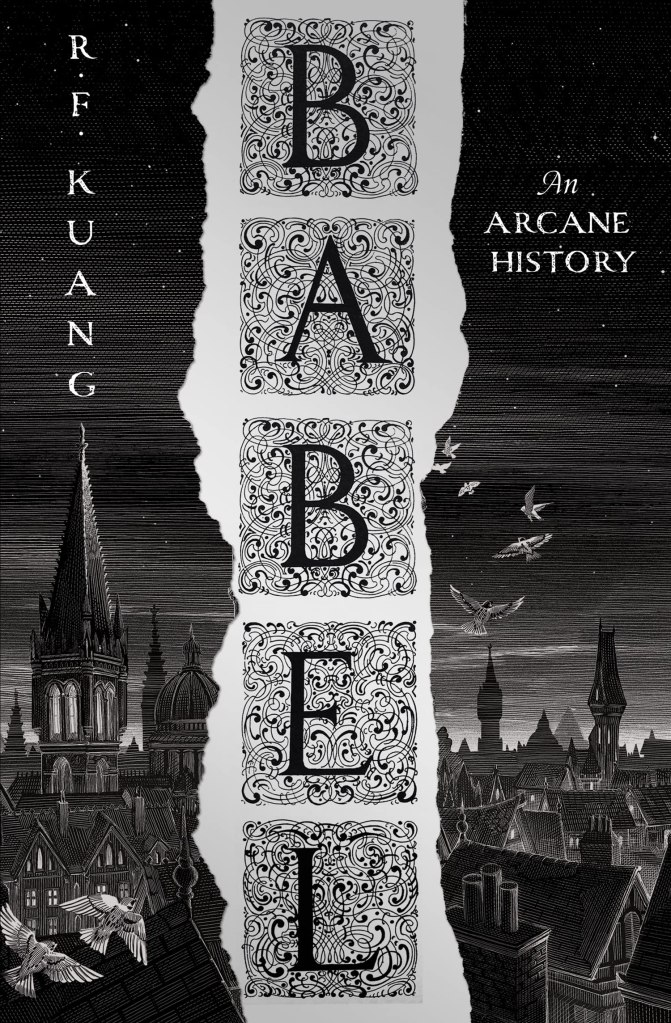
Robin and his friends gradually realise that their work at Babel is reinforcing mass poverty and the colonial system and, ultimately, fuelling future wars. “Truly, the only ones who seemed to profit from the silver industrial revolution were those who were already rich, and the select few others, who were cunning or lucky enough to make themselves so.” He becomes radicalized via the clandestine Hermes Society, which, Robin Hood-like, siphons silver resources away from where they are concentrated in Oxford to where they can help the oppressed. Surprised to learn who else is involved in Hermes, Robin (name not coincidental!) starts working behind the backs of his friends and professors, driven by conscience yet loath to give up the prospects he has through the tremendous privilege of being part of Babel. It goes from being an ivory tower of academia to being a hideaway for strikers and the besieged. And if you know your Bible stories, you’ll remember that Babel is destined to fall.
In faux-archaic fashion, Kuang has given her novel a lengthy subtitle: “Or: The Necessity of Violence – An Arcane History of the Oxford Translators’ Revolution.” The principle behind Hermes is that justice will never be achieved by negotiation; only by force. “Violence was the only thing that brought the colonizer to the table; violence was the only option.” Kuang published this fourth novel at age 26 and it manifests a certain youthful idealism. The sense of retrospective righteous anger is justified but also unsubtle; I felt similarly about Kuang’s Yellowface. Although there are exciting twists in the latter half of the book, I preferred the early semi-Dickensian atmosphere as Robin investigates his parentage and learns the joy of language and friendship. Kuang also adds a queer angle: an unrequited heterosexual crush comes to nothing because two same-sex friends are in love, even if they can never say. For as full-on and high-stakes as the plot becomes, I wished I could stay in this quieter mode.
Kuang has rendered the historical setting admirably and, though this is a typical adventure novel in that she has prioritized action over depth of characterization, one does get invested in the central characters and their interactions. The whole silver-working motif at first seems implausible but quickly becomes an accepted part of the background. Longstanding fantasy readers will probably have no problem reading this, but if you’re unsure and daunted by the 540-page length, ask yourself just how interested you are in word meanings and the history of colonialism and uprisings. (Little Free Library) 
[P.S. OMG, have you seen her wedding photos from a few weeks ago?!]
Also two DNFs, argh!
 The Museum of Whales You Will Never See: Travels among the Collectors of Iceland by A. Kendra Greene (2020) – This sounded quirky and fun, but it turns out it was too niche for me. I read the first two “Galleries” (78 pp.) about the Icelandic Phallological Museum and one woman’s stone collection. Another writer might have used a penis museum as an excuse for lots of cheap laughs, but Greene doesn’t succumb. Still, “no matter how erudite or innocent you imagine yourself to be, you will discover that everything is funnier when you talk about a penis museum. … It’s not salacious. It’s not even funny, except that the joke is on you.” I think I might have preferred a zany Sarah Vowell approach to the material. (Secondhand – Bas Books and Home, Newbury)
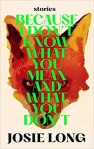 Because I Don’t Know What You Mean and What You Don’t by Josie Long (2023) – A free signed copy – and, if I’m honest, a cover reminiscent of Ned Beauman’s Glow – induced me to try an author I’d never heard of. She’s a stand-up comic, apparently, not that you’d know it from these utterly boring, one-note stories about unhappy adolescents and mums on London council estates. I read 108 pages but could barely tell you what a single story was about. Long is decent at voices, but you need compelling stories to house them. (Little Free Library)
 Bookish Beck = Rebecca Foster. American transplant to England. Freelance proofreader and book reviewer.
 Bookish Beck
I am very interested in word meanings but maybe not enough to take me through this one.
LikeLiked by 1 person
I’m not sure I’ve ever seen you read anything with fantasy elements … or am I forgetting something? (Perhaps Susanna Clarke.)
LikeLiked by 1 person
A few with surreal elements – The Sea Beast Takes a Lover, The Mannequin Makers, although thats more gothic than fantasy, and I loved The Night Circus but that’s as close as it gets!
LikeLiked by 1 person
Nope. Yet again you come to the rescue of my tottering TBR!
LikeLiked by 1 person
I don’t think I’ve ever seen you read anything close to fantasy!
LikeLike
And I doubt if you ever will!
LikeLike
Oddly, the “woke Harry Potter” comment makes me want to try it, LOL. So far I’ve not been tempted by it. But I’m not ruling it out.
LikeLiked by 1 person
Funny how that comment put Kate off but attracted you! I think if you’re in the right reading mood it could be addictive. I wish I had been able to sustain my initial obsessive interest.
LikeLiked by 1 person
The ‘woke Harry Potter’ is enough to ensure that this one won’t be on my reading list!
Also, I switch out books from my initial 20 Books of Summer list all the time!
LikeLiked by 1 person
Ha ha, I only ever got through 1.5 HP books + 1 film (as an adult) and never got the fuss. I would say I definitely enjoyed this more.
Definitely, me too. I think only 9 from my final list will be ones I had on the pile at the beginning of the summer.
LikeLike
I haven’t read ANY Harry Potter (I realise this might send book bloggers into meltdown) or seen any of the movies. I’m just not into wizards (that makes fans go crazy because they tell me it’s not about wizards blah blah blah but it doesn’t appeal to me at all).
LikeLiked by 1 person
Honestly, they’re really not that well written; totally skippable.
LikeLike
Kudos to your husband, would definitely describe this as ‘woke Harry Potter’, and I was disappointed as I felt it could have been so much more. For me, it was the climax that worked while the rest was a slog, but I agree the pace was off and it’s incredibly unsubtle.
LikeLiked by 1 person
An off-hand remark that ended up being perfectly appropriate.
I guess Kuang wanted to ensure maximum readability, including by teens. And I’m sure her bank balance would show that it has worked!
LikeLiked by 1 person
I’m interested in language, colonialism and different terms for the same thing and I have read the odd fantasy novel, still, I don’t think I could face that MUCH of Babel!! I loved The Museum of Whales but appreciate I am obsessed with Iceland so was very happy to go into this niche. I am horribly behind on my 20 Books after some Shiny reading/reviewing last month, argh!
LikeLiked by 1 person
I’m just about to finish Book 13 and will try to catch up on reviews today. As usual, it will all be a last-minute dash to the finish line!
LikeLiked by 1 person
This is in constant demand at the library, which I learned when my first loan was recalled, so I knew I had to read it quickly when I next picked up a copy, but even though I absolutely loved the world and its wordiness initially, my attention flagged around the same place yours did, and the rest took real effort. While I agree that the action is well-structured, the overall intent (I’m avoiding end-spoilers) felt too calculated/predictable for me (which could have been offset if I’d felt more invested in the characters but that fell away too)…which I probably wouldn’t have minded a bit given how young in her writing career she is, but with all the nominations and attention my expectations were high. Now I’m trying to get up the gumption to read Yellowface despite all that.
LikeLiked by 1 person
We had a very similar experience with this one! Yellowface is equally fun, interesting and well-intentioned, but also equally unsubtle.
LikeLike
I suppose my thought is that the intent is broadcast with the newer novel? So I would expect to find some types and predictability along the way? My expectations might be more inline? Writers like Charles Yu and Percival Everett and Paul Beatty handle this kind of maneuver so deftly (overturning assumptions, etc.) that I think I’ve been spoiled, but her concepts are worthy so in that sense it’s great that so many other readers are connecting with her stories and are unbothered by the elements that we found disappointing. Maybe I’ll just wait until the furor about Yellowface falls away…
LikeLiked by 1 person
[…] T. Kingfisher. (Bad the dog is also in peril far too often.) In the end, this reminded me most of Babel by R.F. Kuang with its postcolonial conscience and words as power. I enjoyed this enough that I […]
LikeLike