Three more July releases after yesterday’s Disability Pride Month special. Today is all fiction, but with rather different settings: Atlantic Canada, upstate New York and Mexico, and a London restaurant. The time period ranges from the last days of the First World War to 2013. The themes? Murder, plagues, accidental deaths and gourmet food in addition to those perennial subjects of finding love and coming to terms with identity.
Come to the Window by Howard Norman
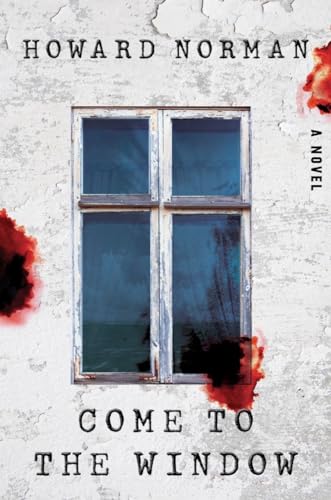 This was my eighth book by Norman and felt most similar to My Darling Detective and Next Life Might Be Kinder. Nothing much happens in the Nova Scotia fishing village of Parrsboro – until the night in April 1918 that Elizabeth Frame shoots dead her husband of 11 hours and throws the revolver into the blowhole of a beached whale. The story is a boon for Toby Havenshaw, a journalist with the Halifax Evening Mail, and quickly becomes an obsession. It’s never a whodunit so much as a why as Toby reports on the trial and follows Elizabeth when she goes on the lam. The sordid case just keeps getting stranger, drawing in bigamy, illegitimate pregnancy, and so on.
But Norman never treats all this too seriously; it is almost a tragicomic foil to the more consequential matters of world war and an influenza pandemic, which soon has Atlantic Canada in its grip as well. Toby’s wife, Amelia, is a hospital surgeon operating on returning veterans. She’s so quietly capable she makes Toby look a dunce, and their everyday rapport and unusual road to parenthood in their late thirties are charming. I also enjoyed Norman’s Dickensian naming (Bevel Cousins, Dr. S. S. Particulate) and literary references: the title phrase is from Matthew Arnold, and L. M. Montgomery gets a mention.
No doubt Norman wrote this as a Covid response; the parallel with the Spanish flu has been irresistible for many. He really captures the feeling of living through a uniquely terrible world situation. However, I’m not sure this short novel will prove memorable. Such has been true for his other recent novels, which pale in comparison with The Bird Artist. (Read via Edelweiss)
How We Named the Stars by Andrés N. Ordorica
I learned about this through the Observer’s 10 best new novelists feature and requested a copy via a Northern Fiction Alliance online showcase. There’s a sweet Heartstopper vibe to the story of an unlikely romance blooming between Daniel de la Luna and Sam Morris, his roommate at the University of Cayuga (= Cornell). Sam is a hunky jock while Daniel is a nervous would-be writer who has only just become comfortable with calling himself gay.
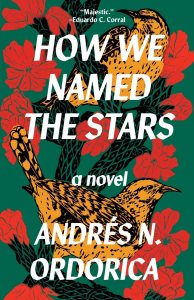 Ordorica, also a poet, immediately sets an elegiac tone by revealing Sam’s untimely death soon after the end of their freshman year. To cope with losing the love of his life, Daniel writes this text as if it’s an extended letter to Sam, recounting the course of their relationship – from strangers to best friends to secret lovers – and telling of his summer spent in Mexico exploring his family history, especially the parallels between his life and that of his late uncle and namesake, who was brave enough to be openly gay in the early days of the AIDS crisis.
Unfortunately, solid ideas and a warm-hearted approach are swamped by a host of problems. Ordorica writes a pretty good sex scene but the rest is clichéd, purple or awkward prose (“I snapped photo after photo of you, laughing all the while from your infectious elation”; “I felt unmoored, unsettled, and utterly liminal, in a state of flux”; “I sank into my pillows, muffling my tears as my mind floundered into even deeper waves of sadness”) and stiff dialogue. The cultural references and terminology feel all wrong for 2011, let alone for the 1988 diary entries of Uncle Daniel’s. The Mexico subplot is too tidy and Daniel’s breakdown after news of Sam’s death, which appears to involve full-blown alcohol addiction, is implausibly resolved within a chapter. The characterization of the secondary figures, particularly Daniel’s trio of queer Cayuga friends, is tissue thin.
It seems likely that Ordorica channeled much of his own experience into this queer coming-of-age narrative. He may have been aiming for star-crossed lovers and a groundbreaking own voices story, but this is run-of-the-mill stuff – more like a college student’s first draft than a finished book.
With thanks to Saraband for the proof copy for review.
Test Kitchen by Neil D. A. Stewart
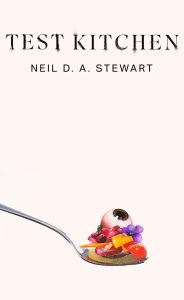 I spied this in one of Susan’s monthly previews. (If you haven’t already subscribed to her blog, do so at once. You’ll never be short of ideas for what to read.) Midgard is a fine dining restaurant with a tree in the middle whose multiple small courses evoke childhood memories and disguise one foodstuff as another. The London establishment earned two Michelin stars and has a perpetual waiting list, but as a news piece at the start presages, it will be forced to close its doors within five years after a series of disasters. Every other chapter introduces another set of diners, table by table: a first date, a reunion of old friends, a 12-year-old foodie trying to forestall his parents’ divorce, a restaurant critic and her freeloading acquaintances, and a solitary man who should really get that face wound seen to.
Many of these situations aren’t what they seem; the same goes for the intervening glimpses into the kitchen. Our host for these is Marley, the most recently hired waitress, who fled a chaotic home life in Melbourne. She didn’t show for work today; she’s in hiding, yet knows everything about the staff dynamics so is a perfect tour guide. There’s a mixture of nerves and bravado running through the kitchen as dinner starts. A knife accident, a food allergy, and a champagne cork hitting a customer are only the beginning of the evening’s mishaps. While I was initially drawn to the structure, which is almost like a linked short story collection, and I can’t resist a restaurant setting, the narrative trickery and the way that the mood evolves from slapstick to grotesque put me off. I enjoyed individual vignettes, but the whole didn’t come together as satisfyingly as in Sweetbitter or Service, among others.
With thanks to Corsair (Hachette) for the free copy for review.
 Bookish Beck = Rebecca Foster. American transplant to England. Freelance proofreader and book reviewer.
 Bookish Beck
Thanks for the link (and the complment!), Rebecca. I wimped out of Test Kitchen because of that cover and may well avoid it altogether now. Sweetbitter is particularly hard to beat for me. Have you read Merritt Tierce’s Love Me Back? Similar territory.
You’re the second blogger I’ve seen who was disappointed with How We Named the Stars. I’ve read two from this year’s Observer list – Going Home and Hard by a Great Forest – both of which were excellent but this one seems to be a dud.
LikeLiked by 1 person
You’re welcome! The cover image is apt for Test Kitchen, both literally and for a sense of how gruesome it gets. No, I haven’t read Love Me Back, but I’ll look into getting it secondhand.
It’s a real shame as there were promising elements to the Ordorica and I’d enjoyed another read from the Observer list (The Ministry of Time). However, I’ve also had several disappointments from it this year, alas, whereas last year it produced my favourite novel of the year, The New Life.
LikeLiked by 1 person
Butting in here, but: a) the cover image of Test Kitchen, and the promise of grue, reminds me strongly of the Ralph Fiennes/Anya Taylor-Joy film The Menu, which is genuinely brilliant and highly recommended, but somehow I’m not sure I’d want to read the book… b) Love Me Back is great. I read it way back in 2016-ish and adored it.
LikeLiked by 1 person
I’ve not heard of the film. I’ll see if I can watch it when I’m next at my sister’s in the States (she has Netflix, etc.). I wonder if Stewart was inspired by the case of Armin Meiwes…
LikeLike
You know I agree about Ordorica! The evocation of time period really was massively off. The diary entries were so confusing for much of the novel, as well, and I don’t think they needed to be (why call them both Daniel?)
LikeLiked by 1 person
I guess it was supposed to be a ‘big reveal’ with clever parallels throughout. He needed a lot more editorial guidance with this one. The Observer inclusion is pretty baffling.
LikeLiked by 1 person
I second your recommendation to Susan’s blog. And it looks as though, yet again, you’ve saved me the trouble of adding to my TBR.
LikeLiked by 1 person
Susan’s monthly round ups always plant new books in my TBR!
LikeLiked by 1 person
For sure! I don’t know if that’s a good thing or a bad thing sometimes 😉
LikeLiked by 1 person
I love a good kitchen novel, film, or series. (Bars, retail shops, too.) And I agree with Elle’s recommendation of “The Menu” although it’s not what I’d expected (despite having read reviews that didn’t spoil anything but warned that it would not be what one expected…in other words, I should have known better). how We Named the Stars is on my TBR (and reaadily available, now, locally, I think) and I think I’ve read only one Norman (if that). As usual, reading about your reading just makes me want to read more.
LikeLiked by 1 person
Norman often sets his stories in Canada. Surely that’s reason enough for you to read more of him 😉 Start with The Bird Artist, though (if you’ve not already read that one).
LikeLike
[…] proved to be another disappointment from the Observer’s 10 best new novelists feature (following How We Named the Stars by Andrés N. Ordorica). The setup was promising: in 2008, Iris reeling from her break-up from […]
LikeLike
[…] by Rupi Kaur (that … ain’t poetry); 2 from the Observer’s 10 best new novelists feature (here and […]
LikeLike