This is one of those classics I’ve been hearing about for decades and somehow never read – until now. Right from the start, I could spot its influence on African American writers such as Toni Morrison. Hurston deftly reproduces the all-Black milieu of Eatonville, Florida, bringing characters to life through folksy speech and tying into a venerable tradition through her lyrical prose. As the novel opens, Janie Crawford, forty years old but still a looker, sets tongues wagging when she returns to town “from burying the dead.” Her friend Pheoby asks what happened and the narrative that unfolds is Janie’s account of her three marriages.
{SPOILERS IN THE REMAINDER!}
- To protect Janie’s reputation and prospects, her grandmother, who grew up in the time of slavery, marries Janie off to an old farmer, Logan Killicks, at age 16. He works her hard and treats her no better than one of his animals.
- She then runs off with handsome, ambitious Joe Starks. [A comprehension question here: was Janie technically a bigamist? I don’t recall there being any explanation of her getting an annulment or divorce.] He opens a general store and becomes the town mayor. Janie is, again, a worker, but also a trophy wife. While the townspeople gather on the porch steps to shoot the breeze, he expects her to stay behind the counter. The few times we hear her converse at length, it’s clear she’s wise and well-spoken, but in the 20 years they are together Joe never allows her to come into her own. He also hits her. “The years took all the fight out of Janie’s face.” When Joe dies of kidney failure, she is freer than before: a widow with plenty of money in the bank.
- Nine months after Joe’s death, Janie is courted by Vergible Woods, known to all as “Tea Cake.” He is about a decade younger than her (Joe was a decade older, but nobody made a big deal out of that), but there is genuine affection and attraction between them. Tea Cake is a lovable scoundrel, not to be trusted around money or other women. They move down to the Everglades and she joins him as an agricultural labourer. The difference between this and being Killicks’ wife is that Janie takes on the work voluntarily, and they are equals there in the field and at home.
In my favourite chapter, a hurricane hits. The title comes from this scene and gives a name to Fate. Things get really melodramatic from this point, though: during their escape from the floodwaters, Tea Cake has to fend off a rabid dog to save Janie. He is bitten and contracts rabies which, untreated, leads to madness. When he comes at Janie with a pistol, she has to shoot him with a rifle. A jury rules it an accidental death and finds Janie not guilty.
I must admit that I quailed at pages full of dialogue – dialect is just hard to read in large chunks. Maybe an audiobook or film would be a better way to experience the story? But in between, Hurston’s exposition really impressed me. It has scriptural, aphoristic weight to it. Get a load of her opening and closing paragraphs:
Ships at a distance have every man’s wish on board. For some they come in with the tide. For others they sail forever on the horizon, never out of sight, never landing until the Watcher turns his eyes away in resignation, his dreams mocked to death by Time. That is the life of men.
Here was peace. [Janie] pulled in her horizon like a great fish-net. Pulled it from around the waist of the world and draped it over her shoulder. So much of life in its meshes! She called in her soul to come and see.
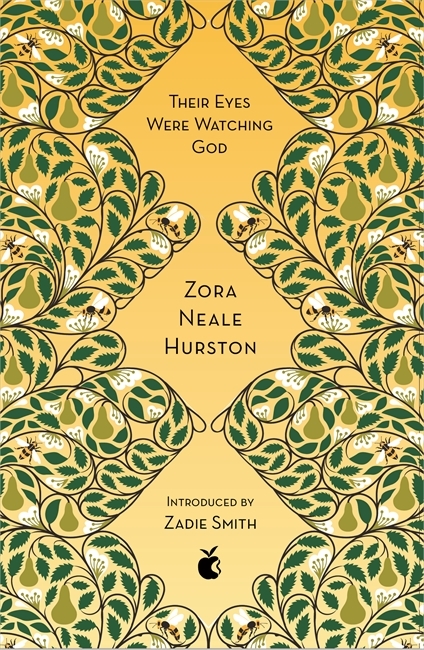
There are also beautiful descriptions of Janie’s state of mind and what she desires versus what she feels she has to settle for. “Janie saw her life like a great tree in leaf with the things suffered, things enjoyed, things done and undone. Dawn and doom was in the branches.” She envisions happiness as sitting under a pear tree; bees buzzing in the blossom above and all the time in the world for contemplation. (It was so pleasing when I realized this is depicted on the Virago Modern Classics cover.)
I was delighted that the question of having babies simply never arises. No one around Janie brings up motherhood, though it must have been expected of her in that time and community. Her first marriage was short and, we can assume, unconsummated; her second gradually became sexless; her third was joyously carnal. However, given that both she and her mother were born of rape, she may have had traumatic associations with pregnancy and taken pains to prevent it. Hurston doesn’t make this explicit, yet grants Janie freedom to take less common paths.
What with the symbolism, the contrasts, the high stakes and the theatrical tragedy, I felt this would be a good book to assign to high school students instead of or in parallel with something by John Steinbeck. I didn’t fall in love with it in the way Zadie Smith relates in her introduction, but I did admire it and was glad to finally experience this classic of African American literature. (Secondhand purchase – Community Furniture Project, Newbury) 
The main question we ask about the books we read for Literary Wives is:
What does this book say about wives or about the experience of being a wife?
- A marriage without love is miserable. Marriage is not a cure for loneliness.
There are years that ask questions and years that answer. Janie had had no chance to know things, so she had to ask. Did marriage end the cosmic loneliness of the unmated? Did marriage compel love like the sun the day?
(These are rhetorical questions, but the answer is NO.)
- Every marriage is different. But it works best when there is equality of labour, status and finances. Marriage can change people.
Pheoby says to Janie when she confesses that she’s thinking about marrying Tea Cake, “you’se takin’ uh awful chance.” Janie replies, “No mo’ than Ah took befo’ and no mo’ than anybody else takes when dey gits married. It always changes folks, and sometimes it brings out dirt and meanness dat even de person didn’t know they had in ’em theyselves.”
Later Janie says, “love ain’t somethin’ lak uh grindstone dat’s de same thing everywhere and do de same thing tuh everything it touch. Love is lak de sea. It’s uh movin’ thing, but still and all, it takes its shape from de shore it meets, and it’s different with every shore.”
This was a perfect book to illustrate the sorts of themes we usually discuss!
See Kate’s, Kay’s and Naomi’s reviews, too!
Coming up next, in December: Euphoria by Elin Cullhed (about Sylvia Plath)
 Bookish Beck = Rebecca Foster. American transplant to England. Freelance proofreader and book reviewer.
 Bookish Beck
The audiobook *was* a really great way to rad this book – with Ruby Dee as narrator, it was an experience. The only drawback is that I didn’t make note of my favourite passages and some of the interesting details flew in one ear and out the other. But the *feeling* of the story is forever embedded.
I love that last quote you’ve included about love being like the sea.
I have a hard time with the idea that Janie and Tea Cake were equals, because some of the things that happened (which I mention in my review). On the other hand, all marriages are different and if the parties making up the marriage are happy with the way things are, then who am I to say that their marriage isn’t good enough? I wonder what it would have become had Tea Cake not died early on? Would Janie have remained happy with it, or would it have eventually soured?
LikeLiked by 1 person
I’ve still only listened to one work of fiction, and that was short stories with the narrator changing for almost every one.
You’re probably right: had he lived longer he would have gambled away more of her money and cheated on her again, and the marriage wouldn’t have stayed happy.
I’d like to imagine that in her new life she becomes a wise woman of the town whom everyone comes to for advice. And avoids marriage for the rest of her life!
LikeLiked by 1 person
That sounds like a good ending to me!
LikeLike
Great assessment of a sometimes vexing novel! I read Their Eyes Were Watching God for school, and again about three years ago. The dialect is very intense; I have a feeling this is partly political on Hurston’s part, an assertion of the worth of the stories of people who speak this way, but it makes it a little awkward to quote from the book. Especially as a white person, I found myself wondering how to discuss moments that happen within the dialogue without doing vocal blackface. (Concluded the best way was to say the words without the accent.) The strong impression that remained with me was that dreamy, deeply figurative language in the narration, and the sense of Janie’s longing for freedom as being in some way incompatible with her longing for love.
LikeLiked by 1 person
That’s cool that your high school taught it. I could see it being a good lead-in to The Color Purple and Beloved.
I like to imagine that in her second widowhood Janie figures out how to be happy with living alone.
LikeLike
I struggled with this when we read it for book club but I agree that those narrative passages you quote are beautiful, and I hadn’t thought about the fact that her childlessness is never raised as an issue – which does chime with historical accounts of motherhood becoming ever more important post WWII.
LikeLiked by 1 person
In a book club was a good way to read it as the others noted things I did not. I’m not sure I’d attempt more by Hurston if I knew there was equal use of dialect. Perhaps her memoir would be different, though.
LikeLiked by 1 person
IIRC, the Alice Walker essay is about the innovative choice Hurston made to use dialect like this. It helped me appreciate it even if, like you, I found it difficult.
LikeLiked by 1 person
This book is on my Classics Club List but I think I’m only partially looking forward to the challenge.
LikeLiked by 1 person
I didn’t wholeheartedly love it, but it had its good points. Would it be cheating to watch the movie instead? 😉
LikeLiked by 1 person
Haha. I think maybe it would … but it’s definitely an idea:)
LikeLiked by 1 person
I loved this book when I read it some years ago (never had it assigned in school.) The dialect took a minute to get used to but it didn’t detract from the gorgeous writing. I wish this was assigned more in schools! But I can see why it’s not.
LikeLiked by 1 person
I think it could easily replace a book by a white man on a syllabus!
LikeLiked by 1 person
[…] Rebecca’s, Kay’s and Naomi’s reviews, […]
LikeLike
Totally agree that marriage is no cure for loneliness – in fact, it can be the opposite.
In terms of your second question… I have to think about that one. I wonder if the ‘equality’ bit only applies to things that are valued equally? For example, if a person didn’t care about money, would it matter if one person in the marriage had more or less? And I’m also thinking about equality within the context of power… I’ll be pondering your question!
LikeLiked by 1 person
Janie and Tea Cake certainly seemed to ascribe different importance to financial security and fidelity. Although she seemed to have the power in their relationship, simply by being male he had more freedom to do what he wanted.
LikeLiked by 1 person
I listened to this on audio and I do think it made it much easier!
LikeLiked by 1 person
Sounds like the right choice.
LikeLiked by 1 person
How did your comfort level with ZNH’s reproduction of speech patterns fit with your experience of Kim Coleman Foote’s in Coleman Hill? I think I remember that you felt that her characters’ speech felt quite readable? If so, I wonder what the difference was. It’s been too long since I first read Their Eyes but I remember reading it aloud in my apartment by myself to get the flow of it all, rather than make the letters on the page do all the work. I’ve got some of her stories for the next Story Quarterly (the posthumous collection) and quite enjoyed those too. (For your techical question, I believe the ceremonies were different, agreements over records.)
LikeLiked by 1 person
I don’t remember having an issue with the Foote at all. I think her rendering of the dialect must have been milder — a kindness to readers, I think.
Thanks for the technical answer!
LikeLike