Simon and Karen’s classics reading weeks are always a great excuse to pick up some older books. I found on my shelves a chilly Brooklyn-set novella that has been praised to the skies by the likes of Jonathan Franzen, and then borrowed a short and unsettling novel about warring English schoolboys from the library.
Desperate Characters by Paula Fox
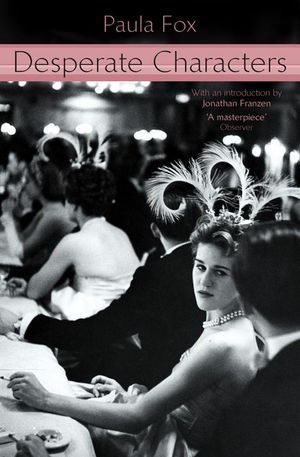 Other covers feature a cat, which is probably why this was on my radar. Don’t expect a cat lover’s book, though. The cat simply provides the opening incident. Sophie Bentwood is a forty-year-old underemployed translator; she doesn’t really need to work because her lawyer husband Otto keeps them in comfort. Feeding a feral cat, she is bitten savagely on the hand and over the next several days puts off seeking medical attention, wanting to stay in uncertainty rather than condemn herself to rounds of shots – and the cat to possible euthanasia. Both she and Otto live in this state of inertia. They were never able to have children but couldn’t take the step of adopting; Sophie had an affair but couldn’t leave Otto to commit elsewhere.
The cat bite seems to set off a chain of mishaps, culminating with the Bentwoods discovering that their house in the country has been vandalized. In the meantime, not a lot happens. The couple goes to a party and Sophie sneaks out for late-night drinks with her husband’s ex-partner, to whom she confides her affair. In Jonathan Franzen’s introduction, he compares to Bellow, Roth and Updike – but thinks Fox surpasses them all. The book explicitly references the Thoreau quote about people living lives of quiet desperation. I could sympathize with the midlife malaise depicted. As stagnant marriage stories go, this reminded me of what I’ve read by Richard Yates, just with a little less drinking. It would have made a good Literary Wives selection. In general, though, I can’t summon much enthusiasm. Given the cult classic status, I expected more. (Secondhand – Community Furniture Project, Newbury)
I’m the King of the Castle by Susan Hill
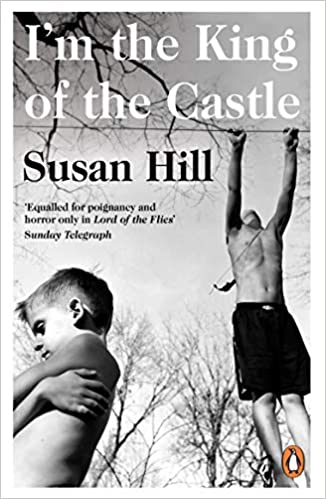 I’m almost tempted to mark this as an R.I.P. read, because it’s very dark indeed. Like The Woman in Black, it takes place in an ominous English mansion and its environs. Other scenes take place in a creepy forest and at castle ruins, adding to the Gothic atmosphere. Edmund Hooper and his father move into Warings after his grandparents’ death. Soon his father makes an unwelcome announcement: he’s hired a housekeeper, Helena Kingshaw, who will be moving in with her son, Charles, who is the same age as Edmund. Hooper writes Kingshaw (as the boys are called throughout the book, probably to replicate how they were known at their boarding schools) a note: “I DIDN’T WANT YOU TO COME HERE.”
That initial hostility erupts into psychological, and sometimes physical, abuse. Kingshaw quickly learns not to trust Hooper. “He thought, I mustn’t let Hooper know what I truly think, never, not about anything.” He tries running away to the woods but Hooper follows him; he makes friends with a local farm boy but it’s little comfort when he’ll soon be starting at Hooper’s school and it looks as if their lonely widowed parents might marry. The boys learn each other’s weaknesses and exploit them. At climactic moments, they have the opportunity to be gracious but retreat from every potential truce.
Heavy on dialogue and description, the book moves quickly with its claustrophobic scenes of nightmares come to life. Referring to the boys by surname makes them seem much older than 10 going on 11. Their antagonism is no child’s play – as the title ironically suggests – or harmless bullying. Is it evil? The reader feels for Kingshaw, the more passive one, yet what he does in revenge is nearly as bad. I was reminded somewhat of Harriet Said… by Beryl Bainbridge. It’s a deeply uncomfortable story, not least for how nature (pecking crows, cases of dead moths) is portrayed as equally menacing. (Public library)
Another 15 books from 1970 that I’ve read:
Jonathan Livingston Seagull by Richard Bach (in the running for worst book I’ve ever read)
Are You There, God? It’s Me, Margaret by Judy Blume
Runaway Ralph by Beverly Cleary
Fifth Business by Robertson Davies
84, Charing Cross Road by Helene Hanff
If Only They Could Talk by James Herriot
Ripley Under Ground by Patricia Highsmith
Crow by Ted Hughes
Moominvalley in November by Tove Jansson
Being There by Jerzy Kosiński
The Bluest Eye by Toni Morrison
Sing Down the Moon by Scott O’Dell
Love Story by Erich Segal
The Driver’s Seat by Muriel Spark
The Trumpet of the Swan by E.B. White
(Lots of children’s books there! Clearly they were considered modern classics during my 1980s childhood.)
I’ve previously participated in the 1920 Club, 1956 Club, 1936 Club, 1976 Club, 1954 Club, 1929 Club, 1940 Club and 1937 Club.
 Bookish Beck = Rebecca Foster. American transplant to England. Freelance proofreader and book reviewer.
 Bookish Beck
Hi Rebecca
Susan Hill is our neighbour and we know her very well. We like her dark old-fashioned stories. More interesting for book lovers are her two books about books “Howards End is on the Landing” and “Jacob’s Room is Full of Books”.
All the best
The Fab Four of Cley
🙂 🙂 🙂 🙂
LikeLiked by 1 person
Wow!! I’ve read 8 of her books, including those 2 bookish ones.
LikeLiked by 1 person
Only read Hill’s non fiction books the two books she wrote about reading and loved them
LikeLiked by 1 person
Those are popular ones! A good reminder to read one’s own books.
LikeLike
Lots of good books were published in 1970!
LikeLiked by 1 person
When you go digging, most years have lots of famous titles.
LikeLiked by 1 person
I did I’m The King Of The Castle for GCSE – it made an absolutely indelible impression on me. I’m glad I read it at that age as I don’t think I would really have got it as an adult. How I felt for poor Kingshaw.
LikeLiked by 1 person
Yeah, I can see how it would be really powerful for a teen not much older than the main characters.
LikeLiked by 1 person
Ooh, I’m the King of the Castle sounds haunting in the most human way (the kind where you can’t stop thinking about a character’s cruelty, or another character’s suffering). Those often hit me hard, but I’m glad to hear this is effective; I didn’t find The Woman in Black remotely scary as a book, though think the film or play would definitely get to me.
LikeLiked by 1 person
The comps to Lord of the Flies are inevitable, but warranted.
I’m finding that with all my R.I.P. reads this year: nothing is scaring me! So am I just jaded, or what?
LikeLike
Maybe you just haven’t found the thing that scares you yet! Sometimes it’s surprising and not what you expect.
LikeLike
Station Eleven, which I’m rereading for book club, is actually the scariest thing I’ve encountered recently. Seeing how prescient it was of Covid, with just a difference of degree, and thinking how much worse a future pandemic could be.
LikeLike
An interesting pair of choices! I’ve heard good things about the Fox so it’s a shame you were a bit underwhelmed. As for the Hill, that really does sound dark!!
LikeLiked by 1 person
I reckon you’d enjoy the Fox.
LikeLiked by 1 person
That Hill one does sound dark – the two boys in Alan Hollinghurst’s latest were upsetting enough for me!
LikeLiked by 1 person
It’s hard to read about bullying and abuse. As a reader you feel powerless to do anything to help the victims.
LikeLiked by 1 person
Wow, I had no idea that Hill was quite THAT dark. I do love a lot of her writing. And the Fox sounds right up my street – I chuckled at you saying she was better than Bellow, Roth, and Updike and still not that overwhelmingly good 😀 Stick it to ’em!
LikeLiked by 1 person
Maybe her darkest work? I don’t know; I haven’t read her proper mystery series.
Ah, that was Jonathan Franzen saying so, but I’m no big fan of that male triad anyway!
LikeLike
Paula Fox isn’t so well known in Canada, so I didn’t have any particular expectations. The one I read is actually her memoir and I consistently confuse it with this novel (which I do have, unread. on my shelves, though I regularly confuse myself by thinking it’s the other way ’round, but I’ve recently set myself straight thanks to another review of this novel for the Club). Of the other 1970s you’ve read, I’ve read all the children’s ones too (except for the Moomins, which somehow I made it to adulthood without knowing about…my Scandi childhood reading stopped at Pippi) so I guess our parents were shopping in the same bookstores. hah
LikeLiked by 1 person
What did you think of Paula Fox’s memoir? Do you recall any interesting trivia about her life?
I only discovered the Moomins when I came to England as an adult!
LikeLike
I loved it, which stood out because I was still reading nearly all fiction, so a memoir (any non-fiction really) had to be very engaging for me to climb over my bias. (That’s also why I didn’t take any notes. I couldn’t see why I’d want them from non-fiction. heheh)
So we are both late Moomin-bloomers!
LikeLiked by 1 person
[…] I’ve previously participated in the 1920 Club, 1956 Club, 1936 Club, 1976 Club, 1954 Club, 1929 Club, 1940 Club, 1937 Club, and 1970 Club. […]
LikeLike
[…] in the 1920 Club, 1956 Club, 1936 Club, 1976 Club, 1954 Club, 1929 Club, 1940 Club, 1937 Club, 1970 Club, and 1952 […]
LikeLike