I love a good year-challenge narrative and couldn’t resist considering these together because of the shared theme. Sure, there’s something gimmicky about a rigorously documented attempt to obey the Bible’s literal commandments as closely as possible in the modern day. But these memoirs arise from sincere motives, take cultural and theological matters seriously, and are a lot of fun to read.

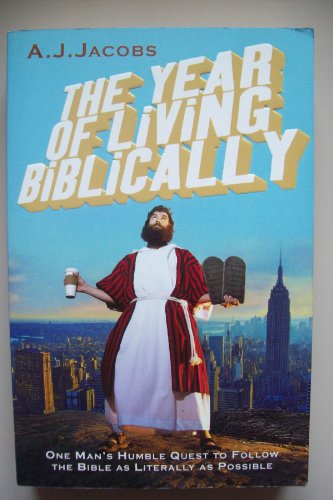
The Year of Living Biblically: One Man’s Humble Quest to Follow the Bible as Literally as Possible by A.J. Jacobs (2007)
Jacobs came up with the idea, so I’ll start with him. His first book, The Know-It-All, was about absorbing as much knowledge as possible by reading the encyclopaedia. This starts in similarly intellectual fashion with a giant stack of Bible translations and commentaries. From one September to the next, Jacobs vows, he’ll do his best to understand and implement commandments from both the Old and New Testaments. It’s not a completely random choice of project in that he’s a secular Jew (“I’m Jewish in the same way the Olive Garden is an Italian restaurant. Which is to say: not very.”). Firstly, and most obviously, he stops shaving and getting haircuts. “As I write this, I have a beard that makes me resemble Moses. Or Abe Lincoln. Or [Unabomber] Ted Kaczynski. I’ve been called all three.” When he also takes to wearing all white, he really stands out on the New York subway system. Loving one’s neighbour isn’t easy in such an antisocial city, but he decides to try his best.
 Jacobs is confused by the Bible’s combination of sensible moral guidelines and bizarre, arcane stuff. His conviction is that you can’t pick and choose – even if you don’t know why a law is important, you have to go with it. One of his “Top Five Most Perplexing Rules in the Bible” is a ban on clothing made of mixed fibers (shatnez). So he hires a shatnez tester, Mr. Berkowitz, who comes to investigate his entire wardrobe. To fulfil another obscure commandment, Berkowitz helps him ceremonially take an egg from a pigeon’s nest. Jacobs takes up prayer, hospitality, tithing, dietary restrictions, and avoiding women at the wrong time of the month. He gamely puts up a mezuzah, which displays a Bible passage above his doorframe. He even, I’m sorry to report, has a chicken sacrificed. Despite the proverb about not ‘sparing the rod’, he can’t truly bring himself to punish his son, so taps him gently with a Nerf bat; alas, Jasper thinks it’s a game. Stoning adulterers? Jacobs tosses pebbles at ankles.
The book is a near-daily journal, with a new rule or three grappled with each day. There are hundreds of strange and culturally specific guidelines, but the heart issues – covetousness, lust – pose more of a challenge. Alongside his work as a journalist for Esquire and this project, Jacobs has family stuff going on: IVF results in his wife’s pregnancy with twin boys. Before they become a family of five, he manages to meet some Amish people, visit the Creation Museum, take a trip to the Holy Land to see a long-lost uncle, and engage in conversation with Evangelicals across the political spectrum, from Jerry Falwell’s megachurch to Tony Campolo (who died just last week). Jacobs ends up a “reverent agnostic.” We needn’t go to such extremes to develop the gratitude he feels by the end, but it sure is a hoot to watch him. This has just the sort of amusing, breezy yet substantial writing that should engage readers of Bill Bryson, Dave Gorman and Jon Ronson. (Free mall bookshop) 
A Year of Biblical Womanhood: How a Liberated Woman Found Herself Sitting on Her Roof, Covering Her Head, and Calling Her Husband “Master” by Rachel Held Evans (2012)
 Evans’s book proposal must have referenced Jacobs’s project, but she comes at things from a different perspective as a progressive Christian, and likely had a separate audience in mind. Namely, the sort of people who worry about the concept of biblical womanhood and wrestle with Bible verses about women remaining silent in church and not holding positions of religious leadership over men. There are indeed factions of Christianity that take these passages literally. Given that she was a public speaker and popular theologian, Evans obviously didn’t. But in her native Alabama and her new home of Tennessee, many would. She decides to look more closely at some of the prescriptions for women in the scriptures, focusing on Proverbs 31, which describes the “woman of valor.” She looks at this idealized woman’s characteristics in turn and tries to adhere to them by dressing modestly, taking etiquette lessons, learning to cook and hosting dinners, and practicing for parenthood with a “Baby-Think-It-Over” doll. Like Jacobs, she stops cutting her hair and meets some Amish people. But she also sleeps outside in a tent while menstruating and undertakes silent meditation at an abbey and a mission trip to Bolivia. Each monthly chapter ends with a profile of a female character from the Bible and what might be learned from her story.
It’s a sweet, self-deprecating book. You can definitely tell that she was only 29 at the time she started her project. It’s okay with me that Evans turned all her literal intentions into more metaphorical applications by the end of the year. She concludes that the Church has misused Proverbs 31: “We abandoned the meaning of the poem by focusing on the specifics, and it became just another impossible standard by which to measure our failures. We turned an anthem into an assignment, a poem into a job description.” Her determination is not to obsess over rules but to continue with the habits that benefited her spiritual life, and to champion women whenever she can. I suspect this is a lesser entry from Evans’s oeuvre. She died too soon – suddenly in 2019, of brain swelling after a severe allergic reaction to an antibiotic – but remains a valued voice, and I’ll catch up on the rest of her books. Searching for Sunday, for instance, was great, and I’m keen to read Evolving in Monkey Town (about living in Dayton, Tennessee, where the famous Scopes Monkey Trial took place). (Birthday gift from my wish list, 2023) 
 Bookish Beck = Rebecca Foster. American transplant to England. Freelance proofreader and book reviewer.
 Bookish Beck
I’d really like to read Held Evans (somehow did not know she had died—how awful.) The Jacobs strikes me as a little odd, though, because a lot of what he does seems to be just… pretty standard Orthodox Judaism? (There are people, I understand, who have jobs just like “clothing fibre examiner”—or “boundary checker”, or “lightswitch-turner-on”—for these communities, so that people can either adhere or get around prohibitions like this.) I suppose the point is watching someone from a different background figure out how seriously to take all of this stuff; the “all or nothing” attitude is fascinating (and comprehensible, although I disagree).
LikeLiked by 1 person
Yeah, she was only 37 and a mother of two by then. So sad. I have really enjoyed the two books I’ve read by her so far.
True, Jacobs’s project starts with espousing Orthodox Judaism (maybe to an extreme? — following as many of the 600+ commandments as he can, even the obscure ones and head-scratchers), which is a novelty for him as a secular Jew, but then he adds on the New Testament stuff.
To hugely oversimplify, both authors end up deciding that the details are not so important as an attitude of reverence and thankfulness and a social justice outlook.
LikeLiked by 2 people
That does seem by far the most sustainable place to end up!
LikeLiked by 1 person
Oh no, sorry to hear that Evans died so young. That book sounds like it might have fresh relevance with the rise of the tradwife movement.
LikeLiked by 1 person
A trend that has passed me by, clearly! 😉
LikeLiked by 1 person
I read the Jacobs book years ago and remember it was funny and entertaining.
LikeLiked by 2 people
I would happily read any of his other books. I love the tone.
LikeLiked by 2 people
I love the ‘just another impossible standard’ quote. It seems women are held to that regardless of their faith.
LikeLiked by 2 people
I loved the Jacobs when I read it ages ago and particularly enjoyed the fact his wife sat on all the seats in the house while on her period so he couldn’t sit down anywhere (I hope I’ve remembered that right!). The Held Evans one looks equally good, well found!
LikeLiked by 3 people
Ha ha, yes, you’re right! A feminist act of resistance.
LikeLike
I’ve read both of these and found them interesting and funny. I’ve really appreciated Held Evans perspective in her writing.
LikeLiked by 1 person
I can see why you paired these two for sure: irresistible!
LikeLiked by 1 person
[…] that made me laugh: Lots, but particularly Fortunately, the Milk… by Neil Gaiman, The Year of Living Biblically by A.J. Jacobs, and You Don’t Have to Be Mad to Work Here by Benji […]
LikeLike