It’s my first time participating in Reading Wales Month, hosted this year by Karen of BookerTalk. I happened to be reading a collection by a Welsh-Gujarati poet, and added a Welsh hill farming memoir to my stack so I could review two books towards this challenge.

A God at the Door by Tishani Doshi (2021)
 I discovered Doshi through the phenomenal Girls Are Coming out of the Woods, which I reviewed for Wasafiri literary magazine. This fourth collection is just as rich in long, forthright feminist and political poems. Violence against women is a theme that crops up again and again in her work, as in “Every Unbearable Thing”: “this is not / a poem against longing / but against the kind of one-way / desire that herds you into a / dead-end alley”. The arresting title of the sestina “We Will Not Kill You. We’ll Just Shoot You in the Vagina” is something the former Philippines president Rodrigo Duterte said in 2018 in reference to female communist rebels. Doshi links femicide and ecocide with “A Possible Explanation as to Why We Mutilate Women & Trees, which Tries to End on a Note of Hope”. Her poem titles are often striking and tell stories in and of themselves. Several made me laugh, such as “Advice for Pliny the Elder, Big Daddy of Mansplainers,” which is shaped like a menstrual cup.
In defiance of those who would destroy it, Doshi affirms the primacy of the body. The joyfully absurd “In a Dream I Give Birth to a Sumo Wrestler” ends with the lines “How easy to forget / that all we have are these bodies. That all of this, all of this is holy.” Poems are inspired by Emily Dickinson and Frida Kahlo as well as by real events that provoke outrage. The clever folktale-like pair “Microeconomics” and “Macroeconomics” contrasts a woman dutifully growing peas and trying to get ahead with exploitative situations: “One man sits on another if he can. … One man goes / into the mines for another man to sparkle.” I also found many wise words on grief. Doshi is a treasure. (Secondhand – Green Ink Booksellers, Hay-on-Wye) 
Place of Stones by Ruth Janette Ruck (1961)
“Farming is rather like the theatre—whatever happens the show must go on.”
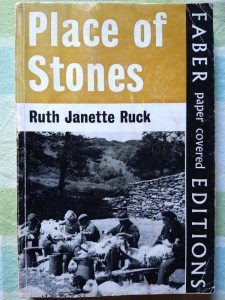 I reviewed Ruck’s Along Came a Llama several years ago when it was re-released by Faber. This was the first of her three memoirs about life at Carneddi (which means “place of stones”), the hill farm in North Wales that she and her family took over in the 1950s. After college, Ruck trained at a farm on the Isle of Wight and later completed an apprenticeship at Oathill Farm, Oxfordshire under George Henderson, who seems to have been something of a celebrity farmer back then (he contributes a brief but complimentary foreword). By age 20 she was in full charge of Carneddi, where they kept sheep, cattle and fowl. Many of their neighbours had Welsh as a first or only language. At that time, farmers were eligible for government grants. Ruck put in an intensive hen-rearing barn and started growing strawberries and rearing turkeys for Christmas.
Even when things were going well, it was a hand-to-mouth existence and storms or illness could set everything back. The Rucks renovated a nearby cottage to serve as a holiday let. Another windfall came in the bizarre form of a nearby film shoot by Twentieth Century Fox (The Inn of the Sixth Happiness, starring Ingrid Bergman). Mountainous North Wales stood in for China, and the film crew hired Ruck as a driver and, like many locals, as an occasional extra. This book was light and mildly entertaining, though probably more detailed about everyday farm work and projects than I needed. I was reminded again of Doreen Tovey, especially in the passage about Topsy the pet black sheep, but also this time of Betty Macdonald (The Egg and I) and Janet White (The Sheep Stell). (Secondhand – Lions bookshop, Alnwick) 
 Bookish Beck = Rebecca Foster. American transplant to England. Freelance proofreader and book reviewer.
 Bookish Beck
I wonder how much Wales looks like China. Oh well, they probably figured no one would know. I’ll never forget the boo-boo in Ordinary People, a scene set supposedly in Houston that had mountains in the background. All they had to do was look at a map to see that there are no mountains, or even hills anywhere near Houston, which is on a huge area of flatlands leading to Galveston Bay and the Gulf of Mexico.
LikeLiked by 1 person
Apparently North Wales and North China are both mountainous so it was a decent match. There are a few photos in the book and it’s very funny to see the replica Great Wall-style ramparts the set-designers built, and Ruck wearing a “coolie hat” — yikes!
LikeLiked by 1 person
Oh my goodness.
LikeLike
The only Tishani Doshi I’ve read, according to my log, is a novel; I was sure that I’d read this collection, because the cover was familiar straight away, but perhaps not. Either way I enjoyed your thoughts on it. You would think that poem title had to be hyperbole, let alone a direct quote from just a few years ago. Yikes. How slow things are to change.
The filming anecdote made me smile. I’m sure many times I have been satisfied by that kind of sneakery (as a means of reducing production costs).
LikeLiked by 1 person
I’ve wondered if I’d like her fiction, too. Can you recall anything about the novel?
LikeLike
I took quite a few notes, which made me wonder if I’d posted on it back then and I did. I was rating the Orange (i.e. Women’s Fiction Prize) nominees with swatches of colour back then, heheh, and hers was a fairly pale square, but it was just her debut, and you obviously enjoyed her poems…
LikeLiked by 1 person
I saw Tishani do the dance performance of Girls Are Coming Out of the Woods and it was so powerful. I didn’t realise she had a connection to Wales.
LikeLiked by 1 person
Wow, that must have been amazing! She’s always described as Welsh-Gujarati, but I don’t know which side of the family is from Wales.
LikeLiked by 1 person
Doshi sounds well worth reading. And I love the sound of Ruck’s memoir, too.
LikeLiked by 1 person
I would commend Doshi’s poetry to you. I enjoyed the later memoir I’d read by Ruck a little more, but there is something peaceful about reading about the farming life.
LikeLiked by 1 person
Maybe from a distance the mountains of North Wales and North China could look the same – they both have snowy peaks. But the vegetation would surely give the game away or did the camera crews manage to only do long shots?
LikeLiked by 1 person
I couldn’t tell you! I was rather impressed that Ruck got to rub shoulders with Ingrid Bergman, though.
LikeLike
That Doshi line about bodies is wonderful.
LikeLiked by 1 person
I would highly recommend her work if you ever come across it.
LikeLiked by 1 person
An excellent and different pair for the month, well done!
LikeLiked by 1 person
And this past week in Hay-on-Wye I topped up with two more Welsh books that I’ll read next year!
LikeLike