Simon and Karen’s classics reading weeks are always a great excuse to pick up some older books. I assembled an unlikely trio of lesbian romance, niche theology, and an animal-lover’s children’s classic.

Carol by Patricia Highsmith
Originally published as The Price of Salt under the pseudonym Claire Morgan, this is widely considered the first lesbian novel with a happy ending (it’s more open-ended, really, but certainly not tragic; suicide was a common consequence in earlier fiction). Therese, a 19-year-old aspiring stage designer in New York City, takes a job selling dolls in a department store one Christmas season. Her boyfriend, Richard, is a painter and has promised to take her to Europe, but she’s lukewarm about him and the physical side of their relationship has never interested her. One day, a beautiful blonde woman in a fur coat – “Mrs. H. F. Aird” (Carol) – comes to her counter to order a doll and have it sent to her out in New Jersey. Therese sends a Christmas card to the same address, and the women start meeting up for drinks and meals.
 It takes time for them to clarify their feelings to themselves, let alone to each other. “It would be almost like love, what she felt for Carol, except that Carol was a woman,” Therese thinks early on. When she first visits Carol’s home, a mothering dynamic prevails. Carol is going through a divorce and worries about its effect on her daughter, Rindy. The older woman tucks Therese into bed and brings her warm milk. Scenes like this have symbolic power but aren’t overdone; another has Therese and Richard out flying kites. She brings up homosexuality as a theoretical (“Did you ever hear of it? … I mean two people who fall in love suddenly with each other, out of the blue. Say two men or two girls”) and he cuts her kite strings.
The second half of the book has Carol and Therese setting out on a road trip out West. It should be an idyllic consummation, but they realize they’re being trailed by a private detective collecting evidence for Carol’s husband Harge to use against her in a custody battle. I was reminded of the hunt for Humbert Humbert and his charge in Lolita; “the whole world was ready to be their enemy,” Therese realizes, and to consider their relationship “sordid and pathological,” as Richard describes it in a letter.
The novel is a beautiful and subtle romance that unfolds despite the odds against it. I’d read five of Highsmith’s mysteries and thought them serviceable but nothing special (I don’t read crime in general). This does, however, share their psychological intensity and the suspense about how things will play out. Highsmith gives details about Therese’s early life and Carol’s previous intimate friendship that help to explain some things but never reduce either character to a diagnosis or a tendency. Neither of them wanted just anyone, some woman; it was this specific combination of souls that sparked at first sight. (Secondhand from a charity shop that closed long ago, so I know I’d had it on my shelf unread since 2016!) 
The Courage to Be by Paul Tillich
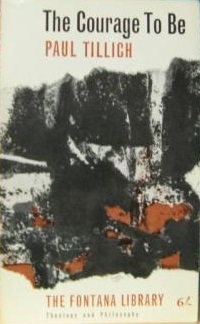 Tillich is a theologian who left Nazi Germany for the USA in 1933. I had to read selections from his work as part of my Religion degree (during the Pauline Theology tutorial I took in Oxford during my year abroad, I think). This book is based on a lecture series he delivered at Yale University. He posits that in an age of anxiety, which “becomes general if the accustomed structures of meaning, power, belief and order disintegrate” – certainly apt for today! – it is more important than ever to develop the courage to be oneself and to be “as a part.” The individual and the collective are of equal importance, then. Tillich discusses various philosophers and traditions, from the Stoics to Existentialism. I have to admit that I barely got anything out of this, I found it so jargon-filled, repetitive and elliptical. It’s been probably 15 years or more since I’ve read any proper theology. I adopted that old student skimming trick of reading the first paragraph of each chapter, followed by the topic sentence of each paragraph, but that left me mostly none the wiser. Anyway, I believe his conclusion is that, when assailed by doubt, we can rely on “the God above the God of theism” – by which I take it he means the ground of all being rather than the deity envisioned by any specific religious system. (University library)
Charlotte’s Web by E.B. White
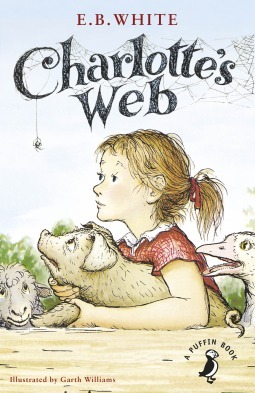 My library has a small section of the children’s department called “Family Matters” that includes the labels “First Time” (starting school, etc.), “Family” (divorce, new baby), “Health” (autism, medical conditions) and “Death.” I have the feeling Charlotte’s Web is not at all well known in the UK, whereas it’s a standard in the USA alongside L.M. Montgomery and Laura Ingalls Wilder. Were it more familiar to British children, it would be a great addition to that “Death” shelf. (Don’t read the Puffin Modern Classics introduction if you don’t want spoilers!) Wilbur is a doubly rescued pig. First, Fern Arable hand-rears him when he’s the doomed runt of the litter. When he’s transferred to Uncle Homer Zuckerman’s farm and an old sheep explains he’ll be fattened up for slaughter, his new friend Charlotte intervenes.
Charlotte is a fine specimen of a barn spider, well spoken and witty. She puts her mind to saving Wilbur’s bacon by weaving messages into her web, starting with “Some Pig.” He’s soon a county-wide spectacle, certain to survive the chop. But a farm is always, inevitably, a place of death. White fashions such memorable characters, including Templeton the gluttonous rat, and captures the hope of new life returning as the seasons turn over. Talking animals aren’t difficult to believe in when Fern can hear every word they say. The black-and-white line drawings are adorable. And making readers care about invertebrates? That’s a lasting achievement. I’m sure I read this several times as a child, but I appreciated it all the more as an adult. (Little Free Library) 
I’ve previously participated in the 1920 Club, 1956 Club, 1936 Club, 1976 Club, 1954 Club, 1929 Club, 1940 Club, 1937 Club, and 1970 Club.
 Bookish Beck = Rebecca Foster. American transplant to England. Freelance proofreader and book reviewer.
 Bookish Beck
Carol sounds fascinating! I will have to keep a look out for it 🙂
LikeLiked by 1 person
Highly recommended!
LikeLiked by 1 person
Charlotte’s Web is one of my favourite children’s classics – it still holds up after all these years.
LikeLiked by 1 person
It really does!
LikeLiked by 1 person
Wow, it’s a long time since I read Charlotte’s Web! I should know this but is it really not very well known in the UK? I know people are less familiar with the Little House books though will sometimes get a reference to the Little House on the Prairie TV series. Need people who had UK based early childhoods to chime in here!
LikeLiked by 1 person
Well, there’s a Puffin Classics edition and it made its way into my Little Free Library around the corner, so that says something. But I don’t think it’s a household name like in North America. My husband looked at the cover and said, “You’re reading a book about a pig?”
LikeLiked by 1 person
Charlotte’s Web is the only one of these I’ve read, and that was a long time ago, but—devastating! I’d forgotten that Fern can hear the animals speaking, too. Does that surprise her, or does she seem to find it normal? (I assume it’s at least a little surprising, otherwise she lives in a world that knowingly farms and slaughters articulate beings, which is a step further than even Tender Is the Flesh was willing to go…) Shame about the Tillich.
LikeLiked by 1 person
It seems totally normal to Fern, but when she tells her mother what the animals have been saying, her mother consults a doctor about her. [“Dr. Dorian” — I had to wonder if that inspired the name of the main character in Scrubs.] But, delightfully, the doctor says maybe animals do indeed talk but we just don’t know how to understand them properly.
Fern is initially distressed that Wilbur is to be killed, but over the course of the book she starts spending less time with the animals and more with a boy from her class with whom she shares a ride on the Ferris wheel. Bo-ring!
LikeLike
NOOOO it’s the Susan Problem all over again!
LikeLike
I really enjoyed Carol too
LikeLiked by 1 person
An absolute classic, I don’t know why it took me so long to read it.
LikeLiked by 1 person
Such an interesting post, and just goes to show the range of books about in 1952!!
LikeLiked by 1 person
For sure!
LikeLike
Charlotte’s Web is definitely a classic children’s classic here in the UK, and still widely read. Certainly by my three. In fact it’s the only one of your choices today that I have read!
LikeLiked by 2 people
Oh, wonderful! I’m happy to stand corrected.
LikeLiked by 1 person
😊
LikeLike
I looooved Charlotte’s Web as a child; it’s such a beautiful and special little story. Also rather surprised to hear, as someone who grew up in Canada, that Lucy Maud Montgomery is also popular in the USA?! For some reason I thought she was more of a hometown hero sort of thing!
LikeLike
Oh yes, LMM is treasured by readers the world over. There was a 1985 TV miniseries of Anne of Green Gables that my family watched over and over via PBS; that may be how many discovered her.
LikeLiked by 1 person
I read Charlotte’s Web with James because it was the “one book” that all the county elementary schools read together his Kindergarten year. I remember us both crying while I was reading it! An absolute classic.
LikeLiked by 1 person
I think there was a cartoon made of it as well?
LikeLiked by 1 person
I haven’t been able to reread any of E.B. White’s books. I don’t even think the others are as atrociously sorrowful as CW, but I’ve left them all be (despite having tried to find his other writing…as if he mightn’t be just as deft with writing about sad things there). Interesting that they’re not so well known over there! I can’t actually remember if I read Carol, but I think I ended up watching the film without realising it was a book and then never returned to the book (I’ve read the Ripleys). I haven’t read anything by your theologist, but I can relate to the sense of finding a book that I once read seemingly easily at school that now seems nearly impenetrable.
LikeLiked by 1 person
I think I also read Stuart Little and The Trumpet of the Swan, but I don’t really remember those.
I’d like to see the film of Carol.
LikeLike
I echo we definitely had Charlotte’s Web and I must have read it once, been devastated and never touched it again, being me! I definitely had UK versions of the Little House books and they were also in the library. I have a book of Japanese philosophy I need to read as it promises to help me discover why I am like I am (Iris Murdoch had it and it informed her writing which informed my being) but I am worried I won’t be able to grasp it!
LikeLiked by 1 person
I may have to eat my words … in fact, I filled a reservation for Charlotte’s Web at the library this morning!
LikeLiked by 1 person
[…] all three characters. This confident, tender story of changing mores and steadfast love is the new Carol for our times. (Such a lovely but low-key novel was liable to make few ripples, so I’m delighted […]
LikeLike
[…] all three characters. This confident, tender story of changing mores and steadfast love is the new Carol for our […]
LikeLike
[…] I’ve previously participated in the 1920 Club, 1956 Club, 1936 Club, 1976 Club, 1954 Club, 1929 Club, 1940 Club, 1937 Club, 1970 Club, and 1952 Club. […]
LikeLike
[…] Carol by Patricia Highsmith: Widely considered the first lesbian novel with a happy ending. Therese, a 19-year-old aspiring stage designer, meets a wealthy housewife – “Mrs. H. F. Aird” (Carol) – in a New York City department store one Christmas. When the women set off on a road trip, they’re trailed by a private detective looking for evidence against Carol in a custody battle. It’s a beautiful and subtle romance that unfolds despite the odds and shares the psychological intensity of Highsmith’s mysteries. […]
LikeLike
[…] all three characters. This confident, tender story of changing mores and steadfast love is the new Carol for our […]
LikeLike
[…] mysteries by Highsmith and enjoyed them well enough, but murders aren’t really my thing. (Carol is the only work of hers that I’ve truly loved.) My specific issue here was with the central […]
LikeLike
[…] do otherwise as these are the texts that first taught him about death, loneliness and friendship: Charlotte’s Web, The Wind in the Willows, The Magician’s Nephew and Watership Down. (Also The Secret Garden.) […]
LikeLike
[…] 1920 Club, 1956 Club, 1936 Club, 1976 Club, 1954 Club, 1929 Club, 1940 Club, 1937 Club, 1970 Club, 1952 Club and 1925 […]
LikeLike